Nutrition and Calorie Tips

Just a Coffee …and a snack’

‘Just a Coffee …and a snack’ ☕️

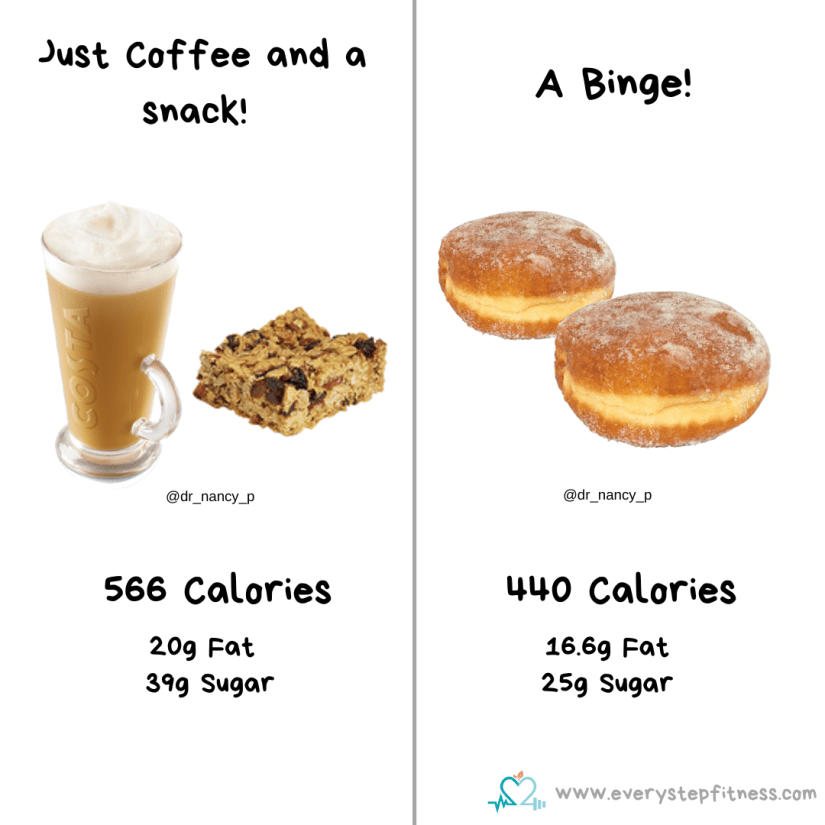
Perception is everything! Many of us would probably have a coffee and a snack without giving it a huge amount of thought – a latte and a granola slice (healthy right?) is fine for an afternoon snack. Yet if you’d wolfed down 2 jam doughnuts you might be feeling guilty, like you’d over down it and you may even refer to it as a binge.

To be honest neither is an ideal snack – they’re both a decent number of calories and probably more than most can afford as a daily snack. However, as you can see, the coffee and granola slice is considerably more calories than the two doughnuts. They also contain significantly more fat and sugar. So whilst you might be beating yourself up over the doughnuts, in reality it’s not as bad as the coffee and snack.

It’s all about perception – the coffee and granola slice are not only viewed as being an acceptable snack, there is also a positive perception around the granola slice as it contains nuts (good fats, protein etc) and dried fruit (nutrient rich). Whereas the doughnuts are universally recognised as “junk” food.

Knowledge is power so being aware of the calorie content of things, and also of our own perceptions of the things we consume is always a good thing.

If you want the latte and granola slice- have it and enjoy it. If you want to eat your way through two jam doughnuts then go for it. Just be aware of the calories so you’re making an educated choice!

🤗

Xx
Nutrition and Calorie Tips

OMG I’ve blown it!…..

OMG I’ve blown it!….. 😱

I hear this sort of thing so often… a client has ended up having a Mcdonald’s for lunch and thinks they’re blown everything, they’re disappointed and angry with themselves and feeling guilty. On another day they’re feeling virtuous because they went to Pret and had the Falafel an Hummous Rice bowl – which is full of “healthy” food so it must be good.

Now before anyone reacts – I’m not suggesting a Mcdonalds is a “healthy” option, nor am I suggesting it’s got more health benefits than the falafel and hummus bowl. They’re both very different nutritionally, and they both taste very different too. But for many people trying to lose fat or weight they might naturally assume that the McDonald’s is a terrible option and that by having it they’ve ruined their day (diet -wise). Whereas if they chose the falafel bowl they would be feeling guilt-free and virtuous and like they were on track. However in actual fact that “healthy” bowl has more calories and fat, and less protein than the 6 nuggets and small fries. The McDonald’s also has over 50% less salt too. The bowl also doesn’t include any dressing which can add another 200+ calories (and extra fat and salt).

So if you had to grab a McDonald’s (or just fancied one) you’d be far better off just having one. I’m certainly not suggesting your whole diet be made up of “junk food”, but it’s important to be aware of the facts to avoid unnecessary guilt. And to remember that lots of the foods we perceive as being “healthy” may in fact be higher calorie and therefore unhelpful for weight loss if you’re consuming them without realising the calories. At the end of the day, as always, it comes down to calories. If you want to lose fat or weight, then you need to be at a calorie deficit. And it’s important to still have foods you enjoy as part of an overall balanced diet. So don’t sweat it if you end up with a McDonald’s now and then if you want it, but then have a dinner with a range of whole foods and vegetables etc.

Be curious about what you’re putting in your body, look at the nutritional labels on food and don’t always assume the “health” food is the best choice.

🤗

Xx

Tuesday Tip

Tuesday Tip: Expectation Setting

Tuesday Tip: Expectation Setting 🤔

When you head into a new health and fitness regime or “diet” it’s really important to make sure your expectations are set at the right level. Relying on things which promise quick fixes and instant results can make everything much harder on yourself. So whilst it might seem tempting to choose some detox/cleanse/supplement that promises results in 3-4 weeks, in the long term this can impact negatively on your relationship with food, your hormones, your metabolism, your body image and your mental health.

Long term sustainable changes aren’t quick, they take months and even years. So rather than looking for the “easy”, fast option to throw money at, instead look for a long term, sustainable solution – which works for you. This will usually include:

⁃ Consistency – over weeks/months – not days.

⁃ Persistence – sticking with it for a significant period of time, despite fluctuations in weight/fat, good days/ bad days etc.

⁃ Small habit changes – things you can change, for life, not for a few weeks.

⁃ Balance – finding how to balance things for you, working out what’s more important to you and how to work that into your new lifstyle e.g. the friday night meal out may be non negotiable so including that in a way that still lets you reach your desired goal.

⁃ Deciding on your priorities – ultimately it’s up to you to make any health/diet changes a priority and it may be that right now they’re not – and that’s ok, but be honest about it. If now isn’t the right time to make changes to your lifestyle then recognise that it simply isn’t a priority right now.

⁃ Mindset changes – this could be moving away from the “f*ck it” attitude when you have a “bad” day, or it could be reframing how you view meals out and whether you want to spend your calories on multiple courses, or it could be about embracing the small positive changes you achieve etc

There’s no quick fix, there’s no cleanse, detox or juice that can get you where you want to be (and more importantly staying there forever), recognise that change takes time and occurs in small steps ,not giant leaps! Get those expectations in order!

Happy Tuesday 🤗

Xxx

Nutrition and Calorie Tips

Sugar is bad!!… or is it? …

Sugar is bad!!… or is it? … 🥣

I often hear and see people claiming that sugar is bad! Clients will tell me that they are “cutting back on sugar” for example. When asked what foods they mean specifically it usually includes things like biscuits, chocolate, cakes, ice cream etc. But these foods aren’t just “sugar” – they all contain significant amounts of fat too.

As you can see from this comparison – 100g of sugar contains nothing but sugar. It’s 99.9 g of carbs – no fat, no protein etc. All of those carbs are sugar. The biscuits on the other hand contain around 62g carbs, of which only 28g is actually sugar. It contains almost as much fat, other carbs and some protein etc. These foods that people commonly associate with sugar are a mixture of sugar, fat and salt which make them hyper-palatable. That means they’re designed to taste really good – which encourages you to eat more. Eating 100g of pure sugar in one sitting is actually not a pleasant experience (try it – I dare you lol!) and it isn’t something most people would do. Eating 100g of biscuits though – well thats super easy and is only 4-5 biscuits in most cases. To consume the same amount of actual sugar as pure sugar you’d need to eat 350g of biscuits in one sitting (which is over 20 biscuits!).

So this combo of sugar, fat and salt is what makes biscuits and other snacks so easy to over eat. That’s not to say biscuits are bad but they have the potential to derail you from your goals because they’re calorie dense (i.e. more cals in a smaller package) and as I said they taste great so you’re likely to eat more. So it’s not the sugar thats causing this – its the combination of ingredients in these products. So vilifying sugar is pointless and a misunderstanding of where the real issue lies. In fact sugar is actually an important nutrient and the brain’s main fuel source.

In sum, sugar isn’t “bad”, it isn’t causing you to gain fat in itself. If your diet contains a range of whole foods and is balanced overall then having the odd “sugary” snack like biscuits/cakes etc is fine – just account for it in your calories.

🤗

Xx

Tuesday Tip

Tuesday Tip: To Avoid Gluten or Not?

Tuesday Tip: To Avoid Gluten or Not? 🍞

Do you really need to avoid gluten? For the majority of us the answer is no! It’s pretty trendy right now to ditch carbs and specifically to ditch gluten but should we really be doing that?

For 1% of population who suffer from Coeliac disease gluten is a major problem. It’s is an autoimmune response which causes the body to attack the protein in gluten, ‘gliadin’. These attacks damage the villi lining the small intestine preventing normal nutrient absorption. It’s a serious condition; sufferers experience severe stomach problems and may be in extreme pain. It’s not a ‘bit of bloating’. It’s diagnosed with a blood test, and you’d know if you had it! In a further 3 – 5% of the population there may be some level of intolerance to gluten resulting in stomach upsets. That leaves 95% of us with no issues whatsoever.

Gluten is a compound with a large surface area so it takes longer to be digested. This means you could be suffering problems from simply eating too fast and not chewing properly, so try chewing 15 times per mouthful to keep the enzymes working in your mouth, so that some of the digestive process can start before food even reaches the stomach.

People often complain that bread, pizza or pasta etc are making them bloated and that as a result they avoid gluten at all costs. But don’t be too quick to blame gluten. It’s not uncommon for these foods to make you bloat. The cause of this bloating is not the gluten, but actually water retention as a result of the short-chain carbs in wheat-based foods. So combat this by going for complex carbs – wholegrains, wholewheat breads etc and ensure you’re drinking lots of water. And if you do think you’re reacting after eating meals like pasta or pizza, then it’s probably far less likely to be the gluten and more likely to be the fatty cheese, roasted onions and rich toppings and sauces causing the problem – not the pizza base or pasta itself.

If you think giving up gluten will give you an energy boost,I’m afraid you’ll be wrong. Recent studies show that going gluten-free, when you don’t need increases tiredness and fatigue. Gluten-containing foods also provide a range of other nutrients we need so cutting it out you can cause more probs. Instead chose foods full of slow release carbs e.g. wholewheat pasta and bread, and lots of fruit and veg.

So before you diagnose yourself with a gluten sensitivity and drop all wheat, spelt, rye, barley etc perhaps stop and have a think. What is actually happening? Sure maybe you’re bloating after certain foods or meals but you’ve probably been eating gluten your whole life right? So why would you suddenly be intolerant of it? You weren’t ten years ago…. If you really feel like you react to gluten then speak to your Dr asap and arrange a proper test, otherwise enjoy a wide variety of foods that you like to eat!

Happy Tuesday 🤗

Xxx