Nutrition and Calorie Tips

Why it’s generally harder for women to lose weight than men

Why it’s generally harder for women to lose weight than men 👫

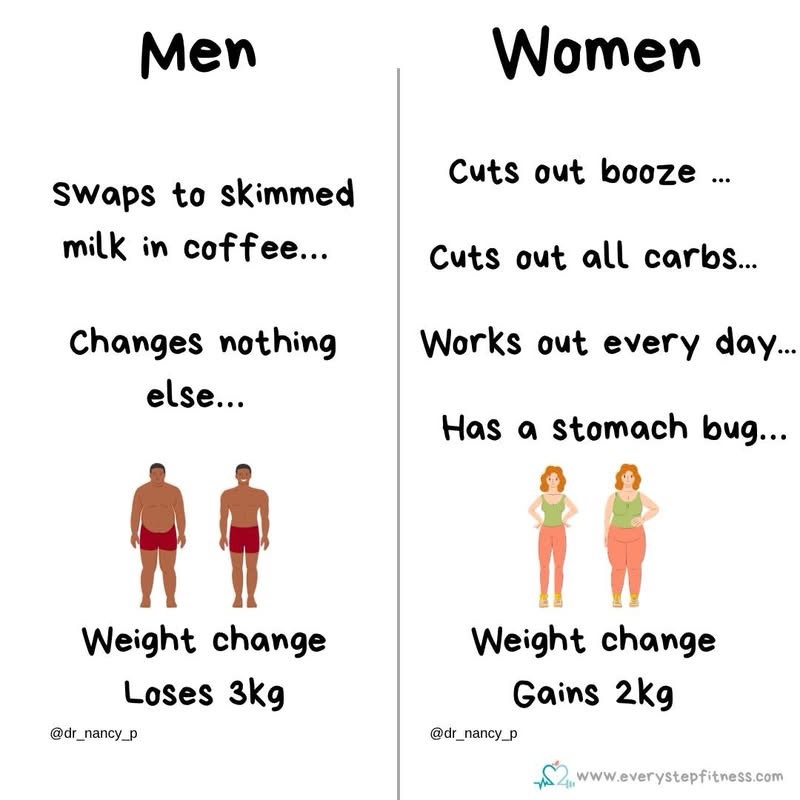
I encounter this a lot with my clients, especially couples. A man appears to change very little in their diet and loses 3kg in a week, whilst a woman cuts carbs, cuts booze, workouts tonnes and gets a stomach bug and puts on 2 kg! Now obviously this is just a humorous example but it’s not actually that far from the truth. Men really do tend to respond faster than women when it comes to weight loss, so why is this?

Generally, men will burn more calories at rest than women due to them being taller, heavier and naturally more muscular. This means they will need to consume more calories to maintain their weight. It also means they can consume considerably more calories and still be in a calorie deficit. For example a 6ft man, weighing 95kg needs around 2,600 cals to maintain so anything below that is a deficit. In contrast a 5ft 6inch woman, weighing 67 kg needs approx 1800 cals to maintain and less to lose weight. That’s almost a 1000 cals difference and makes a huge difference when trying to accommodate your meals, snacks and then social stuff on top.

This is even harder if you’re a couple as you may be likely to eat similar things/portions so if you’re both eating around 1600 cals then the man will be at an even greater deficit so will lose weight much more rapidly.

Whilst it’s not possible to out exercise diet obviously there is also some impact from the amount of calories burnt and men will naturally burn more calories than women due to their height, weight and muscle mass.

Women may see higher fluctuations in weight too (which makes the process harder) as they can be more susceptible to fluid retention in response to stress and other hormones. In addition there are psychological reasons it’s harder for women. ‘Diet culture’ is so prevalent and affects women from a very young age. Most of my female clients have been on and off diets since they were teenagers to some degree. These repeated attempts at trying to find dietary success can completely fracture anyone’s mindset around their bodies and food. Whilst men do also face these struggles it’s not usually to the same extent.

What you can do about it?

Women can increase their chances of weight loss success by increasing muscle mass (which increases your BMR so you burn more calories at rest).

And whilst it is indeed harder for women to lose weight that doesn’t mean the law of thermodynamics don’t apply. If you are in a calorie deficit you will lose body fat and you may still be losing fat even if the scale doesn’t necessarily show it. So make sure you’re tracking accurately so you know you’re eating in a calorie deficit.

Work on any habits, thoughts and behaviours that may have held you back due to diet culture (e.g. move away from overly restrictive dieting or cutting out food groups).

Overall don’t give up! Use objective measures to keep track of progress beyond the scales and don’t worry if your other half or men in your life seem to be ‘doing better’ – it’s not better – it’s just different!

🤗

Xx
Tuesday Tip

Tuesday Tip: Plan B toolkit

Tuesday Tip: Plan B toolkit 🔨

Life will always get in the way of our weight loss/fitness plans and aspirations – that’s just life! That doesn’t mean you need to abandon your goals every time life gets tricky, busy or stressful. An all-or-nothing mindset where you’re constantly ‘writing your diet off’, and consequently overindulging after every small deviation or always waiting for life not to get in the way, is not conducive to long-term, sustainable, healthy weight management.

A common trait amongst those that maintain their weight loss habits long term is that they have a plan B. Being able to limit damage and enact the next best option rather than writing everything off entirely is the key to success. To do this it helps to have a toolkit of plan B’s. There is always an option that still aligns with your overall goal, even if it isn’t a perfect option. Doing something is always better than doing nothing!

So think about situations where you find it hard or impossible to stick to your calories, then think of the next best option.

• Identify situations where your ideal nutrition plans become difficult.

• What’s the best possible option in that situation?

• Repeat and you’ll have a toolkit of options to draw upon when required.

For example: It might be a work trip, a holiday, or a day where you forgot to pack your lunch – what’s the best option you can manage? On holiday / work trip maybe it’s avoiding the buffet breakfast and going for eggs on toast and fruit? Forgot your lunch – maybe it’s lower calorie options from local cafes? Out with the children at McDonald’s – what’s the best option calorie wise? Dinner at friends – what can you control? Portions? Amount of booze? Busy and stressed with no time to track calories – stick to known calorie options / use ready prepared meals. Missed lunch and starving – grab a small snack to tide you over rather than getting a takeaway on the way back etc.

Over time, you’ll end up with a whole host of plan B’s for whatever life throws at you and move away from the all or nothing mindset.

Happy Tuesday 🤗
Xx

Tuesday Tip

Tuesday Tip: Visual cues

Tuesday Tip: Visual cues 👀

Portion control is one of the biggest issues when it comes to losing weight.We often gauge how much to eat by how much food is placed in front of us; the eat what’s on your plate approach. This holds true even when the plate refills e.g. in one study those eating soup from a bowl that secretly refilled from a hidden tube consumed 73% more than those using a regular bowl.

When it comes to snacks (biscuits, crisps etc) ‘you can’t eat just one,’ right? If we have larger bags we eat more. With the cost of living crisis this may become more of an issue as we buy in bulk to save money. However visual cues to portion size can mean people eat less e.g. in one study on stackable crisps (Pringles) researchers inserted a red crisp to indicate portion size. Participants weren’t told what it meant. Those with the red crisps tended to stop eating sooner. It acted as a sort of “stop sign,” a subconscious indicator you’ve had enough. In another study participants were given unlimited fried chicken wings whilst watching a film. One group had the bones cleared from their plate regularly, one didn’t. Those who kept their bones ate less as they had a visual reminder of what they’d eaten.

Essentially there are 3 reasons we overeat beyond satisfaction in these scenarios:

– We lose track of how much we have eaten.

– We perceive a ‘normal amount’ of food to be whatever the serving size happens to be.

– Eating becomes a semiautomated habit, continuing until interrupted e.g. you’re focused on the TV instead.

Visual cues help regulate how much you eat by showing appropriate serving sizes, helping you track what you’ve eaten and interrupting habitual eating. How can we do this?

• Smaller plates or bowls = smaller portions. You’ll often eat less.

• Buy pre-portioned snacks or measure snacks into a bowl and leave the packet in the cupboard.

• Leave wrappers, drinks cans etc on the table so you can see how much you’ve eaten/drunk.

• Pay attention to what you’re eating and avoid prolonged mindless eating.

These small changes can lead to big calorie savings over time!

Happy Tuesday 🤗

Xx

Nutrition and Calorie Tips

Trick or treat? ..

Trick or treat? ..🎃🍫

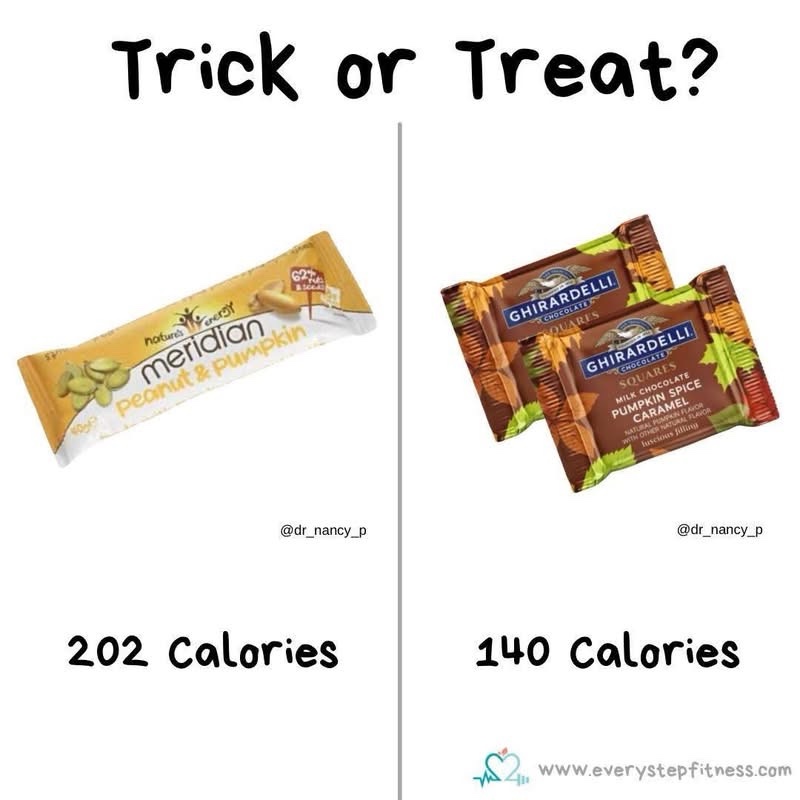
It’s pumpkin season and there’s a multitude of pumpkin spice snacks out there. Pumpkin is often promoted as a health food (pumpkin itself does indeed have many health benefits) and there are lots of snack bars out there that are marketed to imply that they are a “healthy” choice. This is a perfect example – this bar definitely looks like it’s a healthy choice. It’s got nuts and pumpkin seeds in it – great for good fats, vitamin A, and a host of other benefits.

So you might decide to reach for this rather than reaching for a pumpkin spice caramel chocolate square thinking it was a better choice. Well that may not always be the case.

It does contain a good range of nutrients (and fat and sugar) and is definitely a good snack to give you energy and keep you full and will cost you 202 cals. But you could actually have 2 of these chocolate caramel squares for fewer calories. So if you were trying to lose fat/weight and looking for a snack, then rather than reaching for a “healthy” snack bar when you don’t fancy it, you’d be better off just going for a snack you actually want – like the chocolates if that’s what you fancy. And if you do want the ‘healthy’ bars then be sure to read the labels carefully as some are extremely high in calories.

Ultimately, if you’re trying to lose fat or weight, it comes down to calories. So enjoy a balanced diet overall and just be mindful of the calories in what you’re having.

Happy Hallowe’en 🤗
xxx

Tuesday Tip

Tuesday Tip: Pump(kin) it up!

Tuesday Tip: Pump(kin) it up! 🎃

Well it is almost Hallowe’en so I wanted to focus on the most famous of hallowe’en vegetables! The pumpkin! They’re not just great for carving, their nutritional benefits are so good – they’re scary!

Not only is pumpkin really low calorie (26kcals/ 100g), it also contains no saturated fats or cholesterol, and is rich in fibre, anti-oxidants and B vitamins. They are super high in vitamin A, a single serving giving you over 4 times your daily recommended amount. It’s great for eye health and for essential immune function; great to ward off those seasonal colds.

It’s particularly good for helping you recover from workouts. Pumpkins are high in vitamin C, which as well as boosting your immune system also helps the body produce collagen. This is vital for maintaining the structure of your bones and keeping them strong! It’s full of beta-carotene which is a fantastic natural anti-inflammatory, to reduce your post-workout recovery time. It’s also rich in potassium (it has more potassium than bananas). This helps to restore the body’s electrolyte balance after a heavy workout which means you will recover faster and keep those muscles functioning properly.

It doesn’t end with the flesh, the seeds are also brilliant too. They are full of anti-inflammatory compounds and healthy fats, protein and fibre and recent evidence suggests they can help with pelvic floor issues. So sprinkle them over your brekkie or grab a handful for an on the go snack!

It’s such a versatile veg, you can use it in casseroles or stews, make a yummy soup, oven roast it, throw it in a curry, and you can use it in baking too; it makes a great egg or butter replacer in muffins and loaf cakes, and you can even make a pumpkin butter!🤗

The pumpkins sold for carving aren’t the best for cooking as they’re grown to have less ‘meat’. So if you’re buying purely to eat it’s worth going for other pumpkins or squashes, but the carving ones are still perfectly edible. So as you’re carving those pumpkins today save a bit of the flesh and try roasting it or throwing it in a casserole etc.

Happy Hallowe’en guys!

🎃👻

Xx