Nutrition and Calorie Tips

What we think makes up calorie expenditure ..

What we think makes up calorie expenditure .. 🏃🏼‍♀️

When people think about energy expenditure (calories burnt) most people focus on exercise as being the most significant factor. Exercise obviously contributes to our calorie expenditure but for the majority of people, it is not a large percentage of total expenditure.

In reality exercise actually forms a small percentage of our total calorie burn. The majority of your calorie expenditure is from your basal or resting metabolic rate (BMR)- calories burned at rest for the body’s basic functions. A small portion comes from the thermic effect of food (TEF) – calories burned through the process of eating and digestion (this is 10% max). Exercise forms the smallest contribution – it’s dependant on how many workouts you do but usually less than 15%. The most significant contribution, aside from resting metabolic rate, comes from non-exercise activity thermogenesis – calories burned through movement that isn’t formal exercise. This includes fidgeting, standing, walking, house work, gardening etc) and accounts for 15 – 50% depending on how sedentary you are.

These percentages vary between individuals of course. For somebody who is mostly sedentary, then calorie expenditure from exercise and NEAT are much lower. Someone very active or with an active job will burn a large amount from NEAT.

For most people whilst your calorie expenditure might vary a bit day to day depending on whether you workout it’s not going to make a significant difference overall and is far less than a lot of people think.

What does this mean?

Well for a start it means it’s not the end of the world for your weight loss journey if you miss a workout. It’s also a reminder that exercise isn’t a great way to try to lose fat as it would take a huge amount of exercise to produce a significant calorie deficit (which is why what you eat is more important).

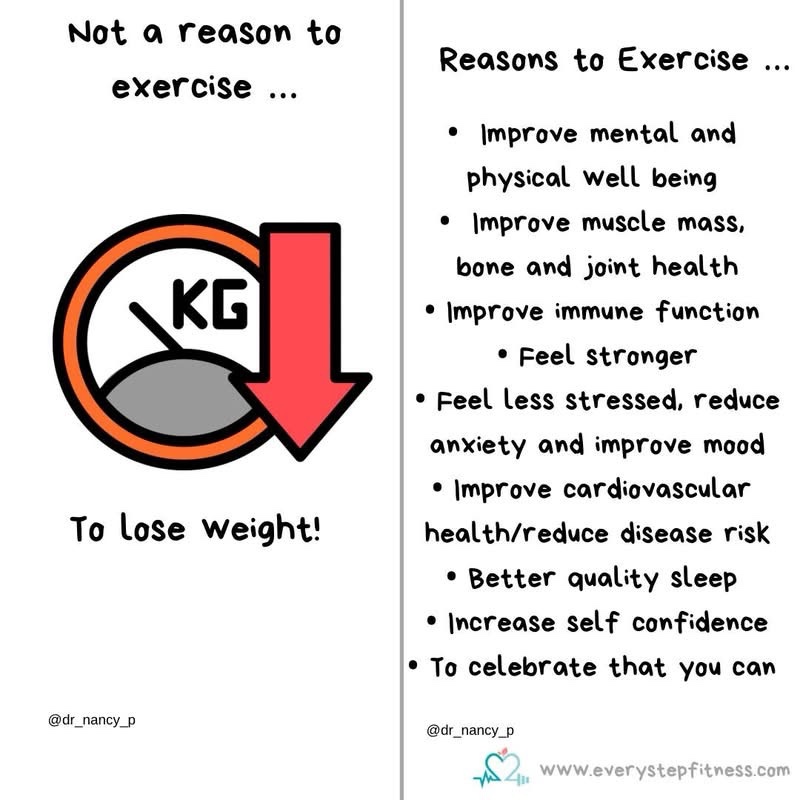
It’s also a good reminder that you don’t need to eat a lot less on days you don’t workout or a lot more on days that you do. You just need to have a sustainable calorie deficit on average. Separate the two – focus on food for weight loss, and exercise for health and well being.

Enjoy 🤗

Xx

Tuesday Tip

Tuesday Tip: Bigger weights aren’t always better

Tuesday Tip: Bigger weights aren’t always better 🏋🏻‍♀️

If you want to get stronger and fitter you have to lift heavy weights in the gym, right? Wrong! Several recent studies have shown this isn’t the case at all.

Recent studies in the Journal of Applied Physiology found that lifting light weights (30 -50% of 1 rep max) for more reps, was just as effective as lifting heavy weights (up to 75-90% of 1 max rep) for 8 – 10 reps both for increasing strength and muscle size. Participants took part in a 12 week program of total-body resistance training (leg press, bench press, shoulder press, leg extension, bicep curls) – half used light weights, half used heavy, all lifted until failure. After 12 weeks, both groups made equal gains in strength and size, except for the chest press, where in fact those lifting lighter weights showed greater gains! Muscle strength increased 25-30%, and both groups put an average of 2.4 pounds of lean muscle on. In addition, biopsies of the muscles showed there was no difference in the growth of muscle fibres in either group (type I and II).

If you want to get stronger then you need to increase your muscle mass (don’t confuse this with getting “bulky”) by activating as many muscle fibres as possible. Day to day activities use the type I fibres first. As demand on muscles increase (more reps, or more weight) you recruit type II fibres – which is what you want. Conventional wisdom states that you can ONLY recruit type II fibres by lifting big weights for fewer reps, but what these studies show is that you don’t need to do that. The key is lifting to fatigue – with whatever weight you choose.

Great news for anyone who wants to get fitter and leaner but doesn’t fancy lifting heavy weights in the gym. You CAN still get strong by doing things like body pump, or workouts with smaller weights IF you are reaching fatigue by the end of the set or track. Lift to the point of exhaustion and it doesn’t matter whether the weights are heavy or light.

Happy Tuesday 🤗xx

Nutrition and Calorie Tips

Swaps to save calories….

Swaps to save calories…. 🥤🍟 🍫

When I’m working with clients for sustainable fat and weight loss one of the big things I try to encourage is making some ‘easy’ swaps that they can incorporate into their diet. to save calories. It’s not about replacing something you love with something you hate (that will never work and will make you feel like you’re deprived) but there are some swaps you can make which you may not even really notice. Or they may be compromises which you’re willing to make.

This is a selection of some of the common ones and although individually some of the calorie savings may seem small it’s amazing how they all add up. Some involve similar tasting but lower calorie products, others are a portion size thing too. Obviously there are loads more – but I have tried to present a few of the main ones that my clients have used and enjoyed. Let me know about your own swaps too!

Here’s the list:

  • Oven chips (100g) 157cals vs 100g potatoes and oil spray (ten sprays) 83 cals
  • Lean beef mince (250g) 313 cals vs meat free mince (250g) 225 cals
  • 15ml olive oil 125 cals vs fry light olive oil spray 1 cal per spray (so even using 25 sprays is still a massive saving)
  • Bacon rashers (3) 180 cals vs Turkey Rashers (3) 72 cals
  • Cheddar cheese (20g) 85 cals vs babybel light (20g) 42 cals
  • Kettle Chips Small bag 205 cals vs pop chips 94 cals
  • Ben and Jerrys tub 1125 cals vs halo top tub 320 cals
  • Mars bar 228 cals vs curly wurly 118 cals
  • Grab bag Haribo 649 cals vs 3 mini bags 162 cals
  • Medium whole milk latte 237 cals vs skinny Americano 25 cals
  • Gin and tonic (single) 93 cals vs Gin and slimline tonic 64 cals
  • San pellegrino Lemonade drink 71 cals vs 7up zero lemonade drink 0 cals
  • Pint of London Pride Ale 199 cals vs Michelob Ultra 95 cals

Remember as part of a balanced diet it’s not a problem including some lower calorie options, especially if they mean you actually stick to it! If you want any help with making swaps just shout!

🤗
Xx

Tuesday Tip

Tuesday tip: Portion Control

Tuesday tip: Portion Control 🥗

Portion control is super important for healthy eating and long term, sustainable fat loss but it’s one of the hardest things to master. Here are a few tips to help you naturally control portion sizes and develop healthy habits.

1 Aim for 50/25/25

Start by filling your plate half full of veg or salad, then a quarter with protein and the remainder with whatever starchy veg or carb you’re having (potato, rice, squash etc).

2 Set aside leftovers

If you plan to eat some for lunch tomorrow etc then set it aside at the start rather than after – that way you won’t be tempted to keep picking after you’ve eaten your portion.

3 Share

When you’re out at restaurants or cafes consider sharing with whoever you’re with. Portions are usually massive at restaurants so it can easily feed two, especially with things like potatoes or chips.

4 Smaller plates

Lots of studies have shown that eating from smaller plates leads to less calories being consumed (even when subjects are allowed to top up the plates). So choose side plates and small bowls to trick yourself into eating less. We’re conditioned to clear our plates, even when we’re already full, so this way you can clear your plate and not over eat.

5 Take a whiff

As well as our eyes our noses are heavily linked to feelings of satiety. Take time to smell the food you’re about to eat – breathe in the scent and savour it. Studies have shown this helps to limit the number of calories consumed by tricking your brain in to thinking you are more full than you are.

6 Don’t eat from the bag

Put your food or snacks out on a plate before eating then, rather than eating from the bag. Visually seeing your what you’re eating sends a message to the brain about the quantity you’re consuming and leads to less likelihood of overeating.

7 Put away distractions

When you’re eating focus on eating. If you’re distracted by TV, phones, etc then studies have shown you’re likely to over eat. Pay attention to what’s going into your mouth and you’ll be better able to recognise when you’re full and stop before you overeat.

Happy Tuesday 🤗
Xx

Nutrition and Calorie Tips

Skipping lunch to save calories ….

If you’re trying to lose fat and watching your calories it’s often tempting to skip meals to ‘save calories’.

You may also be rushing around and think you don’t have time to eat a meal. Lunch is a classic one and I often hear from clients that they ‘tend not to eat lunch’ for various reasons, and just ‘grab a snack’ on the go thinking they’re actually saving calories.

Sometimes there’s also the perception that something like a sandwich is a poor choice for lunch (because of the bread… 😬which is actually fine!) and that ‘healthy’ snacks are better.

In reality it’s extremely easy to clock up a large number of calories with this approach without even realising it. Often you’re rushing around so you grab a snack bar, that doesn’t satisfy you so a bit later you’ll have some fruit, maybe a biscuit with your coffee, then another ‘healthy’ bar later in the afternoon etc.

In actual fact you’d be better off just having a sandwich (even a relatively high cal one) for lunch which is just a quick and easy to grab and eat.

So if this is you, and you’re trying to lose fat and not seeing results, then maybe just stop and have a think about how much you may actually be eating with all the snacks.

Obviously if not eating lunch works for you and doesn’t cause you to overeat with snacks etc then keep doing what your doing! But it doesn’t hurt to just be a bit more mindful right? 🤗