At this time of year all the coffee shops bring out their range of seasonal coffees and snacks. Starbucks has its iconic pumpkin spice latte so if you’re out and about you may well decide to grab a quick seasonal drink and a snack to go with it.
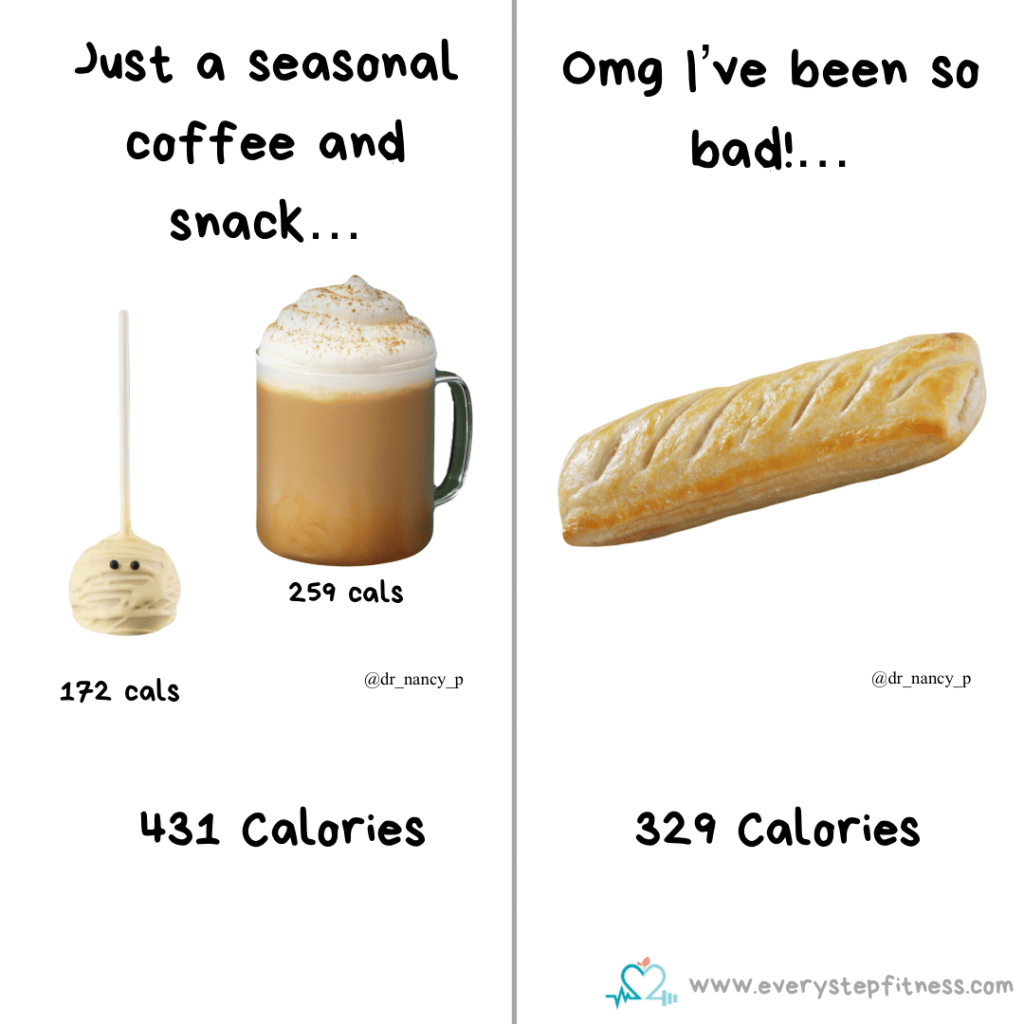
This particular example is a medium Pumpkin spice Latte (with semi skimmed milk) and a small cake pop. You’d probably think this was a reasonable thing to have as a snack and you might realise it’s a few hundred calories but it can’t be that bad… It’s just a coffee and a little cake pop right?
On the other hand if you grabbed a sausage roll from Greggs you may be berating yourself for ‘being bad’.
In reality that seasonal coffee comes in at around 259 cals, and the cake pop is 172 cals. That’s a total of 431 cals. In comparison the sausage roll is a mere 329 cals! Whilst there’s absolutely nothing wrong with spending over 400 cals on coffee and a snack you may find that if you’re trying to watch your calories that you can’t accommodate that many cals for a snack. In addition if you don’t realise how many cals they are you are likely to go over calorie budget that day.
Knowledge is power so being aware of the calorie content of things, and also of our own perceptions of the things we consume is always a good thing. If you want the seasonal drink and snack – have it and enjoy it. If you wants sausage roll then go for it. Just be aware of the calories so you’re making an educated choice!
So Autumn is certainly in the air; cooler, darker evenings and mornings. For me, and many of my clients and class members this is a tough transition. It’s hard to find motivation to continue regular exercise, and we crave warming, comfort foods. I’ve posted this before but it’s always a useful reminder at this time of year.
Low energy, low mood and low motivation makes us want to hibernate rather than work out. So how can you keep that summer mojo going? Focus on shorter workouts if you’re struggling to find motivation for long sessions. In an ideal world you’d aim for 30-45 mins of high intensity exercise 3 x week: a class, a home hiit workout, or a cycle or run. But anything is better than nothing so if you can only do 10-15 mins then that’s fine! Don’t forget all the other ways you can exercise too like gardening, walking, swimming etc
Find a gym buddy; it’s harder to skip that workout when you’re doing it with someone else. Join a colleague for a lunchtime run, or meet up with a friend at the gym or at a class. The social side of fitness plays a massive role in keeping you on track.
Try to sneak exercise in whenever you can: park further away, take the stairs, walk over to speak to colleagues in the office rather than phoning or try a walking meeting with colleagues. If you’re watching the kids play sport then walk the sideline instead of standing still.
Exercise isn’t about losing weight, it’s great for stress relief and at this time of year when things can be a bit manic it’s a great release. The endorphins will lift your mood and help energise you. Make the most of those bright autumnal days and go for a walk outside.
Focus on warming, filling foods like soups and casseroles. I also like to stew up a load of fruit (apples, pears, plums, berries – whatever!) and use it as a snack or pud. Warm it up, sprinkle some oats or a little cereal on it and a dollop of Greek yoghurt – a great comforting dish!
Oh and just because it’s not hot you still need to be drinking plenty of water. It’s even more important to ensure you’re properly hydrated at this time of year as it’s when most of us forget – so get sipping while you workout!
Don’t let the changing seasons get you down – embrace it – enjoy it and have some fun this Autumn 🍁
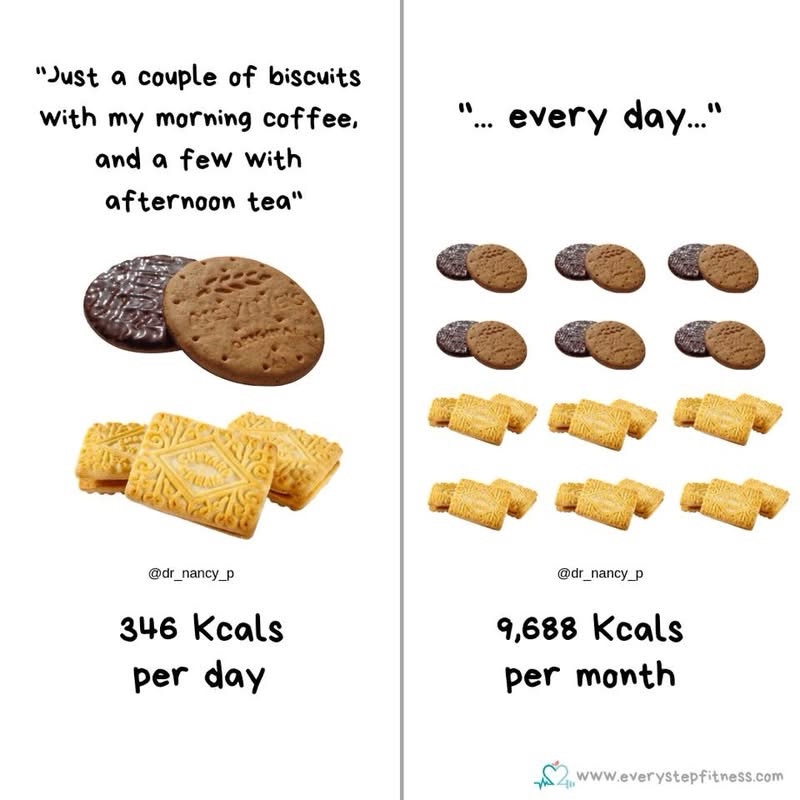
A couple of biscuits with coffee or tea are a common staple of many homes and workplaces.
There is absolutely nothing wrong with it, biscuits on their own don’t make you fat, but if you’re having them by default, out of habit, on top of a diet which is already providing you with enough calories then you will gain fat (or fail to lose fat).
The issue with biscuits is that they’re so easy to munch through without even realising you’re doing it, it’s a quick few hundred cals you won’t even notice you’re having. You only need a deficit of 2-300 cals a day to see fat loss so that’s your potential deficit gone right there. Over the course of a month it’s a whopping 9,688 cals!
So, if you’re goal is fat loss, perhaps it’s worth just being a bit more mindful about those biscuits with your tea/coffee, or if you’re having them then log and count the calories and include them within your daily calorie goal! And if you are trying to cut calories then maybe those biscuits are an ‘easy’ cut to make.. just going for half the amount would save you over 4,500 cals…
Tracking calories is a tool we can use strategically at certain times to accomplish specific goals, whether that’s improved health, sports performance, fat loss, or muscle gain. It can teach us quite a bit about food and nutrition as well, such as learning the energy and macronutrient composition of various foods.
Tracking accurately is a skill though and it’s very common for people to unintentionally and unknowingly under-report or under-track their food intake in general. Small mistakes with tracking can really add up over the days and weeks and can mean the difference between you losing fat or maintaining your weight.
Here are some common mistakes:
Eyeballing portions
Estimating and eyeballing portion sizes can be the difference between being in a calorie deficit or not. Weighing with a food scale in grams or ounces is the most accurate method you can use.
Grazing and mindless bites
Untracked grazing, bites, snacks, sips, and licks still count towards your calories and can really add up. Often , we’re not even aware we’re doing this, so increasing your mindfulness and awareness can be key. Plan out your snacks ahead of time and consider portioning things out in advance into serving containers or buy your snacks prepackaged.
Raw vs Cooked
Food loses and gains water weight when we cook it. For example, rice and pasta “gain” water weight while potatoes, protein sources, and vegetables “lose” water weight when they are cooked. Cooking methods and times affect how much water is gained or lost. The most accurate method is to weigh your food raw – or before you cook it. But what matters the most is that you are consistent with the method you chose and you choose the right calories to log – so check whether the cals listed are “cooked” or”raw” entries.
Generic meal entries
Your homemade spaghetti bolognese will have vastly different calories than many of the generic entries available in your tracking app. Track your meals by either entering each ingredient or (a more efficient way) use the recipe function in the app.
Oils, dressings, condiments etc
Cooking oils, mayonnaise , mustard, ketchup, BBQ sauce, butter, milk in coffee, sauces, preserves and salad dressings are easy to forget. However, they can quickly add up to be a few extra hundred calories. Don’t forget to track the oil you cook with (or swap to a 1 cal oil spray), condiments, milk, and dressings etc.
Not checking the accuracy of entries
Certain tracking apps (like MFP) are notorious for having inaccurate or misleading entries. Sometimes the serving size is incorrect, sometimes the actual calories are out, so if you can double check the entry against the label then do. Also, make sure your serving sizes are accurate in bought items and in your own pre-loaded meals or recipes (we tend to change servings over time so worth revisiting now and then).
Forgetting to log
It’s so easy to forget what we’ve consumed – studies all support this and even trained nutritionists don’t recall everything. The best way to prevent this is to track in advance or as you go along. Before something goes in your mouth just open the app and log it. Don’t wait until the end of the day to log things. Aside from forgetting what you’ve had it’s also too late to make any changes once you’ve eaten it.
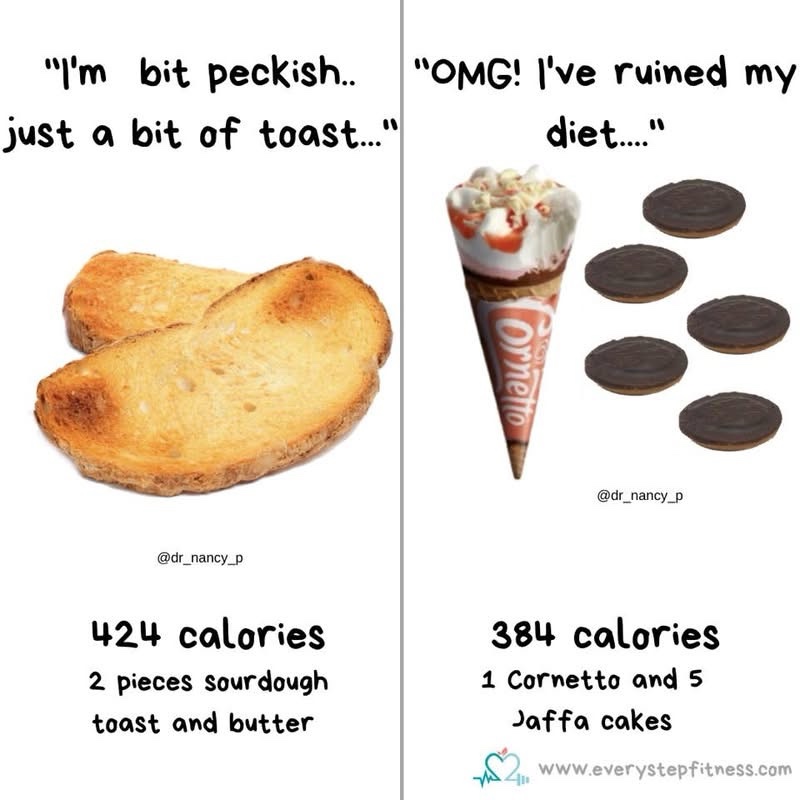
We all know the feeling, it’s mid afternoon, we’re a bit peckish but we’re ‘being good’ so don’t want to reach for a biscuit. Instead we grab a couple of slices of toast – nothing wrong with that right? It means we’re still on track with our ‘diet’ and all’s well….
But some days you may not have that will power… sun’s out, so you grab a cornetto out the freezer.. then have just one Jaffa cake… which becomes 2, 3, .. or maybe just one more – so that’s 4 and perhaps a final one… so you finally stop at 5! Now you’re wracked with guilt! How could you be so stupid? You’ve totally ruined your ‘diet’! Why don’t I have any self control you say to yourself?!
Hold on just one second! Perception is a wonderful thing… and it can also be a terrible thing. That toast that seems ‘ok’ may not be that much better. Two slices of sourdough toast with butter is up to 424 cals. That cornetto and 5 Jaffa cakes… a mere 384 cals! So neither is a great choice if you’re trying to stick to a particular calorie goal, but in most cases you’ll view the cornetto/Jaffa cake saga as a total disaster on the diet front, whilst probably overlooking the toast completely.
It pays to be aware of the calories in what you’re eating. That way you can choose with knowledge rather than your preconceived or conditioned ideas about what’s ‘bad’ or ‘good’. Being aware of the calories in different foods empowers you to make that choice and can help remove the guilt. Knowledge is power!