Nutrition and Calorie Tips

Carbs make you fat….

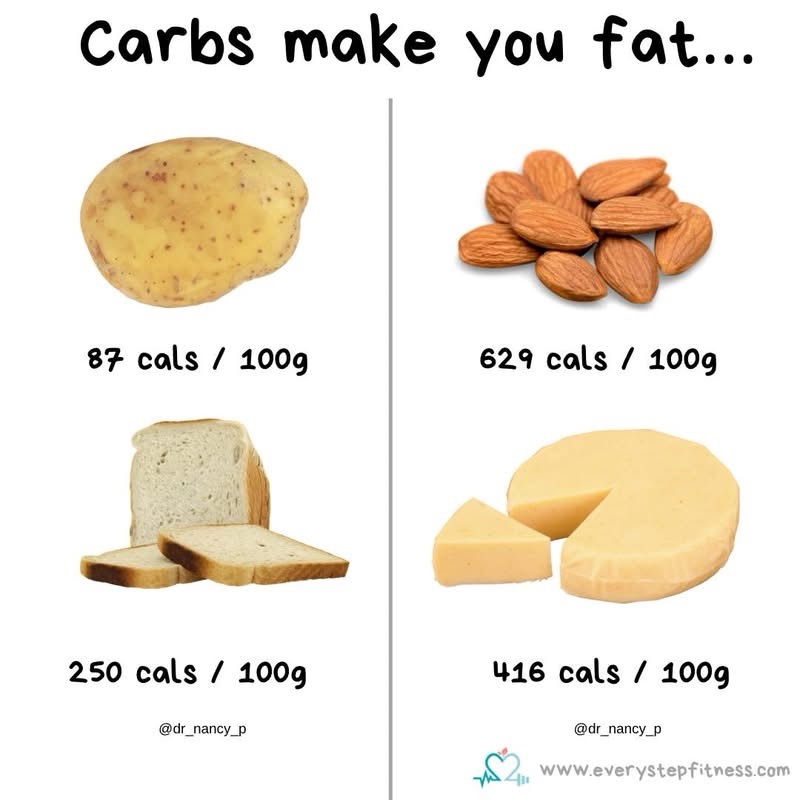
Carbs make you fat…. 🥔 🍞

I actually lose count of the number of times people tell me it’s carbs that are making them fat, or stopping them losing weight, or that they just need to cut carbs and they’ll lose weight….

The rhetoric is usually something along the lines of – to lose fat/weight you need to cut or reduce carbs and focus on more protein and fat based foods (nuts are a prime example). Many new clients I meet have either tried eliminating carbs from their diet or that they intend to, by which they usually mean cutting out potatoes, bread, pasta etc. Many social media ‘experts’ have suggested that carbs are ‘bad’ and to be avoided – but this is based on very little actual evidence. In fact many studies have supported the fact that eliminating carbs has no significant impact when it comes to weight loss – it’s the total calories that have the impact.

No food or macro is inherently fattening. It all comes down to calories. Carbs do not make you fat – as you can see in this example – those high carb foods are actually far lower in calories per 100g than those high fat foods. Now eating fat-heavy foods won’t make you fat either – but this just illustrates the point re carbs quite nicely.
From a fat loss standpoint, fats are more calorie dense than carbs or protein. Fats contain 9 calories per gram, carbs contain 4 calories per gram and so does protein. Therefore, fat as a macronutrient is more than TWICE the amount of calories compared to carbohydrates or protein. This doesn’t mean fat is ‘bad’ it just means foods that are high in fat are also high in calories, so be mindful mindful of your portions! Often it’s what you’re putting on the carbs that make them higher in calorie – like cheese, butter, nut butter etc.

You CAN eat carbs and still lose weight when you are able to achieve a energy deficit. So stop believing that carbs are responsible for your weight gain. They’re not – whether intentional or not you were just eating more calories than you needed.

🤗
Xx
Tuesday Tip

Tuesday Tip: Lemon water

Tuesday Tip: Lemon water 🍋

Social media claims lemon water aids digestion, detoxifies the body, rejuvenates skin, promotes weight loss, boosts metabolism, balances pH, reduces inflammation and even prevents cancer. So, is it really an elixir of life? Nope!

1. Weight loss

Lemons contain pectin, a type of fibre that can help with fullness but a squeeze of juice contains virtually none. Water may fill you up or replace a higher-calorie drink, but there’s no magic effect from the lemon.

2. Detoxification

Your liver and kidneys remove waste products from your body. They don’t need ‘detoxing”’ certainly not by lemon water. No food or drink flushes mysterious toxins from your system.

3. Balancing pH

The claim is that our bodies are too acidic and need “alkaline” foods. In reality, your body tightly regulates blood pH. If it moves outside its normal range, that’s a serious medical problem not something fixed by breakfast! Food may alter the pH of your urine, but it cannot meaningfully change your blood pH. There’s also no evidence that an alkaline diet or lemon water prevents or cures cancer.

4. Boosting metabolism

Lemon water has no meaningful effect on metabolism. Many so-called ‘metabolism-boosting’foods produce, at most, a tiny and temporary effect.

5. Digestion

Good hydration supports normal digestion and helps prevent constipation. Adding lemon isn’t necessary it’s the water doing the work.

6. Immunity

Lemon provides some vitamin C, but the small amount used in lemon water is unlikely to “boost” your immune system or make a meaningful difference if you already eat a reasonably balanced diet.

Lemon water isn’t harmful per se, but regularly exposing teeth to acidic drinks can contribute to enamel erosion. It may also aggravate heartburn or reflux in some people.

So drink it if you enjoy the taste or the ritual but don’t expect it to detox your body, melt fat or transform your health!

Happy Tuesday 🤗

Xx

Nutrition and Calorie Tips

Supplement marketing tricks…

Supplement marketing tricks… 💊

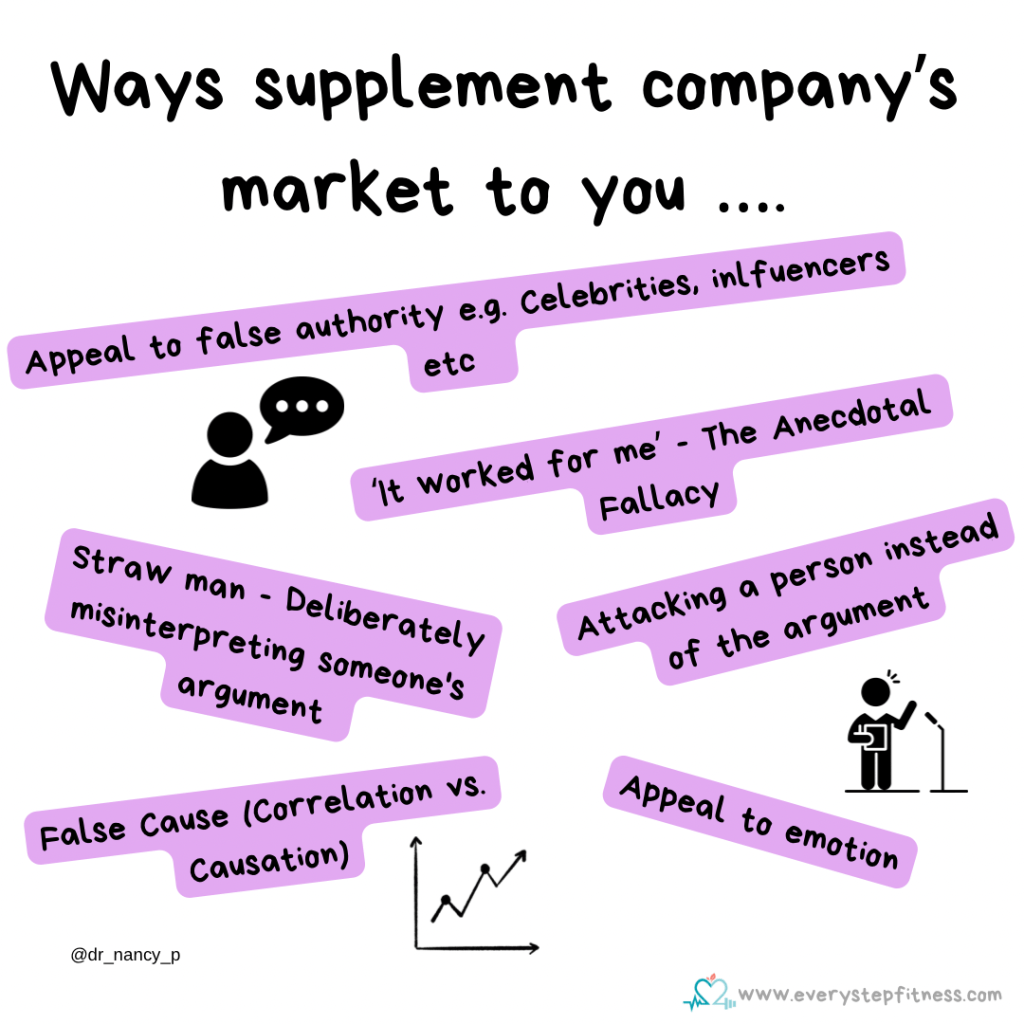
The supplement industry is very good at convincing us that we have a problem and that their product is the solution. Good marketing isn’t the same as scientific evidence.

Here are some common tricks:

1. Appeal to false authority: A celebrity, influencer or even a medical professional isn’t automatically an expert in nutrition. Check whether their qualifications are relevant and whether they’re being paid.

2. The anecdotal fallacy: ‘It worked for me!’ is a personal story, not scientific proof. Testimonials may be genuine, exaggerated or completely fabricated. Even when they’re true, one person’s experience cannot tell us whether something works generally.

3. Straw man arguments: Deliberately misinterpreting someone’s argument to make it easier to attack. E.g if I said ‘most people don’t need supplement X’ that doesn’t mean nobody needs it. People may say ‘well I have a specific medical condition that requires it therefore you’re wrong’ and use that to debunk your argument. People with particular medical needs are not ‘most people.’

4. Attacking the person: ‘Don’t listen to her, she isn’t in shape.’ Someone’s appearance doesn’t determine their knowledge. Equally, a six-pack, white coat or enormous following doesn’t make someone credible. Look at the evidence, not the person.

5. False cause, correlation vs causation: ‘I started taking collagen and my skin improved.’ One happening after the other doesn’t prove it caused it. Perhaps they also changed their diet, skincare, sleep, stress levels or exercise habits.

6. Appeal to emotion: ‘If you cared about your health, you’d buy this.’ This uses fear, guilt or shame to make you buy. Not purchasing an expensive supplement doesn’t mean you don’t care about your health.

Supplements are useful when there’s a genuine need, but ‘natural,’ popular and heavily promoted doesn’t mean it’s necessarily effective or safe. Ask what the claim is based on. Is there good-quality evidence? Is the person qualified? Are they selling something? Could something else explain the result?

Once you recognise these tricks, you’ll see them everywhere. Your health and your bank balance may thank you!

🤗

Xx

Tuesday Tip

Tuesday Tip: Do you need electrolytes? 💧

Tuesday Tip: Do you need electrolytes? 💧

Electrolyte drinks are all over social media at the moment: tablets, powders and expensive little sachets promising ‘better hydration’. But does your 45-minute workout really require a this? Probably not!

Electrolytes are minerals including sodium, potassium, chloride, calcium and magnesium. They help regulate fluid balance and are involved in nerve signals and muscle contractions. They are essential but that doesn’t automatically mean you need to buy a supplement. Your body is great at keeping these minerals within a narrow range, and most of us replace what we lose through ordinary food. For everyday life and a typical gym class, walk, run or workout, plain water is usually absolutely fine. Electrolytes become more useful when losses are genuinely high; prolonged or intense exercise (over 90 minutes), very hot conditions, unusually heavy sweating, endurance events, or significant fluid loss through vomiting or diarrhoea. Just because you sweated that means you need them, we all sweat during exercise!

Also sodium is the main electrolyte lost in sweat, but many of us already consume enough, if not too much, in our diet. Regularly adding more ‘just in case’ isn’t better and can be damaging , particularly if you have high blood pressure, kidney or heart problems. Some products are also rather high sugar. So after your workout class, drink some water and eat your usual balanced meal. You almost certainly don’t need a brightly coloured drink, a salty sachet or a monthly supplement subscription to recover!

Electrolytes aren’t nonsense but they are marketed as necessary when they really aren’t. Save them for when the duration, heat or sweat loss genuinely warrants them. As a personal note- I’ve not taken any electrolytes at all during this hot summer and I do tonnes of exercise a week teaching classes (and had no ill effects!).

Save your pennies! Save your blood pressure and and if you are using them encourage you to drink by making your water taste nicer then

go for squash instead.

Happy Tuesday 🤗

Xx

Nutrition and Calorie Tips

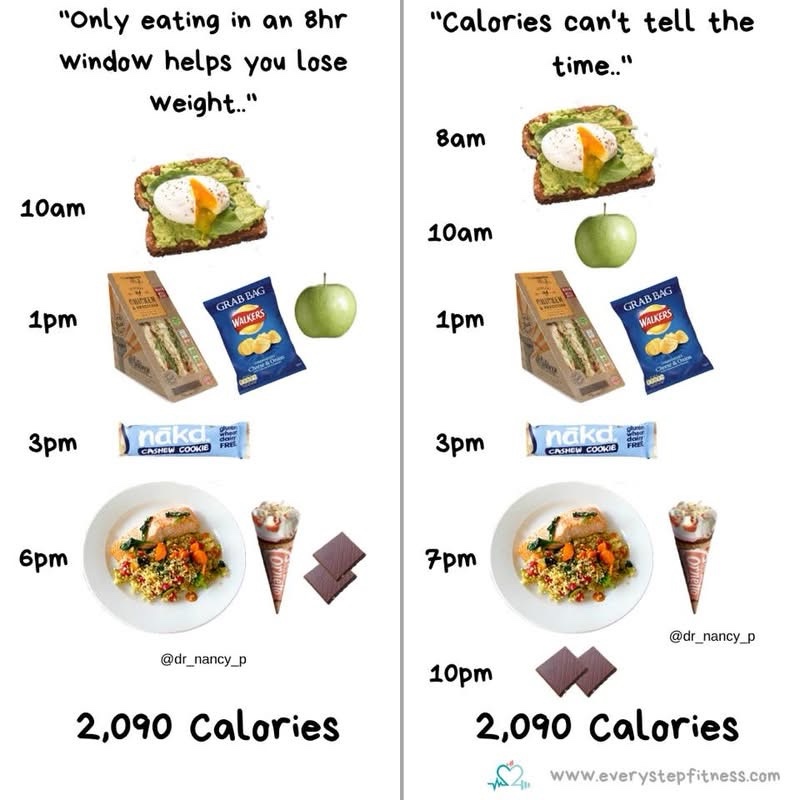
“Calories can’t tell the time…. “

“Calories can’t tell the time…. “ ⏰

It’s really easy to fall into the trap that eating your meals/snacks etc at certain times of day (or not eating at certain times of day) will help you lose weight (fat) more quickly.

One common idea is that you should fast for a certain number of hours during the day and only eat within a certain window of time. This varies but is usually an 8hr window or so. Proponents of this method suggest that by only eating during certain hours you can forget “complicated” diets etc and lose weight without doing anything more. You’ll hear lots of people saying they’ve achieved great fat loss using this method and they undoubtedly have. So surely it works then? Well yes it works – but only because those people have ended up eating fewer calories and therefore been in a calorie deficit, and lost fat/weight.

The problem with this method is that it doesn’t account for individual’s daily caloric requirements. So if someone started this method, but was eating more than their daily calorie requirement within that 8hr window, then they wouldn’t make any progress. Studies have shown that this method ONLY results in fat /weight loss when participants eat fewer calories than they are expending, and are therefore in a calorie deficit. Meal timing is irrelevant in terms of fat loss, it’s energy in vs out that matters.

Having said that, for some people, it’s easier to eat fewer calories if they restrict the hours in which they are “allowed” to eat. So if skipping breakfast, or not allowing yourself to eat after 8pm works for you then go for it! BUT you still need to be eating in a calorie deficit. For some people though, fasting for long periods of time, or skipping meals, isn’t a sustainable strategy long term. It can result in reduced energy levels, and excessive hunger, leading to periods of “binge” eating and therefore eating more than their daily calorie target. It can also lead to less activity (and therefore fewer calories burned) due to low energy levels.

So basically – do what works for you, but remember it’s the total calories that count – not when you eat them

🤗

Xx