Nutrition and Calorie Tips

‘It’s not worth recording…..’

‘It’s not worth recording…..’ ☕️

If you’re trying to lose fat and are working on reducing calories then you’re probably going to be recording your cals somehow. But are you really recording everything? It’s very easy to overlook some things because they seem so insignificant.

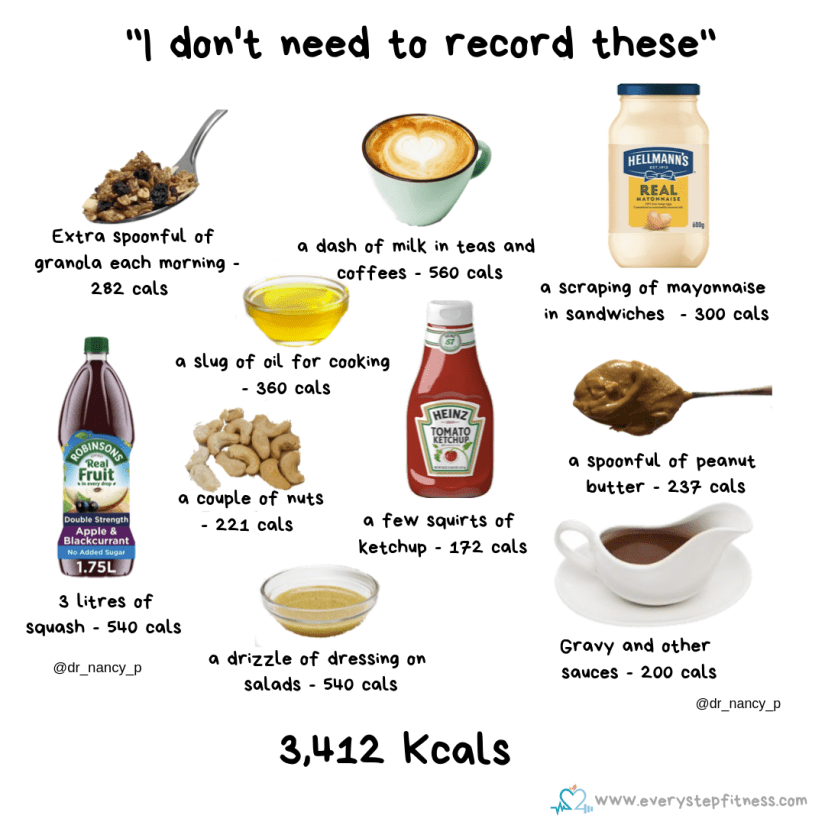
This is just an example of an average week for many people and where extra calories can sneak in. An extra spoonful of granola with brekkie every day (282 cals), a dash of milk in your tea or coffee (assuming 2 cups a day – 560 cals), a scraping of mayonnaise on your lunchtime sandwich (3 times a week – 300 cals), a slug of oil for cooking (3 meals – 360 cals), a sneaky spoonful of peanut butter because you’re hungry (237 cals), low sugar squash (a mere 18 cals for 100ml, but 3 litres of squash over the week – 540 cals), a few cashew nuts in the afternoon (a few every day – 221 cals), a squirt of ketchup with meals (5 meals – 172 cals), a drizzle of dressing on salads (3 salads – 540 cals), and finally gravy or similar sauces on your Sunday Roast (200 cals)…. That little lot totals 3, 412 cals over the course of a week. And let’s be honest for many of us we probably have even more of some of these….

But hey, they’re not worth recording right? Wrong! A sensible calorie deficit for fat loss is around 200 – 300 cals per day. With this little lot you’ve wiped out your weekly deficit without even noticing. All these little extras sneak in without really affecting how full we feel and without us noticing but they can really add up.

So if you are trying to lose fat, or your fat (weight) loss has stalled perhaps go back to basics and double check where some little extras could be coming in? And be a bit more mindful of these, or simply record them and have them within your daily calories. 🤗

Xx
Nutrition and Calorie Tips

‘The reduced sugar myth….’

‘The reduced sugar myth….’ 🍫

Sugar is often vilified as the cause of all health issues and as a result many companies have latched on to the idea that people are keen to reduce their sugar consumption. Now whilst sugar in excess amounts is undoubtedly not good (no nutrient in excess is) normal amounts of sugar in the diet are absolutely fine. However if you’re diabetic or trying to reduce your reliance on sugary snacks then it may be sensible to opt for some lower sugar options.

If you’re trying to lose weight (fat) then you may also decide to reduce sugar consumption. Many people equate lower sugar to mean lower calorie and would therefore go for the reduced sugar option in the belief that it would help them lose weight. In this example the actual difference is pretty insignificant.

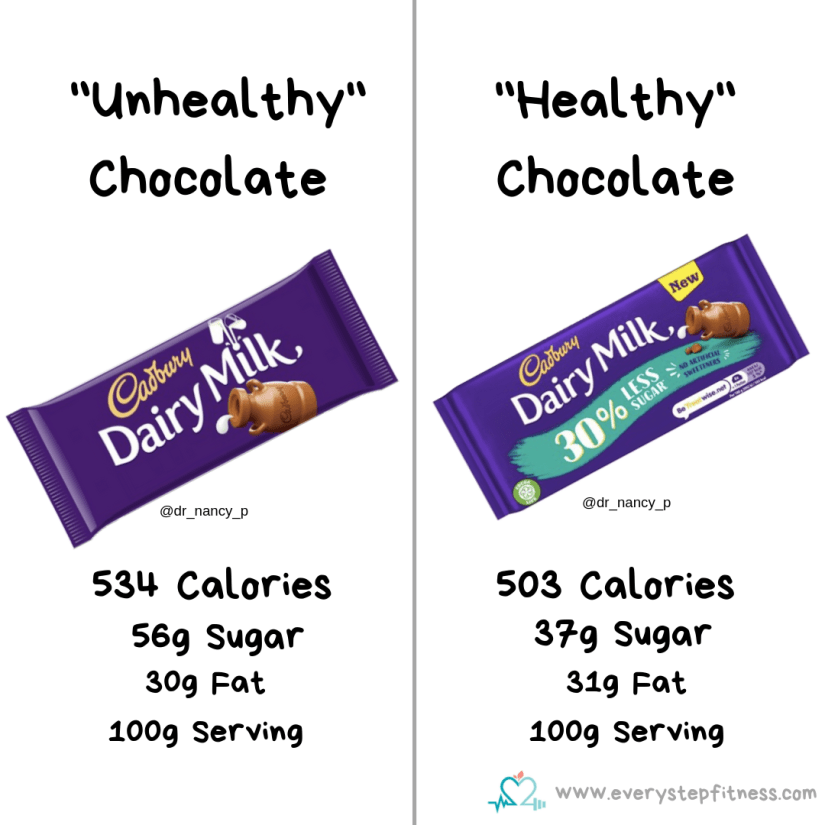
A standard Cadbury Dairy Milk contains 534 cals per 100g, whilst the reduced sugar version contains 503 cals – a reduction of 31, which is unlikely to result in weight loss. Yes, every little bit counts, but the expectation would probably be that it was much lower and therefore you may eat a larger portion, or expect bigger fat losses from this small change.

Cadbury’s are undoubtedly aware of this as they’ve made their standard bar size for the reduced sugar option a smaller size – 85g rather than the usual 110g of a normal dairy milk. So at first glance you’d assume it was a lower calorie option. It’s not really – it’s just a smaller bar! Clever eh?

So if you’re trying to reduce your calories and are going for the reduced sugar versions of things you love just take some time to check the calories and portion sizes and see if there really is a difference. If you enjoy the reduced sugar option and it helps to keep you on track then go for it! But don’t pay more for a marketing ploy when you don’t need to. Enjoy the chocolate you like, in moderation, as part of a balanced diet 🤗

Xx

Nutrition and Calorie Tips

‘Bad’ fries or ‘good’ nuts…

‘Bad’ fries or ‘good’ nuts… 🍟

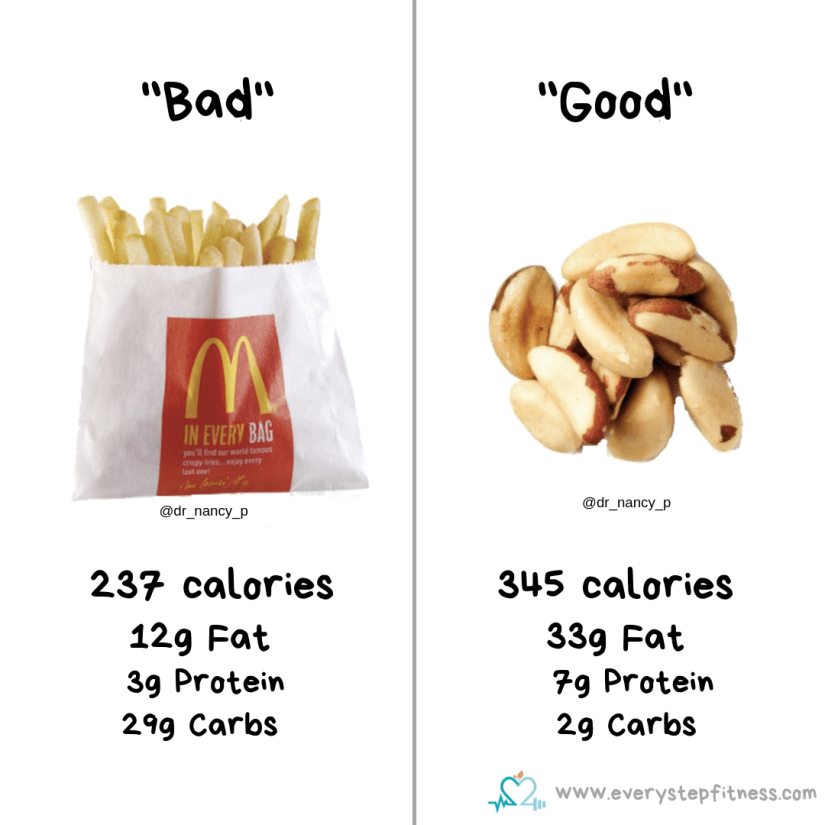
If you had snacked on a bag of small fries you would probably be feeling guilty that you’d chosen a ‘bad’ option. In contrast if you’d had 50g of Brazil nuts you would probably be polishing your halo for having such a ‘good’ snack.

Now before anyone jumps down my throat I am not suggesting Mcdonald’s fries are healthier than Brazil nuts. From a nutritional point of view the Brazil nuts are definitely a better choice. They’ve also been shown to reduce HDL cholesterol levels amongst other benefits. They contain heart-healthy fatty acids, such as polyunsaturated fats, and are rich in antioxidants, minerals, and fibre. They are the best source of the mineral selenium which is essential for the immune system, thyroid and cell function. They are calorie dense though.

McDonald’s fries on the other hand have no redeeming features other than the fact they may taste good. They’re not a nutrient dense food.

However they are lower calorie than the Brazil nuts.

So if your goal was fat loss and you decided to just replace those fries you have every Saturday afternoon with the Brazil nuts because they’re ‘good’ you’d actually be consuming more calories. Thereby not helping your goal.

Am I suggesting you should choose fries over Brazil nuts? No of course not! But if you enjoy occasional bags of fries then have them. If you like Brazil nuts then have them. But just educate yourself on the number of calories and consume them within your total calorie goal. Blindly choosing foods just because they’re perceived to be ‘good’ isn’t a sensible approach. No foods are inherently good or bad – they just have different costs and benefits. The Brazil nuts give you lots of great nutrients, the fries may help you stay on track and give you some pleasure – both are fine!

Enjoy 🤗xx

Nutrition and Calorie Tips

‘Lunch isn’t great, I tend to have a sandwich…’

‘Lunch isn’t great, I tend to have a sandwich…’ 🥪

Something I hear a lot from my clients is that ‘their lunch isn’t great as they just ended up having a sandwich’….. There’s a perception that a sandwich is an inherently bad choice when it comes to lunch. Often this stems from the idea that carbs (aka bread) are bad or ‘dirty’ and should be avoided. I hear them berating themselves for going for the sandwich option.

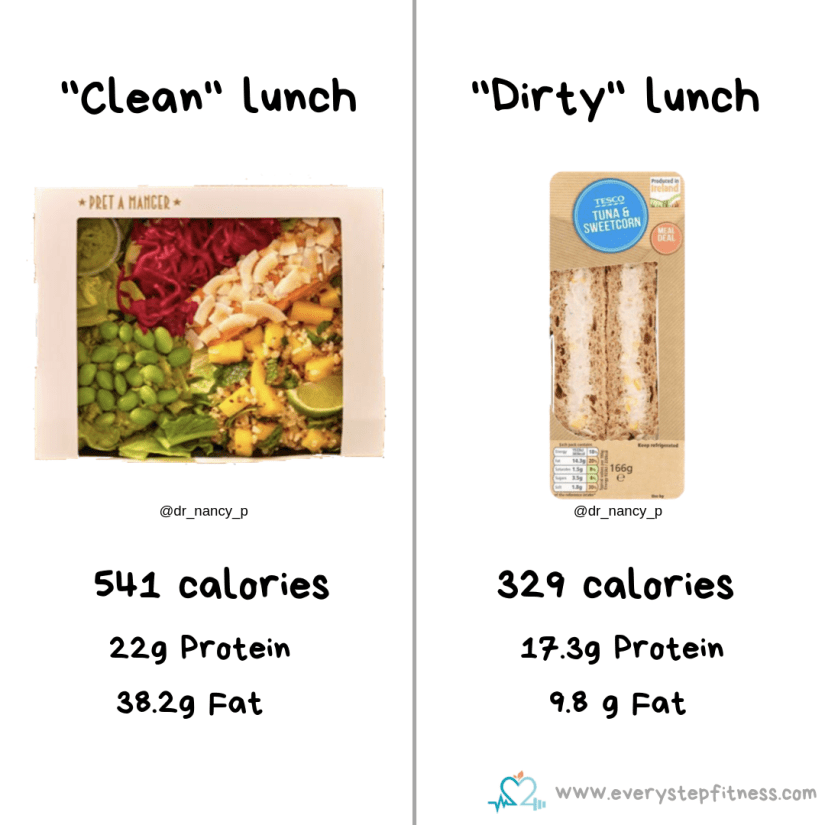
In contrast something like the Pret Californian salmon salad is viewed as a great option – because it’s ‘clean’ and therefore ‘good’. The fact that it’s a salad helps to create this image, and the fact that it’s loaded with protein and good fats from the salmon help too.

In reality both are great lunch options. The salmon salad does contain lots of great nutrients and will certainly fill you up – but with the dressing it’s a hefty 541 calories. The tuna and sweetcorn sandwich on the other hand is only 329 cals, is also loaded with protein and good fats and will also keep you full. It’s also a lot cheaper and more widely available.

So if you have the calories and want the Pret salad – go for it! If you prefer a sandwich, or just find the sandwich a more convenient cost effective option then go for that! It’s a perfect package of carbs, protein and fats to keep you satisfied.

Foods aren’t ‘dirty’ or ‘clean’, or ‘good’ or ‘bad’ – they’re just foods. Aside from fuelling you they also have to fit in to your lifestyle. As part of a balanced diet you can have both of these – totally guilt free!

Enjoy 🤗 xx

Tuesday Tip

Tuesday Tip: Too Much Protein?

Tuesday Tip: Too Much Protein? 🍗

Protein is all the rage right now – pushes for its ability to aid weight loss, help keep you full, build muscle and added to pretty much everything in the supermarket now! But is it possible to eat too much?

Yes and no!

It’s important to get enough protein – not only is it essential for health (Amino acids in protein are the building blocks for your body), it’s also great at keeping you fuller for longer, but do we really need as much as it seems? The recommended amount is around 0.75g of protein per kg of bodyweight. So if you weigh 65kg you need around 49g a day – a chicken sandwich, porridge with milk, and a veggie chili will give you well over that easily.

Studies do show that higher amounts of protein keep you fuller for longer and there’s also evidence to suggest that higher intakes of protein can help preserve muscle mass when losing weight. If you’re trying to build

Muscle then higher protein is also important(1.2g to 1.6g per kilo).

But…. just because slightly more protein is good that doesn’t mean loads is better.

Studies have shown over 2g per kg brings very little benefit. There’s no way to store protein so any surplus is used for energy – which means of course if you’re consuming more calories than you expend you will store it as fat. Despite scaremongering about excess protein and kidney issues there is little evidence of this in healthy adults. There is evidence though that excess protein causes changes in gut bacteria and digestive issues.

It’s also worth considering what you’re cutting out in order to get extra protein in. If you’re swapping grains for protein you’ll be consuming less fibre which can lead to gut issues.

For the majority of people, exercising regularly and eating a balanced diet, you’ll be getting plenty of protein. So if you’re reaching for ‘protein’ laden snacks just because you think they’re better then don’t bother, have what you enjoy instead. If you’re adding protein powder to everything just for the sake of it – stop and think whether you really need to. Are you just adding extra calories for the sake of it? As always, balance is key! 🙌🏼

Happy Tuesday 🤗

Xx