Tuesday Tip

Tuesday Tip: Don’t exercise to earn food

Tuesday Tip: Don’t exercise to earn food 🍫

With the recent Easter weekend there will undoubtedly be a lot of talk of exercising to ‘burn off’ those Easter eggs. In fact the media usually produces a list of activities and the equivalent amount of Easter chocolate it would burn. This is actually totally misguided and a really bad way to approach food and weight loss. Aside from the fact that it’s almost impossible to out exercise diet (mainly because we grossly over estimate the amount of calories we burn exercising) it’s also an extremely unhealthy relationship to foster between food and exercise.

If you are choosing to eat something you enjoy, that you want to eat and that fits into a balanced, flexible diet then eat it! You do not need to earn or burn your food with exercise. Food and exercise do not exist in an exchange-based system.

Choose exercise that you enjoy – if running isn’t your thing then walk, if you hate spin classes then try a different class etc. Eat to

nourish and fuel your body, it will then use that fuel as needed on a daily basis. So don’t skip lunch because you didn’t missed a workout that day or avoid dessert because you skipped the gym. Remember that your body still needs fuel to function – to fuel the brain, to fuel your muscles to get you from a to b, to fuel all your bodily functions. And remember that you won’t have actually burn as many calories exercising as you think anyway so it’s a futile effort.

So the next time you workout think to yourself – why am I exercising l? Is it to feel good? Is it to relieve stress? Is it to move your body in a way that feels good? Or is it punishment or to earn/burn food?

Eat to fuel your body, and exercise because you enjoy it. In regards to that Easter chocolate you may have eaten – view it as fuel to help you workout IF you want to – not something you have to exercise to burn off!

Happy Tuesday 🤗xx
Nutrition and Calorie Tips

Enjoying a seasonal treat ….

Enjoying a seasonal treat …. 🥚 🍫

I never tell clients cut out any foods/drinks totally from their diet and as a big fan of Easter chocolate I certainly wouldn’t ever be ‘banning’ chocolate eggs, but if you are trying to lose weight/fat then you may just want to be aware of the calories involved.

There’s no reason you can’t have any Easter eggs you want as it ultimately comes down to whether you’re in a calorie deficit. However, with the size of some of the eggs out there now it’s very easy to rack up over a thousand calories or more, without even noticing!

For example – if you’re a fruit and nut fan and lucky enough to receive the ‘ultimate’ egg you’d be looking at over 2,700 cals for the entire egg and accompanying bar (the egg alone is over 2,200 cals!). That’s more than most people’s daily calorie goal 😬

In contrast you could enjoy a large fruit and nut egg and the bars for around 1500 cals. Now ok, the egg is just a milk choc egg (not full of fruits and nuts like the ultimate one) but it’s still delicious and that’s still almost a whole day’s calories for many people.

So if Easter eggs are your thing (they are definitely mine!) then maybe just be aware of the cals in them if you’re trying to stick to your goals.

Enjoy! 🐣

Xx

Tuesday Tip

Tuesday Tip: What happens when fat is lost?

Tuesday Tip: What happens when fat is lost? 😅

There are widespread misconceptions about what happens when we lose fat. It’s important to understand the process of how fat is actually lost to be able to set realistic goals and expectations.

So what we think of as body fat is actually adipose tissue, which is essentially excess energy that is stored for future use. Fat is lost when we create a calorie deficit – usually via reducing the number of calories you consume. When you’re in a calorie deficit the body utilises the stored fat. Triglycerides contained within the fat cells are ‘burnt’ or oxidised to release energy. This involves many enzymes and biochemical processes but the end products are water, carbon dioxide, with energy being released at the same time .

84 percent of the fat becomes Carbon dioxide which is then excreted by the lungs

as we exhale. The remaining 16 percent becomes water and is excreted from sweating, urinating, breathing, Bowel movements, tears etc.

Before you get too excited – breathing faster, or sweating more isn’t going to result in more fat loss! Fat loss happens as a result of a long term, consistent change in your dietary habits abs lifestyle. So sadly, as always, the answer for fat loss isn’t flashy or sexy, but rather dull and rooted in science – a long term calorie deficit achieved mainly via eating less and moving more!

Happy Tuesday 🤗xx

Nutrition and Calorie Tips

Things that make you fat….

Things that make you fat…. 🍟

There are so many myths and there is so much pseudoscience out there around weight and fat loss. Depending on who you follow you may be told that eating carbs is making you fat, or that eating after 8pm is making you fat, or perhaps it’s eating fat that’s making you fat? Or you may have seen people saying that eating too much fruit is the problem, or eating sugar, or perhaps it’s because you snack? Or maybe it’s because you have breakfast… or maybe it’s because you don’t….

This is all rubbish. Eating carbs don’t make you fat, neither does eating fat or sugar – it all comes down to the total calories – you could eat solely carbs and lose fat if you were at a calorie deficit. Eating fruit certainly doesn’t make you fat – yes it’s often ‘full of sugar’ but that’s not a bad thing.. it’s fruit – so it’s full of fructose, and tonnes of other micronutrients that we need to function and of course it all comes down to calories. It’s actually quite hard to be in a calorie surplus just from fruit!

Eating after a certain time, or only eating at certain times also won’t make you fat – as long as you’re within your daily calorie limit.

Eating breakfast (or not eating it) and snacking aren’t issues either – if they help you stick to your daily calorie limits.

Stop focusing on the small stuff and listening to pseudoscience – this is just confusing the issue. Eating too many calories and consuming consistent caloric surplus is what makes you gain weight. Of course that means the reverse is also true – a calorie deficit (however you achieve it) will result in fat loss!

🤗

Nutrition and Calorie Tips

What you think happens on a super low calorie diets…

What you think happens on a super low calorie diets… 🥗

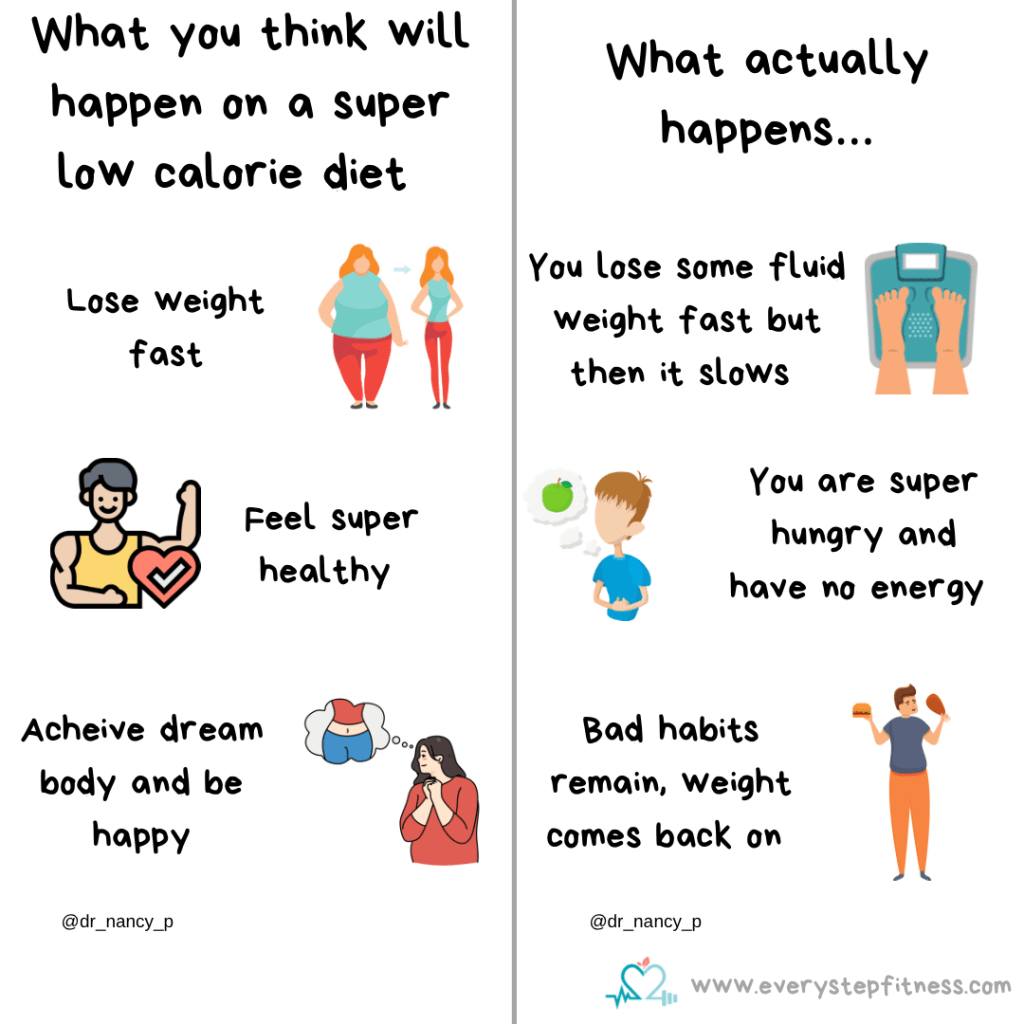
If you’re trying to lose weight/fat it’s very tempting to go in hard and aim for a super low calorie diet – this may be in the form of a ‘juice’ diet/cleanse, or some form of fasting, meal substitutes etc or just a v low calorie diet (under 1200 cals). In doing this you might expect that you’ll lose weight fast, feel super healthy and achieve that dream body! Boom! All your problems solved!

The reality however is that yes you may well lose some weight initially – much of which will be fluid to start with. And you may feel like you’re ‘cleansing’ your system to begin with (of course you’re not – your liver and kidneys do a great job of that every single day anyway!). However with these sorts of low calorie diets you will also find that you’re extremely hungry, tired, lacking in energy, irritable, subject to picking up more infections etc (as the immune system is suppressed ) and less able to do your workouts etc and probably miserable. As these diets inevitably involve cutting out foods you enjoy you’ll also feel deprived, and the chances of not being able to stick to the diet, and binging is extremely high.

All this leads to low adherence and means they’re not sustainable so after a short time you’re likely to return to your normal eating pattern. It doesn’t change any habits and therefore doesn’t result in long term weight loss.

So rather than going for short term fixes and slashing calories instead aim for a small yet sustainable calorie deficit, work on changing your habits and making life long changes so you can lose weight and maintain it!

🤗