Nutrition and Calorie Tips

Coconut oil is good for weight loss…..

Coconut oil is good for weight loss….. 🥥

It’s very common in the media for certain foods to be proclaimed as ‘good’ or ‘bad’ for weight loss and health. In reality this is rarely the case – individual foods rarely make a significant impact on weight loss or health – rather it’s the overall balance of these foods within the diet that matter. When it comes to weight loss the calories are actually what matter most.

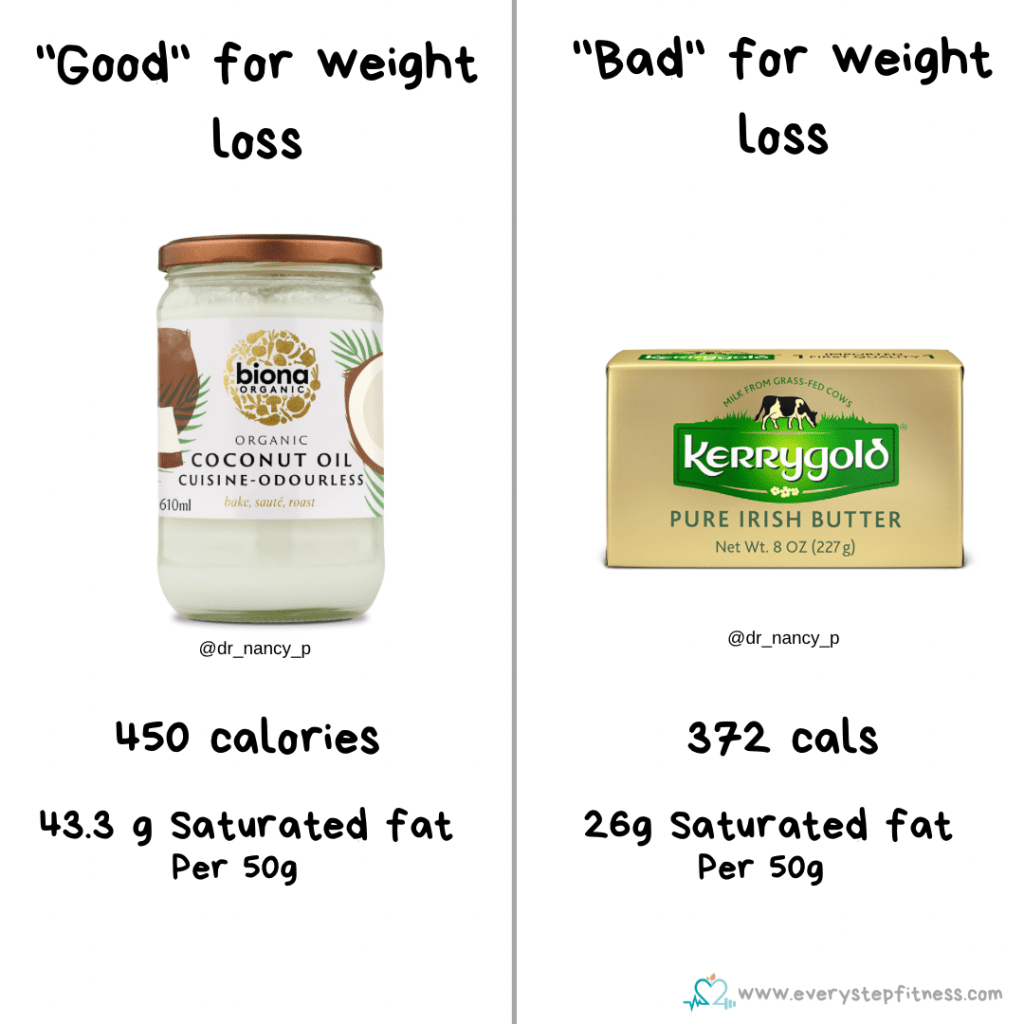
Coconut oil is one such food that many proclaim as being ‘good’ for weight loss, whereas butter has been vilified as ‘bad’. I often hear clients tell me they’ve swapped to coconut oil and with that comes a presumption that it will aid their weight loss journey. The claims around coconut oil include that it boosts metabolism, regulates blood sugar levels, and increases fat loss. In actual fact there are no reliable studies to support these assertions. Coconut oil is in fact extremely high in saturated fat, and calories. Compared to butter it contains more calories and a higher proportion of saturated fats. Saturated fats aren’t inherently bad and should certainly be included in your diet, but there are multiple studies which demonstrate links to increased risk of cardiovascular disease and high consumption of saturated fats. So if you already have a diet high in saturated fats adding more probably isn’t a great idea!

Coconut oil’s reputation as a ‘super food’ means that many might presume it would be lower calorie than traditional butter and therefore use it without really considering the calories. If goal was to lose weight then blindly using coconut oil in place of butter and other oils/spreads wouldn’t be a good choice. However if you enjoy coconut oil then by all means use it – just be aware of the calories it contains.

As always – knowledge is power! Never assume ‘healthy’ or ‘good’ foods are automatically lower in calories!

🤗
Tuesday Tip

Tuesday Tip: Are Fat burners worth it?

Tuesday Tip: Are Fat burners worth it? 💊

The idea of taking a pill to burn fat is a really enticing one and it’s not surprising people are eager to take them. But let’s not forget the basics – in order for fat loss to happen in the first place you HAVE to be in a calorie deficit. So the bad news is that fat burners don’t actually burn fat. Sorry.

So what do they do? Well they actually aim to increase energy expenditure. They do this because they contain stimulants – like caffeine. The idea is that they could aid fat loss because you would burn more calories and end up in a greater calorie deficit. However in reality they do little to increase your energy expenditure on a day to day basis. They may give you a little extra energy for your workouts but the difference in calories burned will probably only be 100 or so at the most. A cup of black coffee would have the same effect. Most importantly if you’re taking fat burners but are in a calorie surplus then they’re not doing to do anything other than create a deficit in your bank balance.

A review of studies of the use of fat burners found their effects to be insignificant when compared to diet and exercise alone. In addition, some fat burners can cause health issues. Hepatic and renal issues (liver and kidney) have been associated with some

fat burning supplements, as have strokes and sudden cardiac arrests. There is also the risk of psychiatric and cognitive issues with many fat burners too.

So all in all fat burners aren’t really worth it, and could even cause adverse health issues. They could be used as stimulants which may help with energy levels but other stimulants like coffee or caffeine containing products will have a similar effect. So you’re much better saving your money and focusing your efforts on sustainable lifestyle changes in diet and exercise that will provide long term changes and overall health.

Happy Tuesday 🤗xx

Nutrition and Calorie Tips

It’s ok, I’ve had a healthy snack…

It’s ok, I’ve had a healthy snack… 😇

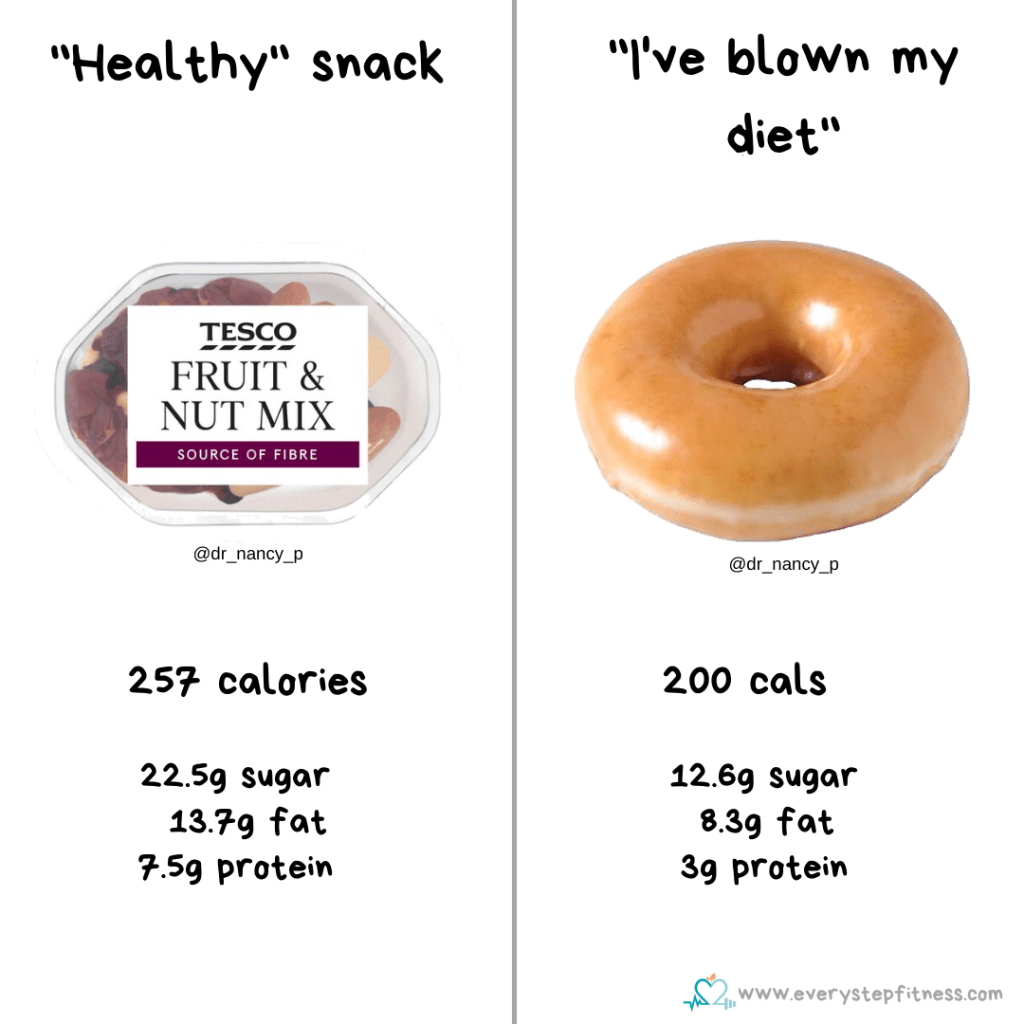
When you’re trying to lose fat it’s natural to try to avoid ‘junk’ food or foods high in sugar and fat. And for many people succumbing to that craving for something like a Krispy kreme doughnut is then considered a failure, accompanied by feelings of guilt and shame. But had they had the fruit and nut snack pot they’d have been feeling virtuous and like they’d stayed on track.

In reality in terms of calories, sugar and fat the ‘healthy’ snack is actually worse! Yes the snack pot has a little more protein (which can help you feel fuller for longer), and more micronutrients, so it is a slightly more balanced snack, but that doesn’t mean the doughnut is necessarily a bad option.

Overall calories and overall nutrition are what count – and if you’re trying to lose fat you need to be in a calorie deficit – in that scenario the doughnut is a better option. Especially if you’re eating a balanced diet and getting protein and the other nutrients in your other meals.

Emotional well being is also important and depriving yourself of foods you enjoy and instead choosing the graze box under the misguided impression that it’s a healthier option or because it’s marketed as ‘protein’ isn’t good for long term sustainability or a healthy approach to food.

Personally I’d choose both on different days – and I’d include them in my calories. The fruit and nuts are brilliant and do make a great snack option (as long as you’re aware of the calories) but sometimes if you’re dying for a doughnut then just have the goddamned doughnut! And enjoy it! 🍩🤗

Nutrition and Calorie Tips

What you should focus on during a workout

What you should focus on during a workout… 🏋🏻

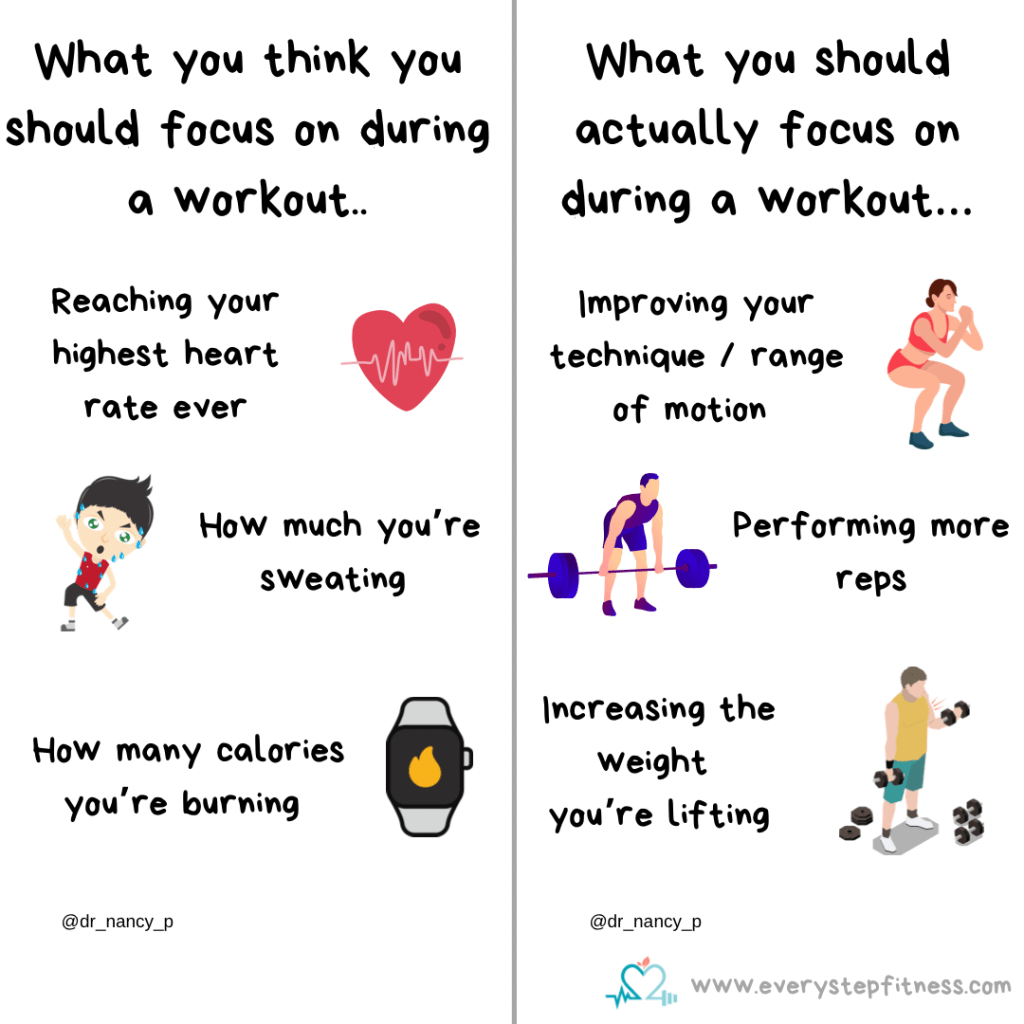
There’s a common misconception that you can only get a ‘good’ workout if your heart rate peaks at its highest ever, that you are sweating tonnes, or if you are burning as many calories as possible. Many people focus on these as indicators or whether their workout was good or bad.

However none of these correlate with how effective a workout actually is. They also don’t correlate with how much fat you’re burning either. Hitting a higher heart rate doesn’t mean you’re burning more body fat. Sweating doesn’t either – it just means you’re cooling your body down or it could relate to your level of hydration, hormones, etc.

Most importantly your calorie burn doesn’t necessarily reflect the effectiveness of your workout. It’s highly inaccurate – no device can accurately count how many calories you’re burning. It’s also irrelevant. It may take you 45 mins to burn 500 calories but you can consume those calories in 4 mins (or less!). You can never out exercise what you’re eating (and I’ve written about this in other posts). Unless you’re working out for 10 hours a day it’s impossible to use exercise to lose fat (Note – working out for that long is most definitely not a suggestion!). It’s your diet that determines the fat loss.

So exercise should be focused on increasing and improving performance. Separate it from the calorie side of things. Instead focus on lifting more weight, doing more reps, improving your 5k time, improving your range of motion and technique etc. Don’t put your energy and effort into things that ultimately don’t matter and will just cause you more stress. Chasing higher heart rates and higher calorie burns isn’t sustainable or enjoyable. Don’t chase a feeling – chase results – getting stronger, doing more push ups, managing that burpee, lifting more

weight etc.

🤗

Xx

Tuesday Tip

Tuesday Tip: Will that day of overeating make you fat?

Tuesday Tip: Will that day of overeating make you fat? 🍔

We can all relate to that feeling of eating way too much and worrying we will instantly gain fat. But is this really a cause for concern? Can one ‘binge’ really make you gain fat overnight? In the main – no!

It takes approximately 3500kcal extra calories to gain 1 lb of fat. That’s about

500kcal extra per day over the week. Even if you did that for a week that still wouldn’t guarantee that you’d gain 1lb of fat immediately because your energy expenditure is never the same each day.

But what about if you eat it in one day?When we overeat, we think that all that extra food is going to turn into fat, but that’s not necessarily true. But then why do the scales go up the next day? And why isn’t it stored as fat?

Some of the calories are used for digestion and absorption of food itself. When you’ve overeaten your body temperature also rises and you get more ‘fidgety’ as your non-exercise activity thermogenesis (NEAT) inceases (all the subconscious movements increase e.g. respiration, blinking, etc ). Some of the extra food will be used to replenish glycogen stores in the liver and muscles. For each 1g of glycogen 3g of water is retained. Even if the glycogen stores are full the body still doesn’t prioritise converting carbs into fat. This only happens if you’re consistently eating more cals than you burn. Storing carbs as fat is the body’s least preferred method of using excess carbs. Sodium also increases water retention so if part of what you overate was carb and salt heavy then there’ll be significant water retention – not fat! In addition you have the weight of the actual food in your digestive system.

So one single day/meal probably won’t lead to too much fat gain. The weight gain you see is mostly fluid and glycogen stores. It’s longer term overeating that leads to fat gain. If you get right back on track you’ll be ok! If however your average daily cals are consistently over your calorie requirement over the course of days/ weeks then that will lead to fat gain.

Happy Tuesday 🤗xx