Nutrition and Calorie Tips, Tuesday Tip

Tuesday Tip: Just Eat Less

Tuesday Tip: Just Eat Less 🍟

If you want to lose weight/fat but don’t know where to start the simplest thing to do is – just eat less! No I’m not being facetious – just bear with me here.

As you will no doubt have realised from my posts the key to losing weight/fat is by being in calorie deficit. Obviously one really good way to do this is by counting calories. But this may not be something you want to do or feel ready to do for whatever reason.

So the simplest way to achieve a calorie deficit, without following some unsustainable diet trend, going on a ‘detox’ or excluding food groups is to eat exactly what you’re eating now…. But just eat less of it!

So instead of having seconds at dinner, just have one plate of food, instead of having 2 pieces of chicken thigh, have 1, instead of snacking on 4 biscuits, have 2, drop to one milky coffee a day instead of three… etc etc.

Just these simple changes will probably save you at least 400-800 calories a day (if not more). Best of all you probably won’t notice the changes either.

You could also try some lower calorie swaps – you still don’t need to count calories to do this. You can swap cooking oil for a one cal

spray, swap crisps for pop chips, swap chocolate digestives for custard creams, swap red wine for a slimline gin and tonic etc

Trying to lose weight/fat can seem really overwhelming and complicated at first but it doesn’t need to be. Keep it simple and you’ll see progress!

Happy Tuesday 🤗

Xx

Nutrition and Calorie Tips

What you think weight loss involves…and what it actually involves…

What you think weight loss involves…and what it actually involves… 🥗

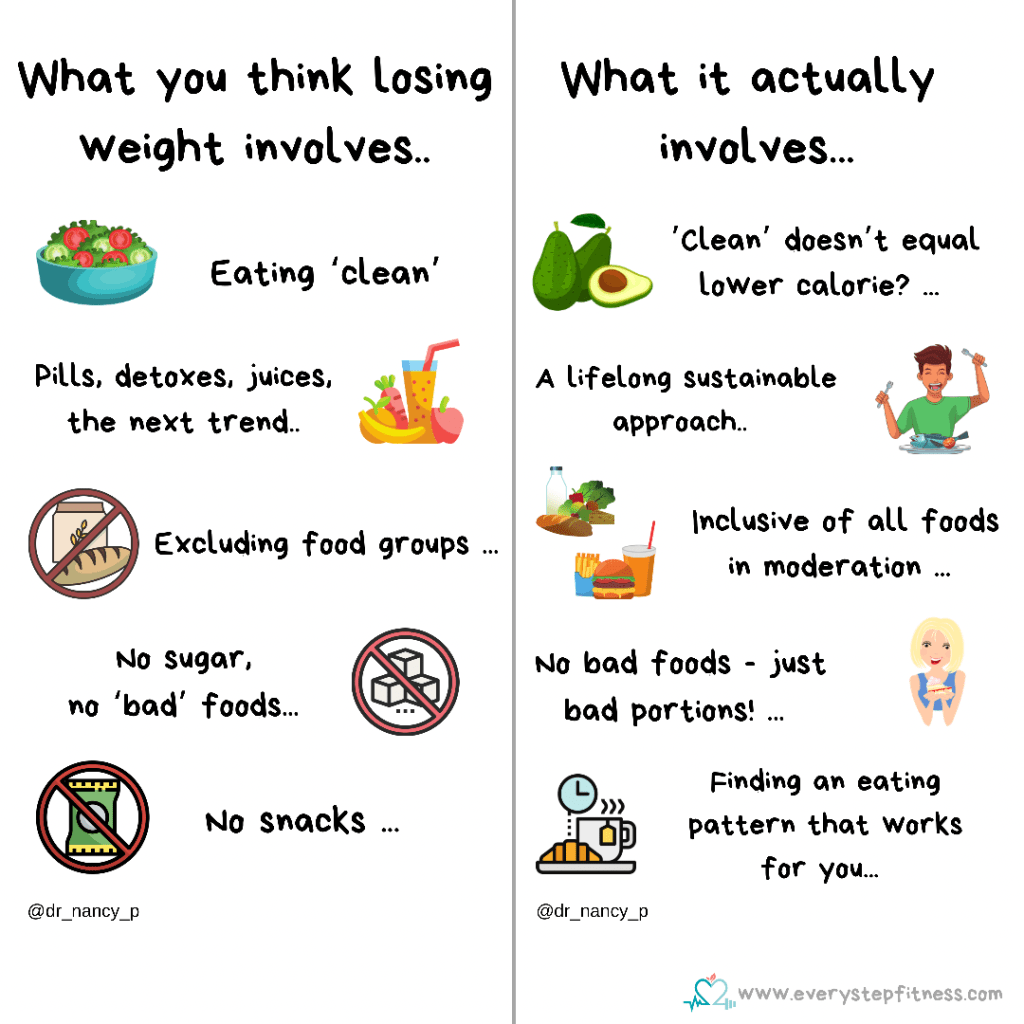
There are many misconceptions about what you need to do to lose weight or fat. You’ll hear lots of people saying you need to ‘eat clean’, cut out carbs, do a detox, have a juice cleanse, avoid sugar and bad foods, and stop snacking etc. However it’s really far more straight forward than that.

There are no magic pills, no secret cleanses or detoxes. There’s definitely no need to exclude food groups. There is no such thing as ‘clean’ food – it’s a totally meaningless term – and bears very little relationship to weight/fat loss. No foods are inherently bad – rather it’s the quantity of them that you eat that makes them better or worse than others. Snacking is also not inherently bad or a barrier to weight loss, in fact strategic snacking can help you lose weight.

Ultimately it all comes down to calories. However you choose to achieve it you need a calorie deficit to lose weight/fat. Now it may be that reducing certain foods in your diet help you achieve this e.g. reducing the portion size of pasta, swapping some snacks for lower calorie options, or reducing alcohol intake. But you don’t need to cut them out completely. You also can’t guarantee weight loss via ‘clean’ eating – as often those ‘clean’ foods are high in calories (e.g. avocado, nuts, smoothies etc). That’s not to say they’re ‘bad’ – they obviously have lots of benefits in terms of nutrients but the calories still count.

If you want to achieve life long, sustainable weight loss then no diet fad /pills/ detoxes or exclusion diets will work long term. Instead focus on moderation, calorie awareness and incorporating all the foods you enjoy within a balanced diet!

🤗
xx

Tuesday Tip

Tuesday Tip: 10,000 Steps?

Tuesday Tip: 10,000 steps? 🚶🏼‍♀️

We’re all used to being told to walk 10,000 steps a day – but why 10,000?

It turns out the 10,000 number isn’t based on any particular research or evidence, it’s in fact based on marketing for a Japanese pedometer in the 1960s and may not be the holy grail for health it’s built up to be.

10,000 steps equates to roughly 5 miles (depending on gait etc) – when you’re just starting out that’s actually a really long way! You may not have the confidence, fitness or time to get close to 10,000. So having that goal can backfire if you’re constantly not hitting it and feeling bad. Also of course most trackers tend not to include things like swimming, cycling or spinning in the step count or any resistance training so it’s not an accurate measure of activity. On the flip side for some hitting 10,000 is a walk in the park (🤣) due to their job or commute so why have that as the goal?

A better approach, and one I use with my clients, is to track your current steps for a week or so, and look at the patterns. Then set goals based on those. If on work days you’re only hitting 4,000 steps, there’s no point aiming for 10,000 if you can’t hit them, instead aim for 6,000 instead – a moderate increase in activity. And rather than just focusing on steps think about increasing overall activity across the week.

Studies suggest 150 mins of moderate aerobic activity (walking, Swimming, gardening etc) , or 75 mins of intense activity (hiit classes, spin, etc) per week is the minimum requirement for overall health. If you’re trying to lose weight start there and then if you’re hitting it increase the goals.

When it comes to fat loss increases in NEAT (Non-exercise activity thermogenesis) or the energy expended for everything we do that is not sleeping, eating or sports-like exercise, is what matters in terms of increasing your overall calorie burn. So garden, walk, fidget, stand up – be as active as you can! And forget 10,000 and set yourself some realistic step goals.

Happy Tuesday 🤗

Xx

Tuesday Tip

Tuesday Tip: Meal frequency and weight loss

Tuesday Tip: Meal frequency and weight loss 🥘🥗

Following on from last week’s tip on fasting, there’s lots of confusion about meal frequency and weight loss: eat more often to lose weight, or eat less often to lose weight? Actually how much you eat matters more than how often you eat. If you want to lose fat the most important thing is to reduce your calorie intake.

The idea is that eating more small meals = faster metabolism = more weight loss? Sadly not – yes digestion increases metabolic rate BUT it depends on the amount of cals, not how often you eat. Eating 1400 cals in one meal or 3 small meals makes no difference. Studies have shown that when total cals are controlled eating more often makes no difference. What it might do though is affect your ability to stick to those calories!

So is skipping meals bad? Scientifically it’s not, it won’t suddenly cause you to enter starvation mode and magically store fat (though it can increase the risk of acid reflux). What it may do is make you hungrier later or cause you to snack more or make bad choices, it could also mean you have less energy so you are less active and burn fewer cals.

Consider eating less often if:

– many small meals doesn’t fit your lifestyle

– you don’t want to think about food all the time

– you have any digestive problems (longer breaks between meals gives your body a chance to digest)

– you enjoy larger portions

Consider eating more often if:

– you struggle not to snack and want to spread your cals over the day

– you’re trying to gain weight and can’t eat enough in one meal

– you have an active job and high cal demands

– you’re an athlete

– you feel “hangry” all the time

There’s no magic number of meals per day for weight loss. Trust yourself – if you like smaller meals more often then go for it, if not stick to 3 meals or whatever. Whichever you choose though stick to it as studies show that meal irregularity can have negative health impacts. So whether it’s 2, 3, or 6 meals a day that’s fine but don’t forget, regardless of how many meals you split it in to, it’s the total calories that matter!

Happy Tuesday 🤗

xx

Tuesday Tip

Tuesday Tip: Easy Calorie Cuts

Tuesday Tip: Easy Calorie Cuts 🥗

If you’re trying to lose weight or fat then the one thing you need is a calorie deficit. Whilst tracking your calories using an app is one way to achieve this there are also ways to help facilitate the deficit (with or without tracking).

#1 One cal oil spray – I’ve written about this before and it’s a no brainer. Swapping oil in cooking for a one cal oil spray saves hundreds of cals without compromising taste (and sprays come in a variety of oils too – olive, avocado, coconut, sunflower)

#2 Swap to diet drinks – a full sugar fizzy drink is around 140 cals per can, a diet one is close to zero. (See my previous posts on why diet drinks are perfectly safe to drink if you’re concerned on that score)

#3 Swap to sweetener –

If you have sugar in your hot drinks then consider a swap to a sweetener instead. (See my post on sweeteners if you’re concerned about using sweeteners )

#4 Make other swaps – swapping full fat yoghurt to low or zero fat, swapping spreads to low versions, ice cream to a lower cal version etc. Within the context of a balanced diet these swaps make an easy and safe calorie saving.

#5 Drink – drink water or zero calorie drinks before and during meals. This helps to hydrate you and keep you feeling fuller.

#6 Limit meals out – whilst it’s perfectly possible to plan ahead and stay within cals for occasional meals out it’s very hard to maintain a deficit if you’re eating out/getting take away a multiple times a week.

#7 Booze – limit the booze or swap for lower cal options eg slimline gin and tonic, low alcohol beer, champagne/ Prosecco etc

#8 Lean meat – choose leaner cuts of meat or swap eg bacon medallions instead of rashers, chicken breast instead of drumsticks, rump instead of ribeye steak etc

#9 up the veggies – load your meals with veg and salad. The extra fibre and volume helps to keep you full and adds additional micronutrients which is always good. It also reduces space on the plate for higher calorie options.

#10 Slow down – eat mindfully and slow down. Chew your food properly and avoid distractions when you eat. This gives time for the signals from the stomach saying you’re full to reach the brain and prevents over eating.

Happy Tuesday 🤗

xx