Tuesday Tip

Tuesday Tip: No bad foods

Tuesday Tip: No bad foods 🍕

I hear people referring to things like cake, chocolate, cookies, crisps, pizza, chips etc as ‘bad’ foods. As a result people often feel like they’ve failed if they eat them. It’s really vital to shift your perception of these types of foods if you want to have some balance manage long term maintenance and sustainability.

Of course there are foods which have more fat, sugar, or calories and fewer micronutrients. Whilst those types of food aren’t the healthiest they serve other purposes – including improved mental well being so they should absolutely be included in your diet. It just means you have to manage the portion sizes of these types of foods. Having an entire pizza, garlic bread and a tub of ice cream – perhaps not the best idea, having a few slices of pizza and a small bowl of ice cream as part of a balanced diet – absolutely fine!

This is where being aware of the calories in foods is so important. You can then manage your calorie budget to incorporate the foods you enjoy that are higher calorie. Also try pairing them with more nutrient dense foods when you can. You can’t get ‘fat’ from one pizza, or one tub of ice cream, equally you can’t get ‘thin’ from one salad or one bowl of fruit- we need all of them in our diets. Lose the all of nothing mindset and lose the idea that foods are good or bad – you can continue to have any foods you like and enjoy, just manage the quantity!

Happy Tuesday 🤗

xx
Tuesday Tip

Tuesday Tip: Fibre 101

Tuesday Tip: Fibre 101 🌾

I think most of us are aware that fibre is an important part of your diet. It plays a large role in overall health and is linked to reduced blood cholesterol, blood sugar regulation, reduced risk of cardiovascular disease, stroke, type 2 diabetes and some cancers. It’s also key to gut health and also helps with weight loss.

Fibre is the part of the food that isn’t digested in the small intestine. Dietary fibre ends up in the large intestine or colon where bacteria partially ferment it. Some passes through the body almost unchanged.

We need approx 25-30g fibre a day and there are 3 types; resistant starch, soluble fibre, insoluble fibre.

Resistant starch resists digestion in the small intestine and is fermented in the large intestine, producing gasses which help keep the Bowel lining healthy. Examples include chickpeas, black and kidney beans, cooked and cooked rice, pasta and potatoes, unripe bananas.

Soluble fibre dissolves in water forming a thick gel which slows digestion. Examples include lentils, psyllium husks, pears, sweet potato, avocado, prunes, oats, asparagus, legumes, Brussels sprouts, green beans.

Insoluble fibre adds bulk and keeps the bowels regular – keeping food moving through the intestines. It’s found in the skins/surfaces of roots, grains and seeds. Examples include wholegrain bread, pasta, rice and cereals, wheat bran, strawberries, celery, nuts and seeds, courgette, corn, broccoli.

We need all types in our diet. As well as the health benefits they also help keep you feeling full!

Happy Tuesday 🤗

xx

Tuesday Tip

Tuesday Tip : To breakfast or not to breakfast?

Tuesday Tip : To breakfast or not to breakfast? 🍳

I often hear people saying that they are not a ‘breakfast person’. They often say that they don’t eat breakfast because they forget, they’re rushing, they aren’t hungry, don’t think they need to, or just don’t want to. Some people also skip breakfast to have more calories for later in the day. Now whilst this is all absolutely fine and can work for some people (I have some clients who employ this strategy very successfully), it doesn’t always. Very often skipping breakfast means that, although they’ve stocked up some calories for later, they’re so ravenously hungry that they overeat. You may not even recognise the issue – but if you regularly skip breakfast and also have a problem of overeating/snacking after dinner then it might be worth revisiting that pattern.

Consider planning in some breakfast, and trying to view it as something that will fuel you for the day and prevent you from bingeing later, rather than something that just takes up calories. Aim for something with some protein in it – eggs, greek yoghurt, nut butters , milk etc as well as carbs. It doesn’t have to be traditional breakfast foods if that’s what puts you off – you can eat anything you like for brekkie. Equally you don’t have to have breakfast as soon as you wake – it can be a couple of hours later if that works better for you.
Try experimenting with different dishes and timing and see if anything helps reduce those post dinner munchies.

Many people do cope perfectly well without breakfast but if you’re finding you’re not able to control your appetite later in the day and are over eating then maybe you’d benefit from including breakfast in your daily diet.

Happy Tuesday 🤗
xx

Nutrition and Calorie Tips

I want frosties but I’m watching my calories so having weetabix…”

“I want frosties but I’m watching my calories so having weetabix…” 🥣

Before I start I’m not suggesting Frosties – sugar coated flakes of corn are a particularly ‘healthy’ breakfast. But I think most people would naturally assume it was also significantly higher in calories than other ‘healthy’ cereals and I imagine that given the choice, most people would choose the weetabix as the better option to reduce calories. But is it really?

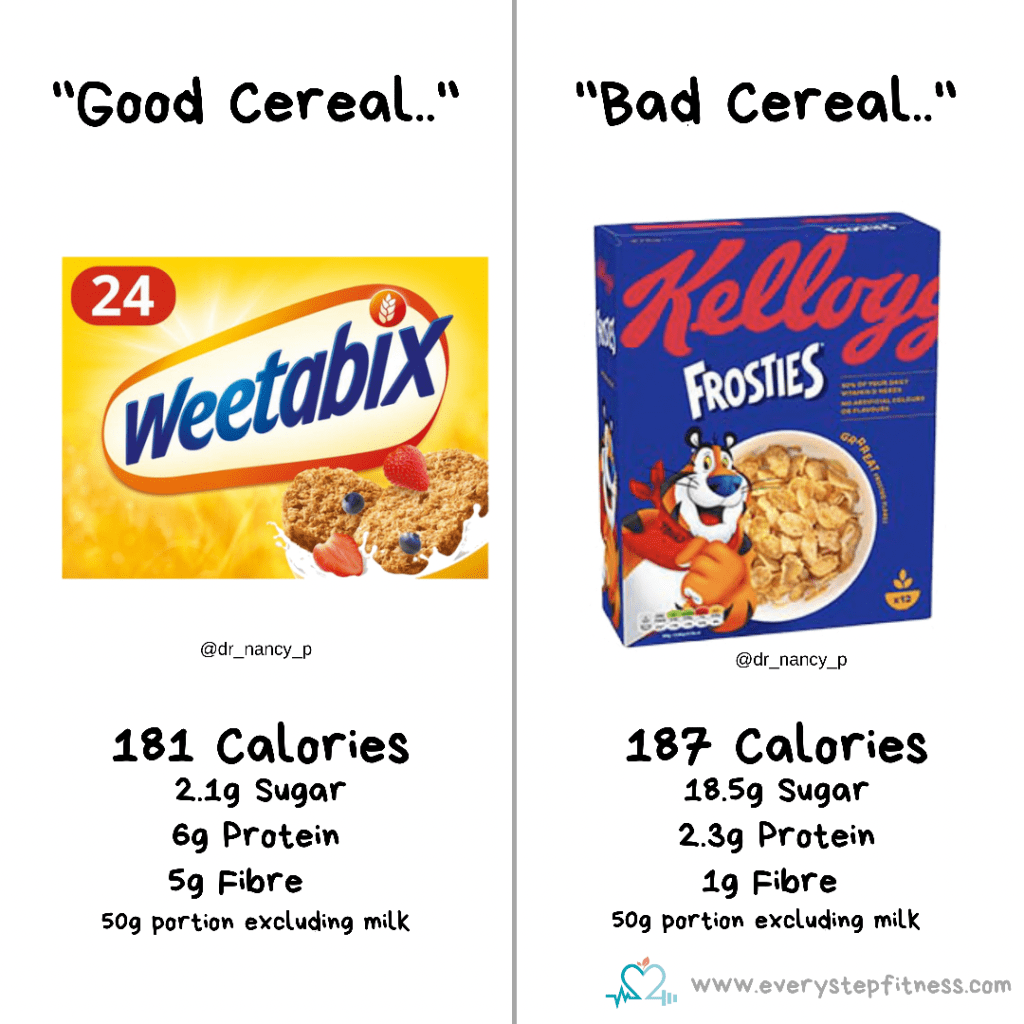
A 50g portion of frosties (because who actually has the recommend 30g?!) comes in at 187 calories (excluding the milk). Now as expected it’s high in sugar (18.5g) – I mean it’s coated in the stuff so that can’t be a surprise.

In contrast 50g of weetabix are 181 cals, so they’re only actually marginally less calorific – 6 calories (which in the grand scheme of things means very little). Now they obviously contain much less sugar (2.1g) and more protein (6g), and fibre (5g), which are beneficial of course but that doesn’t make them automatically better for weight loss.

When it comes to fat loss it’s the calories that matter – create a calorie deficit and you will lose fat/weight. So in this scenario you’d be no better off with the weetabix over the frosties. Now there are some additional benefits to the weetabix as I mentioned – less sugar, a little extra protein and more fibre which may help keep you a little fuller. Both cereals are fortified with vitamins and minerals anyway so you’re not missing out on as much as you think with the frosties. Plus many people will add sugar etc to weetabix anyway – thereby increasing the sugar and calories.

Now personally, I am not a fan of frosties at brekkie – but not because I think they’re that much worse than weetabix – rather I just don’t want super sweet cereal at that time in the morning lol!

However if you love frosties and you enjoy a bowl for brekkie then go for it (they’re also great sprinkled on ice cream …) ! If you love the weetabix then have it! But if you’re eating weetabix because you think it’s lower calorie, or feeling guilty for loving a bowl of frosties to start your day, then stop worrying. As long as you’re having a balanced diet you’ll get plenty of nutrients in throughout the day so if you love frosties enjoy them! 🥣 😋

Whichever you choose – read the labels, check the calories and be mindful of your portion size but most importantly enjoy it!

🤗 xx

Tuesday Tip

Tuesday Tip: Activity Tracker Caution

Tuesday Tip: Activity Tracker Caution ⌚️

Fitness trackers and smart watches are a brilliant tool to help get you moving, to track your activity and steps and to give you an idea of the intensity of your workout BUT they’re not a great tool for measuring calories burned.

The assumption is that these expensive watches are fairly accurate at measuring your calorie expenditure during exercise / daily life. The reality is most of these haven’t been tested at all and vary hugely in accuracy. A 2016 study found that whilst some trackers were only up to 8% out when sedentary they overestimated activity (including walking) by up to 40%. A further study in 2017 found some trackers overestimated exercise calorie expenditure by up to 93%!

This is why if you’re eating back your calorie burned from your tracker (or even just eating back half of them) you’re likely to be eating any calorie deficit you’ve accrued and may find you’re not losing weight/fat. So if you do have an activity tracker don’t use it to measure the calories you’ve burnt so you can go and eat them! You can however use them to measure your relative burn to see how ‘hard’ you’re working or how used to your workout you’re becoming by using it as a relative measure of effort

and by using the heart rate data. You can also them to measure steps (again accuracy varies a bit but they’re still great for seeing how active you are).

As I’ve said before – separate the exercise from the food side of things. Exercise for mental and physical well being, NOT to earn food.

Happy tracking! 🤗

xx