Tuesday Tip

Tuesday Tip: Pre-workout coffee?

Tuesday Tip: Pre-workout coffee? ☕️

Coffee as a pre-workout is something that’s often recommended social media and fitness blogs but does it really help?

A recent study found that consuming even a small amount of caffeine before and during exercise can help people exercise almost a third longer. A study tested found that those who consumed caffeine whilst cycling were able to keep going for longer than those who drank water, delaying fatigue by up to 60%. The only drawback is that caffeine is also a diuretic, so it can cause dehydration. Other studies have however shown the dehydrating effect to be minimal and the consensus is that moderate consumption of caffeine is ok.

Other studies have shown that caffeine can trigger muscles to start using fat as an energy source, but this is only occurs when other energy sources are depleted. In endurance athletes for example, caffeine is used to get extra energy out of the body’s reserves during an event So in isolation it won’t magically burn body fat for you sadly.

Researchers have also found that caffeine can help reduce muscle pain. The study in The Journal of Pain found that caffeine (compared to a placebo) reduced thigh-muscle pain during exercise (which can mean being able to continue for longer) .

So overall caffeine does indeed enhance performance and makes it ‘easier’ to put in more effort during exercise. These effects are more noticeable during endurance exercise (over 90 mins). Caffeine also plays a role in helping contribute to clearer thinking and greater concentration. The effects are greater in those that rarely have caffeinated drinks as tolerance is built up, and the effect varies wildly from person to person.

So do you need to start necking an espresso before you workout? Probably not, but it could help on days when you need a little extra boost to get through your workout. However, caffeine can also have unwanted effects and its use can result in caffeine jitters, headaches, upset stomach or insomnia, and excessive consumption can have serious health risks, so best to use it only if you’re already a caffeine drinker.

Happy Tuesday 🤗

Xx

Nutrition and Calorie Tips

The real problem…

The real problem… ☕️ 🍪

When you’re trying to lose weight its often easier to fixate on the main meals, planning out breakfasts, lunches and dinners and focusing on them. That’s great and that will definitely help, but often that’s not actually where the issue lies.

An average breakfast of 250 – 350 cals, a lunch of 500 – 600 cals and a dinner of 600 – 700 cals gives you around 1,400 – 1650 cals per day. For most people this will be perfect for weight loss or maintenance (obviously it’s age, gender, height, weight, and activity dependant so this is just an example). But what about all the extras? Those things that you have every day without perhaps even realising it. The couple of cappuccinos (380 cals) you have throughout the day, and those biscuits you grab from the staff room (168 cals).. or maybe that smoothie you have to go with your lunch (it’s fruit right?) – that’s another 351 cals. Perhaps it’s the handful of “healthy” cashew nuts you grab in the afternoon (167 cals), or the mocha latte you treat yourself to as it’s been a tough day (455 cals)… or the chips you grab from the kid’s plate while they’re having their tea… (250 cals)… This little lot of extras racks up a whopping 1,771 cals! And you can easily see how it could happen without really noticing.

Now I’m definitely NOT saying you need to cut out all coffee, or biscuits, or not treat yourself to things BUT it’s definitely worth examining all these little extras when it comes to trying to create a calorie deficit. You’ll probably find that your main meals are actually fine and it’s some of the extras that are where the extra calories are coming in.

🤗

Xx

Tuesday Tip

Tuesday Tip: Eating out, on track

Tuesday Tip: Eating out, on track 🍽

With restaurants reopening I know a lot of people are heading back our for meals etc. So I thought it would be useful to go over a few tips to help you stay on track, when when eating out.

Look up the menu in advance and decide what you will have, or a few options that you fancy. Then reverse engineer your day around it – log the meal, and fit your other meals around it.

You may want to prioritise lean protein for your main course e.g. steak and salad. But be mindful that restaurant portions are 2-3 times bigger than those you’d have at home, so consider a doggy bag.

Try to choose 1 or 2 courses rather than 3 if you can. Remember you’re the customer – if you want starter and dessert, or 2 starters, or even 2 desserts you can do that! You don’t have to go for starter, main and dessert.

Avoid extras – bread, olives, nibbles, oil, dressings etc. Ask for sauces on the side and you can decide how much you want to use. Ask for your veggies without butter etc too and be mindful of liquid calories (both alcoholic and non alcoholic).

Choose your indulgence – perhaps it’s booze, or the dessert, or the bread basket – whatever it is (for me it’s always dessert!), rather than having them all! It’s ok to enjoy a meal out but if you want to stick to your calorie targets then you can’t have it all.

Focus on the company and conversation – that’s what you’ll remember from the meal. It won’t be the food or that glass of wine, it will be the laughs and stories with your friends or family that you remember in months and years to come, not whether you had dessert or not!

Happy Tuesday 🤗

Xx

Nutrition and Calorie Tips

What you track vs what you actually eat…

What you track vs what you actually eat… 🥜 🥄

If you’re hoping to lose fat in a sustainable way you need to be aiming for a deficit of around 200-300 cals a day. So you have your calorie goal, and you’re tracking your calories and weighing your portions. You diligently weigh your peanut butter for your slice of toast … 30g – that’s 169 cals – all tracked, all good. But what about the little bit you just scrape off the side of the jar as you’re getting that spoonful… or that bit that dropped on the plate that you wiped off with your finger.. or the bit you lick from the lid….

All that can add up to another 15g – that’s an extra 84 cals.

84 cals in itself isn’t going to ruin your progress, but if you’re having a couple of slices of toast a day that’s 168 extra calories a day or 1,176 cals a week! And that’s assuming that’s the only “extras” you have. That can easily stop you progressing or slow it down. And to be honest you probably don’t even realise you’re doing it.

So if you’re tracking cals and hoping to lose fat then perhaps double check you’re actually tracking what you’re eating, especially with calorie dense foods like nut butters etc.

🤗 xx

Nutrition and Calorie Tips

Bread is bad! 🍞

Bread is bad! 🍞

I’ve lost count of the number of times people tell me they need to stop eating bread, or that they’ve had a bad week with too much bread, or their main weight loss issue is their love of bread…..

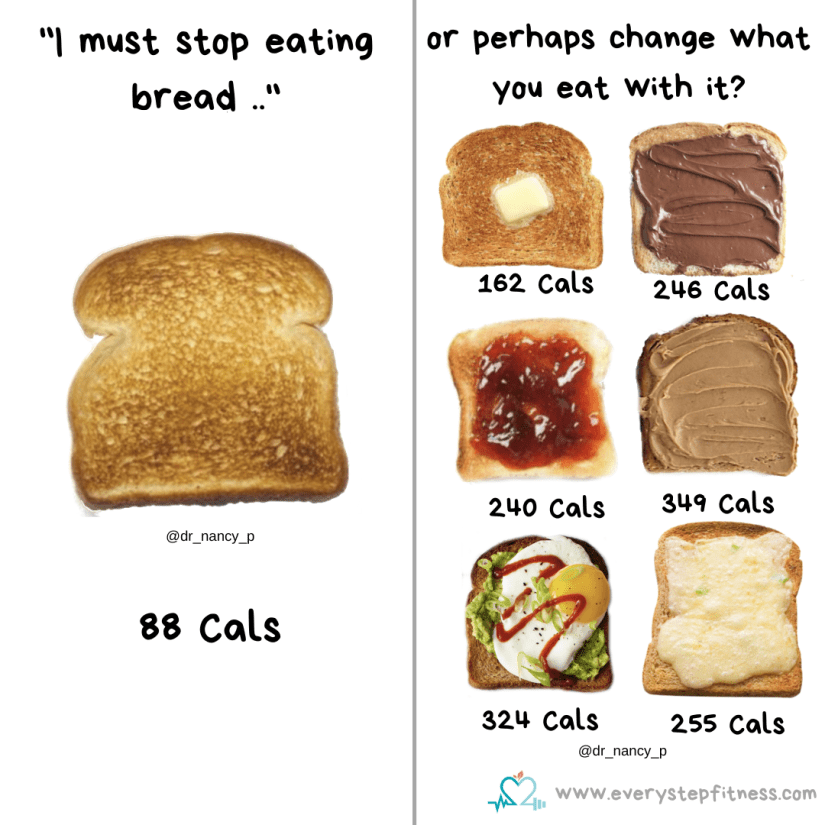
There seems to be a common misconception that bread is inherently bad and that having it means you can’t lose weight. Bread in itself (white or brown) is not that high in calories – a typical slice of hovis is 88 cals, and even a small sourdough is only 120 cals or so. Bread in itself is not a problem, what you put on it is the problem. The scraping of butter that you barely notice almost doubles the calories that slice of bread/toast will give you. Butter and 30g jam nearly triples the calories, as does a serving of Nutella (without butter underneath)! If you’re a peanut butter fan then that 40g serving (without any butter underneath) brings that piece of toast up to 349 cals. A snack of a little cheese on toast (no butter) is around 255 cals whilst a brunch of toast, 75g avocado, egg and a little ketchup comes in at 324 cals ….

Technically it is of course possible for bread to derail you if you’re eating a huge amount, like any food, but it’s far more likely to be what you’re putting on the bread that’s doing the damage. Bread isn’t the devil; in fact it’s a great source of carbs, which we all need. It tastes good and it’s also a really convenient food for a snack or lunch (as a sandwich) etc and there’s no need to cut it out of your diet to lose weight, but it may pay to be aware of what you’re putting on it and consider some lower cal toppings if you are trying to watch the calories.

Enjoy bread responsibly 🤣

🤗 xx