Tuesday Tip

Tuesday Tip: Sticking to your ‘diet’

Tuesday Tip: Sticking to your ‘diet’ 🥗

Diet (i.e food you are eating for your nutritional goals not a fad ‘diet’) adherence is the most important element of successful fat loss and long term maintenance. Here are some tips to help:

#1 Eat what you like

All diets can result in fat loss, if you have a calorie deficit. Increase the chances of sticking to it by choosing foods close to what you currently enjoy. Ideally that is a balanced diet containing a range of whole foods and the ‘treat’ foods you enjoy. If you like carbs don’t cut them out, if you hate kale don’t eat it etc!

#2 Be realistic

We often have unrealistic expectations of how long it will take to achieve results. A recent study found 50% people with unrealistic expectations of their goals dropped out within a year. You can still have a big goal, just realise it will take time to get there, so aim for small losses week by week.

#3 Environment

Set yourself up for success – don’t keep tasty, energy-dense foods in the house. If you must have them then keep them out of sight and out of their packaging. Packaging plays a huge role in food association; remove the trigger (packaging) and you remove the association, reducing the chances of you eating it. 

# 4 Track progress

People often give up because they feel like they’re not making progress. Take measurements, log the weights you’re lifting, measure steps, etc. (NB If you’re relying on bodyweight then take averages over time rather than focusing on individual weight fluctuations).

# 5 Identify your hungry times

Identify when you’re hungriest – morning? Night? Lunch? Eat more when your hunger is high and eat less (or don’t eat) when you’re not. Use hunger as your guide not time of day.

#6 Set a moderate deficit

The more aggressive the deficit, the harder it is to stick to. Start with a moderate deficit of 15-20 % below maintenance cals. Remember it’s your average calories that count; if you’re within your cals 4 days and over on 3 your deficit is gone. Focus on being under on average over the week (in practice it’s easier to just be within your calories daily but this isn’t always possible).

Happy Tuesday 🤗

Xx

Nutrition and Calorie Tips

‘Bad’ fries or ‘good’ nuts…

‘Bad’ fries or ‘good’ nuts… 🍟

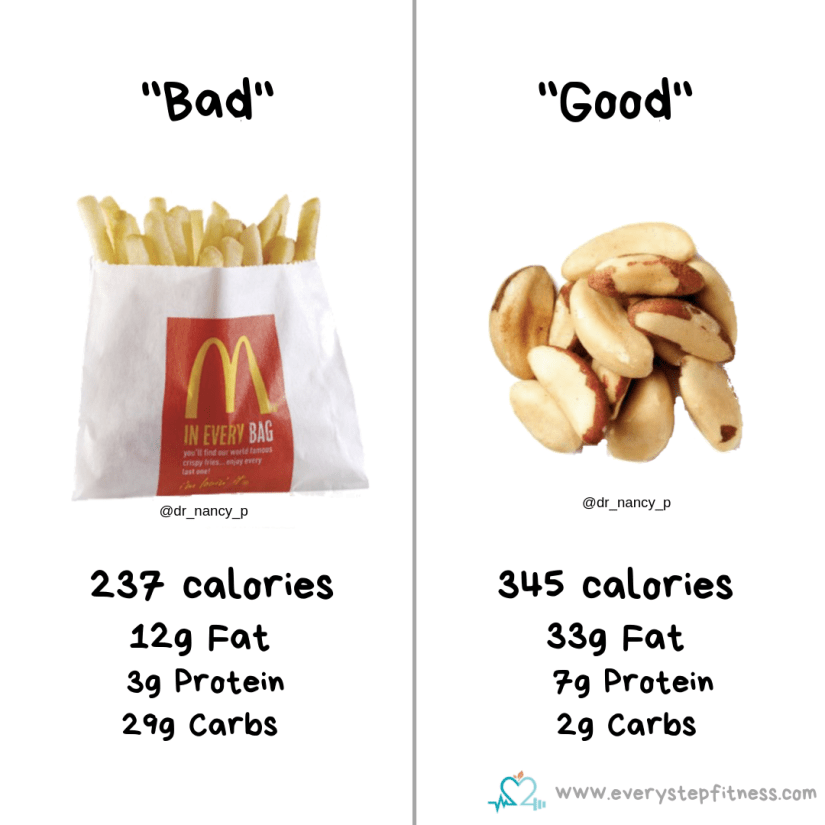
If you had snacked on a bag of small fries you would probably be feeling guilty that you’d chosen a ‘bad’ option. In contrast if you’d had 50g of Brazil nuts you would probably be polishing your halo for having such a ‘good’ snack.

Now before anyone jumps down my throat I am not suggesting Mcdonald’s fries are healthier than Brazil nuts. From a nutritional point of view the Brazil nuts are definitely a better choice. They’ve also been shown to reduce HDL cholesterol levels amongst other benefits. They contain heart-healthy fatty acids, such as polyunsaturated fats, and are rich in antioxidants, minerals, and fibre. They are the best source of the mineral selenium which is essential for the immune system, thyroid and cell function. They are calorie dense though.

McDonald’s fries on the other hand have no redeeming features other than the fact they may taste good. They’re not a nutrient dense food.

However they are lower calorie than the Brazil nuts.

So if your goal was fat loss and you decided to just replace those fries you have every Saturday afternoon with the Brazil nuts because they’re ‘good’ you’d actually be consuming more calories. Thereby not helping your goal.

Am I suggesting you should choose fries over Brazil nuts? No of course not! But if you enjoy occasional bags of fries then have them. If you like Brazil nuts then have them. But just educate yourself on the number of calories and consume them within your total calorie goal. Blindly choosing foods just because they’re perceived to be ‘good’ isn’t a sensible approach. No foods are inherently good or bad – they just have different costs and benefits. The Brazil nuts give you lots of great nutrients, the fries may help you stay on track and give you some pleasure – both are fine!

Enjoy 🤗xx

Nutrition and Calorie Tips

How weight loss actually works….

How weight loss actually works….

Most people measure their fat loss progress by stepping on the scales. The scale can create an all or nothing mentality and can impact not only your happiness but your behaviour. If the scales don’t go down when you’ve been ‘good’ then what’s the point? You may as well throw the towel in and enjoy that cake!

But scale weight isn’t a great measure of progress, mainly because it can’t differentiate between muscle, fat, water or anything else. It just measures the relationship your body mass has with gravity. Sometimes body composition can change without any weight change, e.g. if you gain additional muscle, lose bodyfat and improve hydration you could see minimal weight change. Fat and muscle weigh the same but 1kg of fat is approx 4 times larger than 1kg of muscle, meaning you could very well be smaller and heavier.

Your weight also fluctuates wildly every day. Between morning and afternoon your weight can fluctuate up to 6kg depending on what you eat and drink, and how you exercise. If you drink 2-3 litres of water a day that’s up to 3kg. Then how much do you pee, sweat and breathe out over the day? It’s impossible to measure. Our bodies are mainly water so changes in hydration cause significant weight fluctuations.

In addition a bowel full of food, fibrous or salty meals, and hormonal changes can all influence weight and cause greater daily fluctuations so real change can be hidden. For example, I weighed myself Saturday night, then first thing Sunday and again at 1pm – there was 2kg increase overnight, but a 3 kg loss during Sunday morning! I obviously didn’t put on 2kg overnight or lose 3kg of fat in 6 hours. Depending when I weighed could massively impact how I felt about myself and my progress.

We’re conditioned to focus on weight but instead try to use other measures e.g. items of clothing and how they fit, or cm measurements etc. If you really can’t help stepping on the scales then look at averages over time rather than individual daily variations and focus on trends the long term. 🤗 xx

Tuesday Tip

Tuesday Tip: Too Much Protein?

Tuesday Tip: Too Much Protein? 🍗

Protein is all the rage right now – pushes for its ability to aid weight loss, help keep you full, build muscle and added to pretty much everything in the supermarket now! But is it possible to eat too much?

Yes and no!

It’s important to get enough protein – not only is it essential for health (Amino acids in protein are the building blocks for your body), it’s also great at keeping you fuller for longer, but do we really need as much as it seems? The recommended amount is around 0.75g of protein per kg of bodyweight. So if you weigh 65kg you need around 49g a day – a chicken sandwich, porridge with milk, and a veggie chili will give you well over that easily.

Studies do show that higher amounts of protein keep you fuller for longer and there’s also evidence to suggest that higher intakes of protein can help preserve muscle mass when losing weight. If you’re trying to build

Muscle then higher protein is also important(1.2g to 1.6g per kilo).

But…. just because slightly more protein is good that doesn’t mean loads is better.

Studies have shown over 2g per kg brings very little benefit. There’s no way to store protein so any surplus is used for energy – which means of course if you’re consuming more calories than you expend you will store it as fat. Despite scaremongering about excess protein and kidney issues there is little evidence of this in healthy adults. There is evidence though that excess protein causes changes in gut bacteria and digestive issues.

It’s also worth considering what you’re cutting out in order to get extra protein in. If you’re swapping grains for protein you’ll be consuming less fibre which can lead to gut issues.

For the majority of people, exercising regularly and eating a balanced diet, you’ll be getting plenty of protein. So if you’re reaching for ‘protein’ laden snacks just because you think they’re better then don’t bother, have what you enjoy instead. If you’re adding protein powder to everything just for the sake of it – stop and think whether you really need to. Are you just adding extra calories for the sake of it? As always, balance is key! 🙌🏼

Happy Tuesday 🤗

Xx

Nutrition and Calorie Tips

Chicken is already high protein….

Chicken is already high protein…. 🍗

When it comes to snacking a high protein option can be a good choice – it helps to keep you fuller for longer and more satisfied. This in turn can mean you’re less likely to snack again later or over eat at your main meals and so can help with weight loss or management by helping you stick to your daily calorie goal.

As I’ve said before many brands capitalise on this by marketing their products based on their protein content.

This is a another great example of that marketing. The fridge raider slow roasted chicken bites are marketed as ‘powered by protein’ and yes they make a convenient snack. But they actually only have 12g of protein for 124 cals and are around 91% chicken.

Chicken on the other hand – which is readily available in pre cooked snack size packs – just like the fridge raiders, gives you 16.2g protein for only 79 cals and it’s basically just chicken (98%)! It’s also a lot cheaper too!

So if you’re looking for a meat based protein snack then just save the calories and money and buy some actual chicken!🤗xx