Nutrition and Calorie Tips

‘I’ve switched to dark chocolate because it’s healthier ’…..

‘I’ve switched to dark chocolate because it’s healthier ’….. 🍫

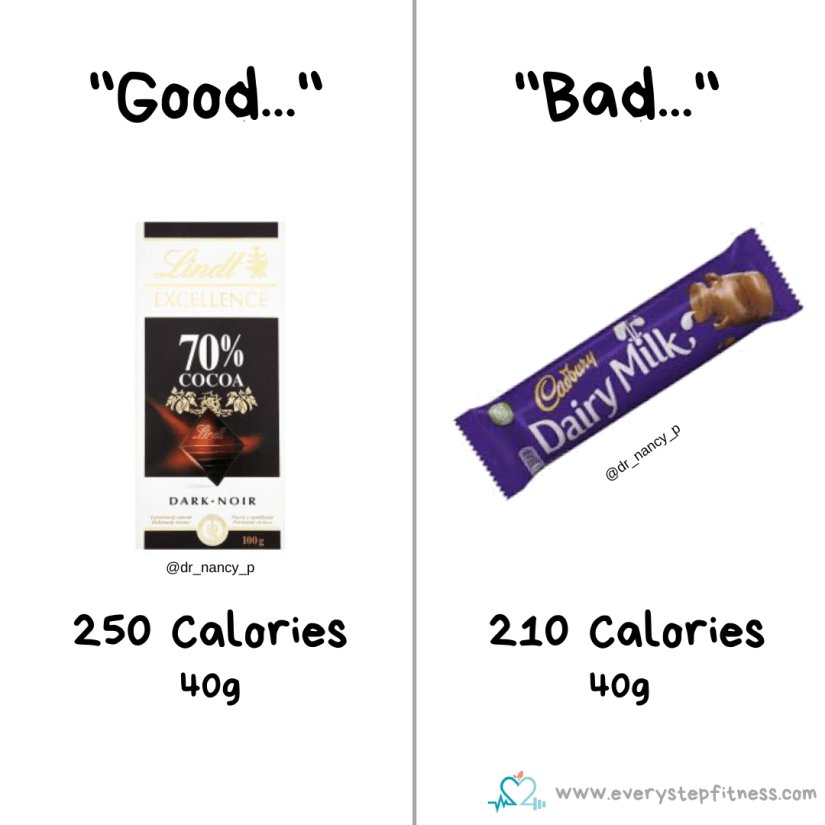
Dark chocolate is better than milk chocolate because it’s healthier right? So it must be better for weight loss right? Maybe not! There is some merit to choosing dark chocolate over other types in terms of some minor nutritional benefits. Dark chocolate provides more antioxidants, whilst tending to contain less sugar, but when it comes to calories you’re often taking on far more than you would have with a typical ‘unhealthy’ chocolate bar. And let’s be honest – even dark chocolate is still a treat so if that’s you’re main source of antioxidants then you probably need to rethink your diet.

Chocolate is not a ‘healthy’ food, but neither is it an ‘unhealthy’ food – it’s just a food to be enjoyed in moderation. As you can see the calories in dairy milk are actually lower than the same quantity of Lindt dark chocolate. So if you love dark chocolate – great! Have it. If you love milk chocolate – have it! If you’re trying to lose fat just ensure you factor it in to your calories and you’ll be fine. But if you’re tucking in to dark chocolate thinking it’s healthy and not even considering the calories it contains you may want to think again.

And if you’re eating it when you don’t like it just because it’s ‘healthy’ then don’t bother – if you want some chocolate have the type you want, in moderation as part of a balanced diet 🤗 🍫

Enjoy xx
Tuesday Tip

Tuesday Tip: Pre-workout coffee?

Tuesday Tip: Pre-workout coffee? ☕️

Coffee as a pre-workout is something that’s often recommended social media and fitness blogs but does it really help?

A recent study found that consuming even a small amount of caffeine before and during exercise can help people exercise almost a third longer. A study tested found that those who consumed caffeine whilst cycling were able to keep going for longer than those who drank water, delaying fatigue by up to 60%. The only drawback is that caffeine is also a diuretic, so it can cause dehydration. Other studies have however shown the dehydrating effect to be minimal and the consensus is that moderate consumption of caffeine is ok.

Other studies have shown that caffeine can trigger muscles to start using fat as an energy source, but this is only occurs when other energy sources are depleted. In endurance athletes for example, caffeine is used to get extra energy out of the body’s reserves during an event So in isolation it won’t magically burn body fat for you sadly.

Researchers have also found that caffeine can help reduce muscle pain. The study in The Journal of Pain found that caffeine (compared to a placebo) reduced thigh-muscle pain during exercise (which can mean being able to continue for longer) .

So overall caffeine does indeed enhance performance and makes it ‘easier’ to put in more effort during exercise. These effects are more noticeable during endurance exercise (over 90 mins). Caffeine also plays a role in helping contribute to clearer thinking and greater concentration. The effects are greater in those that rarely have caffeinated drinks as tolerance is built up, and the effect varies wildly from person to person.

So do you need to start necking an espresso before you workout? Probably not, but it could help on days when you need a little extra boost to get through your workout. However, caffeine can also have unwanted effects and its use can result in caffeine jitters, headaches, upset stomach or insomnia, and excessive consumption can have serious health risks, so best to use it only if you’re already a caffeine drinker.

Happy Tuesday 🤗

Xx

Nutrition and Calorie Tips

The real problem…

The real problem… ☕️ 🍪

When you’re trying to lose weight its often easier to fixate on the main meals, planning out breakfasts, lunches and dinners and focusing on them. That’s great and that will definitely help, but often that’s not actually where the issue lies.

An average breakfast of 250 – 350 cals, a lunch of 500 – 600 cals and a dinner of 600 – 700 cals gives you around 1,400 – 1650 cals per day. For most people this will be perfect for weight loss or maintenance (obviously it’s age, gender, height, weight, and activity dependant so this is just an example). But what about all the extras? Those things that you have every day without perhaps even realising it. The couple of cappuccinos (380 cals) you have throughout the day, and those biscuits you grab from the staff room (168 cals).. or maybe that smoothie you have to go with your lunch (it’s fruit right?) – that’s another 351 cals. Perhaps it’s the handful of “healthy” cashew nuts you grab in the afternoon (167 cals), or the mocha latte you treat yourself to as it’s been a tough day (455 cals)… or the chips you grab from the kid’s plate while they’re having their tea… (250 cals)… This little lot of extras racks up a whopping 1,771 cals! And you can easily see how it could happen without really noticing.

Now I’m definitely NOT saying you need to cut out all coffee, or biscuits, or not treat yourself to things BUT it’s definitely worth examining all these little extras when it comes to trying to create a calorie deficit. You’ll probably find that your main meals are actually fine and it’s some of the extras that are where the extra calories are coming in.

🤗

Xx

Tuesday Tip

Tuesday Tip: Do you need protein shakes?

Tuesday Tip: Do you need protein shakes? 🥤

Protein shakes – all the rage, essential gym kit eh? But are they really necessary?

Protein itself is essential, especially for maintaining and building muscle, so it helps with recovery and is also great at keeping you feeling full. But the reality is most people’s diet includes more than enough protein as it is. Average daily recommended intake is 55g for men and 45g for women’s (with heavy exercisers needing a bit more: 1.2 – 1.7g per kg body weight). It’s not hard to get that in your meals e.g. 1 egg: 6g, 1 chicken breast: 20g, 30g cheddar cheese: 7.5g, 1 serving cooked beef mince: 18g, 1/2 pot cottage cheese: 18g, 1 tin of tuna: 25g, 1 serving Greek yogurt: 18g etc. So it’s pretty easy for most people to eat the required amount, with no shakes or powders required.

In an ideal world, if trying to build muscle then you do want to get some protein in within 30 mins of a strenuous workout. So that could be a reason to grab a shake. But you could save some pennies and instead go for something simple like a glass of milk (dairy milk contains 8g protein, soya milk contains 7g), or one of the best post-workout recovery drinks – chocolate milk (perfect carbs: protein ratio).

Aside from saving money you will also be protecting your health. Recent research shows that too much protein in the diet can increase your risk of osteoporosis amongst other health issues. Plus if you’re already eating a good diet then all you’re doing is taking on extra calories you don’t need, which could stall your weight loss attempts. They’re also not ideal as a meal replacement unless you combine them with other ingredients. For example as an grab and go brekkie option they’re great when combined in a smoothie with banana, milk, etc to give you a range of nutrients and a good balance of carbs too (but Greek yoghurt also does the same!).

So if you’re eating a balanced diet, and working out at a normal level (i.e. not an Olympic athlete!), then don’t stress about protein shakes as they’re really not necessary at all! Save your pennies!

Happy Tuesday 🤗

Xx

Nutrition and Calorie Tips

Low calorie, sweet fix!

Low calorie, sweet fix! 🍪

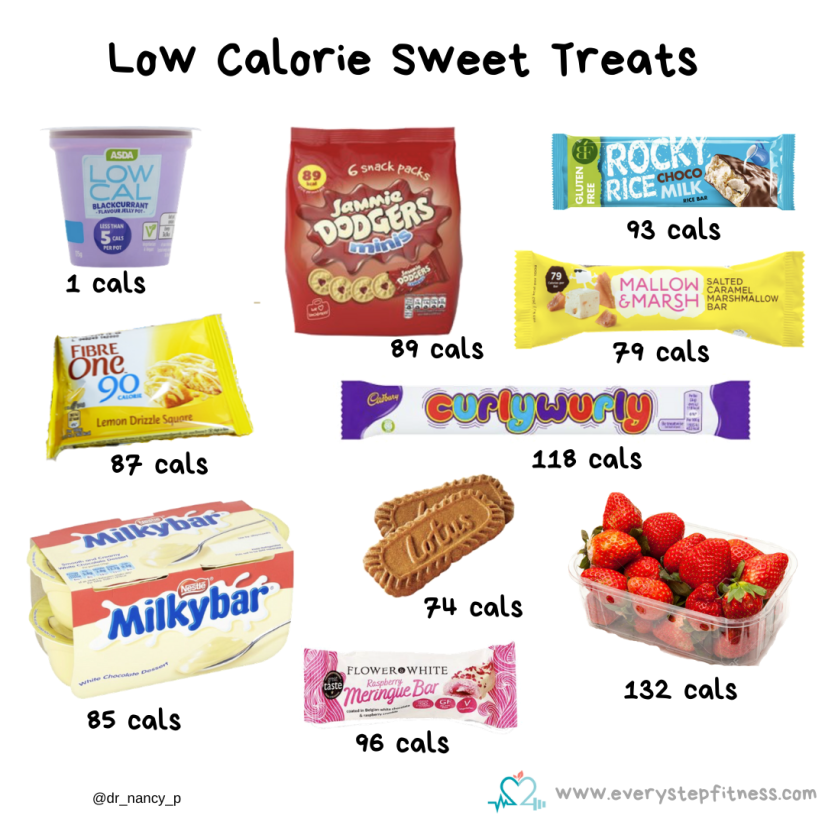
We all need a sweet fix from time to time. There’s nothing wrong with any sweet snack you choose to have, but if you’re trying to fit it into your daily calorie goal it can be handy to have some go to lower calorie options.

This is obviously a tiny drop in the ocean of sweet snack options but hopefully it provides a range of ideas, some of which you may not have thought of. These are particularly useful if you struggle to ‘just have one’ as they’re portioned already or in snack packs (and they’re low enough that you could have a couple!). If you’re gluten or dairy free the Rocky rice bars are well worth checking out – really tasty!

And before anyone starts talking about them being full of ‘sugar’ – yes many are but remember sugar isn’t the devil (and there is no evidence it causes health issues in moderation and in isolation). Sweet snacks and treats are absolutely fine as part of a balanced diet. If that chocolate bar or biscuit a day helps you stay on track and makes you happy keep doing it!

Asda low cal jelly pot – 1 cal

Mini Jammie dodger snack pack – 89 cals

Rocky Rice bar – 93 cals

Fibre one bad – 87 cals

Mallow and marsh bar – 79 cals

Curly wurly – 118 cals

Milkybar mousse – 85 cals

2 pack lotus biscuits – 74 cals per pack

Flower & white Meringue bar – 96 cals

Strawberries 400g – 132 cals

So there you go! A few options to try when you fancy something sweet but don’t want to spend too many calories! I’m sure you all have a few favourites too – let me know what your go to low cal snack options are below.

Enjoy 🤗

Xx