Tuesday Tip

Tuesday Tip: Meal frequency and weight loss

Tuesday Tip: Meal frequency and weight loss 🥘🥗

Following on from last week’s tip on fasting, there’s lots of confusion about meal frequency and weight loss: eat more often to lose weight, or eat less often to lose weight? Actually how much you eat matters more than how often you eat. If you want to lose fat the most important thing is to reduce your calorie intake.

The idea is that eating more small meals = faster metabolism = more weight loss? Sadly not – yes digestion increases metabolic rate BUT it depends on the amount of cals, not how often you eat. Eating 1400 cals in one meal or 3 small meals makes no difference. Studies have shown that when total cals are controlled eating more often makes no difference. What it might do though is affect your ability to stick to those calories!

So is skipping meals bad? Scientifically it’s not, it won’t suddenly cause you to enter starvation mode and magically store fat (though it can increase the risk of acid reflux). What it may do is make you hungrier later or cause you to snack more or make bad choices, it could also mean you have less energy so you are less active and burn fewer cals.

Consider eating less often if:

– many small meals doesn’t fit your lifestyle

– you don’t want to think about food all the time

– you have any digestive problems (longer breaks between meals gives your body a chance to digest)

– you enjoy larger portions

Consider eating more often if:

– you struggle not to snack and want to spread your cals over the day

– you’re trying to gain weight and can’t eat enough in one meal

– you have an active job and high cal demands

– you’re an athlete

– you feel “hangry” all the time

There’s no magic number of meals per day for weight loss. Trust yourself – if you like smaller meals more often then go for it, if not stick to 3 meals or whatever. Whichever you choose though stick to it as studies show that meal irregularity can have negative health impacts. So whether it’s 2, 3, or 6 meals a day that’s fine but don’t forget, regardless of how many meals you split it in to, it’s the total calories that matter!

Happy Tuesday 🤗

xx

Nutrition and Calorie Tips

But it’s full of sugar…

But it’s full of sugar… 🍦

Have you ever been told you shouldn’t be having (insert snack of choice) because it’s FULL of sugar? As if sugar is something that’s inherently bad?

The reality is there is nothing ‘bad’ about sugar. We need sugar – it’s a great source of easy energy and it also tastes great. Sugar is made up of two components, fructose and glucose. The molecular structure is the same no matter where they come from. Fruit contains fructose, glucose and also some sucrose (a combination of fructose and glucose). Sweets/ ice creams etc will tend to be higher in sucrose.

This is a great example – a Solero ice lolly is a perfect low calorie snack or dessert. In the case of the Solero you’re getting mostly just sugar (and a small amount of fat and protein), with an apple you’re getting the sugar, fibre, vitamins and minerals. The fibre slows digestion making it more filling (and good for your gut heath). This means you’re less likely to want to eat more later, and it’s better for your blood sugar levels. So objectively the apple is a better choice health-wise.

However, foods also provide other things – such as pleasure, convenience etc. So if you’re trying to watch your calories, and you really fancy an ice cream you’re better off just having them. Or if you want to swap a higher calorie dessert that you’d normally have for a Solero then thats a great choice! In terms of the impact on weight/fat loss there will be no difference as long as you stay within your daily calories and are aware they will be a less filling option. And in terms of sugar content the apple is actually higher.

I’m not suggesting the Solero is better for you than an apple, nor am I suggesting you avoid fruit in favour of ice creams lol! I’m just suggesting we recognise that no foods are ‘bad’, and that as part of a balanced, healthy diet you can have both! Sometimes the Solero will be what you need, sometimes the apple!

Enjoy 🤗

xx

Nutrition and Calorie Tips

‘It’s only a little sauce on the side – I don’t need to track that…’

‘It’s only a little sauce on the side – I don’t need to track that…’ 🤔

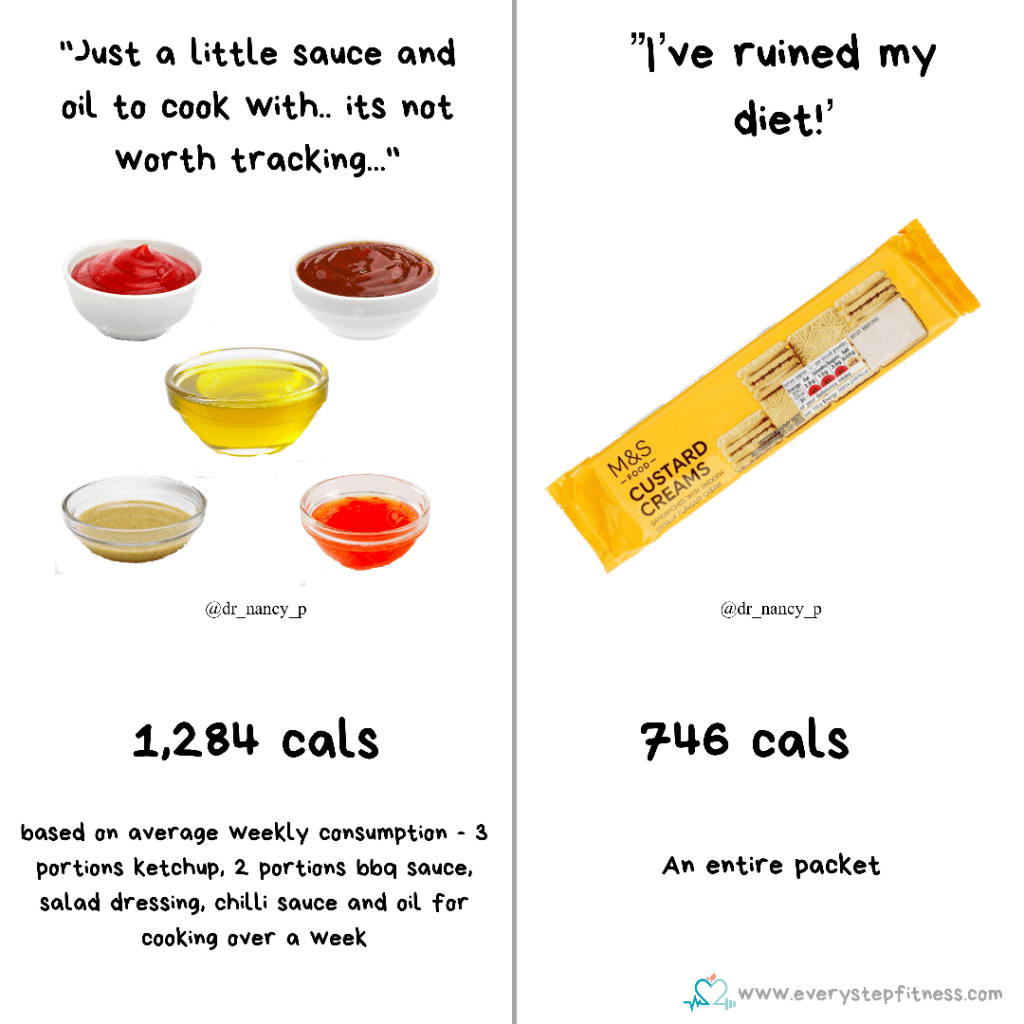
If you’re hoping to lose fat in a sustainable way you need to be aiming for a deficit of around 200-300 cals a day. Most people are pretty good at tracking the big stuff – the sandwich, the packet of crisps, the porridge for breakfast etc but how often do we overlook the little stuff. That little bit of ketchup on the side, that chilli sauce on your rice, that dash of oil in the pan…. And how often when you’re trying to lose fat do you deny yourself something you really want simply because you’re ‘on a diet’. Or how often do you feel like a failure because you’ve succumbed to the biscuits at coffee time?

A whole packet of custard creams comes in at around 746 cals – I guarantee most people would feel like they’d ‘ruined their diet’ if they polished off a packet. In fact many people might feel even a couple of custard creams are something they should avoid whilst on their ‘diet’ and yet we probably don’t even think twice about the 1,284 cals we might rack up in sauces and oil (and tbh that’s a conservative estimate on the oil!). In one week that’s your whole deficit gone and you may not even realise it.

I always tell my clients to track everything – right down to the oil they’re cooking with as that can be the difference. So if you’re tracking cals and hoping to lose fat make sure you include these, and if you’re just trying to cut some cals maybe they’re a good place to start being more mindful too?

Oh and if you fancy a custard cream

Or two – just factor it in to your calories and have it! 🤗

Remember – calories count! 🤗xx

Nutrition and Calorie Tips

Brown rice is healthier… or is it?

Brown rice is healthier… or is it? 🍚

Most people feel like they’re being healthier if they’re having brown rice rather than white. However is it actually that much better?

White grain products have just had the outer layer of the grain removed – in most cases this doesn’t remove that much in terms of nutrition. In terms of calories both products tend to be the similar, although sometimes the white version is actually lower in cals so if you’re tracking your intake then it can be a way to cut some cals. In this example you can see that the brown rice is actually over 40 cals more per 100g.

But what about fibre I hear you cry? Well as you can see, the fibre content is actually pretty similar between the two – there’s only 1g more per 100g in this particular brown rice. If you’re already having a balanced diet, which includes fruit, veg and other grains, then you’re better off simply choosing the one you prefer the taste of and not worrying too much about the fibre. If you’re trying to reduce calories then you may decide to go for white to save a few cals there!

🤗xx

Tuesday Tip

Tuesday Tip: Easy Calorie Cuts

Tuesday Tip: Easy Calorie Cuts 🥗

If you’re trying to lose weight or fat then the one thing you need is a calorie deficit. Whilst tracking your calories using an app is one way to achieve this there are also ways to help facilitate the deficit (with or without tracking).

#1 One cal oil spray – I’ve written about this before and it’s a no brainer. Swapping oil in cooking for a one cal oil spray saves hundreds of cals without compromising taste (and sprays come in a variety of oils too – olive, avocado, coconut, sunflower)

#2 Swap to diet drinks – a full sugar fizzy drink is around 140 cals per can, a diet one is close to zero. (See my previous posts on why diet drinks are perfectly safe to drink if you’re concerned on that score)

#3 Swap to sweetener –

If you have sugar in your hot drinks then consider a swap to a sweetener instead. (See my post on sweeteners if you’re concerned about using sweeteners )

#4 Make other swaps – swapping full fat yoghurt to low or zero fat, swapping spreads to low versions, ice cream to a lower cal version etc. Within the context of a balanced diet these swaps make an easy and safe calorie saving.

#5 Drink – drink water or zero calorie drinks before and during meals. This helps to hydrate you and keep you feeling fuller.

#6 Limit meals out – whilst it’s perfectly possible to plan ahead and stay within cals for occasional meals out it’s very hard to maintain a deficit if you’re eating out/getting take away a multiple times a week.

#7 Booze – limit the booze or swap for lower cal options eg slimline gin and tonic, low alcohol beer, champagne/ Prosecco etc

#8 Lean meat – choose leaner cuts of meat or swap eg bacon medallions instead of rashers, chicken breast instead of drumsticks, rump instead of ribeye steak etc

#9 up the veggies – load your meals with veg and salad. The extra fibre and volume helps to keep you full and adds additional micronutrients which is always good. It also reduces space on the plate for higher calorie options.

#10 Slow down – eat mindfully and slow down. Chew your food properly and avoid distractions when you eat. This gives time for the signals from the stomach saying you’re full to reach the brain and prevents over eating.

Happy Tuesday 🤗

xx