Nutrition and Calorie Tips

‘Too Much sugar….’

‘Too Much sugar….’🍬 🍎

Sugar – so often vilified as something to be avoided, something bad, the root of all our health problems… yet is it really?

The simple answer is no. We need sugar – it’s a great source of easy energy and it also tastes great. Sugar is made up of two components, fructose and glucose. The molecular structure is the same no matter where they come from. Fruit contains fructose, glucose and also some sucrose (a combination of fructose and glucose). Sweets will tend to be higher in sucrose.

Once digested the sugar from 40g of haribo has the same effect in terms of calories as the sugar from an apple. It’s not worse, and no better. There is a however a difference in how it’s metabolised – fructose is metabolised in the liver so doesn’t produce the same blood sugar high and insulin response – fruit is therefore a better choice in that respect.

In the case of the haribo you’re getting mostly just sugar (and a small amount of protein), with an apple you’re getting the sugar, fibre, vitamins and minerals. The fibre slows digestion making it more filling (and good for your gut heath). This means you’re less likely to want to eat more later, and it’s better for your blood sugar levels. So objectively the apple is a better choice health-wise.

However, foods also provide other things – such as pleasure, convenience etc. So if you’re trying to watch your calories, and you really fancy some sweets you’re better off just having them. If you’re rushing and need a quick burst of energy before a run you’re also better off going for sweets. In terms of the impact on weight/fat loss there will be no difference as long as you stay within your daily calories and are aware they will be a less filling option. And in terms of sugar content the apple is actually higher.

I’m not suggesting sweets are better than apples for you, nor that you swap all your fruit for haribo. I’m just suggesting we recognise that no foods are ‘bad’, and that as part of a balanced, healthy diet you can have both! Sometimes the haribo will be what you need, sometimes the apple!

Enjoy 🤗

Xx

Nutrition and Calorie Tips

‘Just a banana…’

‘Just a banana…’ 🍌

Bananas make a fab snack option or addition to your breakfast or lunch. They’re full of carbs for energy and a reasonable amount of fibre and are a great source of potassium. They’re also easily portable and have their own in build packaging so are handy for when you’re on the go.

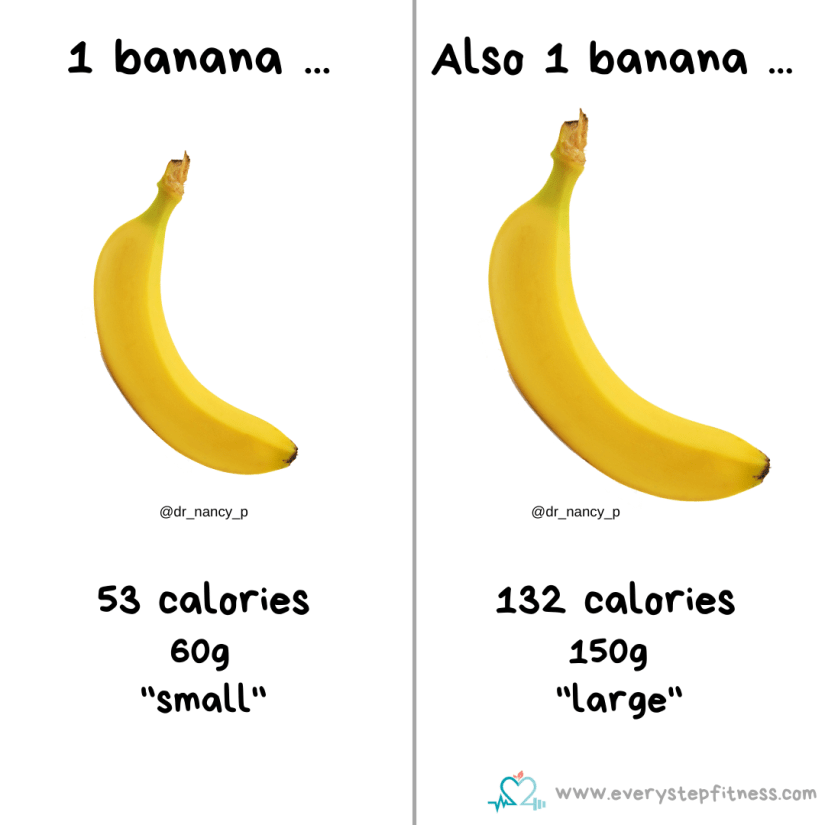
However, if you are trying to lose fat/weight and watching those cals then it’s worth just being aware that bananas can pack a punch when it comes to calories and they also vary wildly. If you’re using a calorie tracking app you’ll often find entries like ‘one small banana’ or ‘one medium banana’ with the associated calories. You’d probably just enter that and assume you were pretty much right. But how small is small? What exactly is ‘medium’? Small to me may be medium to someone else and the calorie differences are pretty large!

The difference between these two bananas is nearly 100g and both are sold as ‘bananas’ – not small or large. So if you were regularly snacking on the larger one you’d be taking in almost 80 extra calories every time. That may not sound like much but over the course of a week or month that will add up. I’m not suggesting you stop having bananas – they’re fab! But just have a go at weighing the next banana you have and see exactly how many calories it does contain.

Knowledge is power right? And if you’re trying to lower that bodyfat then every calorie counts! The more aware you are of what goes in to your mouth the better!

Enjoy 🤗

Xx

Nutrition and Calorie Tips

The ‘health’ halo effect ….

The ‘health’ halo effect 😇….

The “health halo” effect is something we all fall prey to. It’s the perception that certain foods are better for you than others due to their perceived health benefits. Usually terms like “organic”, “plant based”, “high protein”, “contains one of your five a day” are used on the packaging and there’s an assumption that this means they’re the best choice.

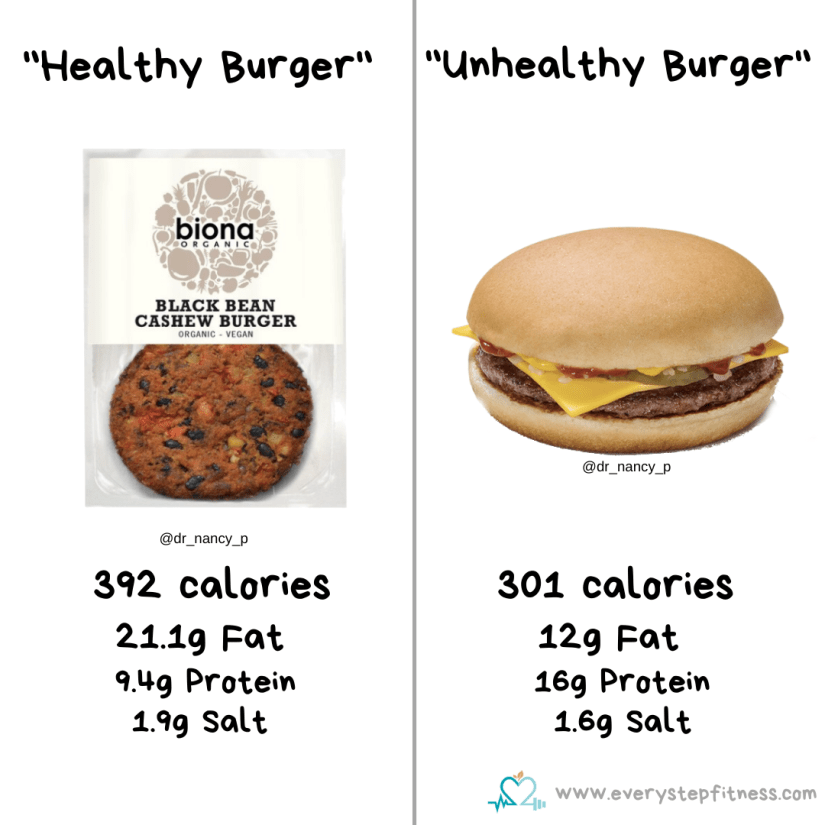
Now before anyone reacts – I’m not suggesting a Mcdonalds cheeseburger is a “healthy” option, nor am I suggesting it’s got more health benefits than the Biona Black bean and cashew burger. They’re both very different nutritionally, and they both taste very different too. But for many people trying to lose fat or weight they might naturally assume that instead of having a cheeseburger for lunch, they’d be better off having the Biona burger. However in actual fact that “healthy” burger has more calories and fat than the cheeseburger, and less protein. The cheeseburger is also lower in salt. The Biona burger doesn’t include the bun and other extras (including cheese) either so you’d be looking at perhaps another 300 or more calories on top (and the associated extra fat and salt).

So if you needed a quick lunch, and really fancied a cheeseburger, you’d be far better off just having one. I’m certainly not suggesting your whole diet be made up of “junk food”, but it’s important to be wary of these marketing ploys which make you perceive things as being “healthy” and therefore lower calorie and helpful for weight loss. At the end of the day, as always, it comes down to calories. If you want to lose fat or weight, then you need to be at a calorie deficit. And it’s important to still have foods you enjoy as part of an overall balanced diet. So have the cheeseburger for lunch if you want it, and then have a dinner with a range of whole foods and vegetables etc.

Be curious about what you’re putting in your body, look at the nutritional labels on food and don’t always assume the branded “health” food is the best choice.

🤗

Xx

Nutrition and Calorie Tips

‘It’s not worth recording…..’

‘It’s not worth recording…..’ ☕️

If you’re trying to lose fat and are working on reducing calories then you’re probably going to be recording your cals somehow. But are you really recording everything? It’s very easy to overlook some things because they seem so insignificant.

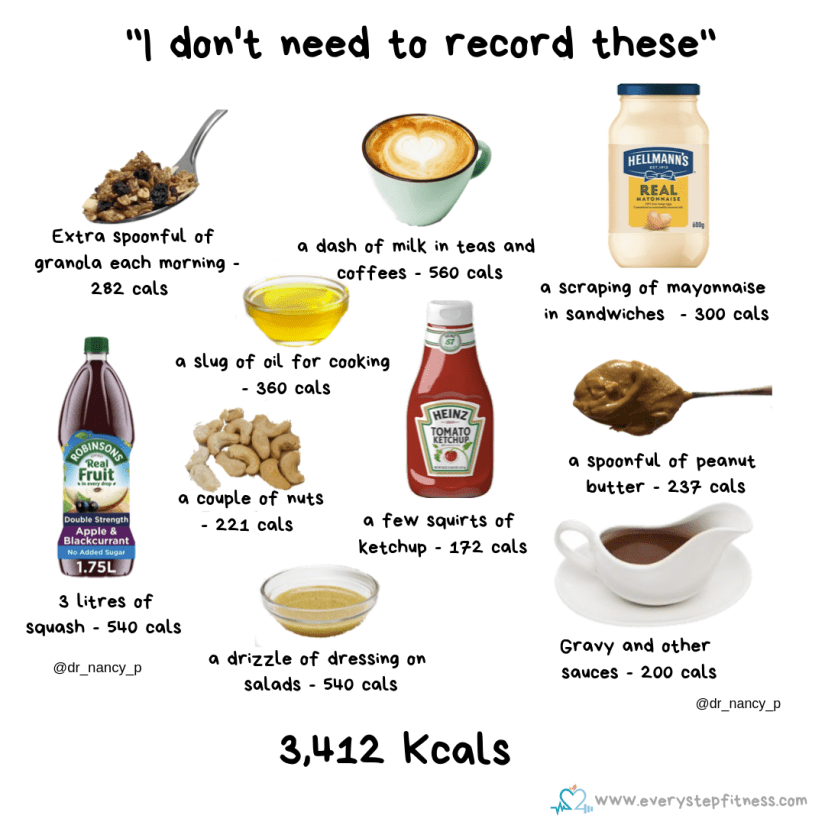
This is just an example of an average week for many people and where extra calories can sneak in. An extra spoonful of granola with brekkie every day (282 cals), a dash of milk in your tea or coffee (assuming 2 cups a day – 560 cals), a scraping of mayonnaise on your lunchtime sandwich (3 times a week – 300 cals), a slug of oil for cooking (3 meals – 360 cals), a sneaky spoonful of peanut butter because you’re hungry (237 cals), low sugar squash (a mere 18 cals for 100ml, but 3 litres of squash over the week – 540 cals), a few cashew nuts in the afternoon (a few every day – 221 cals), a squirt of ketchup with meals (5 meals – 172 cals), a drizzle of dressing on salads (3 salads – 540 cals), and finally gravy or similar sauces on your Sunday Roast (200 cals)…. That little lot totals 3, 412 cals over the course of a week. And let’s be honest for many of us we probably have even more of some of these….

But hey, they’re not worth recording right? Wrong! A sensible calorie deficit for fat loss is around 200 – 300 cals per day. With this little lot you’ve wiped out your weekly deficit without even noticing. All these little extras sneak in without really affecting how full we feel and without us noticing but they can really add up.

So if you are trying to lose fat, or your fat (weight) loss has stalled perhaps go back to basics and double check where some little extras could be coming in? And be a bit more mindful of these, or simply record them and have them within your daily calories. 🤗

Xx

Nutrition and Calorie Tips

‘The reduced sugar myth….’

‘The reduced sugar myth….’ 🍫

Sugar is often vilified as the cause of all health issues and as a result many companies have latched on to the idea that people are keen to reduce their sugar consumption. Now whilst sugar in excess amounts is undoubtedly not good (no nutrient in excess is) normal amounts of sugar in the diet are absolutely fine. However if you’re diabetic or trying to reduce your reliance on sugary snacks then it may be sensible to opt for some lower sugar options.

If you’re trying to lose weight (fat) then you may also decide to reduce sugar consumption. Many people equate lower sugar to mean lower calorie and would therefore go for the reduced sugar option in the belief that it would help them lose weight. In this example the actual difference is pretty insignificant.

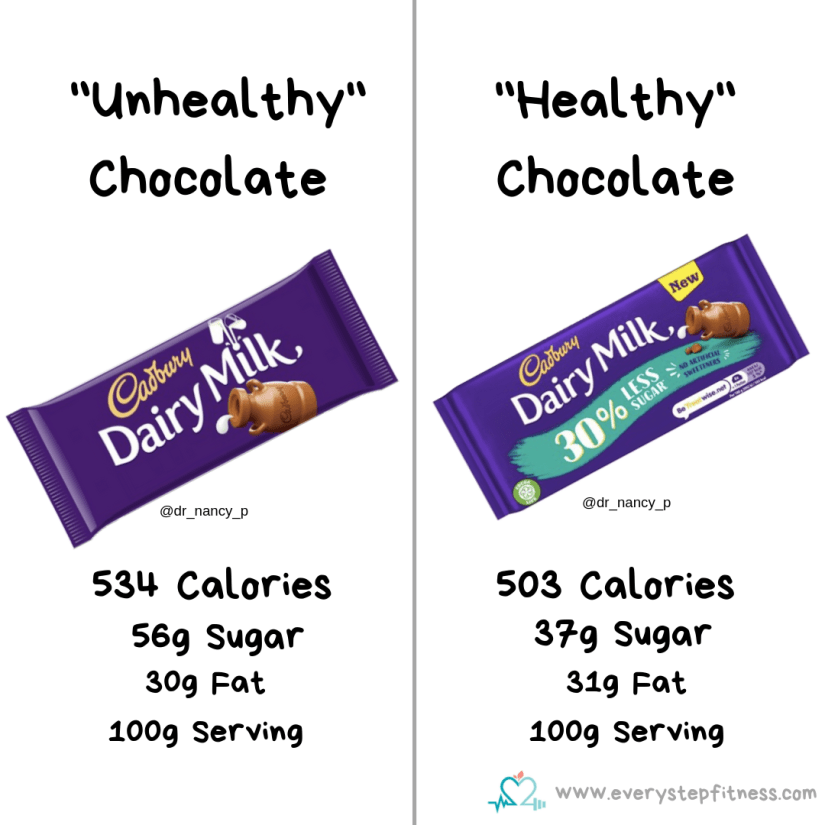
A standard Cadbury Dairy Milk contains 534 cals per 100g, whilst the reduced sugar version contains 503 cals – a reduction of 31, which is unlikely to result in weight loss. Yes, every little bit counts, but the expectation would probably be that it was much lower and therefore you may eat a larger portion, or expect bigger fat losses from this small change.

Cadbury’s are undoubtedly aware of this as they’ve made their standard bar size for the reduced sugar option a smaller size – 85g rather than the usual 110g of a normal dairy milk. So at first glance you’d assume it was a lower calorie option. It’s not really – it’s just a smaller bar! Clever eh?

So if you’re trying to reduce your calories and are going for the reduced sugar versions of things you love just take some time to check the calories and portion sizes and see if there really is a difference. If you enjoy the reduced sugar option and it helps to keep you on track then go for it! But don’t pay more for a marketing ploy when you don’t need to. Enjoy the chocolate you like, in moderation, as part of a balanced diet 🤗

Xx