Nutrition and Calorie Tips

Tuesday Tip: Hunger Management

Tuesday Tip: Hunger Management 😝

Hunger management plays a crucial role in successful weight loss. People often over restrict and starve themselves which, whilst obviously may work temporarily , usually leads to cravings, binge eating, and hunger. All of which derail progress and of course make it unsustainable.

With a sustainable calorie deficit there will still be some mild hunger. This isn’t a cause for concern and it’s to be expected but it’s helpful to have some strategies to help manage this so you can stay on track. Essentially it comes down to making food choices which maximise feelings of fullness whilst minimising calories. Remember total calories still count when it comes to weight loss so these are all within that context.

Here are a few things that can help:

#1 Higher protein intake may lead to improved feelings of satiety and less cravings. But, if you already eat a high-protein diet (1.6g/kg+) then it won’t make much difference. Also be aware that prioritising protein too much may lead to to eating fewer carbs which you also need and can mean you end up low on energy and more hungry. So don’t remove carbs either!

#2 High fibre foods help by bulking food volume, slowing digestive time and increasing gut fermentation – all

Of which lead to feelings of fullness. Low energy dense high fibre foods like fruit and veg are a great option.

#3 Fats can help with feelings of fullness (especially when combined with protein) but

they may not be the best option for

hunger management, especially if you

have a tight calorie budget. Fat provides more then double the energy of carbs / protein so it easy to eat more cals with a smaller serving of a high-fat food, compared to a high-carb food

# 4 Go for high volume foods or combinations of foods. If you’re having a lower calorie snack bulk it out with things like fruit or veggies, or a zero cal drink (water or soft drink) to help.

#5 include whole , unrefined carbs as they aid in satiety, muscle recovery and training performance /energy levels (and they’re tasty!)

#6 Our beliefs and perceptions impact feelings of fullness. Perceptions of what a ‘normal’ portion size is impacts whether we feel full after eating it. Equally our beliefs about certain foods have the same effect e.g. if you believe a protein in bar is more filling it will feel that way. Increasing knowledge around calorie content can help with this.

Happy Tuesday 🤗

Xx

Nutrition and Calorie Tips

Not all burgers are created equal…

Not all burgers are created equal… 🍔

Often when tracking calories it’s easy to underestimate. Very often this isn’t deliberate or even conscious – we either try to estimate based on other known meal items or we search for a similar meal on the database and use that. There’s a subconscious desire to make the calories fit too and a natural tendency to err on the lower side. This has been proven in multiple studies.

In this example if you’d been out at an independent pub (without calories on the menu) and chose the cheeseburger and fries you might realise that the calories will be high. You’d possibly look up some other similar meal items and then assume it would be close. If you for example looked up the McDonald’s version you’d see that a cheeseburger and large fries is around 742 calories. Most people would realise that a pub style burger is likely to be more (the burger itself is usually bigger and of better quality etc) so in my experience with my own clients people estimate around 950-1000 calories.

However as you can see an average pub cheeseburger and fries actually comes in at over 1600 cals and can be as much as 1850 calories with sauces etc. That’s a huge difference and a very substantial amount of calories for one meal. To put it into perspective – one McDonald’s cheeseburger is 298 cals – so that’s the equivalent of eating five and a half of them in one sitting! You’d never do that would you? So why is it ok to eat that 1642 calorie meal?

Obviously if you want to spend your calories on that as a meal then that’s absolutely fine – it’s your choice, and your body. There’s no need to feel guilty but just do so knowingly rather than kidding yourself that you’ve had 1000 calories. Remember knowledge is power!

🤗

xx

Nutrition and Calorie Tips

Things you think cause cellulite…

Things you think cause cellulite… 😏

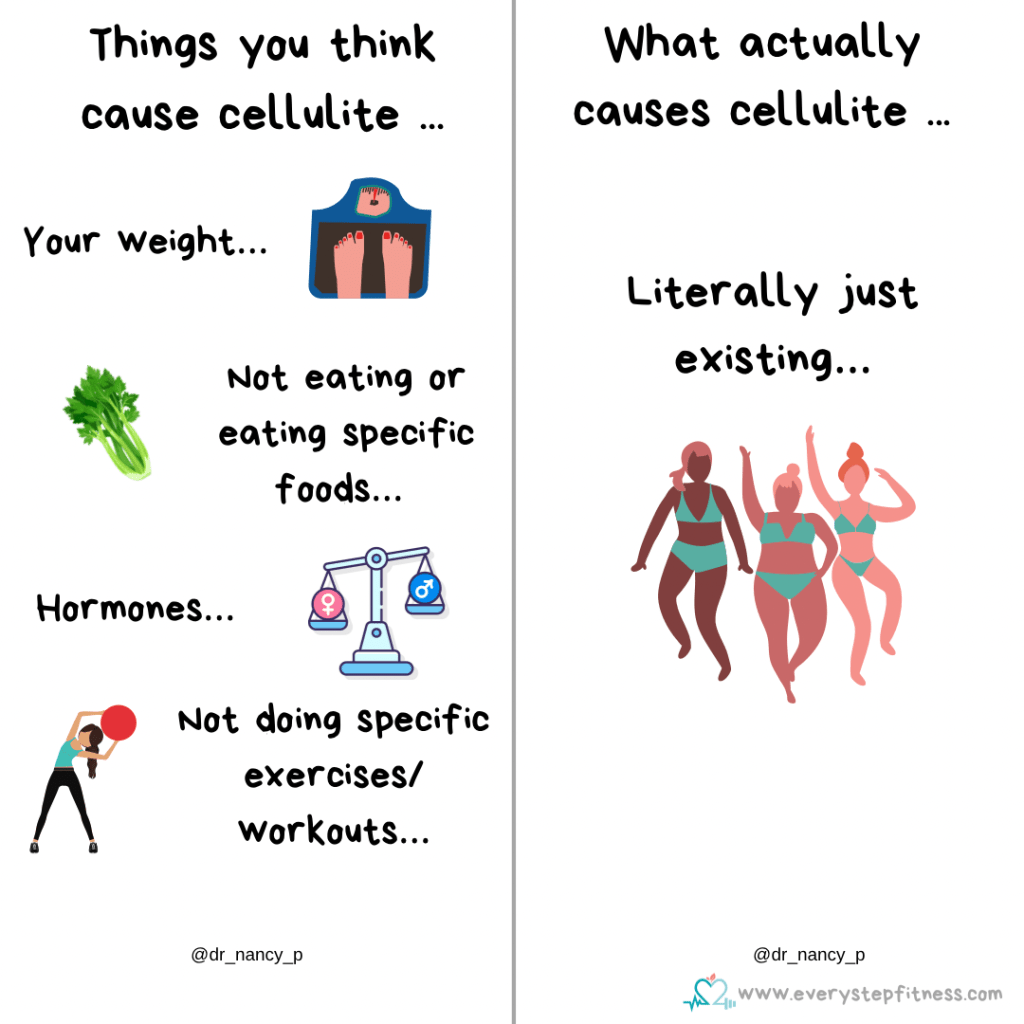
Cellulite, that dimpled, lumpy appearance of the skin, is something over 90% women (and 10% men) suffer from. There are loads of myths out there about what causes it and usually there’s some ‘solution’ they’re selling which can ‘fix’ the problem. There are loads of products and promises out there that claim to reduce cellulite – but what actually causes it and what actually works?

People will have you believe that cellulite is a result of you being heavier than you should be, of eating the ‘wrong’ foods, or not doing the ‘right’ exercises, or a result of hormones and therefore something that you can address. Well the reality is the main cause of cellulite…. is literally just existing (and particularly being female – though men also have it)!

The most important thing to note is that cellulite is normal, it can affect anyone, at any age, weight and fitness. It’s caused by fibrous connective tissue pulling on the fascia beneath the skin causing a dimpled appearance. It’s more prevalent in women because male connective tissue is more tightly interwoven. Women’s higher oestrogen levels also cause fat cells to respond differently, and as we age cellulite increases. It has a strong genetic component and some people are more prone to it than others.

Now whilst it is true that if your bodyfat is high then you may have more prominent and prevalent cellulite, (so fat loss via a calorie deficit may reduce it) but as it’s about the structure of the fat deposits you can’t completely get rid of it, unless you reduce your bodyfat to dangerous levels. You also can’t exercise it away. A good diet, good sleep, and regular exercise are all great for your health but won’t reduce the appearance of cellulite. There is also zero evidence that any specific foods either increase or reduce cellulite. Though studies have shown that if you smoke then giving up can help as the chemicals reduce blood flow, weaken and disrupt collagen formation meaning fat shows through more.

There is zero evidence that any of the so called ‘cellulite’ reducing creams, gels, laser treatments, detoxes, supplements, funky workouts or foods have any significant effect. Any effects are temporary at best and ‘work’ by tightening the top layer of skin but the effects wear off after a few hours. There are surgical options that claim to reduce it but none give permanent results, most are very expensive and involve cutting the fibrous tissue to reduce the appearance.

We all have cellulite – I have it, I’ve had it since my teens, and I had it at my lowest and highest bodyfat. It’s a fact of life so don’t waste energy or money trying to get rid of it. Focus on eating a healthy, balanced diet and doing exercise you enjoy to keep yourself fit and healthy.

🤗 xx

Nutrition and Calorie Tips

Craving chocolate …

Craving chocolate … 🍫

We all have cravings for certain foods or drinks at certain times. It may be for chocolate, biscuits, cheese, toast, wine – etc, whatever it is it’s usually perceived as a “bad” food.

If you’re trying to lose fat/weight then when a chocolate craving hits you may avoid it at all costs. Why? because it’s “bad”. It’s not a snack packed with protein or fats, or vitamins or all those things we know we should be eating. It’s full of sugar (omg!) so it is definitely evil and must be avoided at all costs…..So you avoid it and have some fruit and a yoghurt (because they’re ‘good’)… but that doesn’t really cut it…. So then you have a nakd bar (fruit and nuts so that’s ‘good’ too!)… but you’re still craving chocolate… so you end up eating the chocolate anyway. None of those snacks are an issue and in fact they’re all delicious but you didn’t want them – you wanted chocolate… and now you’ve ended up eating almost 600 calories.

Instead, if you are craving chocolate then just have it! You don’t need to earn it. You don’t need to justify it. Not every item of food you eat needs to be packed with vitamins, protein etc. If you have a balanced diet overall then it’s absolutely fine to have some foods in your diet that aren’t nutritionally great but that give you pleasure!

Funnily enough, the more you label foods as ‘bad’ and try to avoid these foods, the more power and the more the craving you’ll have for them. When you enjoy the foods you crave or want to eat without guilt, they begin to lose their power over you and your urge to overeat them diminishes. Over time, you’re able to eat anything, without eating everything.

Chances are that in most cases if you enjoy that chocolate for your snack, factor it into your day’s calories, then you won’t feel the need to inhale a giant bar later that day or eat loads of other things you didn’t actually want. So rather than creating rules about foods that are good or bad, try to view all foods as things you can have – in moderation.

Enjoy 🤗

Xx

Nutrition and Calorie Tips

Carbs make you fat….

Carbs make you fat…. 🥔 🍞

I actually lose count of the number of times people tell me it’s carbs that are making them fat, or stopping them losing weight, or that they just need to cut carbs and they’ll lose weight….

The rhetoric is usually something along the lines of – to lose fat/weight you need to cut or reduce carbs and focus on more protein and fat based foods (nuts are a prime example). Many new clients I meet have either tried eliminating carbs from their diet or that they intend to, by which they usually mean cutting out potatoes, bread, pasta etc. Many social media ‘experts’ have suggested that carbs are ‘bad’ and to be avoided – but this is based on very little actual evidence. In fact many studies have supported the fact that eliminating carbs has no significant impact when it comes to weight loss – it’s the total calories that have the impact.

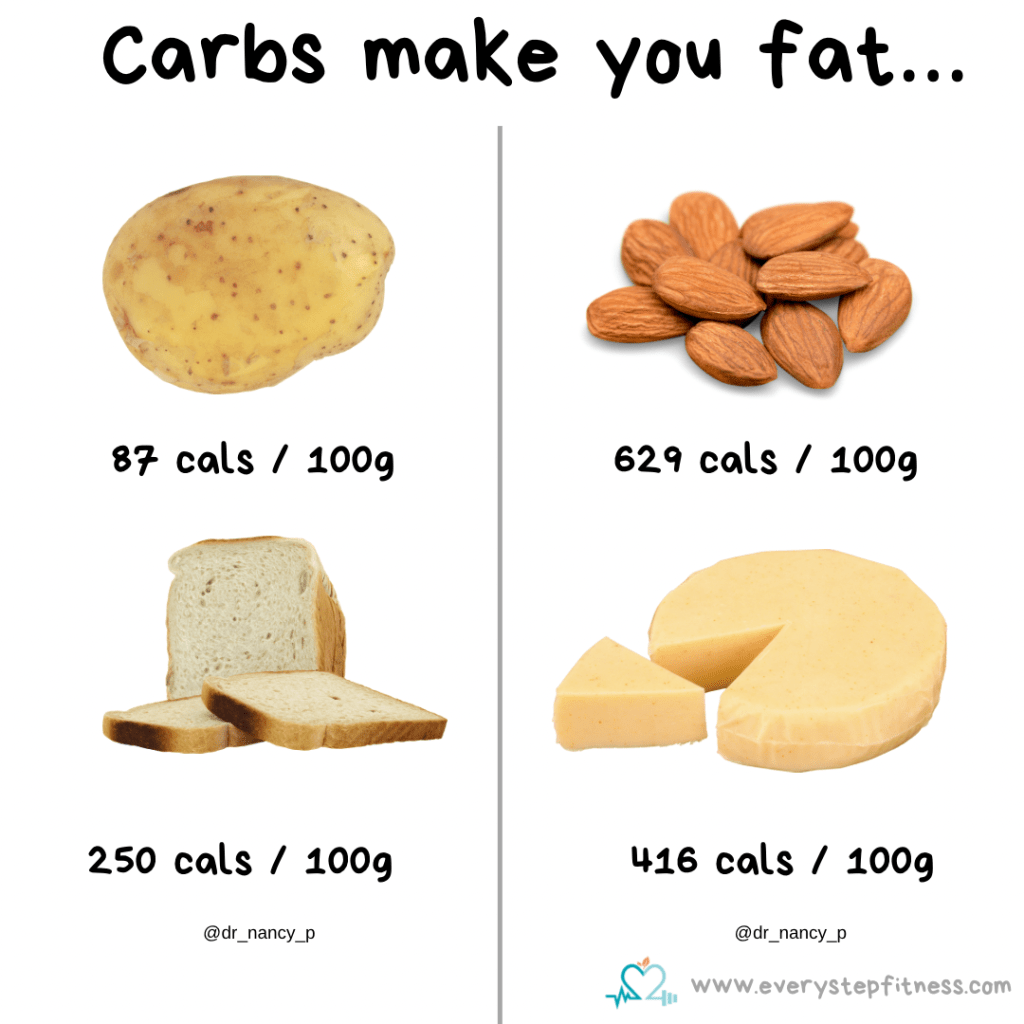
No food or macro is inherently fattening. It all comes down to calories. Carbs do not make you fat – as you can see in this example – those high carb foods are actually far lower in calories per 100g than those high fat foods. Now eating fat-heavy foods won’t make you fat either – but this just illustrates the point re carbs quite nicely.

From a fat loss standpoint, fats are more calorie dense than carbs or protein. Fats contain 9 calories per gram, carbs contain 4 calories per gram and so does protein. Therefore, fat as a macronutrient is more than TWICE the amount of calories compared to carbohydrates or protein. This doesn’t mean fat is ‘bad’ it just means foods that are high in fat are also high in calories, so be mindful mindful of your portions! Often it’s what you’re putting on the carbs that make them higher in calorie – like cheese, butter, nut butter etc.

You CAN eat carbs and still lose weight when you are able to achieve a energy deficit. So stop believing that carbs are responsible for your weight gain. They’re not – whether intentional or not you were just eating more calories than you needed.

🤗

Xx