Tuesday Tip

Tuesday Tip: Protein isn’t magic

Tuesday Tip: Protein isn’t magic 🔮

I talked about carbs last week – the devil food 😉 so now I thought I’d touch on the supposed super star – protein. Eat more protein and you’ll lose weight – right? That’s the rhetoric out there isn’t it? Well I’m sorry but protein isn’t magic – I wish it was, but it just isn’t!

The idea that eating more protein will magically alter the laws of thermodynamics and make you lose weight regardless of how much you eat is just silly. There is a basic law of physics at play here – to lower fat content of the body (i.e. to lose weight), you have to reduce the calories consumed, or increase the calories burned – where these calories come from makes no actual difference. In fact it’s been clearly disproved in many studies. In one study from Columbia University they fed participants liquid meals of fixed calories, some with vastly more protein, some with more carbs, some with more fat – but all contained the exact calories required for the participants to maintain their weight. Guess what – they all maintained their weight… even those eating more protein…

Now that’s not to say protein isn’t super important and a useful factor to consider though. There’s no denying that higher protein foods tend to keep you fuller and more satisfied for longer (especially when combined with fats), and as I’ve mentioned before there is a small increase in the calories used to digest protein (very small and not enough to really influence overall weight loss), it’s also full of vital amino acids for muscle repair and building. If you’re a body builder and looking to put on large quantities of muscle in a short time then yes def prioritise protein (but you’ll be over eating anyway as your goal is muscle gain… not weight loss). If you struggle to stick to your calories because you’re always hungry then yes definitely consider upping your protein and fats a bit in your meals – but not at the complete sacrifice of carbs (otherwise you will crash and burn).

So there it is – yes protein is great, but no it isn’t magic! So no need to fret over it too much!

Happy Tuesday 🤗xx
Tuesday Tip

Tuesday Tip: Low carb diets aren’t magic

Tuesday Tip: Low carb diets aren’t magic 🌟

Low carb (or keto) diets are ALL the rage, and for some people they do seem to work, but not because they magically make you burn fat. Here’s what actually happens

#1 A reduced carb intake leads to almost immediate loss of water weight, hence sudden drops in weight at the start. It’s not fat. It will come back once you eat carbs again.

#2 They involve eating more protein, which is important for hunger control. So you’ll feel fuller and eat less overall, and be in calorie deficit. Calories, not carbs, dictate fat loss and gain.

#3 Protein also has the highest thermic effect of any nutrient (i.e. takes the most cals to metabolise). So you’ll be burning very slightly more cals each day, contributing to the deficit.

#4 These diets also mean more fruit and veggies. These are high in fibre and water making you feel fuller, slowing digestion and less likely to eat as much. They’re also high carb but everyone forgets that lol!

#5 More fats are also consumed, another key for staying fuller for longer and slowing digestion. So once again you’re far more likely eat less.

#6 They revolve around reducing the amount of carbs; the biggest portion of people’s diets. AND most calorie dense junk foods are carb-based so you’d be cutting those out. When you remove a food group you’re removing calories too, so you end up in a deficit.

SO how do these diets work? By getting you to do things that lead to consuming fewer calories, whilst telling you it’s nothing to do with calories and all about magic low carbs!

Does this mean you should do it? If it works for you then sure! Do I think it’s sustainable? Nope. Avoidance of food groups creates a poor relationship with food leading to binges or blow outs. It can also lead to fatigue, health risks, regaining water weight when you go back to carbs, etc and of course it will only work if you have a high refined carb-based diet anyway.

My advice is everything in moderation. We need carbs as much as we need protein and fat. If you want a long term sustainable diet then just focus on reducing overall calories by whatever means works for your lifestyle.

Happy Tuesday 🤗

Xx

Tuesday Tip

Tuesday Tip: Good Egg, Bad Egg?

Tuesday Tip: Good Egg, Bad Egg? 🍳

A recent study suggested that eating eggs (specifically yolks) was linked to a 14% increase in early death (due to raised cholesterol primarily). High levels of LDL cholesterol long term are the strongest risk factor from a blood lipid point of view for cardiovascular disease (whilst HDL cholesterol is considered “good” cholesterol so high levels are not such a problem).

Although increasing dietary cholesterol can impact LDL levels, it’s worth noting that the overall impact is minimal. You would need to have extremely high levels in your diet, doubling the typical “western” diet levels to have even a minor effect. In comparison the effect of high levels of saturated fats is much more significant. And in fact it’s really the ratio of saturated to polyunsaturated fatty acids in the diets that are more important.

So what does this mean? Saturated fats are more closely linked to increased risk of disease and death than dietary cholesterol itself. Try to swap out some saturated fats (e.g. butter, chocolate, cakes, pastries, deep fried foods and fatty cuts of meat) whilst increasing polyunsaturated and monounsaturated fats like extra virgin olive oils, almonds, walnuts, macadamia nuts and oily fish.

It’s also wise to increase fibre levels which helps decrease cholesterol levels via essentially grabbing onto bile in your digestive tract, preventing it being reabsorbed and recycled into cholesterol in your liver.

So what about eggs? Eggs get targeted due to their cholesterol content. However they are low in saturated fat and therefore their impact is clinically insignificant. They are instead an excellent source of protein, omega-3’s, vits A,B,E, D and zinc, phosphorus and potassium. This means we can safely consume eggs without risk of cardiovascular disease or death increasing.

Happy Tuesday 🤗xx

Nutrition and Calorie Tips

I don’t have time to track my calories….

I don’t have time to track my calories…. 🍏

People are desperate to lose fat/weight but often say they just don’t have time to track what they eat. Now whilst it’s perfectly possible to lose weight without tracking calories, there’s no denying that accurately tracking them is an extremely effective way to do it. And in addition is gives you an excellent foundation of knowledge for maintaining any results you achieve.

I completely understand that it can be really stressful trying to balance work, social life, childcare or caring for other family members etc and perhaps even more so right now with home schooling/home working, but I am not sure the excuse of “no time” always rings true.

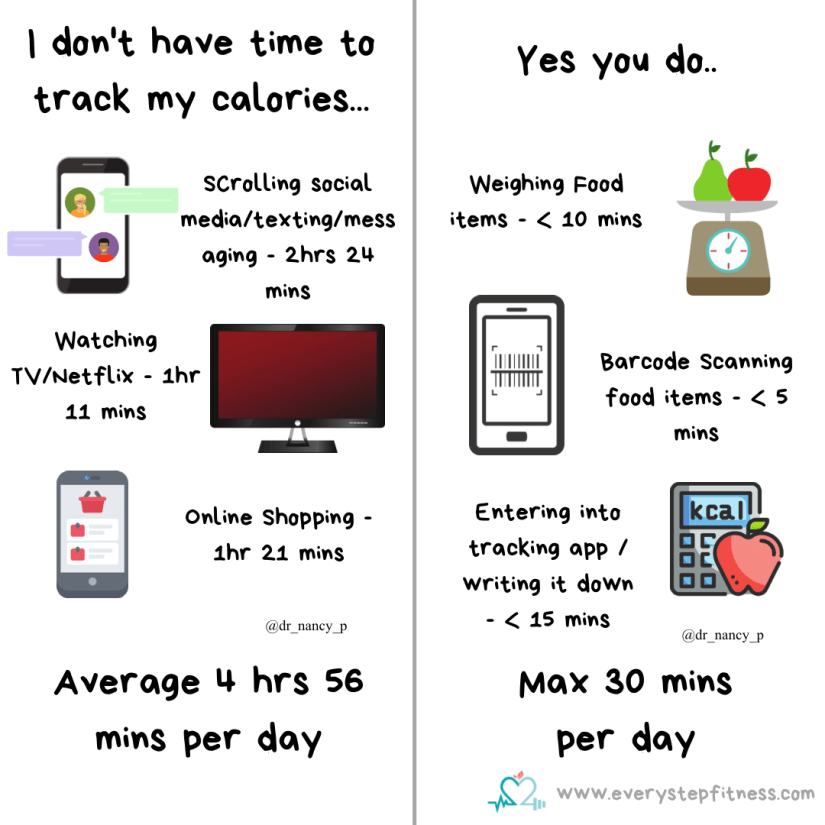
On average, in 2020, people in the UK spent 2hrs and 24 mins a day scrolling social media/messaging etc, 1hr 11 mins watching TV and 1 hr 21 mins online shopping. That’s an average of nearly 5 hrs a day! Now whilst you may claim you don’t spend anywhere close to that amount of time doing those things I bet you spend more than 30 mins on these activities (or similar ones)? Studies have shown that tracking your food; whether it be in an app or physically writing it down, takes no more than 30 mins a day. That includes weighing portions, barcode scanning items that are pre-packaged and then actually entering it into the app/writing it down and adding it up.

You don’t have to devote your life to tracking food, but if you can’t spare a few minutes to think about what’s on your plate before you eat it, you won’t make changes to what you eat and drink to reduce calories. In short – it won’t work. You have to make a change.

If you’re telling yourself you’re too busy or don’t have time to put any attention on your diet, then you’re right – you don’t – but that’s not because you don’t want to, it’s because it’s not enough of a priority right now. Once it becomes a big enough priority you’ll find you do in fact have time. Don’t kid yourself into thinking you’re too busy to track or that it’s a bigger job than it really is, and maybe reconsider the time you spend on other activities that are perhaps not as important for you?

Enjoy 🤗

xxx

Tuesday Tip

Tuesday Tip: Understanding Metabolism

Tuesday Tip: Understanding Metabolism 🤓

Despite what you might think most of your daily calorie burn doesn’t come from exercise. It’s driven by your metabolism (converting food cals to energy) which determines the number of cals you need to maintain your weight.

Your calorie burn consists of:

#1 60-70% Basal metabolic rate; the cals you need at rest, to survive; breathing, digesting, filtering waste, nothing more. It varies with body size (bigger = higher bmr), composition (more muscle = higher bmr), age (younger = higher bmr), genetics, hormones (thyroid hormones) and health (ill = higher bmr).

#2 10% is from food thermogenesis (digesting food). Protein requires the most to digest. 0-3 percent of fat cals are used to digest it, 5-10 % for carbs and 20-30 % for protein. But as food thermogenesis only accounts for 10% of daily burn, eating more protein will only have a small effect on your metabolic rate.

#3 20% is from physical activity; walking, workouts, and day to day activities; typing, carrying heavy loads, standing, fidgeting, shopping, etc.

So if you aren’t seeing the results you want, but are tracking your food right, then maybe you’re overestimating your calorie burn? There’s lots of tips out there to boost metabolism e.g. eating more frequently, or not eating late at night etc but few have studies to back them up.

Some tips which are backed by science include:

# including strength training in your workouts. Boosting your muscle mass increases your BMR and burns more calories at rest. You don’t have to lift big weights, body weight exercises are also effective.

# increase intensity in your workouts; short bursts of intense effort increase afterburn e.g. intervals when running, swimming or cycling, or doing workouts that naturally include it like hiit/ bodyattack/ circuits etc.

#3 Eat enough protein. You’re still only contributing a little extra burn, but by ensuring you have protein with every meal you will not only burn a little more digesting, but more importantly you’ll feel fuller for longer, and you’ll have amino acids to support muscle recovery and repair.

Happy Tuesday 🤗xx