Nutrition and Calorie Tips

If it’s made from cauliflower it must be healthy…. You

If it’s made from cauliflower it must be healthy…. 🍕

I’m sure we’ve all heard of, if not tried, having cauliflower in place of various carbs. Cauliflower is a vegetable so if something is made from cauliflower, it must be healthier than the “normal” version right?

Cauliflower pizza bases have become quite trendy and they’re marketed as being a healthier, better for you version, of your favourite Pizza.

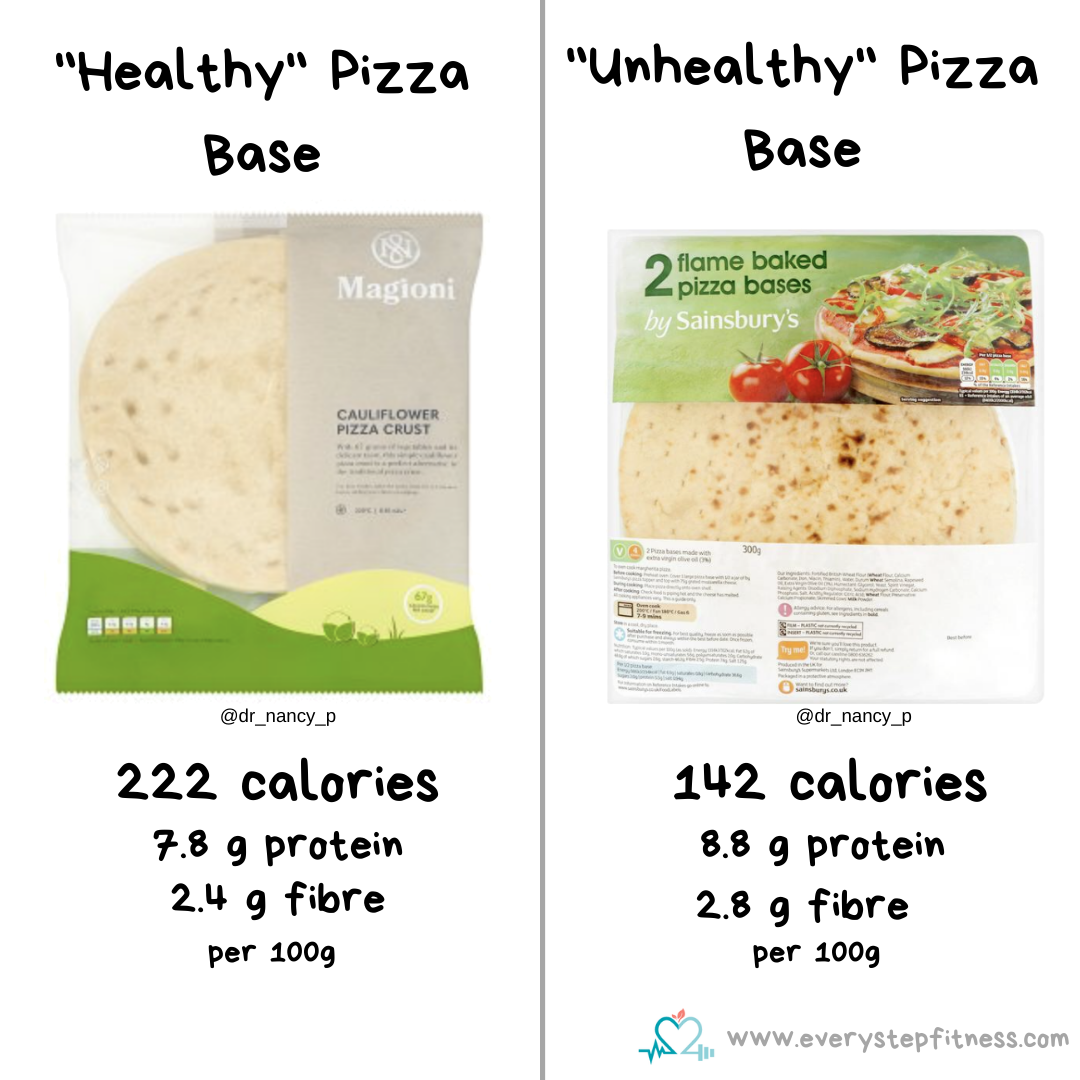
Cauliflower is great – it’s a fab high fibre vegetable and is definitely a good thing to be eating if you like it. But just because something is made from cauliflower doesn’t automatically ,make it better for you. But in the case of a pizza base it’s very misleading. Have you ever tried to make a cauliflower pizza? It’s actually quite hard to make a “dough” without adding a whole of of other things too. At home you could probably make one with very little flour, but it’s not very stable and certainly wouldn’t survive being packaged and sold in supermarkets. So the sort you buy in health food shops/supermarkets etc are actually mostly flour of one type or another. In this example the main ingredient is actually wheat flour… exactly the same main ingredient as in the “normal” pizza base.

The cauliflower pizza is actually higher in calories and lower in protein than the “normal” one and despite often marketed as being high fibre (thanks to the cauliflower) it’s actually lower in fibre than the “normal” pizza base as well.

So all in all, you’re better off sticking to a normal pizza base, unless you particularly enjoy the taste of the cauliflower one!

Enjoy 🤗

Xx
Nutrition and Calorie Tips

Coco-nuts!…

Coco-nuts!…. 🥥

Coconuts are heralded as a “superfood” So coconut yoghurt must be better for you right?

Coconut yoghurt contains fewer carbs than dairy yoghurt as it is lactose free (the natural sugar in milk). It also contains saturated fat, specifically medium-chain triglycerides, which are easily absorbed by the liver and converted to ketones (an alternative energy source in the brain) and could be beneficial for dementia and related conditions. There is also evidence that coconut may help type-2 diabetes, elevated cholesterol levels and may assist weight loss. Critically though many of these benefits are associated with coconut oil or meat,not yoghurt.

It’s plant-based and suitable for those with dairy/lactose allergies or vegans (but not all coconut yoghurt are actually vegan, many also contain dairy milk or gelatin). Natural yoghurt is dairy based but contains live probiotics and is good for gut health. There are no naturally occurring probiotics in coconut yoghurt (though some brands do add them in). If you are aiming for weight/fat loss however then natural yoghurt has some benefits.

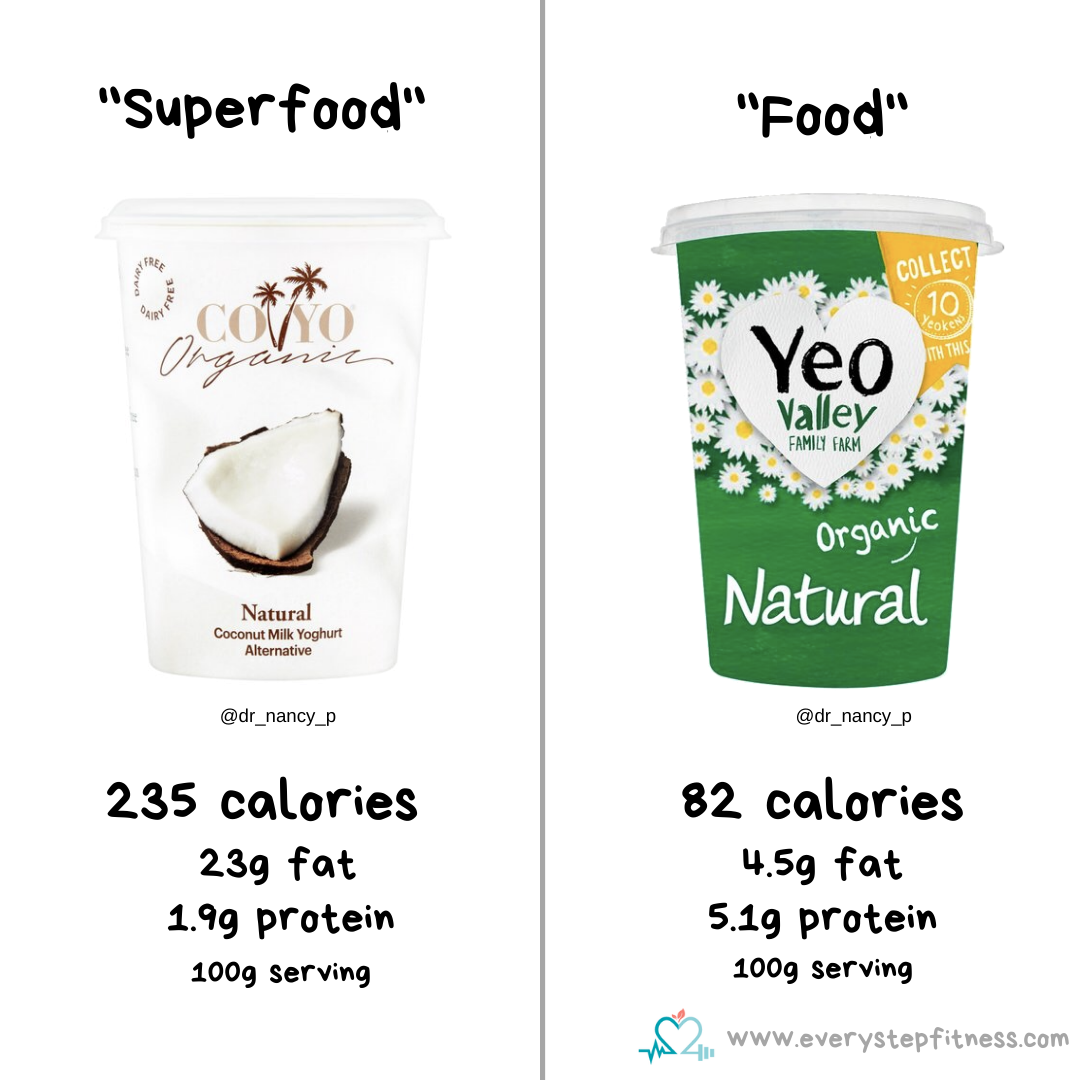
Coconut yoghurt contains significantly more calories than natural yoghurt and approx 5 times as much saturated fat. Whilst the fat in coconut yoghurt is the more beneficial medium-chain triglycerides thats still a large amount of fat and that has it’s own risks. There’s also significantly less protein in coconut yoghurt. Higher protein can help keep you fuller for longer – which from a weight loss perspective is helpful.

So if you were assuming coconut yoghurt is “healthier” and therefore better option for weight loss then think again. The “good” fats in coconut yoghurt don’t offset the extra calories I’m afraid. There are lower calorie coconut yoghurts out there so if you really love coconut yoghurt then check the labels (a lot is watered down reducing the calorie content). If you are unable to eat dairy then consider some of the lactose-free yoghurt which have comparable calories, or go for a soya based option.

As always – calories count guys so check those labels – and have what you want, within your calories. Knowledge is power!

Enjoy 🤗

Xx

Tuesday Tip

Tuesday Tip: Carbs are ok

Tuesday Tip: Carbs are ok 🥖🍞🥔

Carbs are the devil right? We all know someone that cut carbs and lost a stone in 4 weeks or whatever… so obviously carbs are bad?

There is so much conflicting, scientific sounding rhetoric out there blasting carbs – saying you shouldn’t eat them, or if you do eat them you should only eat them at certain times, or that cutting them will result in massive weight loss (well yeah if you cut any major food group out of your diet you’ll lose weight – you’re eating less!).

This is not actually true. The common argument is that carbs cause insulin to be released and to spike and therefore it’s bad because that insulin will somehow cause fat to be stored ….well sorry but all meals do this and in fact some proteins cause a greater response than carbs! In addition those insulin level changes have no direct impact on weight gain or weight loss. You have to be eating more than you’re using to store fat.

Carbs are the body’s preferred fuel source – breaking them down to glucose, but if there are no carbs around the body simply breaks protein to glucose instead. This applies at any time – not just when you’re exercising- because we need glucose to function – both physically and mentally.

Does that mean that there is no point in eating more carbs at certain times and fewer at others? No – you can definitely choose to have more carbs when your body may need extra fuel e.g. when working out, or in the morning when you’ve not eaten all night. But it’s not black and white and you certainly don’t need to ONLY eat carbs at these times and you definitely shouldn’t be avoiding carbs altogether.

How many carbs you eat doesn’t determine your weight loss – it’s total number of calories eaten and calories expended that matter. Carbs are just one part of the equation that you can play around with to help you meet those goals. There’s no need to obsess over carbs – yes small tweaks may help and you MAY find it easier to only eat carbs in the morning, or whenever, but if you like carbs eat them – just manage your portion size.

Happy Tuesday 🤗xx

Nutrition and Calorie Tips

Pizza Night!

Pizza night! 🍕

Socialising is a really important part of a healthy lifestyle and often that will involve eating out with friends or family. There is absolutely nothing wrong with going out and eating whatever you want – be it a massive pizza or anything else.

However if you are trying to lose fat or weight then you may wish to limit these extra calories. One option is simply to avoid social situations. That’s not ideal – life will be full of social situations and if you’re trying to make sustainable changes then you can’t just avoid everything for ever! Or you could of course say “f*ck it” and just have whatever you want. Nothing wrong with that – but if you’re then likely to spend the next few days feeling guilty or being angry with yourself for not making progress etc then that’s not a good option either.

The final option is to simply switch what you have for something that’s essentially the same but just a smaller portion. In this example I’ve gone for a large, “rustica” Gamberone and Chorizo pizza and a large glass of wine. That could wrack up over 1700 calories -which for most people is a large proportion of their daily calories. And let’s be honest, that’s an awful lot of food. No one actually needs a pizza that large… instead you could swap it for a “skinny” or small version of the same pizza (which almost all restaurants offer nowadays) and a small glass of wine. Same taste, same enjoyment, you can socialise, and you’re consuming less than a third of the calories.

So no need to avoid pizza night, or blow the diet, to still be able to enjoy yourself. Consider simply having smaller portions.

Enjoy 🤗

Xx

Nutrition and Calorie Tips

Good potato, bad potato… 🥔 🍠

Good potato, bad potato… 🥔 🍠

The common perception is that white potatoes are somehow a ‘bad’ choice, whilst sweet potatoes are inherently ‘good’.

Sweet potatoes are good – they have a lower glycaemix index than white potatoes (though it’s not actually ‘low’) which means it has a lesser impact on blood sugar levels. It’s also a great source of vitamin A, C, B6 and Potassium and also fibre.

In contrast white potatoes have a higher glycaemic index, slightly less fibre and less vitamin A, but are also good sources of Vitamin C and B6. They aren’t ‘bad’ though.

Despite the higher glycaemic index it’s not the individual foods that matter in that context but rather the glycaemic index of the whole meal, so it will depend what you’re eating with the potatoes. Combined with other low GI foods, protein and fats, the overall GI of the meal will be lowered.

In addition they actually contain fewer calories than sweet potatoes. So from a fat/weight loss perspective you’d be marginally better off having white potatoes.

So if you’ve been tucking in to sweet potatoes thinking they’re better for weight loss then perhaps think again. In reality the difference is pretty small, and the calorie impact is fairly similar. So just have the potatoes you actually like the taste of!

Enjoy 🤗

Xx