Tuesday Tip

Tuesday Tip : Calorie Counting Doesn’t work

Tuesday Tip : Calorie Counting Doesn’t work 🤔

I hear this a lot – people tell me that calorie counting didn’t work for them and that despite only eating 1000 cals (or whatever value it is) they just didn’t lose weight.

If the goal is to lose weight/fat then the only way to do this is to be in a energy (calorie) deficit. This is a fact and hundreds of studies support this. The means by which you achieve that deficit can obviously vary. It doesn’t mean you HAVE to count calories. But if calorie counting didn’t work for you that means you weren’t in a calorie deficit.

If you thought you were only eating 1000 calories then something is definitely going awry as anyone on that level of calories WILL lose weight.

So if calorie counting doesn’t work for you then these are probably the reasons why.

# 1 Measuring inaccurately

This is the most common issue – not weighing food accurately. If you’re just using MyFitnessPal and finding a rough estimate that you ‘think’ is right then it’s not going to cut it. If you’re guessing weights then you’re almost certainly be under estimating – again hundreds of studies show this to be the case – even in experienced ‘trackers’. Eyeballing amounts accurately is incredibly hard and unreliable. So get the kitchen scales out – measure in grams and millilitres (not cups and tbsp) and then you’ll have a better level of accuracy.

# 2 Lack of consistency

You feel like you’ve been on track consistently for weeks but in reality those weekends, nights out, or those days when you’ve emotionally eaten have taken you over etc. We’re very good at ‘forgetting’ (unintentionally) all the times we actually don’t stick to the plan. So if you haven’t lost then perhaps it’s because you haven’t been consistent enough?

# 3 Not enough time

Maybe you’ve been trying for a couple of weeks but aren’t seeing the results you want yet. Well that’s probably because you need to do it for longer! It takes weeks and months – not days to see sustainable losses. Remember you didn’t put the weight on in a few days, it’s not going to come off in a few days either. You need consistency over 7 days a week, for weeks and months.

Happy Tuesday 🤗xx

Nutrition and Calorie Tips

A snack or loads of snacks…

A snack or loads of snacks… 🍫

There are lots of strategies you can use when trying to stick to your calorie deficit to lose weight/fat. Being aware of the calories in the foods you choose to consume and swapping to lower calorie foods which you also enjoy is an obvious option. As well as the calories though it’s worth considering the quantity and volume of the food you’re choosing.

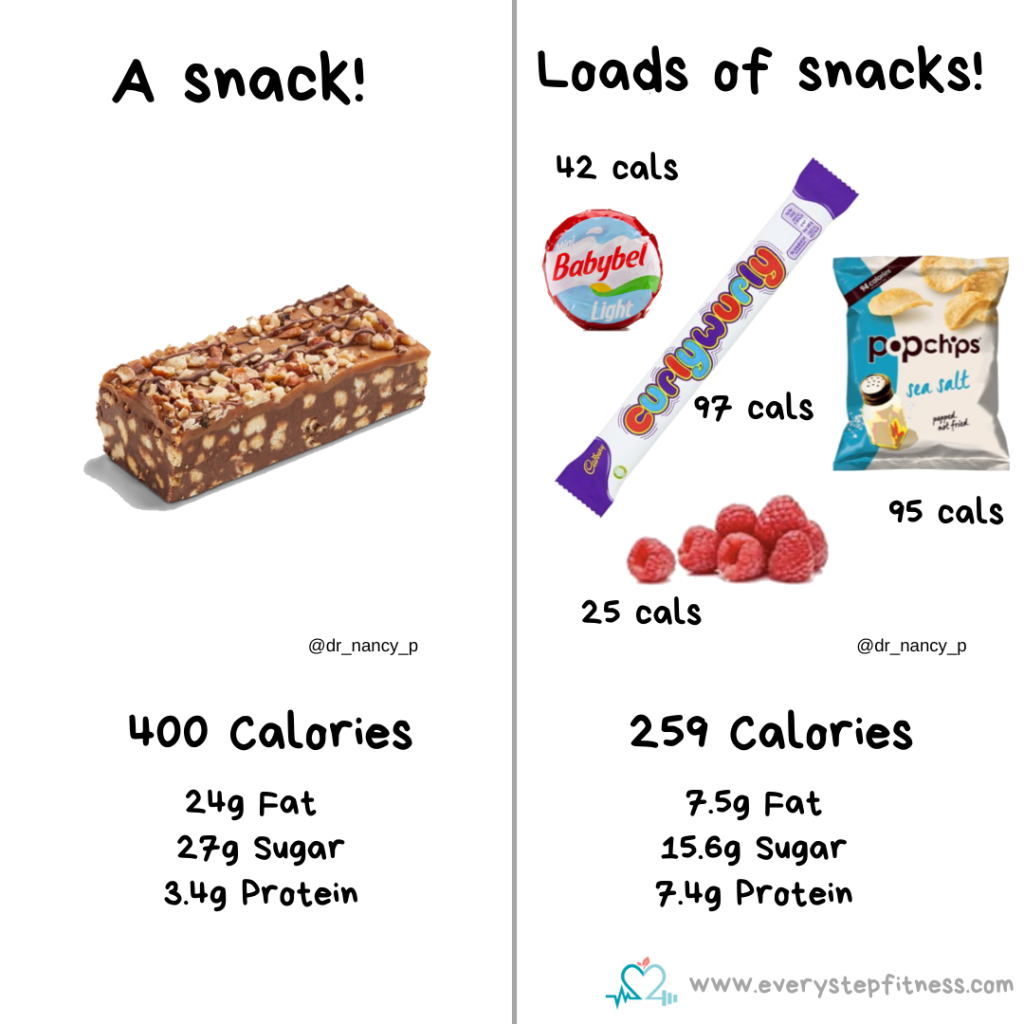
Snacking is a common problem and an easy way to extra calories to sneak in. If you were to snack on a chocolate tiffin bar you’re looking at a substantial 400 calories of food. That’s quite a lot for a snack, and it will be gone in a few bites. However for only 259 calories you could have a curly wurly, a light babybel, some raspberries and a packet of popchips. This combination not only has the advantage of fewer calories overall, but also higher protein overall which will help to keep you fuller for longer, and they contain more fibre (mainly from the raspberries) and other micronutrients which will also help. But an often overlooked aspect is that there is also a greater volume of food in the lower calorie option. It will take you longer to eat the 4 snacks than the muffin, which will also increase feelings of satisfaction. You may also even find you don’t even need to eat all 4 snacks.

Obviously if you fancy the tiffin and can fit it into your calories then go for it but this is just another strategy to add to your toolkit to help you stick to those calories.

Enjoy

Enjoy 🤗

Xx

Tuesday Tip

Tuesday Tip: Don’t Save Certain Foods for the Weekend

Tuesday Tip: Don’t Save Certain Foods for the Weekend 🍫

One really common issue I see is people

saving certain foods for the weekends.

It may seem like a good idea; you know your weakness is chocolate or booze or whatever so you decide to cut it out all week and only have it at the weekend. In theory that should help right?

Sadly it often doesn’t and in fact you’re setting yourself up for failure. For a start that then somehow sets these foods/drinks up as inherently ‘bad’. So you restrict yourself all week by not eating the ‘bad’ foods, probably make yourself quite miserable and then end up craving them. When the weekend comes not only are you craving them and have probably been looking forward to them all week, but you also know you’re ‘not allowed’ them again come Monday. So all will power flies out the window and you’re very likely to over indulge. You will most likely blow any calorie deficit you’ve accumulated during the week and your average calories for the week will be over. However, you won’t feel like they are. After depriving yourself for 5 days you’ll expect to see results – you’ll expect to see weight loss and you’ll be even more disappointed if you don’t (and the likelihood is you won’t because your average calories for the week will be too high).

You’ll also probably feel guilty, beat yourself up and generally not be very nice to yourself for ‘failing’. Which all in all is pretty counterproductive and a great way to be unhappy.

So whether you’re doing this consciously or sub consciously stop ‘saving’ certain foods for the weekend. If there’s a food you enjoy just incorporate it into your diet day to day in moderation and lose the all or nothing approach.

Happy Tuesday 🤗xx

Nutrition and Calorie Tips

‘What you think you had…..’

‘What you think you had…..’ 😬

We all know that to lose weight/fat you need to be eating and drinking at a calorie deficit. Often the problem though is our awareness and perception of what we are actually consuming. Portion control is a massive part of this – specifically underestimating serving sizes and what you’ve consumed.

It doesn’t help that we are continually marketed to to choose larger sizes at better value. More food/drink for less money – of course we want that right? But it doesn’t help when you’re trying to eat and drink less!

Studies repeatedly show that almost everyone, even those who are trained dieticians and nutritionists (and therefore should be ‘experts’ on portion sizes etc) significantly underestimate what they’ve consumed. This is even more so when recording in hindsight. We forget things, we underestimate what we’ve had, we don’t even know we’re doing it.

For example, having a couple of glasses of wine and some crisps with friends before dinner. You may think you’ve had 2 small glasses and a portion (40g) of crisps – that would be approx 381 cals. That’s not bad and can be easily factored into your daily cals. In reality though you probably had 2 large glasses, and much more than the portion size of crisps – closer to 150g (a grab bag size) for example- which comes in at 1,121 cals! That’s not as easy to fit in, and you probably barely noticed the crisps.

So if you’re struggling to lose weight and can’t work out why, try being totally honest with yourself and see if you may actually be underestimating things. The best way to do this is you get out the kitchen scales, weigh the portion and track the calories – before you eat them! You definitive do not need to cut these things out completely – that’s totally counter productive and unsustainable long term. So instead work on becoming more aware of the actual quantities you’re eating / drinking and fit them into your diet accordingly. Knowledge is power!

Enjoy 🤗 xx

Tuesday Tip

Tuesday Tip: Slow metabolism preventing weight loss?

Tuesday Tip: Slow metabolism preventing weight loss? 🍏

I often hear people complaining that their slow metabolism is why they can’t lose weight. Is this really the reason they can’t make progress?

There are variations in metabolic rate e.g. someone with a larger body will have a higher resting metabolic rate. This is the absolute metabolic rate and is related to your age, height, gender, muscle/fat mass etc. In addition two people with the same body composition, age, gender etc may well have some differences in metabolic rate. Aha I hear you cry – so that must be it? That variation must explain why some people find it harder than others to lose weight?

Unfortunately the variation isn’t as much as we think. Once you account for age, gender, fat and muscle mass, height etc you can predict about metabolic rate with about 80-85% accuracy. This leaves around 15-20% of the differences unexplained.

What does that mean in practical terms? Well if you predicted someone’s metabolic rate using their body composition etc at 1800 kcals you would see people ranging from 1600 – 2100 kcals per day. On average it’s a difference of 200-300 kcals above or below the expected rate i.e. you might be burning 200-300 calories fewer per day than expected. Whilst this isn’t ‘nothing’, it’s really not as great as many people think it is. It’s also not enough to justify why you aren’t losing weight if you’re eating 1000 kcals a day etc.

A recent study also found that these variations in metabolic rate were not related to weight gain. Those participants with ‘low’

metabolic rate did not gain more weight than those with a high rate. Why?

Well because resting metabolic rate is only part of the equation. It’s the behaviours you adopt that determine your progress – not your resting metabolic rate. If you have a higher metabolic rate but are sedentary and overeat calorie dense foods you will put on weight. If you have a lower metabolic rate and are conscious of what you’re eating, and active you’ll maintain or lose weight.

Focusing on something you can’t control won’t help – instead focus on what you can control – eating at a calorie deficit and moving more.

Happy Tuesday 🤗xx