Tuesday Tip

Tuesday Tip: Are BCAAs worth it?

Tuesday Tip: Are BCAAs worth it? 🥤

This week’s tip may seem a bit specialist but I’ve had lots of people asking me about these. BCAAs (branched chain amino acids), the supposedly vital pre-workout supplement (usually taken as a drink) which helps muscle recovery and building – are they actually worth taking?

In general – No. Why not?

#1 They don’t build muscle

BCAAs contain leucine, valine and isoleucine, 3 of the 9 essential amino acids for muscle growth/repair. You need all of them, not just those 3. There are also recent studies showing they can actually inhibit muscle growth. Taking them on their own creates competition with other amino acids for absorption, making it harder for the body to use the other “building blocks” to form new muscle tissue.

#2 but…

But “I read that BCAAs increased muscle protein synthesis!” Maybe, but most of these studies have serious limitations, including being conducted by the companies that make them! They’re often compared to water in these studies which isn’t a fair comparison. When compared with other protein sources BCAAs show no benefits.

#3 They don’t reduce muscle soreness.

A recent study showed no reduction in muscle soreness by taking BCAAs which is one of the many benefits proponents of them claim.

#4 They’re empty calories

They’re not zero calories. Think about it – how can they be no calories if they’re amino acids and used for muscle synthesis? Of course they have calories (check the packet!). So you’re taking on extra calories for zero benefit.

#5 They can make you eat more

Recent studies have found BCAAs actually increase your appetite and make you eat more. They also have no impact on fatigue or tiredness. Many reports of this are anecdotal – in most actual studies they have no impact at all.

BCAAs have no nutritional benefits. Unless your diet is devoid of protein, BCAAs will do nothing to help you look better, feel better or perform better. So rather than wasting money and calories on BCAAs just because someone at the gym or on Instagram said they’re ‘vital’ simply have a balanced diet, with normal amounts of protein instead.

Happy Tuesday 🤗

Xx
Tuesday Tip

Tuesday Tip: Burning fat or just burning cash?

Tuesday Tip: Burning fat or just burning cash? 🔥

Fat burners – you’ve seen them on social media, you know people taking them, you may even have taken them yourself. But do they work and are they worth the money?

Fat burners are combinations of food based natural or chemical products which claim to burn fat/increase metabolism. Common ingredients include caffeine, green tea extract, green coffee extract, ginseng, pepper, capsicum etc. More dangerous ingredients include bitter orange, yohimbine, garcinia etc (linked to risk of stroke, heart attack). They claim to increase fat oxidation, induce thermogenesis, affect fat burning hormones/enzymes, etc. In reality they do none of that.

There is limited evidence that SOME fat burners may help reduce hunger (for people in bodybuilding competition prep where calories are unsustainably low), though they’re linked to gastrointestinal distress so not a great option. They usually contain caffeine so provide a stimulant effect but a study in the journal “PLoS one” found that coffee has exactly the same effect on exercise performance and endurance (i.e. an instant coffee an hour before you workout).

They increase metabolism slightly, in the short term (increasing heart rate) but in terms of increasing BMR i.e. calorie burn at rest, which is what is needed to burn more calories (and hence fat), the effect is negligible. A 2017 study found an increase of 65 cals in BMR. This is a tiny increase over the day and won’t lead to increased fat loss. Green tea extract has been shown to increase fat oxidation (i.e. fat burnt by the body) BUT this only leads to fat loss IF you are in a calorie deficit, as fat stores are simply restored the moment you eat. Another study in the Journal of the International Society of Sports Nutrition found no difference over 6 weeks between fat burners and a placebo in fat loss (or muscle mass).

Bottom line – if someone is selling you fat burners stop, think and reconsider. Aside from the potential health risks, you’re throwing money down the drain. Make yourself a coffee or green tea and enjoy the same effects with less risk for less money.

Happy Tuesday 🤗

Xx

Recipes

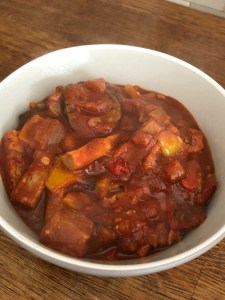
Veggie ‘steak’ casserole

I spotted these quorn veggie steak strips in the supermarket so thought I’d whip up a quick casserole. This is a another easy weekday dinner option, perfect for the cooler evenings. I cook up a batch for the week and then it’s nice and easy to quickly heat it up for dinner (or lunch!).

I’ve used frozen veg for this one as I was running short on time. Never be afraid to use these sorts of frozen veg – they actually have more vitamins and minerals in than the fresh variety so you’re not doing yourself any harm and they’re brilliant if you’re busy and short of time. Obviously use fresh veg if you prefer. Also it’s worth noting that Lea & Perrins Worcestershire sauce contains anchovies so if you’re vegetarian then double check – Biona and other companies make one without the use of animal products and it’s widely available.

This serves at least 8 at about 223 cals per portion.

You will need:

2 pack of quorn steak strips (or any alternative vegetarian product you fancy)

1320g passata (2 bottles at 680g each, but just get approx the same amount)

1 kg mixed vegetables (either 2 packs (500g each) or 2 onions, 2 carrots, 2 sticks celery, 2 peppers, 2 courgettes, 1 small aubergine)

1/2 tsp Paprika

1/4 tsp chilli powder (optional – adjust for taste)

1 tsp mixed herbs

1/2 tsp cayenne pepper

2 vegetable stock cube

1/2 tsp Worcestershire sauce (optional)

A dash of Balsamic vinegar

1/4 tsp of sugar

Salt and pepper

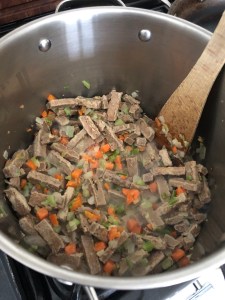
If using fresh veg then prepare it and chop it up. Heat a little oil in a pan, add onions first and allow to soften, then the carrot and celery. Otherwise add the frozen soffito (onion, carrot and celery) mix and allow to soften.

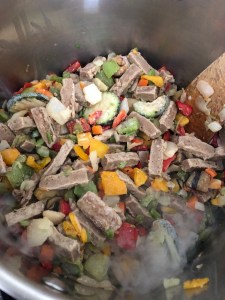
Add the steak strips to the pan and allow to brown. Then add the pepper, courgette and aubergine (if using a pack then just throw it all in at once once the steak strips have browned).

Cook for a couple of mins until the veg start to soften and then add the passata. Stir well and bring to a slow simmer. Add the stock cube, all the spices, balsamic vinegar and Worcestershire sauce and stir well. Add the sugar (this brings out a richer tomato flavour).

Bring to a simmer and allow to cook through for about 10-15 mins.

Serve on its own, with green veg and grains, or with a jacket potato etc.

enjoy 🙂

Xx

Tuesday Tip

Tuesday tip: Portion Control

Tuesday tip: Portion Control 🥗

Portion control is super important for healthy eating and long term, sustainable fat loss but it’s one of the hardest things to master. Here are a few tips to help you naturally control portion sizes and develop healthy habits.

# 1 Aim for 50/25/25

Start by filling your plate half full of veg or salad, then a quarter with protein and the remainder with whatever starchy veg or carb you’re having (potato, rice, squash etc).

# 2 Set aside leftovers

If you plan to eat some for lunch tomorrow etc then set it aside at the start rather than after – that way you won’t be tempted to keep picking after you’ve eaten your portion.

# 3 Share

When you’re out at restaurants or cafes consider sharing with whoever you’re with. Portions are usually massive at restaurants so it can easily feed two, especially with things like potatoes or chips.

# 4 Smaller plates

Lots of studies have shown that eating from smaller plates leads to less calories being consumed (even when subjects are allowed to top up the plates). So choose side plates and small bowls to trick yourself into eating less. We’re conditioned to clear our plates, even when we’re already full, so this way you can clear your plate and not over eat.

# 5 Take a whiff

As well as our eyes our noses are heavily linked to feelings of satiety. Take time to smell the food you’re about to eat – breathe in the scent and savour it. Studies have shown this helps to limit the number of calories consumed by tricking your brain in to thinking you are more full than you are.

# 6 Don’t eat from the bag

Put your food or snacks out on a plate before eating then, rather than eating from the bag. Visually seeing your what you’re eating sends a message to the brain about the quantity you’re consuming and leads to less likelihood of overeating.

# 7 Put away distractions

When you’re eating focus on eating. If you’re distracted by TV, phones, etc then studies have shown you’re likely to over eat. Pay attention to what’s going into your mouth and you’ll be better able to recognise when you’re full and stop before you overeat.

Happy Tuesday 🤗

Xx

Tuesday Tip

Tuesday Tip: Accept you’re not doing it right

Tuesday Tip: Accept you’re not doing it right 🙌🏼

How you think about your fat loss has a profound impact on how you cope with sticking to a sustainable fat loss plan.

If the weight isn’t dropping and you’re saying to yourself ‘I’m doing ‘everything right’ but I’m not losing weight (fat) – it must mean I need a new program or diet or there’s just something wrong with me and I can’t lose weight right? Wrong. If you’re not losing fat then quite simply you’re not doing everything right.

Not losing fat or weight is the ultimate proof that you’re not doing everything right when it comes to fat loss. It means you’re not at a consistent calorie deficit. If you were you’d be losing fat. But the bigger issue is that this sort of thinking of ‘I’m doing everything right’ immediately puts you on the defensive. If you’re doing everything right, then there can’t possibly be anything to correct – because everything is right? So there’s no impetus to change your own behaviours or actions or find a solution.

With the ‘I’m doing everything right’ thinking you can’t possibly be consuming too many calories? You can’t possibly be incorrectly estimating portion sizes , you can’t possibly have forgotten to log some of those calories, it can’t possibly be that you’re doing something (probably subconsciously) that means you’re eating more calories than you think… because you’re ‘doing everything right’.

What we need to do is be a bit more

open minded and accept that we must be doing something wrong so we can then figure out what the solution is and how to fix the problem. So if you’re not making progress and feeling like you’re doing everything right try to take a step back and rephrase it; ‘I’m not losing fat, I must be doing something wrong’ and then you can find out what that is and try to fix it.

That way you’ll be more likely to solve the problem and continue on your fat loss journey

Happy Tuesday 🤗 xx