Recipes

You say Frittata, I say….

You can’t beat a good frittata! So easy to make and so good for you! You can throw in whatever vegetables you have in the fridge and if you make a large one you can keep it in the fridge for up to a week and take for lunches etc.

frittata 2

You will need:
50g Leek
60g Broccoli
50g Frozen peas
110g Cherry tomatoes
6 eggs
55g Feta
1 tsp mixed Herbs

Grease a roasting dish (approx 25cm x 25cm) with a little olive oil and preheat the oven to 200 C.
Slice the leeks and cut the broccoli into small florets. Heat a tbsp olive oil in a frying pan, add the herbs and then the leeks, broccoli and peas. Cook until softened (a few minutes). Chop the tomatoes in to halves and add to the pan and cook for a further 2 – 3 minutes.

frittata 1

Put the cooked vegetables in to the roasting dish in one layer. Beat the 6 eggs together and pour over the top. Chop the feta into small cubes and sprinkle over the egg mixture. Place in the oven for 20 minutes.

frittata 3

Remove and allow to cool a little, then slice and serve. Can be eaten hot or cold.

frittata 4

Enjoy 🙂

xxx


(This recipe was originally published on pureformfitnesskitchen.com)
Tuesday Tip

Tuesday Tip: Losing Fitness?

Tuesday Tip: Losing Fitness? 🏃🏼‍♀️

An enforced rest from exercise, due to injury, illness or holidays can cause an irrational fear that you’ll lose all your hard earned fitness overnight and will be back to square one. But does it really decrease that quickly?

Loss of fitness when you stop exercising is called reversibility. If you stop training the long term physiological benefits such as cardiac hypertrophy (increased size and strength of the heart muscle), increased blood volume and increased aerobic enzymes will start to decline. It’s true that your muscles will start to atrophy (decrease in size and strength) after a short time of inactivity and your neuromuscular co-ordination will often rapidly decline, which is why you feel a bit all over the place when you come back to it.

A recent study of 12 weeks of rest showed an initial decline in fitness (50% reduction in and 7% reduction in VO2 max), but it then stabilises with only 16% loss of overall. Specific fitness losses relate to your own training/exercise history, types of exercise you do (fitness is maintained for longer if you did a variety of types of exercise e.g. not just running), the rest period, and genetic and lifestyle factors. If you’re a regular exerciser it will take longer to lose fitness as things like increased capillary density take much longer to disappear.

If you can’t do your normal exercise then try other types; your cardiovascular system doesn’t know the difference between running and cross training as long as you elevate the heart rate you can maintain or increase aerobic fitness etc.

Prolonged rest is also not always a bad thing. Although it may seem counterintuitive gains in fitness happen when you rest, as your body needs to recover to allow the physiological adaptations to a training stimulus to take place. Also remember that fitness returns extremely quickly – within 2-3 weeks after a prolonged rest.

So if you are out of action for a little while then don’t stress. Stay as active as you can e.g. walking etc and when you’re back from injury/holiday etc get back to your normal routine and you’ll be back where you were (possibly better) in not time.

Happy Tuesday 🤗xx

Nutrition and Calorie Tips

Pizza Night!

Pizza night! 🍕

Socialising is a really important part of a healthy lifestyle and often that will involve eating out with friends or family. There is absolutely nothing wrong with going out and eating whatever you want – be it a massive pizza or anything else.

However if you are trying to lose fat or weight then you may wish to limit these extra calories. One option is simply to avoid social situations. That’s not ideal – life will be full of social situations and if you’re trying to make sustainable changes then you can’t just avoid everything for ever! Or you could of course say “f*ck it” and just have whatever you want. Nothing wrong with that – but if you’re then likely to spend the next few days feeling guilty or being angry with yourself for not making progress etc then that’s not a good option either.

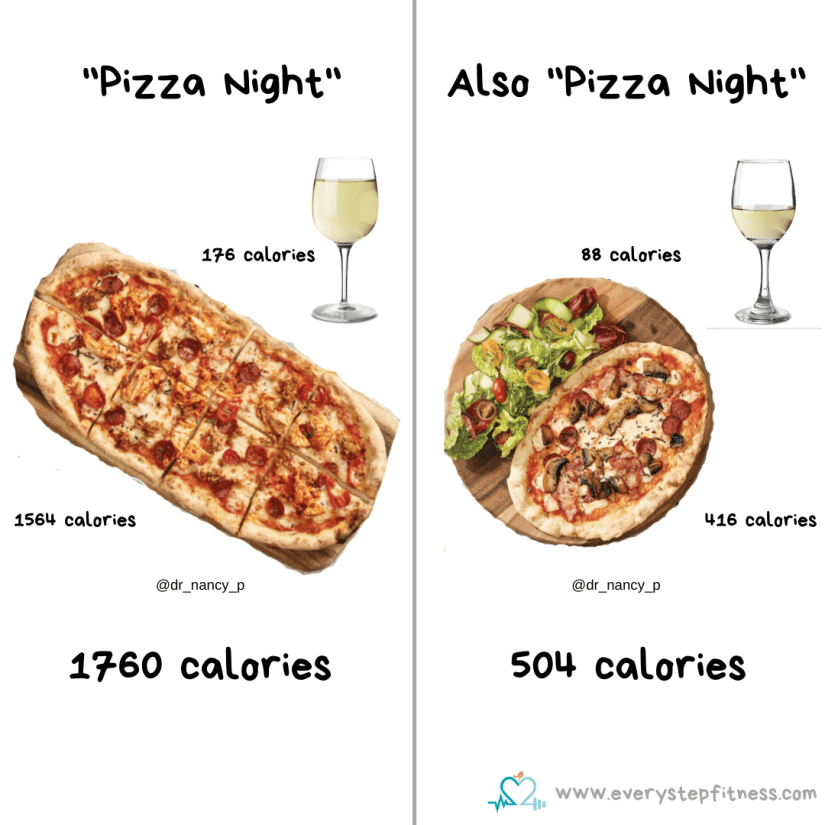
The final option is to simply switch what you have for something that’s essentially the same but just a smaller portion. In this example I’ve gone for a large, “rustica” Gamberone and Chorizo pizza and a large glass of wine. That could wrack up over 1700 calories -which for most people is a large proportion of their daily calories. And let’s be honest, that’s an awful lot of food. No one actually needs a pizza that large… instead you could swap it for a “skinny” or small version of the same pizza (which almost all restaurants offer nowadays) and a small glass of wine. Same taste, same enjoyment, you can socialise, and you’re consuming less than a third of the calories.

So no need to avoid pizza night, or blow the diet, to still be able to enjoy yourself. Consider simply having smaller portions.

Enjoy 🤗

Xx

Nutrition and Calorie Tips

Good potato, bad potato… 🥔 🍠

Good potato, bad potato… 🥔 🍠

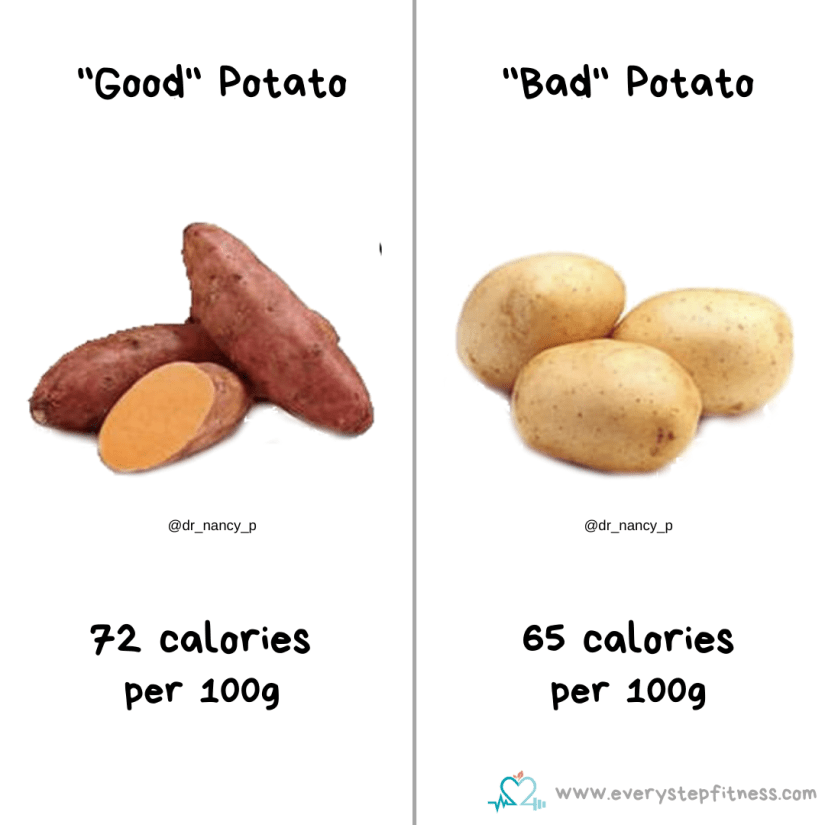
The common perception is that white potatoes are somehow a ‘bad’ choice, whilst sweet potatoes are inherently ‘good’.

Sweet potatoes are good – they have a lower glycaemix index than white potatoes (though it’s not actually ‘low’) which means it has a lesser impact on blood sugar levels. It’s also a great source of vitamin A, C, B6 and Potassium and also fibre.

In contrast white potatoes have a higher glycaemic index, slightly less fibre and less vitamin A, but are also good sources of Vitamin C and B6. They aren’t ‘bad’ though.

Despite the higher glycaemic index it’s not the individual foods that matter in that context but rather the glycaemic index of the whole meal, so it will depend what you’re eating with the potatoes. Combined with other low GI foods, protein and fats, the overall GI of the meal will be lowered.

In addition they actually contain fewer calories than sweet potatoes. So from a fat/weight loss perspective you’d be marginally better off having white potatoes.

So if you’ve been tucking in to sweet potatoes thinking they’re better for weight loss then perhaps think again. In reality the difference is pretty small, and the calorie impact is fairly similar. So just have the potatoes you actually like the taste of!

Enjoy 🤗

Xx

Nutrition and Calorie Tips

A healthy snack….. or is it?

A healthy snack….. or is it? 🍫

There are lots of snack bars out there that are marketed to imply that they are a “healthy” choice. This is a perfect example – this bar definitely looks like it’s a healthy choice. It’s got oats and banana in it – which are great for a sustained energy release, and it contains chia seeds – they’re a super food right so it must be good?

So you might decide to reach for this rather than reaching for a chocolate bar thinking it was a better choice. Well that may not always be the case.

Although it does contain a good range of nutrients and will definitely give you energy and keep you full, it’s also very high in calories (and fat and sugar). You could actually have 2 crunchie chocolate bars for fewer calories. So if you were trying to lose fat/weight and looking for a snack, then rather than reaching for a “healthy” snack bar you’re probably better off just going for a snack you actually want – like a chocolate bar if that’s what you fancy. And if you do want the oat based bars then be sure the read the labels carefully as some are extremely high in calories.

Ultimately, if you’re trying to lose fat or weight, it comes down to calories. So enjoy a balanced diet overall and just be mindful of the calories in what you’re having.

Enjoy 🤗

xxx