Tuesday Tip

Tuesday Tip: Losing Fitness?

Tuesday Tip: Losing Fitness? 🏃🏼‍♀️

An enforced rest from exercise, due to injury, illness or holidays can cause an irrational fear that you’ll lose all your hard earned fitness overnight and will be back to square one. But does it really decrease that quickly?

Loss of fitness when you stop exercising is called reversibility. If you stop training the long term physiological benefits such as cardiac hypertrophy (increased size and strength of the heart muscle), increased blood volume and increased aerobic enzymes will start to decline. It’s true that your muscles will start to atrophy (decrease in size and strength) after a short time of inactivity and your neuromuscular co-ordination will often rapidly decline, which is why you feel a bit all over the place when you come back to it.

A recent study of 12 weeks of rest showed an initial decline in fitness (50% reduction in and 7% reduction in VO2 max), but it then stabilises with only 16% loss of overall. Specific fitness losses relate to your own training/exercise history, types of exercise you do (fitness is maintained for longer if you did a variety of types of exercise e.g. not just running), the rest period, and genetic and lifestyle factors. If you’re a regular exerciser it will take longer to lose fitness as things like increased capillary density take much longer to disappear.

If you can’t do your normal exercise then try other types; your cardiovascular system doesn’t know the difference between running and cross training as long as you elevate the heart rate you can maintain or increase aerobic fitness etc.

Prolonged rest is also not always a bad thing. Although it may seem counterintuitive gains in fitness happen when you rest, as your body needs to recover to allow the physiological adaptations to a training stimulus to take place. Also remember that fitness returns extremely quickly – within 2-3 weeks after a prolonged rest.

So if you are out of action for a little while then don’t stress. Stay as active as you can e.g. walking etc and when you’re back from injury/holiday etc get back to your normal routine and you’ll be back where you were (possibly better) in not time.

Happy Tuesday 🤗xx
Nutrition and Calorie Tips

Pizza Night!

Pizza night! 🍕

Socialising is a really important part of a healthy lifestyle and often that will involve eating out with friends or family. There is absolutely nothing wrong with going out and eating whatever you want – be it a massive pizza or anything else.

However if you are trying to lose fat or weight then you may wish to limit these extra calories. One option is simply to avoid social situations. That’s not ideal – life will be full of social situations and if you’re trying to make sustainable changes then you can’t just avoid everything for ever! Or you could of course say “f*ck it” and just have whatever you want. Nothing wrong with that – but if you’re then likely to spend the next few days feeling guilty or being angry with yourself for not making progress etc then that’s not a good option either.

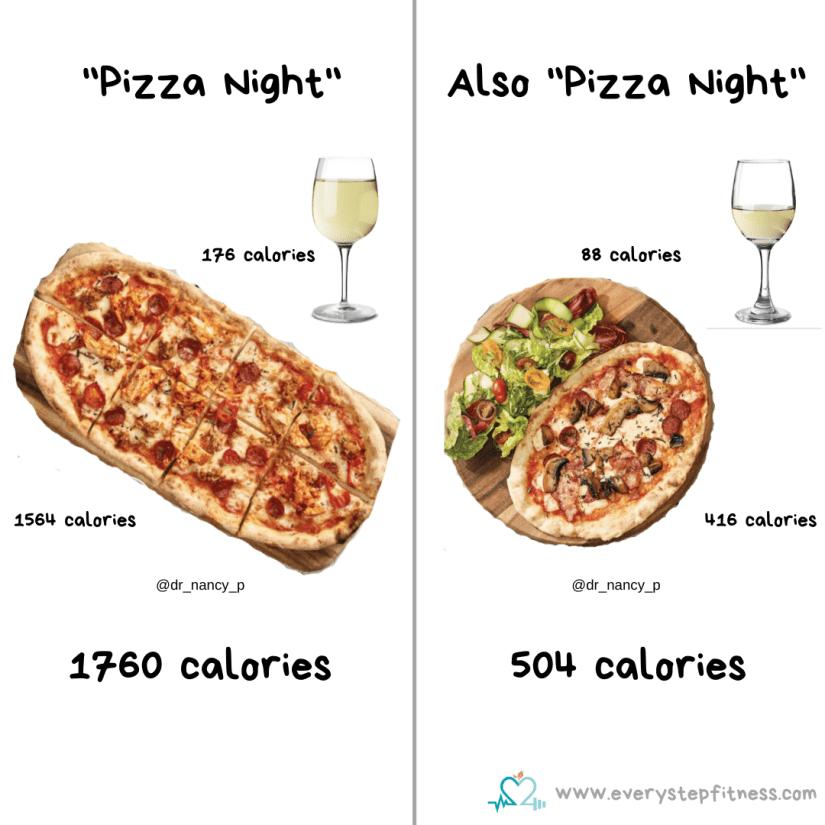
The final option is to simply switch what you have for something that’s essentially the same but just a smaller portion. In this example I’ve gone for a large, “rustica” Gamberone and Chorizo pizza and a large glass of wine. That could wrack up over 1700 calories -which for most people is a large proportion of their daily calories. And let’s be honest, that’s an awful lot of food. No one actually needs a pizza that large… instead you could swap it for a “skinny” or small version of the same pizza (which almost all restaurants offer nowadays) and a small glass of wine. Same taste, same enjoyment, you can socialise, and you’re consuming less than a third of the calories.

So no need to avoid pizza night, or blow the diet, to still be able to enjoy yourself. Consider simply having smaller portions.

Enjoy 🤗

Xx

Tuesday Tip

Tuesday Tip: Always Tired?

Tuesday Tip: Always Tired? 😴

Are you constantly tired although you slept enough? Barring any medical issues there are other reasons why you feel so lethargic.

#1 Rhythm

It’s not just hours of sleep but the rhythm too. So if you always go to bed at different times this can have a negative impact on your health (just like sleeping too little).

#2 Diet

Eating too little leaves you lacking energy of course, but equally eating too much can make you lethargic. Meat, bananas and legumes contain tryptophan which makes us sleepy. Meat is also requires the digestive system to work harder to digest it, which requires additional energy. Too much coffee can be a problem too, initially it stimulates adrenaline production , but leaves you feeling more tired afterwards.

#3 Water

The body is over 50% water. If we drink too little, our metabolism slows down and our body shifts into low gear. So, it is no surprise that we feel dead tired.

#4 Exercise

I know exercise is the last thing you feel like when tired but it gets the heart pumping, boosts metabolism, and increases circulation. A study published in the Journal of Clinical Sleep Medicine showed that regular exercise can improve the quality of your sleep. So, get moving! Park your car farther away, take the stairs or go to the gym!

#5 Light

We need daylight to stimulate our circadian rhythms (internal clock). Try to spend as much time outside as possible. Even on cloudy days, you will get more light outside than inside so go for a short walk. You can also try the special daylight lamps, or leave curtains slightly open to allow morning light in.

#6 Stimuli Stress

We are inundated with so many stimuli every day and this can really wear you down. Our brain has to constantly decide which sensory impressions are important and which can be ignored. With more stimuli the brain has to work harder which uses more energy. So if you’re feeling bombarded try setting specific times to address emails etc rather than checking them at all times of day etc.

So if you are always tired consider if some of these reasons may be contributing.

Happy Tuesday 🤗xx

Nutrition and Calorie Tips

Good potato, bad potato… 🥔 🍠

Good potato, bad potato… 🥔 🍠

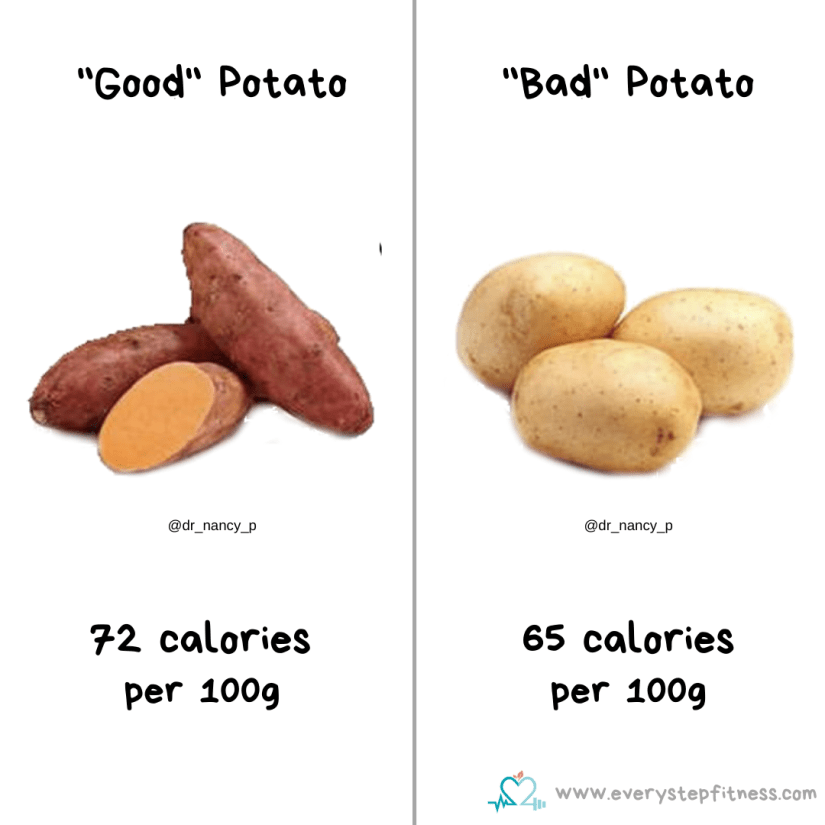
The common perception is that white potatoes are somehow a ‘bad’ choice, whilst sweet potatoes are inherently ‘good’.

Sweet potatoes are good – they have a lower glycaemix index than white potatoes (though it’s not actually ‘low’) which means it has a lesser impact on blood sugar levels. It’s also a great source of vitamin A, C, B6 and Potassium and also fibre.

In contrast white potatoes have a higher glycaemic index, slightly less fibre and less vitamin A, but are also good sources of Vitamin C and B6. They aren’t ‘bad’ though.

Despite the higher glycaemic index it’s not the individual foods that matter in that context but rather the glycaemic index of the whole meal, so it will depend what you’re eating with the potatoes. Combined with other low GI foods, protein and fats, the overall GI of the meal will be lowered.

In addition they actually contain fewer calories than sweet potatoes. So from a fat/weight loss perspective you’d be marginally better off having white potatoes.

So if you’ve been tucking in to sweet potatoes thinking they’re better for weight loss then perhaps think again. In reality the difference is pretty small, and the calorie impact is fairly similar. So just have the potatoes you actually like the taste of!

Enjoy 🤗

Xx

Tuesday Tip

Tuesday Tip: Bigger weights aren’t always better

Tuesday Tip: Bigger weights aren’t always better 🏋🏻‍♀️

If you want to get stronger and fitter you have to lift heavy weights in the gym, right? Wrong! Several recent studies have shown this isn’t the case at all. You may have seen mention of this on the TV last week, I’ve had a look into the study behind the story.

Recent studies in the Journal of Applied Physiology found that lifting light weights (30 -50% of 1 rep max) for more reps, was just as effective as lifting heavy weights (up to 75-90% of 1 max rep) for 8 – 10 reps both for increasing strength and muscle size. Participants took part in a 12 week program of total-body resistance training (leg press, bench press, shoulder press, leg extension, bicep curls) – half used light weights, half used heavy, all lifted until failure. After 12 weeks, both groups made equal gains in strength and size, except for the chest press, where in fact those lifting lighter weights showed greater gains! Muscle strength increased 25-30%, and both groups put an average of 2.4 pounds of lean muscle on. In addition, biopsies of the muscles showed there was no difference in the growth of muscle fibres in either group (type I and II).

If you want to get stronger then you need to increase your muscle mass (don’t confuse this with getting “bulky”) by activating as many muscle fibres as possible. Day to day activities use the type I fibres first. As demand on muscles increase (more reps, or more weight) you recruit type II fibres – which is what you want. Conventional wisdom states that you can ONLY recruit type II fibres by lifting big weights for fewer reps, but what these studies show is that you don’t need to do that. The key is lifting to fatigue – with whatever weight you choose.

Great news for anyone who wants to get fitter and leaner but doesn’t fancy lifting heavy weights in the gym. You CAN still get strong by doing things like body pump, or workouts with smaller weights IF you are reaching fatigue by the end of the set or track. Lift to the point of exhaustion and it doesn’t matter whether the weights are heavy or light.

Happy Tuesday 🤗xx