Tuesday Tip

Tuesday Tip : Reframe those goals 😃

When you’re at the start of a weight loss journey it can seem very overwhelming and almost impossible to achieve. If you have a significant amount of weight to lose (which is of course is a different figure for different people – a lot could be anything from 5 to 50 kg!) then focusing on that as your goal can actually be counter productive.

Rather than trying to lose 15kg why not try losing 1kg 15 times. That changes the perspective – losing 1kg feels achievable right? Once you’ve lost one kg then you lose the next kg etc. It all comes down to your mindset and that will dictate how you approach your weight loss journey, and that will determine whether you’re successful.

Take everything in bite size pieces and small steps. That goes not only for your goals but everything. Instead of trying to overhaul your entire diet and exercise routine just focus on one small change at a time. Maybe adding in an extra walk, or one exercise class a week for example? Or perhaps eating more veggies, or reducing the number of nights a week you drink alcohol, or just starting to track calories (even if not reducing them) etc. One step at at time makes things seem much more achievable and means you’ll feel more successful – which in turn means you will be less likely to give up after a few weeks!

Happy Tuesday🤗xx
Nutrition and Calorie Tips

Carbs make you fat….

Carbs make you fat…. 🥔 🍞

I actually lose count of the number of times people tell me it’s carbs that are making them fat, or stopping them losing weight, or that they just need to cut carbs and they’ll lose weight….

The rhetoric is usually something along the lines of – to lose fat/weight you need to cut or reduce carbs and focus on more protein and fat based foods (nuts are a prime example). Many new clients I meet have either tried eliminating carbs from their diet or that they intend to, by which they usually mean cutting out potatoes, bread, pasta etc. Many social media ‘experts’ have suggested that carbs are ‘bad’ and to be avoided – but this is based on very little actual evidence. In fact many studies have supported the fact that eliminating carbs has no significant impact when it comes to weight loss – it’s the total calories that have the impact.

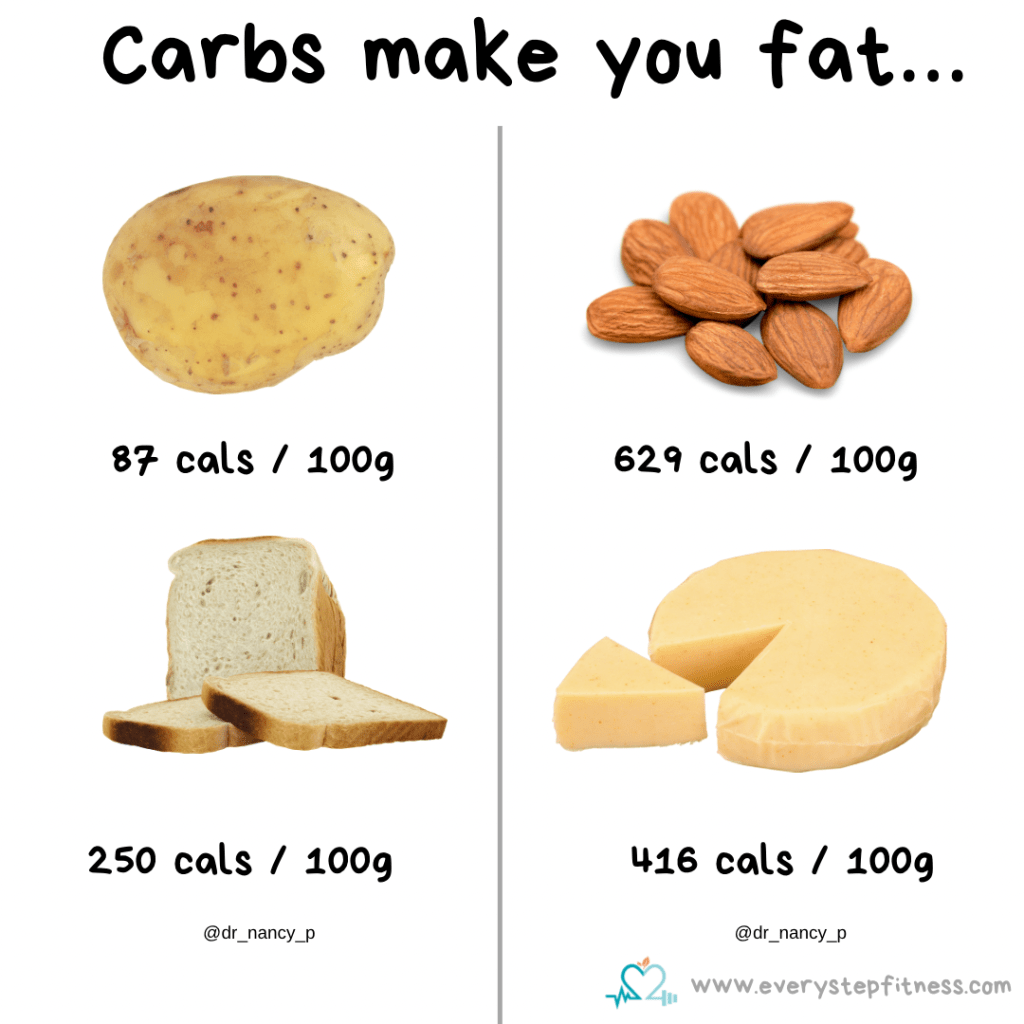
No food or macro is inherently fattening. It all comes down to calories. Carbs do not make you fat – as you can see in this example – those high carb foods are actually far lower in calories per 100g than those high fat foods. Now eating fat-heavy foods won’t make you fat either – but this just illustrates the point re carbs quite nicely.

From a fat loss standpoint, fats are more calorie dense than carbs or protein. Fats contain 9 calories per gram, carbs contain 4 calories per gram and so does protein. Therefore, fat as a macronutrient is more than TWICE the amount of calories compared to carbohydrates or protein. This doesn’t mean fat is ‘bad’ it just means foods that are high in fat are also high in calories, so be mindful mindful of your portions! Often it’s what you’re putting on the carbs that make them higher in calorie – like cheese, butter, nut butter etc.

You CAN eat carbs and still lose weight when you are able to achieve a energy deficit. So stop believing that carbs are responsible for your weight gain. They’re not – whether intentional or not you were just eating more calories than you needed.

🤗

Xx

Nutrition and Calorie Tips, Tuesday Tip

Tuesday Tip: More sweat isn’t always better

Tuesday Tip: More sweat isn’t always better 😅

We often believe the marker of a good or effective workout is how sweaty or out of breath you get? But think about it – if you run up the stairs or for the bus are you sweaty and out of breath? Quite possibly – would you consider it an effective workout? Probably not! Does it get you closer to your goals? Well the goal of getting the bus/to the top of the stairs – yes – but a goal of getting stronger – probably not!

We think how much you sweat correlates to how good a workout is or even much fat you’re burning. The reality is it just means you’re hot and trying to cool down and the amount you sweat can relate totally unrelated factors like hormones, your immune system, levels of hydration and climate. So try not to focus only these superficial feelings. Getting sweaty isn’t the be all and end all of a workout. Just getting sweaty doesn’t mean you’re getting stronger or fitter. Instead focus on things like – are you getting stronger? Are you lifting more weight? Are you managing more reps? Are you improving your form? Are you getting faster? Are you having fun?

If you answer yes to any of these then yes it’s an effective workout – regardless of how much you sweated!

Happy Tuesday🤗xx

Nutrition and Calorie Tips

Why eyeballing amounts is hard…

Why eyeballing amounts is hard… 👀 🥜

I’m always telling my clients to try to be as accurate as possible when they’re tracking their food and calories. This means actually weighing things – particularly anything that is calorie dense.

Very often people tell me that they’re “pretty good” at estimating/eyeballing the amounts they’re having, that they have the same thing each day so they know what it looks like now, that they can estimate pretty well etc. I’m sure some can, but I know I can’t. I can at first but then often amounts creep up without you even realising it.

In this example on the left is 30g peanut butter – measured. On the right is an estimated amount … looks almost the same

right (especially if they weren’t side by side), but it’s actually 75g!

As you can see they look pretty similar to the naked eye, yet the calorie difference is significant (and that doesn’t include the bread it’s on). It would be very easy to assume you were using around 30g peanut butter but actually be using closer to 75g or more! It may not matter now and then but these calories do add up. And if that’s just peanut butter, what about other things?

Now I’m not saying you need to weigh every gram of everything forever. With less calorie dense foods it won’t matter as much but with calorie dense foods (e.g. nut butters, spreads, cheese, avocado etc) when you get it wrong you’re adding a large number of calories. So it’s worth being more

mindful with these sorts of things. This is also why measure like “a scape of peanut butter are no good – what’s a scrape? my scrape may not be your scrape etc Licking that spoon of peanut butter or an extra slug of olive oil in your salad, can easily add up to hundreds of extra calories consumed per day!

So if you are trying to lose fat/watching your calories maybe it’s time to go back and get those scales out and double check those estimates and see if you really are as good as you think you are.

🤗

Xx

Nutrition and Calorie Tips

Most common weight loss mistakes …

Most common weight loss mistakes … 😝

These are the most common mistakes I see with clients trying to lose weight.

# Cutting out favourite foods/food groups

Being over restrictive and cutting out favorite foods/ food groups is unnecessary and means it won’t be enjoyable. You’re setting yourself up for failure and it won’t be sustainable long term.

# Looking for a quick fix.

There are no quick fixes. You didn’t put weight in overnight so you can’t expect to lose it that fast either. Think long term lifestyle as opposed to short term fix.

# Jumping from diet to diet

It’s not about the next fad diet – it won’t be sustainable long term. Just stick to a modest and consistent calorie deficit.

# Too little protein/fat

You don’t need to go overboard on protein or fat, and calories are definitely the most important but protein and fat can help satiety (feeling full) so can prevent snacking and overeating and help recovery.

# Going cardio crazy.

Punishing yourself with hours of exercise won’t help. It will exhaust you and make you hungry. Just include exercise you actually enjoy, ideally a range of resistance training and cardio, and keep generally active.

# Eating back exercise calories.

I’ve written in detail about this but essentially we always overestimate what we burn and our bodies adapt to exercise (as do smart watches – up to 93 percent over!) so eating back exercise calories will usually mean you’re over eating.

#Assuming healthy foods are low calorie

I often hear people proudly telling me they’ve swapped their unhealthy snacks for nuts instead, not realising they’ve actually doubled their calorie intake. It’s easy to carried away with ‘healthy’ but calorie dense foods like nuts, nut butters, avocados etc.

# Estimating calorie intake

Estimating calories generally results in getting it wrong. Studies show that most people grossly underestimate their caloric consumption (even qualified nutritionists and dieticians). Best approach – weigh portions and track accurately. Assume you’re not good at estimating and weigh things rather than assuming you’re always right.

🤗

Xx