Nutrition and Calorie Tips

‘The reduced sugar myth….’

‘The reduced sugar myth….’ 🍫

Sugar is often vilified as the cause of all health issues and as a result many companies have latched on to the idea that people are keen to reduce their sugar consumption. Now whilst sugar in excess amounts is undoubtedly not good (no nutrient in excess is) normal amounts of sugar in the diet are absolutely fine. However if you’re diabetic or trying to reduce your reliance on sugary snacks then it may be sensible to opt for some lower sugar options.

If you’re trying to lose weight (fat) then you may also decide to reduce sugar consumption. Many people equate lower sugar to mean lower calorie and would therefore go for the reduced sugar option in the belief that it would help them lose weight. In this example the actual difference is pretty insignificant.

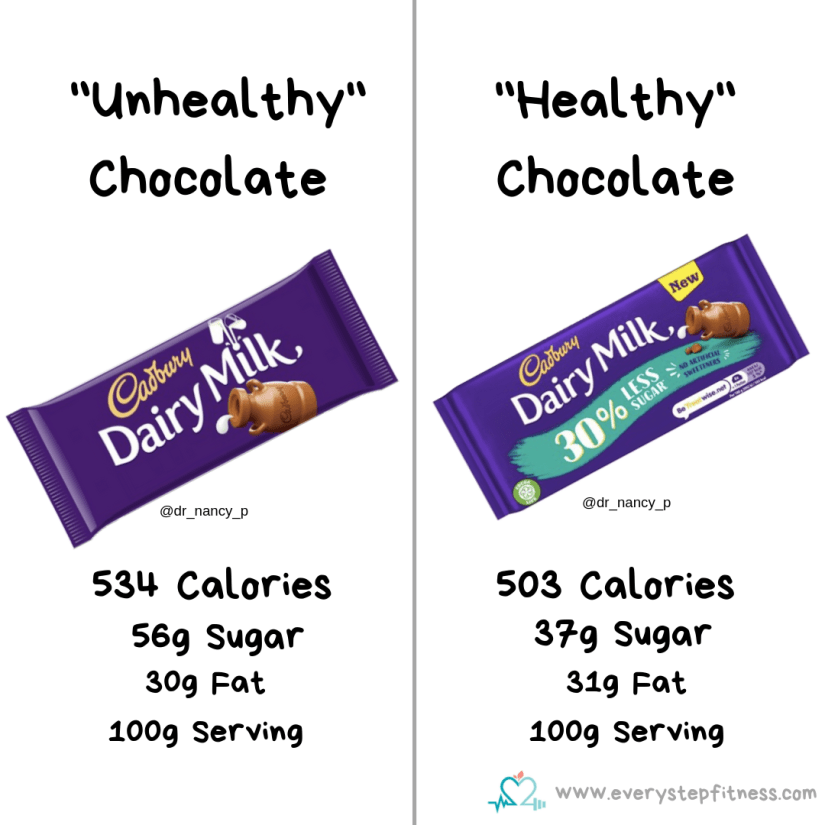
A standard Cadbury Dairy Milk contains 534 cals per 100g, whilst the reduced sugar version contains 503 cals – a reduction of 31, which is unlikely to result in weight loss. Yes, every little bit counts, but the expectation would probably be that it was much lower and therefore you may eat a larger portion, or expect bigger fat losses from this small change.

Cadbury’s are undoubtedly aware of this as they’ve made their standard bar size for the reduced sugar option a smaller size – 85g rather than the usual 110g of a normal dairy milk. So at first glance you’d assume it was a lower calorie option. It’s not really – it’s just a smaller bar! Clever eh?

So if you’re trying to reduce your calories and are going for the reduced sugar versions of things you love just take some time to check the calories and portion sizes and see if there really is a difference. If you enjoy the reduced sugar option and it helps to keep you on track then go for it! But don’t pay more for a marketing ploy when you don’t need to. Enjoy the chocolate you like, in moderation, as part of a balanced diet 🤗

Xx
Nutrition and Calorie Tips

‘Bad’ fries or ‘good’ nuts…

‘Bad’ fries or ‘good’ nuts… 🍟

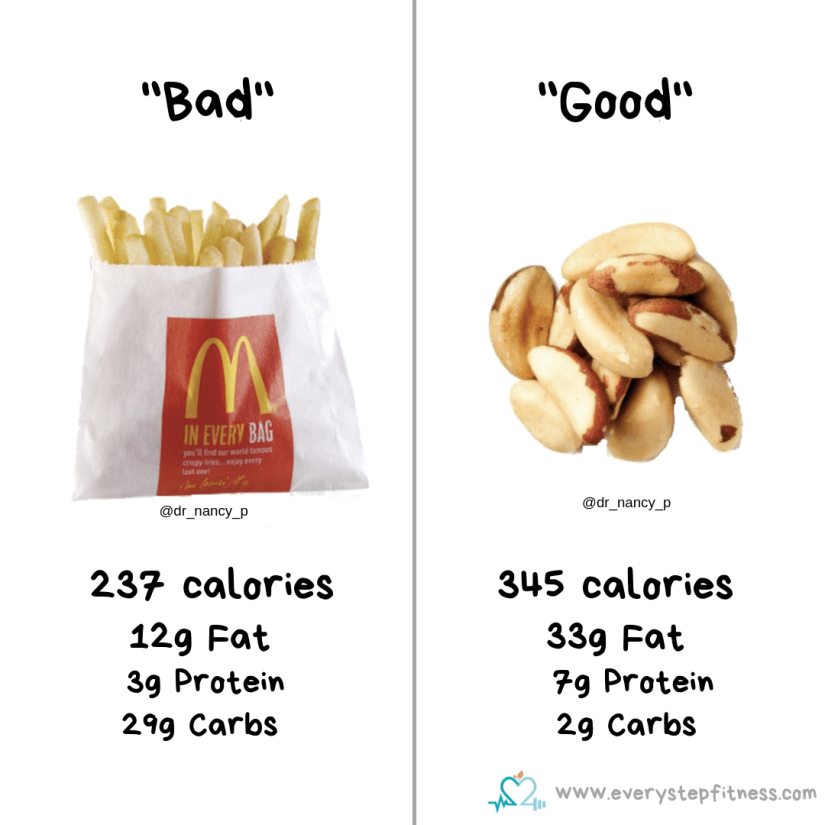
If you had snacked on a bag of small fries you would probably be feeling guilty that you’d chosen a ‘bad’ option. In contrast if you’d had 50g of Brazil nuts you would probably be polishing your halo for having such a ‘good’ snack.

Now before anyone jumps down my throat I am not suggesting Mcdonald’s fries are healthier than Brazil nuts. From a nutritional point of view the Brazil nuts are definitely a better choice. They’ve also been shown to reduce HDL cholesterol levels amongst other benefits. They contain heart-healthy fatty acids, such as polyunsaturated fats, and are rich in antioxidants, minerals, and fibre. They are the best source of the mineral selenium which is essential for the immune system, thyroid and cell function. They are calorie dense though.

McDonald’s fries on the other hand have no redeeming features other than the fact they may taste good. They’re not a nutrient dense food.

However they are lower calorie than the Brazil nuts.

So if your goal was fat loss and you decided to just replace those fries you have every Saturday afternoon with the Brazil nuts because they’re ‘good’ you’d actually be consuming more calories. Thereby not helping your goal.

Am I suggesting you should choose fries over Brazil nuts? No of course not! But if you enjoy occasional bags of fries then have them. If you like Brazil nuts then have them. But just educate yourself on the number of calories and consume them within your total calorie goal. Blindly choosing foods just because they’re perceived to be ‘good’ isn’t a sensible approach. No foods are inherently good or bad – they just have different costs and benefits. The Brazil nuts give you lots of great nutrients, the fries may help you stay on track and give you some pleasure – both are fine!

Enjoy 🤗xx

Nutrition and Calorie Tips

‘Lunch isn’t great, I tend to have a sandwich…’

‘Lunch isn’t great, I tend to have a sandwich…’ 🥪

Something I hear a lot from my clients is that ‘their lunch isn’t great as they just ended up having a sandwich’….. There’s a perception that a sandwich is an inherently bad choice when it comes to lunch. Often this stems from the idea that carbs (aka bread) are bad or ‘dirty’ and should be avoided. I hear them berating themselves for going for the sandwich option.

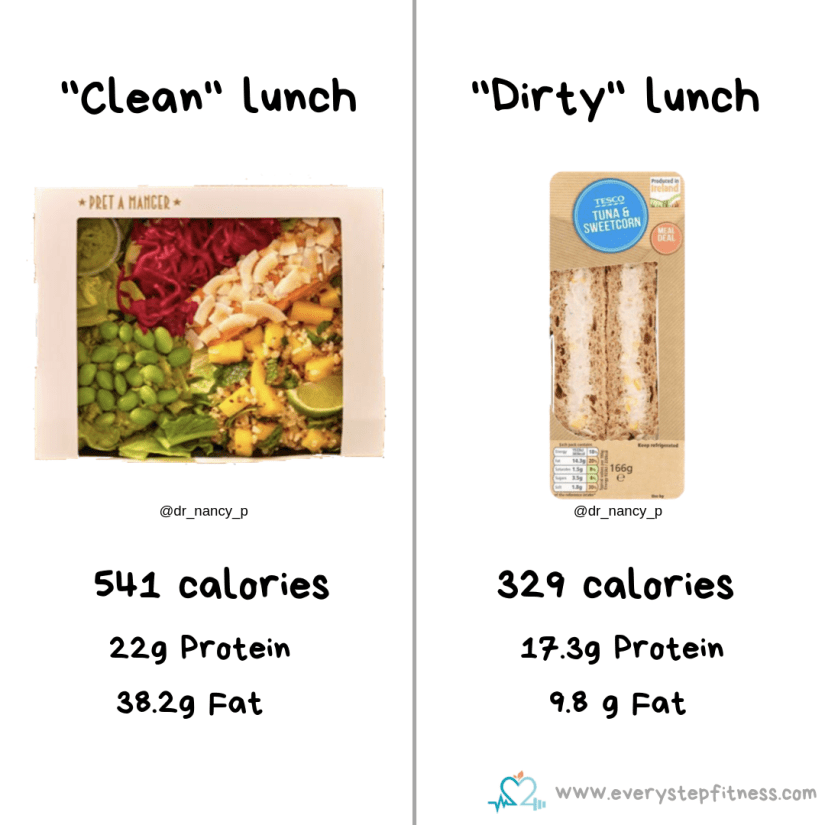
In contrast something like the Pret Californian salmon salad is viewed as a great option – because it’s ‘clean’ and therefore ‘good’. The fact that it’s a salad helps to create this image, and the fact that it’s loaded with protein and good fats from the salmon help too.

In reality both are great lunch options. The salmon salad does contain lots of great nutrients and will certainly fill you up – but with the dressing it’s a hefty 541 calories. The tuna and sweetcorn sandwich on the other hand is only 329 cals, is also loaded with protein and good fats and will also keep you full. It’s also a lot cheaper and more widely available.

So if you have the calories and want the Pret salad – go for it! If you prefer a sandwich, or just find the sandwich a more convenient cost effective option then go for that! It’s a perfect package of carbs, protein and fats to keep you satisfied.

Foods aren’t ‘dirty’ or ‘clean’, or ‘good’ or ‘bad’ – they’re just foods. Aside from fuelling you they also have to fit in to your lifestyle. As part of a balanced diet you can have both of these – totally guilt free!

Enjoy 🤗 xx

Tuesday Tip

Tuesday Tip: How to Get a Flat Stomach

Tuesday Tip: How to Get a Flat Stomach 🙌🏼

Everyone wants a flat stomach or visible abs right? Social media is full of pics of 6 packs selling miracle supplements, teas, exercise programs, or ‘waist’ trainers which can supposedly make you lose belly fat. But sadly there’s no quick fix – if you want a flat stomach it’s going to take more than some magic tea or a load of ab exercises.

First off; everyone has abs – the muscles may be tiny or weak but that 6 pack is there. They’re just hidden under a layer of fat for most people.

Fat does NOT turn into muscle; they are two different things. You could have strong abs, but if they are buried under fat no amount of exercise will give you a flat stomach or a 6 pack, because it doesn’t address the fat on top of your muscles.

A flat stomach only appears when you have a low enough bodyfat percentage.

But ab exercises and magic teas are a lot more exciting to market than ‘eat less, move more’ … so it’s not surprising there are so many products out there making these claims.

So if you’re punishing yourself with endless sit ups every day – stop – it’s not going to give you a flat stomach. You can’t target or spot reduce fat from anywhere. That doesn’t mean we shouldn’t work those muscles, it’s important to work the ab muscles to protect your back etc.

So how can you lose belly fat? Everyone loses fat from certain parts of their body in different orders depending on age, weight, sex, genetics etc. You can’t control where it goes from first. Women will tend to hold more fat in their belly, hips and thighs, whilst men tend to store more in the belly and butt. You may not lose it from those areas first; it may go from your arms or legs etc.

All you can do is aim to lose bodyfat generally and once you lose enough of it you will see it go from everywhere eventually! The only way to do this is to consume fewer calories than you currently are. So track your calories, find out how many you’re currently eating and then reduce it! And stick with it for weeks or months (not just 5 days!). If you’re at a calorie deficit you will lose fat and at some point that fat will come off your belly too!

Happy Tuesday 🤗

Xx

Nutrition and Calorie Tips

How weight loss actually works….

How weight loss actually works….

Most people measure their fat loss progress by stepping on the scales. The scale can create an all or nothing mentality and can impact not only your happiness but your behaviour. If the scales don’t go down when you’ve been ‘good’ then what’s the point? You may as well throw the towel in and enjoy that cake!

But scale weight isn’t a great measure of progress, mainly because it can’t differentiate between muscle, fat, water or anything else. It just measures the relationship your body mass has with gravity. Sometimes body composition can change without any weight change, e.g. if you gain additional muscle, lose bodyfat and improve hydration you could see minimal weight change. Fat and muscle weigh the same but 1kg of fat is approx 4 times larger than 1kg of muscle, meaning you could very well be smaller and heavier.

Your weight also fluctuates wildly every day. Between morning and afternoon your weight can fluctuate up to 6kg depending on what you eat and drink, and how you exercise. If you drink 2-3 litres of water a day that’s up to 3kg. Then how much do you pee, sweat and breathe out over the day? It’s impossible to measure. Our bodies are mainly water so changes in hydration cause significant weight fluctuations.

In addition a bowel full of food, fibrous or salty meals, and hormonal changes can all influence weight and cause greater daily fluctuations so real change can be hidden. For example, I weighed myself Saturday night, then first thing Sunday and again at 1pm – there was 2kg increase overnight, but a 3 kg loss during Sunday morning! I obviously didn’t put on 2kg overnight or lose 3kg of fat in 6 hours. Depending when I weighed could massively impact how I felt about myself and my progress.

We’re conditioned to focus on weight but instead try to use other measures e.g. items of clothing and how they fit, or cm measurements etc. If you really can’t help stepping on the scales then look at averages over time rather than individual daily variations and focus on trends the long term. 🤗 xx