Nutrition and Calorie Tips

What happens when we restrict foods…

What happens when we restrict foods… 🍕

We all have cravings for certain foods or drinks at certain times. It may be for chocolate, biscuits, cheese, fries, Pizza – etc, whatever it is it’s usually perceived as a “bad” food. If you’re trying to lose fat/weight and on a diet then you may cut out or avoid foods like this, so if a craving hits you may avoid it at all costs. Why? because it’s “bad”. This can come from fear that it will

make you gain weight or “ruin” your performance.

This mindset that you have to eat “perfectly” all the time or that certain food are off limits can lead to serious issues, including; disordered behaviors around food, constant thoughts about food, uncontrollable cravings, restriction, bingeing, missing out on fun experiences, negatively impacting your social life, feelings of shame, guilt and anxiety, fear of food, under eating.

What tends to happen when we demonise foods and restrict them is that we can’t stop thinking about them, and that obsession leads to uncontrollable cravings. This often man’s that when you eventually do have that food you over-consume them because you feel like you can ‘never’ have them e.g. I can’t have pizza again so I better eat as much as possible right now! This then leads to feelings of guilt and shame, and impacts weight loss progress. A better approach is to accept that all foods can fit into our diets. It just means we need to have some in moderation. This is easier said than done i know, but it starts from reframing how we think about food. So if you have certain foods or drinks you feel you can’t have when trying to lose weight, instead remind yourself that you can always have any food if you really want it. It’s always available to

you and always will be. When you want it, have it as part of a balanced meal. So if you want pizza – have a few slices, have some

salad or veg with it, enjoy it and factor it into your calories.

Enjoy!

🤗

Xx

Nutrition and Calorie Tips

Protein snack…

Protein snack… 🤔

I’ve talked before about the marketing power of “protein” and how snacks (and other products) are often promoted as “healthy” or better because they contain X amount of protein. The reasoning behind this is the fact that increased protein can help with improved satiety (feelings of fullness) so CAN help to prevent overeating. Also those working out may want to focus on protein to help with muscle building. Unless you’re a bodybuilder or athlete you probably don’t need to go out of your way to take in extra protein as most balanced diets contain far more protein than the average person needs. However you may still wish to focus on higher protein foods and snacks to help keep you feeling full.

So you may well see this protein snickers bar and think it would be a good snack option – it’s something that feels like a treat (a chocolate bar) and it’s high in protein – win win! It’s 192 cals which is actually not bad for a snack at all and contains 10.8g protein – also not bad.

Oh but this is awkward… you could instead have a 150g pot of Skyr stracciatella yoghurt (yoghurt with chocolate pieces in it), a fun size snickers and 50g raspberries, for a similar 188 cals and it will actually provide you with even more protein – 17.3g in fact! And aside from the fact it’s a marginally lower calorie combo, and has more protein, it’s also far greater volume – which also helps to keep you full. It will

take longer to eat, and has a higher amount of fibre too which will aid with the feelings of fullness. You also get the bonus of added micronutrients from the raspberries and yoghurt for overall health. And it will probably help keep you on track as it allows you to have a snickers and extra protein without detailing you from your goals.

Enjoy!

🤗

Xx

Nutrition and Calorie Tips

A well deserved treat….

A well deserved treat…. 🚶🏼‍♀️☕️

How often do you reward your physical activity with some sort of food or drink? Or how often do you justify eating or drinking something because you’ve worked out or done a long walk or because you’re going to? I hear it all the time from clients – ‘I did end up having fish and chips, but I did 3 classes’ or ‘I did go over my calories at the bbq but I did do 25000 steps’.

Now whilst the physical activity is great and is absolutely something to be proud of – it’s not something to use to justify overeating. For starters you don’t need to justify eating food. Trying to ‘earn’ food isn’t a good thing and it also sets up a really unhealthy relationship with food whereby you almost have to ‘punish’ yourself to be allowed to eat. Also the chances are that in most cases you’ve grossly overestimated the number of calories burnt in that activity. If you’re trying to lose weight and aiming for a calorie deficit and using those ‘exercise caloires’ to justify eating more then you’re probably affecting your progress. Even if your activity tracker tells you you’ve burnt xxx cals – it will be an overestimate. Most of our activity trackers (particularly wrist based ones) are inaccurate. So if it tells you you’re burning 600 cals, you’re probably burning far less. A recent study compared calories from activity trackers for various workouts (cross trainer, spin, treadmill etc) and found they over estimated calories burned by an average of 40% with some overestimating by 90%!

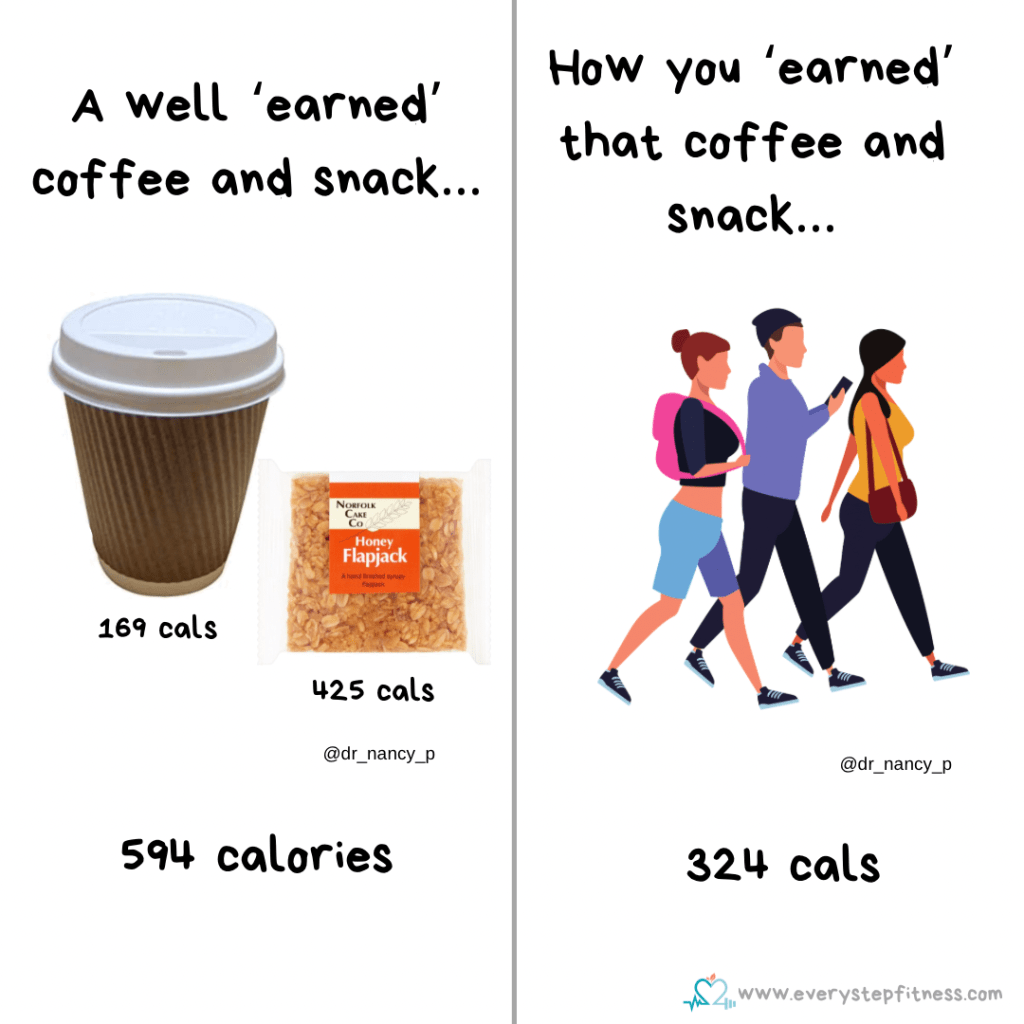
This is a great example – you’ve just gone for a two hour walk, and you get to the coffee shop and reward yourself with a large cappuccino and a flapjack! That’s ok right? Because you’ve walked miles! Obviously the calories burnt vary with age, gender, height, walking speed, fitness etc but an average calorie burn for that distance for a 50yr old, 5ft 5 female walking at average pace is 324 cals. The coffee and flapjack are a minimum of 594 cals!

So does this mean we shouldn’t bother working out? No of course not! Workouts and general activity (energy burned from daily life activities) all help to increase the calories we use, build lean muscle, keep our hearts and lungs healthy etc so it’s vital! What you shouldn’t be doing is eating these back or using them to justify eating more than you need. They’re a bonus; an additional help towards that calorie deficit. Track them, log them, but don’t treat them as a green light to eat what you want.

Equally you don’t need to ‘earn’ food – if you’re aware of the calories in things you can make informed choices about what you eat. It’s your body – you can eat what you want, when you want – you don’t have to exercise to earn it. Just be aware of the impact it may have on your progress if weight loss is a goal, then make the choice! Knowledge is power!

Nutrition and Calorie Tips

Just a soft drink…

Just a soft drink… 🥤

If you’re hoping to lose weight or fat then you need to be in a calorie deficit i.e. consuming fewer calories than you use per day/week etc. If you want to do it in a sustainable way you need to be aiming for a deficit of around 200-300 cals a day. Whether you track your calories to achieve this, or whether you just reduce portion sizes/make lower calorie swaps etc most people are better at taking food into account e.g. the mid afternoon snack, the pizza for dinner, but very often we overlook the liquid calories.

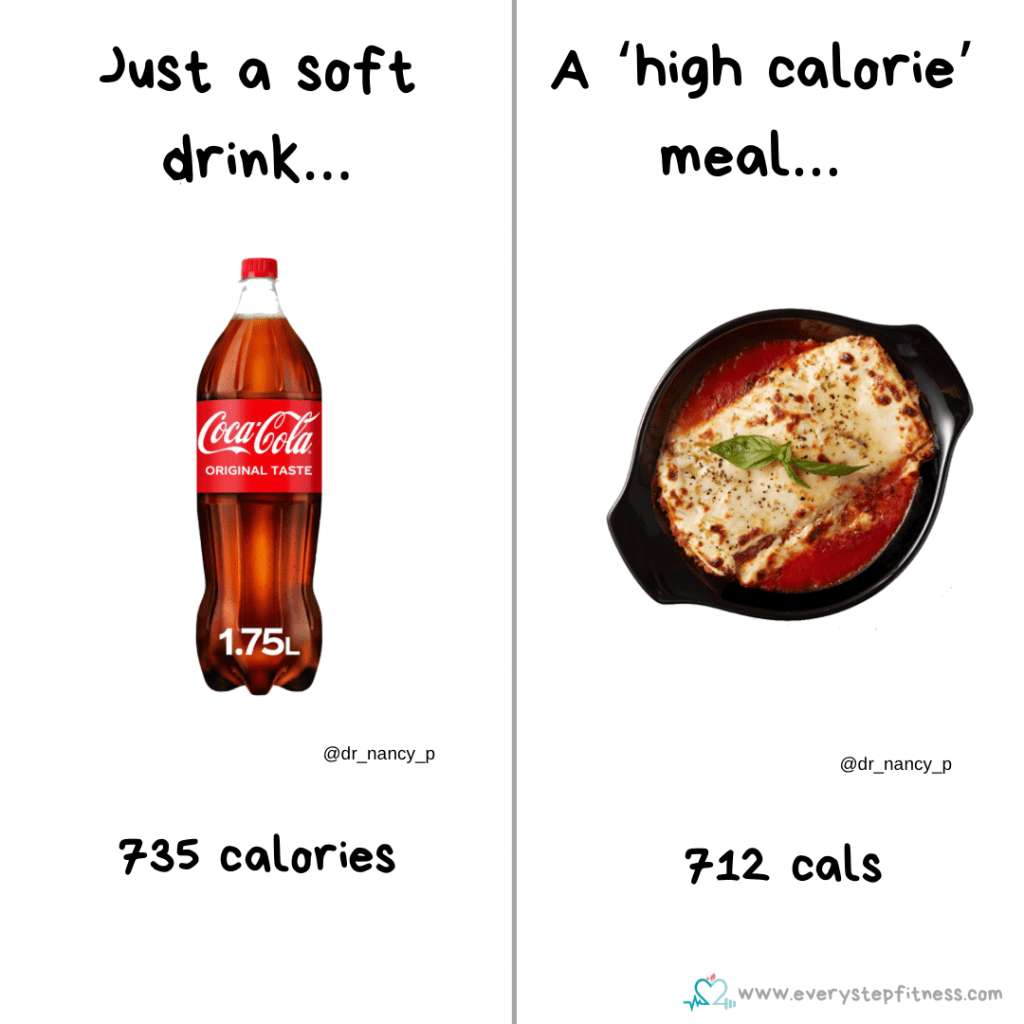
You’d probably be pretty aware of the calories in a pizza express lasagne for example, and if not aware of the exact number you’d certainly realise it was a fairly high calorie meal. But would you be as aware of the calories in a soft drink like coke? It’s not unusual for people to have 1-3 glasses of something like this a day so it’s entirely possible you could drink a 1.75 litre bottle in a day or two. You may overlook including that in your calories and yet it’s actually more cals than a main lasagne!

Now that’s not to say you shouldn’t have the coke – if you want it and like it then have it! Just be aware of the calories in it before you do. The same applies to juices, alcoholic drinks, coffees and teas (unless drunk black). If you’re not dead set on the coke then swap it for a zero calorie soft drink instead – it’s an easy win!

So if you’re tracking cals and hoping to lose fat make sure you include these, and if you’re just trying to cut some cals maybe they’re a good place to start being more mindful too?

Remember – ALL calories count! 🤗xx

Nutrition and Calorie Tips

Should you weigh yourself?

Should you weigh yourself? 📉

When you’re trying to lose weight (by which we really mean body fat as that is what actually results in body shape change) then it’s important to find ways to measure progress.

The scale can be a great tool to assess whether you’re making progress, or not. However, the number the scale shows is JUST a number. It’s merely your relationship to gravity at that particular moment in time. It’s meant to be used as a data point to track progress over time. If you decide to use the scale, you need to overlook the day to day changes you will inevitably experience. Scale weight is affected by lots of factors – amount of food in your system, hydration levels, glycogen levels, hormones, salt content of your diet, recent exercise, type of food you ate yesterday (diff foods can result in more or less temporary water retention) etc. None of which are a reflection of how much fat you’ve lost or how your shape has changed. Think about it – if you had the body you wanted and felt confident to wear anything you liked, would it matter what that scale number was? No!

Data is king and the more data you have the better decisions you can make regarding your progress. It’s not good to rely too much on one method of monitoring progress since they’re all subject to daily fluctuations that can make harder to view and interpret the data. Using things like body measurements, and how clothes fit are useful ways to see if you’re losing fat (if that is your goal). If you do use the scale then it’s better to take regular readings and then take the average for the week or month and compare that to previous averages to show the overall trend.

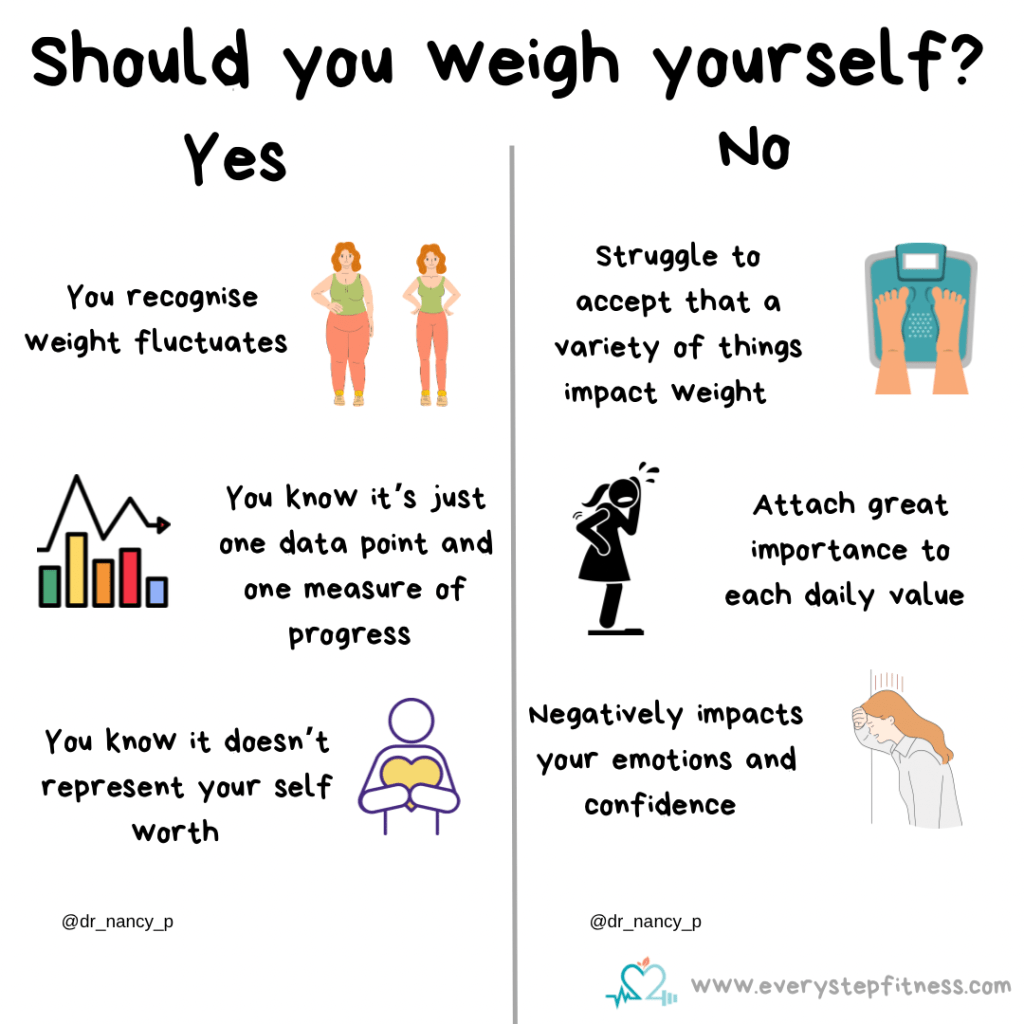
Should you weigh at all? First off ask yourself – what’s your relationship with the scale like? How much power do you give that number to define how you feel

for the rest of the day? Are you thinking about all the factors that influence that scale number? If you find it hard to overlook those fluctuations and hard to rationalise that they may be a result of things other than fat gain, if you you dread the scale and that the number impacts you emotionally, then no, it’s probably not a good option for you right now. Use other measurements of progress like measurements, progress pics, how clothes fit, performance, mindset changes and changes in confidence instead. If you like data and recognise that the scale number will fluctuate and that doesn’t faze you then go for it!

🤗

Xx