Nutrition and Calorie Tips

Healthy vs unhealthy starter?

Healthy vs unhealthy starter? 🥟

If you’re trying to watch your calories or lose weight then restaurant meals can be tricky (although considerably easier now larger restaurants have calories on their menus). We often have a number of preconceived ideas about which the ‘healthier’ option is and equate that with lower calorie. In reality sometimes things aren’t quite as you’d expect.

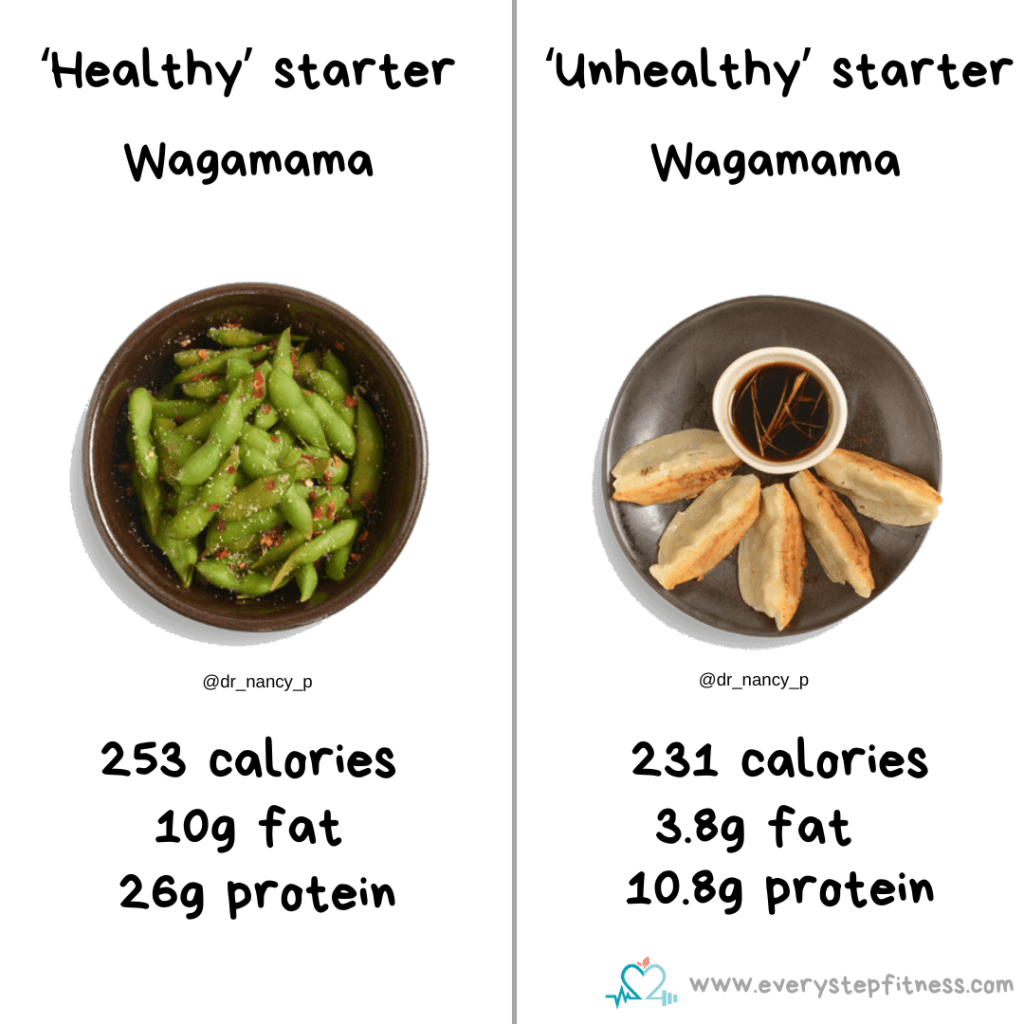
A great example of this is the classic Wagamama starter or side of edamame beans with chilli garlic salt. These yummy little beans are a popular dish and definitely a healthy choice as they’re full of nutrients. I think most people would order them thinking they were the best option calorie wise, and probably not even really think about tracking the cals (because they’re just veg right?). You’d probably munch on these without even thinking about it before you had your main starter and meal. Or you may even avoid another starter or side you actually prefer to choose these instead in the belief they’d be lower calorie.

However that’s not actually the case. It would be natural to assume that the pulled pork gyoza starter was a ‘worse’ choice in terms of calories. In reality that dish is actually lower calorie and fat than the edamame beans. The difference isn’t huge but it is there nonetheless. It also shows that those beans are a significant addition to the overall calories of the meal. So they are definitely worth counting and not something to have as an extra unless you actually want them!

Enjoy 🤗

xxx
Tuesday Tip

Tuesday Tip: Diet and Sleep Quality

Tuesday Tip: Diet and Sleep Quality 😴

I recently wrote about the link between sleep and fat loss and how increased sleep can aid fat loss. I discussed ways to help aid sleep but one other factor that impacts sleep quality is diet.

Sleep quality can be characterized by the amount of slow wave sleep (SWS) & rapid eye movement (REM) sleep one gets at night. As sleep progresses these 2 stages occur with greater duration. SWS has a restorative function and is known as deep sleep. Both SWS and REM are involved in memory consolidation.

Studies have found that certain nutrients can influence sleep quality. Increased saturated fat and decreased fibre intake reduces SWS , increased night time wake ups, and decreased overall sleep quality.

Alcohol consumption decreases REM sleep, whilst caffeine is linked to delayed sleep

onset (difficulty falling asleep) and decreased sleep quality. I’m addition larger portions or eating large meals just before bed also disrupts sleep due to the thermogenic effect of digestion.

In contrast increased carbohydrate consumption is linked to faster sleep onset (falling asleep faster), and increased protein and dairy can promote longer sleep duration. This is particularly true for tryptophan rich protein sources such as milk, yogurt, turkey,chicken, fish, eggs, pumpkin seeds, beans, peanuts and leafy green veggies. The idea of a nighttime glass of milk aiding sleep comes from the fact it’s rich in tryptophan and natural melatonin

Antioxidant (Vit C, E & A) and magnesium consumption not only aids recovery from exercise but may also affects sleep since their regulation is influenced by pro-inflammatory cytokines which promote sleep.

So what’s the takeaway here? No takeaway that’s for sure!

Avoid large meals, alcohol and caffeine close to bedtime. Instead have a balanced light meal including carbs, protein and dairy (if you eat it) and green veggies to aid sleep. And if you need a snack later on consider something like a bowl of cereal with milk for example.

Happy Tuesday 🤗xx

Nutrition and Calorie Tips

Weekday restriction = weekend overeating

Weekday restriction = weekend overeating🍕

This is an extremely common pattern I see – being overly restrictive during the week and then overeating at the weekends. It’s tempting to go for lower calories during the week so you can ‘relax’ at the weekend. There’s nothing wrong with this and it is a strategy I employ with some clients, so sometimes this CAN work, but it rather depends how much you restrict and relax!

For example, let’s say you have a cal goal of 1800 cals. So Monday to Thursday you go extra low and only eat 1500 cals. By Friday you’re feeling deprived and craving the foods you’ve avoided, and then Saturday and Sunday you totally “relax” and have a few “treats”, because it’s the weekend right? You’ve been good all week so it’s fine… Things like two weekend breakfasts, a pizza, a few glasses of wine, some crisps, Sunday evening ice cream and chocolate etc are easily well over 1500 extra calories and take you to 14,750 calories for the week

That makes a daily average of 2100 cals and is why you won’t be losing fat. These sort of weekend ‘treats’ aren’t crazy or particularly over indulgent. I’m sure we’ve all had weekends like that right? But if you’re overly restrictive during the week you’ll find it even harder to restrain yourself over the weekend.

Now I’m definitely not suggesting you don’t enjoy some of these foods from time to time, but if you really want to lose fat then its worth getting away from the idea of restricting during the week and ‘relaxing’ at the weekends. Have the things you enjoy but in moderation and within your overall weekly calorie target – all week.

Choose a sensible calorie goal that you can include some treats in and stick to it every day – being overly restrictive during the week rarely works and almost always results in over eating at the weekends.

If you do have events or meals out to plan for at the weekends you can still reduce your weekday calories a little to give you a buffer for the weekend but only aim to save 100-150 cals per day max. Also try going for smaller options of the weekend treats, a small bar of chocolate, a single portion bag of crisps, low cal ice cream etc. Pick one meal you want to let your hair down with rather than the entire weekend and keep tracking over the weekend so you can see where the extra cals are creeping in.

🤗

Xx

Nutrition and Calorie Tips

‘Low calorie’ cereal vs normal cereal…

‘Low calorie’ cereal vs normal cereal… 🥣

Weight loss is such a massive industry that it’s not surprising food manufacturers have tapped into that for their marketing. It’s very common to see foods marketed as ‘skinny’ or low calorie. Most people would assume that the ‘skinny’ chocolate cereal is a lower calorie choice whilst the coco pops are a higher calorie choice.

In reality the coco pops are actually lower in calories than the skinny branded product. The skinny cereal also use a 25g serving for their proclamation of only 108 calories, whilst most cereals use 30g. So if you were comparing these quickly in store you may not spot that (30g coco pops is 116 cals).

So don’t automatically assume these weight loss branded foods are always the better option. Sometimes they’re the same or worse than other brands and often pricier. If you enjoy them then definitely have them, but if you’re only having them because you think they’re ‘good’ then think again.

Read the labels and look at the calories and then make your choice. If you’re trying to lose weight then go for the lowest calorie option, that you actually want to eat!

🤗xx

Tuesday Tip

Tuesday Tip: You snooze, you win!

Tuesday Tip: You snooze, you win! 😴

Whilst fat/weight loss always comes down to maintaining a calorie deficit there are things which help make this easier – sleep being one of the biggest ones.

Sleep is one of the most underrated contributors to overall health and body composition. Chronic lack of sleep has negative effects on the immune, endocrine, nervous and cardiovascular systems and increases risk of illness and injury. Studies have shown an association between increased BMI and those with a chronic lack of sleep (under 7hrs a night). Studies also show that reduced sleep is associated with an increased energy intake – sleeping under 5.5 hrs a night was linked to an average increase of almost 250 cals per day. A further study investigated the impact of improving sleep length on energy intake and found that extending it to 8 hrs a night led to a decrease in energy intake of 270 cals per day. There was also a link to weight loss in this group (unsurprisingly given the reduced calorie intake). For each extra hour of sleep energy intake decreased by 162 cals per day.

Lack of sleep also impacts your exercise resulting in reduced reaction times, accuracy, strength and endurance. It also results in longer recovery times.

So how can you improve your sleep?

⁃ Aim to set aside approx 30 mins before bed to wind down and destress.

⁃ Aim for consistent sleep and waking times – so try to avoid the pattern of early wake ups during the week and very late wake ups at the weekend.

⁃ Reduce consumption of caffeine, alcohol and nicotine in the 2-3 hours before bed

⁃ Studies have also shown that reducing screen time before bed leads to improved sleep quality, falling asleep faster and waking up less during the night. So aim to put your phone away 30 mins before bed, and avoid viewing potentially stimulating content like social media/news as it can impact your mood/anxiety levels which will result in less sleep.

So put the same effort you do into your diet into your sleep to maximise results!

Happy Tuesday 🤗xx