Tuesday Tip

Tuesday Tip: Dealing with Weight Loss Plateaus

Tuesday Tip: Dealing with Weight Loss Plateaus📈

Usually a few months into a new diet (or eating regime) we start to see plateaus – this is despite people claiming they are still eating the same amount (at a calorie deficit) and exercising the same. Why?

As you get ‘smaller’ your resting metabolic rate drops so you need fewer calories, therefore you may need to adjust your calorie target. You may also be more tired as you’re running at a calorie deficit – this impacts your activity levels – both consciously in terms of perhaps skipping workouts, working out less, reduced intensity, fewer steps etc but also subconsciously. A recent study found that for every 1kg lost participants expended 20 – 30 cals less energy per day. This is a subconscious reduction in NEAT (non-exercise activity thermogenesis) such as standing less, walking less, less fidgeting etc and a decrease in bodily functions e.g. blinking less, breathing slower etc

In addition as you progress diet adherence weakens and motivation wanes, so you’re more likely to have a few more ‘off track’ days. You’re also likely to be relying more on eyeballing portions and not being as accurate – without realising it extra calories sneak in and portion sizes subtlety increase.

Subconscious eating also increases – a nibble of the kid’s tea, a handful of cereal as you pass the kitchen, grabbing a biscuit at work etc. You become less aware of these.

A couple of recent studies found that as weight (fat) loss dropped participants subconsciously increased their calorie intake. For every 1kg of fat lost, they were consuming an extra 100 calories per day, without even realising they were doing it.

So after losing 3-4kg you could be unknowingly consuming an extra 400 cals, and burning 120 cals less, that means an extra 520 cals a day which wipes out your deficit, can stall any fat loss and even cause weight regain.

So what can you do?

First accept it’s happening. The hard thing is that it won’t FEEL like you’re eating more and moving less, so it’s easy to blame other causes – hormones, ‘my stubborn body’, the ‘diet’ etc. Go back to basics and measure portions again and be mindful of extra mouthfuls of things you’re not tracking (grabbing the odd handful of cereal, crisp, etc). Focus on more filling foods to help combat the hunger too – foods high in fibre, protein and good fats.

In terms of energy expenditure – try to be as active as possible – add a few more steps to your day for example, be mindful of standing more than sitting etc.

Happy Tuesday 🤗

Xx
Nutrition and Calorie Tips

Raw vs cooked calories….

Raw vs cooked calories…. 🍝

A question I’m often asked is whether you should track your calories as raw or cooked weights? To be honest it doesn’t matter as long as you’re consistent and know which you’re tracking so you can record the correct calories, but it can be a little confusing!

Unless otherwise stated nutrition labels are usually raw weights. However, you’ll find sometimes some grains, pasta and pulses might be listed as cooked or ‘as prepared’ weights – which is when you need to be careful, as you will underestimate cals if you weigh them raw.

Different foods absorb different amounts of water as they’re cooked. This makes them swell and weigh more. So for things like rice, pasta, cereals etc it’s probably best to track them as raw weights. As you can see there are small differences between white and brown varieties but only after cooking really, which is down to the differing amounts of water they absorb. You’ll also find different shapes and types of pasta will vary too for the same reason. Oats are the same and in fact over 80 percent of the weight in cooked oats is actually water.

Protein sources, like chicken, tend to lose weight when cooked. This is because the water and liquids in the meat evaporate during cooking. They loose 20-25 percent of their weight during cooking. Again it’s best to track raw weights. It’s also worth noting that the cooking method has an impact on meat too. The calories for 100g cooked chicken are based on a grilled skinless chicken breast, the same amount of roast chicken (skinless) is 220 cals – due to the fats in the meat thanks to the roasting. So that’s also worth remembering if you’re a roast fan or are oven baking chicken with the skin on.

Whichever you chose to track is up to you but be sure to choose the right option in your tracking app.

Enjoy 🤗

Xx

Nutrition and Calorie Tips

Coffee time!

Coffee time…! ☕️

If you’re a coffee drinker then it might be worth just taking note of the calories in your brew of choice (if you’re trying to lose weight/fat).

A swap to a different style of coffee can help save some cals – especially if you’re a multiple brew a day kinda person.

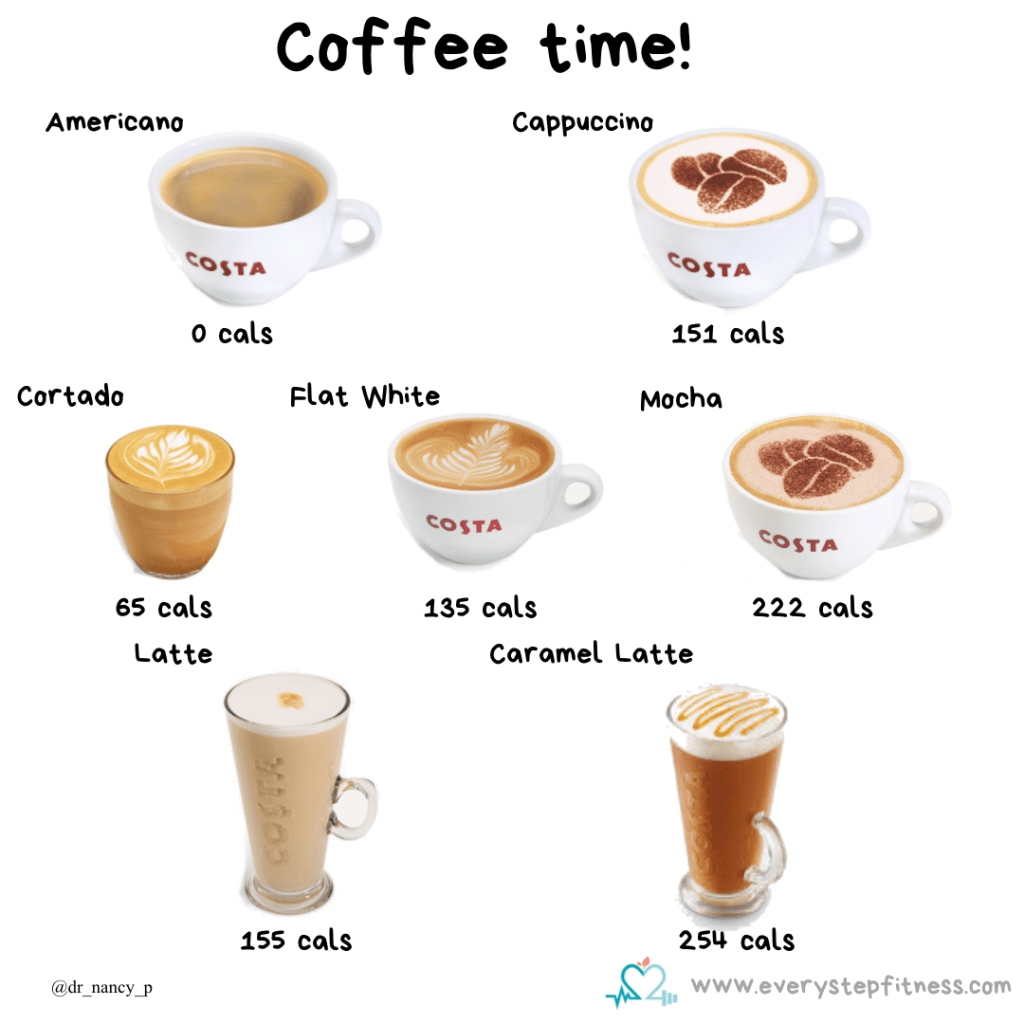
Remember coffee itself is essentially calorie free so it’s the milk and any additional syrups etc that add the calories. This is just an overview of a few of the most commonly ordered coffees. They happen to be Costa coffees but the calories are similar across brands. These calories are based on a medium sized drink , made with semi-skimmed milk. I’ve discussed the calories in other milks before and you can also save calories by going for skimmed milk or unsweetened almond milk which is the lowest calorie option.

Here’s a run down of the most commonly ordered brews:

Americano – if you have it black it’s basically 0 cals.

Cappuccino – 155 cals

Cortado – 65 cals

Flat white (nb this is for the largest size which is a small) – 135 cals

Mocha – 222 cals

Latte – 155 cals

Caramel latte – 254 cals

Enjoy 🤗

Xx

Tuesday Tip

Tuesday Tip: Tips for Eating out within your calories

Tuesday Tip: Tips for Eating out within your calories 🍽

Many of us are back to eating out, if trying to lose fat/weight it can be a challenge to keep things under control. Here are some tips to help reduce those extra cals.

#1 Sauces on the side

Ask for sauces/dressings on the side. Choose tomato-based sauces, and avoid cream based ones. This can save over 300 cals.

#2 Stand your ground

Don’t feel pressured to go for higher cal options just because others are. Its your body, not theirs, so choose what you want. It should be about the company, not what’s on your plate/glass.

#3 Check in advance

Check the menu in advance, choose your meal and log the cals ahead of time. You can then make it fit into your daily/weekly target. You’ll also be less likely to be swayed by whoever you’re with.

#4 Avoid the nibbles

It’s an obvious one but just avoid the pre dinner bread, or olives etc You don’t need them, you’re about to have a full meal!

#5 One course

Most restaurant main courses will be 650 – 1500 calories so you really don’t need more. Ideally go for one course, especially if eating out several times a week.

#6 Starter for main

Try going for a starter as a main and then bulk it out with a side salad or veg. This is also a great tactic if the people you’re with are having 2 courses – you can have a starter and a starter!

#7 Food choice

For starters opt for salad or soup (avoid cream-based ones), then fish (white fish is best) or chicken for main, grilled or baked. Vegetarians beware of cheese-based dishes and consider asking for the vegan options. For pud; a sorbet or fruit based dessert is best.

# 8 Limit the booze

Booze is extra cals so try to avoid it, or alternate with tap water and try to choose lower calorie options (e.g. slimline gin and tonic).

#9 Don’t starve yourself

Don’t starve yourself before a meal out as you’re likely to lose self control and overeat. Instead adjust your other meals to save 100-200 calories on the days before and after to help buffer it.

#10 It’s not about the food

When you look back at these events it won’t be the food you remember – it will be the shared stories and laughs, with the people you’re with. Take the focus off the food.

Happy Tuesday 🤗

Xx

Nutrition and Calorie Tips, Uncategorized

The lower sugar myth…

Sugar is often vilified as the cause of all health issues and as a result many companies have latched on to the idea that people are keen to reduce their sugar consumption. Now whilst sugar in excess amounts is undoubtedly not good (no nutrient in excess is) normal amounts of sugar in the diet are absolutely fine. However if you’re diabetic or trying to reduce your reliance on sugary snacks then it may be sensible to opt for some lower sugar options.

If you’re trying to lose weight (fat) then you may also decide to reduce sugar consumption. Many people equate lower sugar to mean lower calorie and would therefore go for the reduced sugar option in the belief that it would help them lose weight. In this example the actual difference is pretty insignificant.

A bag of normal Colin the Caterpillar sweets contain 499 cals, whilst the reduced sugar version contains 471 cals – a reduction of 28, which is unlikely to result in weight loss. Yes, every little bit counts, but the expectation would probably be that it was much lower and therefore you may eat a larger portion, or expect bigger fat losses from this small change. So at first glance you’d assume it was a lower calorie option. It’s not really! Clever eh?

So if you’re trying to reduce your calories and are going for the reduced sugar versions of things you love just take some time to check the calories and portion sizes and see if there really is a difference. If you enjoy the reduced sugar option and it helps to keep you on track then go for it! But don’t pay more for a marketing ploy when you don’t need to. Enjoy the sweets you like, in moderation, as part of a balanced diet 🤗

Xx