Tuesday Tip

Tuesday tip: Turning fat in to muscle

Tuesday tip: Turning fat in to muscle 💪🏼

How do you turn fat in to muscle?

Sadly you can’t! Fat is fat, muscle is muscle – totally different types of tissue. Both can be lost or gained – that’s it. So what’s happening when people say this? Well in reality people are losing some fat, and gaining some muscle, which is why it may seem like fat has “turned into” muscle. Fat is lost when you have a calorie deficit, muscle is gained by having a calorie surplus, working out (a muscle building stimulus) and having the raw materials to do it – protein. In most cases if you’re losing weight you are mostly losing fat, though if you are also upping your exercise then there will be some increase in muscle too – which is one reason why weight loss is often not a perfectly linear process. This will work best for those with a reasonable amount of fat to lose, on a moderate calorie deficit i.e. no starvation diets, who also increase their activity. This is what I design for many of my clients. It means you’ll be losing fat and also gaining a little muscle too. As muscle is denser than fat you’ll also shrink (they weigh the same… muscle just takes up less space than fat).

So what about when you stop working out? Does muscle magically turn in to fat?

Nope! it can’t! What happens though is if it’s short term your muscles are just less “pumped” so you “feel” fatter. Longer term you simply lose some muscle and probably gain some fat. This is because when you remove the stimulus which tells your body to build/maintain muscle (i.e. strenuous physical activity) you will lose the muscle mass. You’ll also end up burning fewer calories both through less activity, but also less muscle mass means a lower bmr (basal metabolic rate – i.e. calories burnt at rest), and so you are more likely to end up in a calorie surplus and put on fat.

The only way to prevent muscle being lost long term is to continue to workout! But you can prevent fat being gained – simply by ensuring you don’t eat more than your maintenance level of calories (easier said than done – though not impossible!)

So bottom line – fat can never be turned into muscle, and muscle is never turned into fat!

Happy Tuesday 🤗

xx

Recipes

Chocolate peanut butter healthy pancakes

Something for a rainy Sunday afternoon! These are based on my quick and easy healthy banana pancakes (recipe here) – just with a couple of Sunday additions! This makes two small pancakes, enough for one person, and comes in at approx 280 calories, plus the fruit.

You will need:

1 banana

1 egg

2 tbsp flour (any flour you like)

Cinnamon (optional)

1 tbsp cocoa powder

1 tbsp peanut butter

Fruit of your choice

Mash the banana with a fork in bowl, add the egg and mix well.

The mixture will vary in consistency depending on your banana size and ripeness, and egg size – it really doesn’t matter though. Add the flour, cocoa and cinnamon and mix well. Stir in the peanut butter.

The batter will be lumpy – that’s fine too! Heat a little oil in a pan and then add the batter. Leave to cook on one side, then flip.

Serve with fruit (if you need it you can also add some maple syrup or other liquid sweetener but I find the fruit is sweet enough)

Enjoy 🙂

xx

Recipes

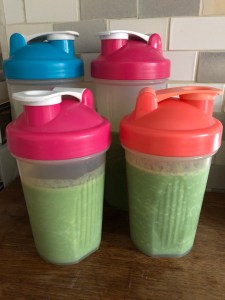
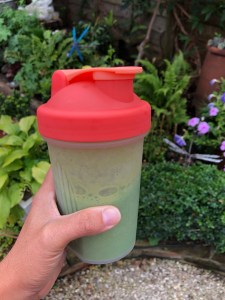
Vanilla brekkie smoothie

This is my brekkie almost every day – it’s easy to grab and go, and I make a batch of 4 or 5 so I don’t have to worry in the mornings. You can switch the protein powder for nut butter if you like, I use the powder because it helps to keep me full and gives a balanced brekkie for me. Don’t worry about the spinach – you can’t taste it at all, but it does give a load of extra vitamins and minerals and studies have shown it also helps to increase exercise performance so it’s worth including!

This makes a full large blender load (I use a vitamix which holds almost 2 litres) and I split that between 4 or 5 shakers, each is about 250 – 75 cals. I use frozen spinach for ease but you can use fresh too.

You will need:

2 bananas

1 litre of your milk of choice (I usually use light soya, but go for whatever you fancy)

2 very large scoops of protein powder (I use a vanilla one usually and the scoop is equivalent to about 2 heaped tbsp)

8 cubes of frozen spinach (or 2 large handfuls of fresh)

Large handful of ice

Pop it all in the blender, whiz until smooth and creamy. Pour into shakers and store in the fridge. I usually add a couple of cubes of ice in the morning just to keep it cool.

Enjoy! 🙂

Xx

Recipes

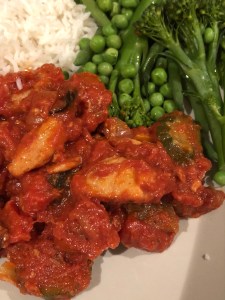
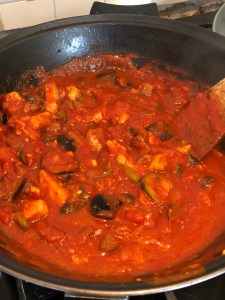
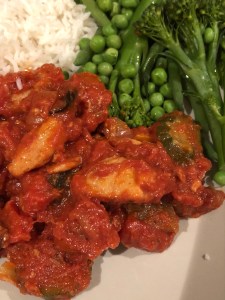
Quorn ‘chicken’ catchyuppy!

This is an adaptation of an old favourite of mine. It’s actually a cacciatore but I always used to call it catchyuppy as a child so the band has stuck! I used to use left over roast chicken for this (and you obviously can too) but this version is vegetarian and lower in calories, but still just as yummy and filling! It’s also quick and easy to make.

I like to use the quorn chicken fajita strips in this but you can use any of the chicken pieces if you prefer. You can use any veg you like and if you’re short on time you can use the frozen packs of roasted veg (they usually contain courgette, pepper, onion, aubergine). Also it’s worth noting that Lea & Perrins Worcestershire sauce contains anchovies so if you’re vegetarian then double check – Biona and other companies make one without the use of animal products and it’s widely available.

This serves 4 at about 270 cals per portion.

You will need:

Approx 300g quorn chicken (2 packs of fajita strips)

400g passata

300g mixed vegetables (either a pack or 1 onion, 1 pepper, 1 courgette, 1 small aubergine)

1/2 tsp Paprika

1 tsp mixed herbs

1/2 tsp cayenne pepper

1 vegetable stock cube

1/2 tsp Worcestershire sauce (optional)

1/2 tbsp Balsamic vinegar

1/2 tsp of sugar

Salt and pepper

If using fresh veg then prepare it and chop it up. Heat a little oil in a pan, add the onions and pepper first, allow to soften then add the courgette and aubergine (if using a pack then just throw it all in at once). Add the quorn chicken and allow to brown a little.

Cook for a couple of mins and then add the passata. Stir well and bring to a slow simmer. Add the stock cube, all the spices, balsamic vinegar and Worcestershire sauce and stir well. Add the sugar (this brings out a richer tomato flavour).

Bring to a simmer and allow to cook through for about 10-15 mins.

Serve with green veg and grains.

enjoy 🙂

Xx

Tuesday Tip

Tuesday Tip: Meal frequency and weight loss

Tuesday Tip: Meal frequency and weight loss 🥘🥗

There’s lots of confusion about meal frequency and weight loss: eat more often to lose weight, or eat less often to lose weight? Actually how much you eat matters more than how often you eat. If you want to lose fat the most important thing is to reduce your calorie intake.

Eating more small meals = faster metabolism = more weight loss?

Sadly not – yes digestion increases metabolic rate BUT it depends on the amount of cals, not how often you eat. Eating 1200 cals in one meal or 3 small meals makes no difference. Studies have shown that when total cals are controlled eating more or less often makes no difference. What it might do though is affect your ability to stick to those calories!

Skipping meals is bad? Scientifically it’s not, it won’t suddenly cause you to enter starvation mode and magically store fat – it all comes down to calories. What it may do is make you hungrier later or cause you to snack more or make bad choices, equally it could mean you don’t have the energy to workout and make you less active, burning less cals. So stick to what works for you.

Consider eating less often if:

⁃ many small meals doesn’t fit your lifestyle

⁃ you don’t want to think about food all the time

⁃ you have any digestive problems (longer breaks between meals gives your body a chance to digest)

– you enjoy larger portions

Consider eating more often if:

– you struggle not to snack and want to spread your cals over the day

– you’re trying to gain weight and can’t eat enough in one meal

– you have an active job and high cal demands

– you’re an athlete

– you feel “hangry” all the time

There’s no magic number of meals per day for weight loss. Trust yourself – if you like smaller meals more often then go for it, if not stick to 3 meals or whatever. Whichever you choose though? stick to it as studies show that meal irregularity can have negative health impacts – so whether it’s 2, 3, or 6 meals a day that’s fine. But don’t forget – regardless of how many meals you split it in to, it’s the total calories that matter!

Happy Tuesday 🤗

xx