Nutrition and Calorie Tips

A well deserved treat….

A well deserved treat…. 🚶🏼‍♀️☕️

How often do you reward your physical activity with some sort of food or drink? Or how often do you justify eating or drinking something because you’ve worked out or done a long walk or because you’re going to? I hear it all the time from clients – ‘I did end up having fish and chips, but I did 3 classes’ or ‘I did go over my calories at the bbq but I did do 25000 steps’.

Now whilst the physical activity is great and is absolutely something to be proud of – it’s not something to use to justify overeating. For starters you don’t need to justify eating food. Trying to ‘earn’ food isn’t a good thing and it also sets up a really unhealthy relationship with food whereby you almost have to ‘punish’ yourself to be allowed to eat. Also the chances are that in most cases you’ve grossly overestimated the number of calories burnt in that activity. If you’re trying to lose weight and aiming for a calorie deficit and using those ‘exercise caloires’ to justify eating more then you’re probably affecting your progress. Even if your activity tracker tells you you’ve burnt xxx cals – it will be an overestimate. Most of our activity trackers (particularly wrist based ones) are inaccurate. So if it tells you you’re burning 600 cals, you’re probably burning far less. A recent study compared calories from activity trackers for various workouts (cross trainer, spin, treadmill etc) and found they over estimated calories burned by an average of 40% with some overestimating by 90%!

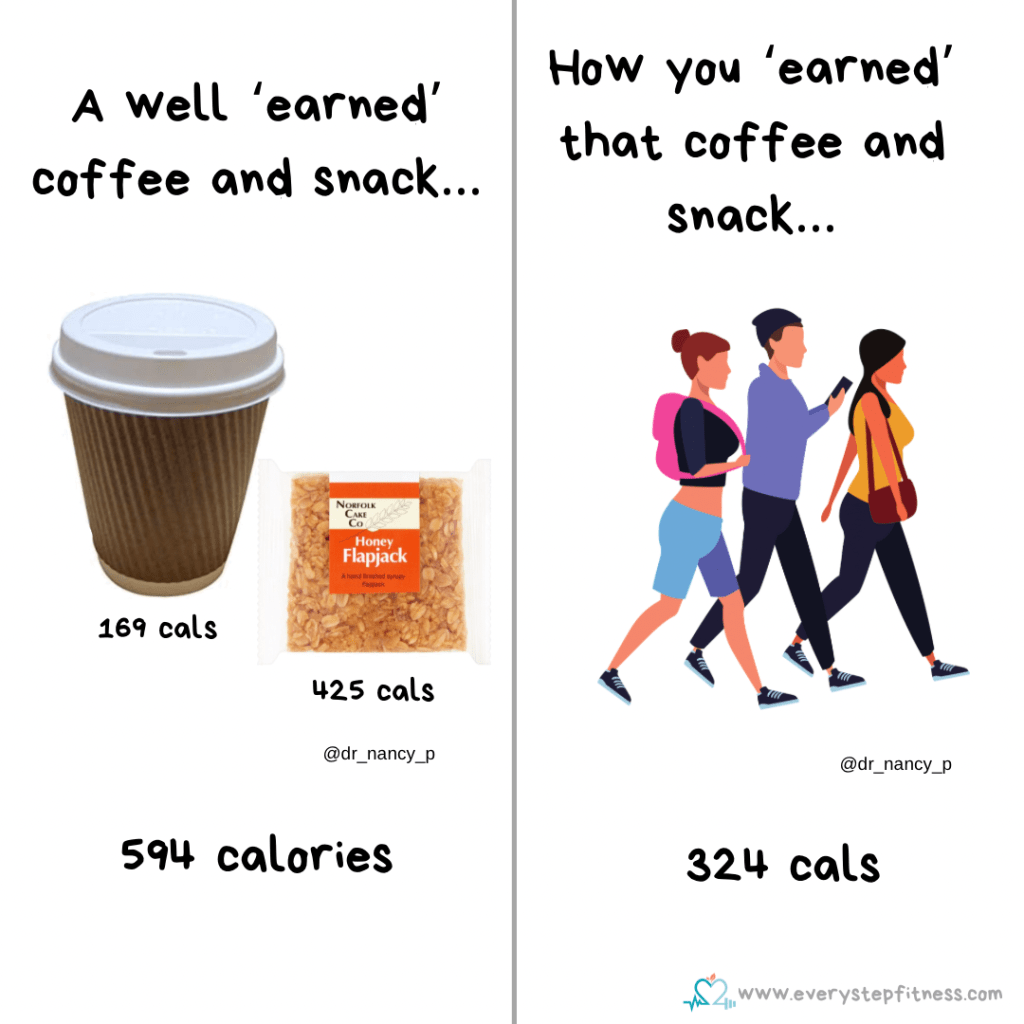
This is a great example – you’ve just gone for a two hour walk, and you get to the coffee shop and reward yourself with a large cappuccino and a flapjack! That’s ok right? Because you’ve walked miles! Obviously the calories burnt vary with age, gender, height, walking speed, fitness etc but an average calorie burn for that distance for a 50yr old, 5ft 5 female walking at average pace is 324 cals. The coffee and flapjack are a minimum of 594 cals!

So does this mean we shouldn’t bother working out? No of course not! Workouts and general activity (energy burned from daily life activities) all help to increase the calories we use, build lean muscle, keep our hearts and lungs healthy etc so it’s vital! What you shouldn’t be doing is eating these back or using them to justify eating more than you need. They’re a bonus; an additional help towards that calorie deficit. Track them, log them, but don’t treat them as a green light to eat what you want.

Equally you don’t need to ‘earn’ food – if you’re aware of the calories in things you can make informed choices about what you eat. It’s your body – you can eat what you want, when you want – you don’t have to exercise to earn it. Just be aware of the impact it may have on your progress if weight loss is a goal, then make the choice! Knowledge is power!
Tuesday Tip

Tuesday Tip: Cheat Meals

Tuesday Tip: Cheat Meals 🍔

You’ll often hear people talking about having chest days/ meals when they’re on a ‘diet’ and trying to lose weight / fat. Essentially it’s a day or meal when you eat whatever you want – so you stick to your calories all week and then relax and have anything you want for one day. They’re actually a really bad idea! This is why.

They can ruin your progress and mess up your relationship with food. For example, let’s say you are targeting 1800 cals per day to lose fat. You achieve this for 6 days, then day 7 you have a cheat day – which involves a takeaway, desserts, drinks, snacks etc of over 3,500 cals (very easy to achieve with a large takeaway and a few drinks). In one day you’ve wiped out your calorie deficit for the entire week.

The biggest issue is the word – cheat. Cheating is never associated with anything positive is it? So it already has negative connotations. Plus what are you cheating on? Yourself and your attempt to create healthy eating habits – that’s not good either! The cheat mentality just encourages a restrict/binge cycle approach to weight loss. If your diet is so restrictive you NEED to cheat then something is going very wrong!

Some argue that the ‘cheats’ boost your metabolism. Studies show that in reality there is only a short term increase of 3-10%, the majority of which is due to the thermic effect of food (your body burns more calories trying to digest the thousands of calories you consumed), and an increase in activity expenditure (people tend to move more when overfed). The extra calories burnt was only around 100-150 cals. So why would you eat 1000’s of extra calories to boost your metabolism by 150 cals? It makes no sense.

So does this mean you can’t eat more calories on some days? Of course not – it’s vital to be able to incorporate higher calorie days/meals into your diet but without derailing progress. The better approach is to work on a weekly average for your cals – so 1800 cals per day gives you a total of 12,600 cals per week. So you could lower your cals to 1700 for 6 days and then have 2,400 on one day for example (or however you want to distribute it). Just be careful of trying to go too low in the week to give more cals at the weekend – otherwise you’re back in the restrict/binge cycle.

You don’t have to do this but it’s a great way to be able to accommodate social events etc without derailing your progress!

Happy Tuesday 🤗xx

Nutrition and Calorie Tips

Just a soft drink…

Just a soft drink… 🥤

If you’re hoping to lose weight or fat then you need to be in a calorie deficit i.e. consuming fewer calories than you use per day/week etc. If you want to do it in a sustainable way you need to be aiming for a deficit of around 200-300 cals a day. Whether you track your calories to achieve this, or whether you just reduce portion sizes/make lower calorie swaps etc most people are better at taking food into account e.g. the mid afternoon snack, the pizza for dinner, but very often we overlook the liquid calories.

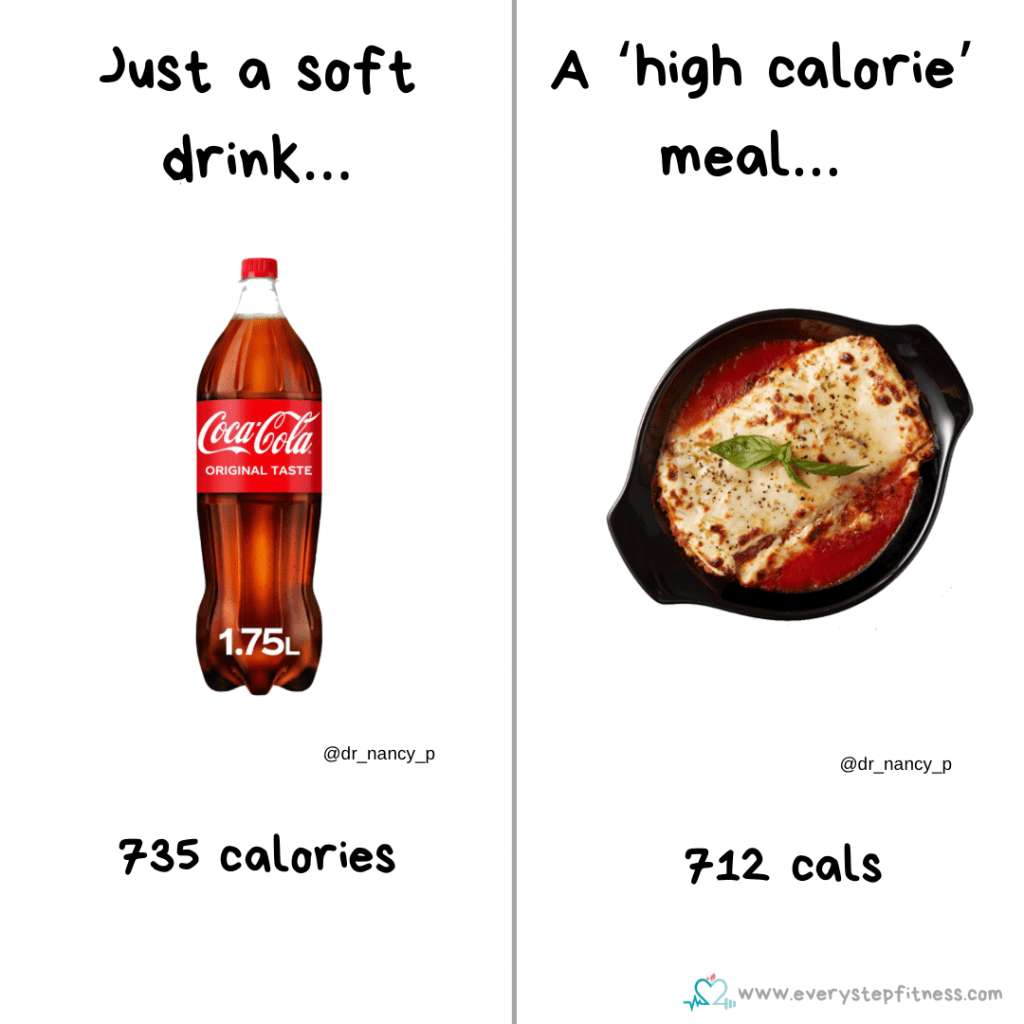
You’d probably be pretty aware of the calories in a pizza express lasagne for example, and if not aware of the exact number you’d certainly realise it was a fairly high calorie meal. But would you be as aware of the calories in a soft drink like coke? It’s not unusual for people to have 1-3 glasses of something like this a day so it’s entirely possible you could drink a 1.75 litre bottle in a day or two. You may overlook including that in your calories and yet it’s actually more cals than a main lasagne!

Now that’s not to say you shouldn’t have the coke – if you want it and like it then have it! Just be aware of the calories in it before you do. The same applies to juices, alcoholic drinks, coffees and teas (unless drunk black). If you’re not dead set on the coke then swap it for a zero calorie soft drink instead – it’s an easy win!

So if you’re tracking cals and hoping to lose fat make sure you include these, and if you’re just trying to cut some cals maybe they’re a good place to start being more mindful too?

Remember – ALL calories count! 🤗xx

Tuesday Tip

Tuesday tip: Alcohol and weight loss

Tuesday tip: Alcohol and weight loss 🍸

I never tell clients to give up booze, life would be miserable without that if it’s one of your go to ‘treats’ – I do however suggest it could be one way to ‘easily’ cut calories by reducing the amount they consume. Mainly because it’s a discreet, easily identifiable thing to reduce, but also because alcohol can affect weight loss in other ways.

Alcohol contains 7 calories per gram (vs 4 cals for carbs and protein,and 9 for fat). More alcohol means more calories. Unlike food, alcohol contains little to no nutritional value. Alcohol calories don’t fill you up like food calories do, or provide many micronutrients. This isn’t an issue in a balanced diet but just worth remembering when prioritising what you choose to consume.

Alcohol calories are processed differently too. Alcohol is a toxin so the cals are used immediately to generate adenosine triphosphate (ATP) to detoxify it. This detoxification is a labour intensive process so the liver ‘shuts down’ and stops processing fat, carbohydrates and protein because it needs to deal with alcohol. Hence why you get the munchies, because the detoxification of alcohol inhibits gluconeogensis (breaking down of our internal food stores). So not only does alcohol inhibit fat burning it also encourages over eating. The lack of inhibitions associated with alcohol also make it more likely you’ll ‘stuff the diet’ and eat more than you intended; so it’s a triple whammy!

So if you’re going to drink then just consider:

⁃ Plan ahead -do I have the calories in my budget? Can I bank cals for the night out?

⁃ How will consuming this affect my goals?

⁃ Is there a lower cal alternative that will allow me to stay on track?

⁃ Can I stay in control and only have 1 or 2 (or is it a trigger for binge behaviours?

⁃ Am I prepared for the consequences (hangover, munchies, loss of control, potential feelings of guilt etc)?

Alcohol is something you should enjoy in a

controlled manner. Learning how to work things into your calories teaches you how to be in control.

Happy Tuesday 🤗xx

Nutrition and Calorie Tips

Should you weigh yourself?

Should you weigh yourself? 📉

When you’re trying to lose weight (by which we really mean body fat as that is what actually results in body shape change) then it’s important to find ways to measure progress.

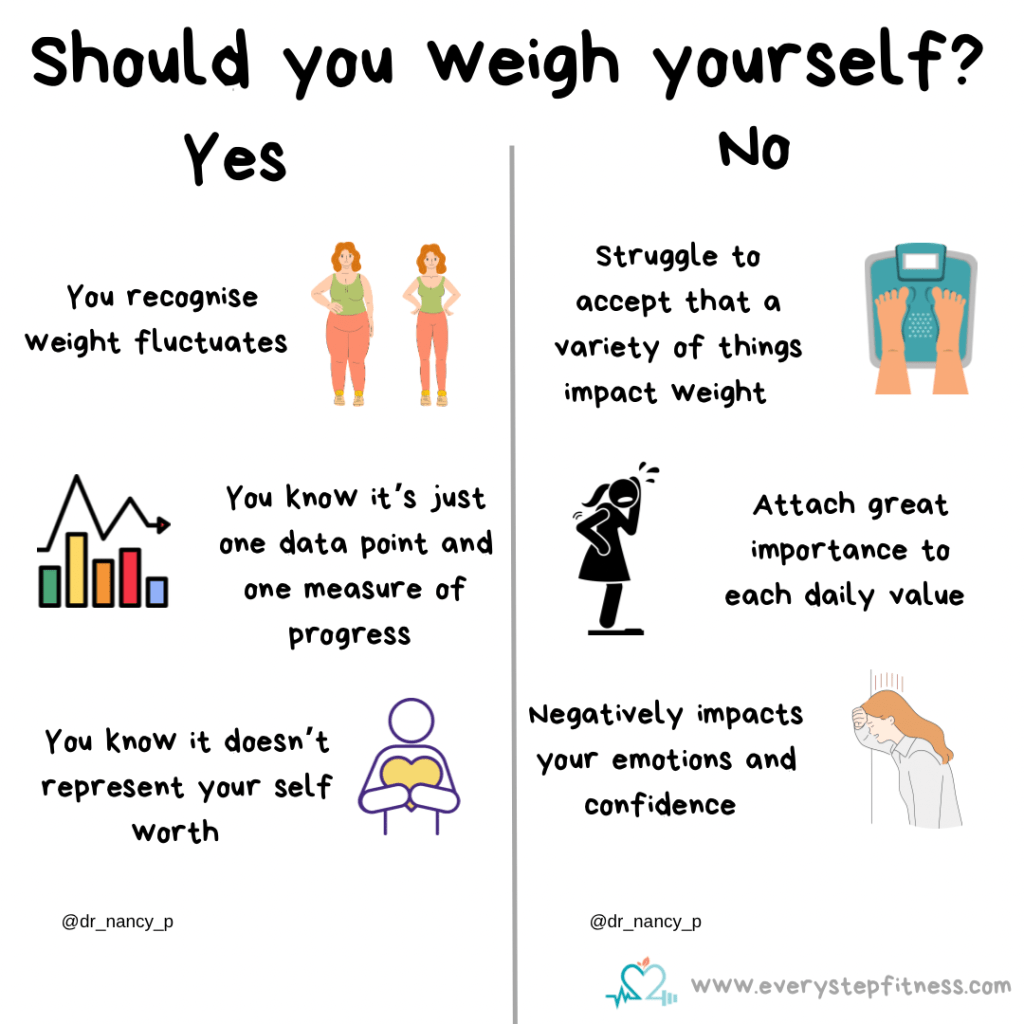
The scale can be a great tool to assess whether you’re making progress, or not. However, the number the scale shows is JUST a number. It’s merely your relationship to gravity at that particular moment in time. It’s meant to be used as a data point to track progress over time. If you decide to use the scale, you need to overlook the day to day changes you will inevitably experience. Scale weight is affected by lots of factors – amount of food in your system, hydration levels, glycogen levels, hormones, salt content of your diet, recent exercise, type of food you ate yesterday (diff foods can result in more or less temporary water retention) etc. None of which are a reflection of how much fat you’ve lost or how your shape has changed. Think about it – if you had the body you wanted and felt confident to wear anything you liked, would it matter what that scale number was? No!

Data is king and the more data you have the better decisions you can make regarding your progress. It’s not good to rely too much on one method of monitoring progress since they’re all subject to daily fluctuations that can make harder to view and interpret the data. Using things like body measurements, and how clothes fit are useful ways to see if you’re losing fat (if that is your goal). If you do use the scale then it’s better to take regular readings and then take the average for the week or month and compare that to previous averages to show the overall trend.

Should you weigh at all? First off ask yourself – what’s your relationship with the scale like? How much power do you give that number to define how you feel

for the rest of the day? Are you thinking about all the factors that influence that scale number? If you find it hard to overlook those fluctuations and hard to rationalise that they may be a result of things other than fat gain, if you you dread the scale and that the number impacts you emotionally, then no, it’s probably not a good option for you right now. Use other measurements of progress like measurements, progress pics, how clothes fit, performance, mindset changes and changes in confidence instead. If you like data and recognise that the scale number will fluctuate and that doesn’t faze you then go for it!

🤗

Xx