Tuesday Tip

Tuesday Tip: Common Tracking Errors

Tuesday Tip: Common Tracking Errors 😳

Tracking calories is a tool we can use strategically at certain times to accomplish specific goals, whether that’s improved health, sports performance, fat loss, or muscle gain. It can teach us quite a bit about food and nutrition as well, such as learning the energy and macronutrient composition of various foods. Tracking accurately is a skill though and it’s very common for people to unintentionally and unknowingly under-report or under-track their food intake in general. Small mistakes with tracking can really add up over the days and weeks and can mean the difference between you losing fat or maintaining your weight.

Here are some common mistakes:

# Eyeballing portions

Estimating and eyeballing portion sizes can be the difference between being in a calorie deficit or not. Weighing with a food scale in grams or ounces is the most accurate method you can use.

# Grazing and mindless bites

Untracked grazing, bites, snacks, sips, and licks still count towards your calories and can really add up. Often , we’re not even aware we’re doing this, so increasing your mindfulness and awareness can be key.

Plan out your snacks ahead of time and consider portioning things out in advance into serving containers. Or, buy your snacks prepackaged.

# Raw vs Cooked

Food loses and gains water weight when we cook it. For example, rice and pasta “gain” water weight while potatoes, protein sources, and vegetables “lose” water weight when they are cooked. Cooking methods and times affect how much water is gained or lost. The most accurate method is to weigh your food raw – or before you cook it. But what matters the most is that you are consistent with the method you chose and you choose the right calories to log – so check that whether the cals listed are “cooked” or”raw” entries.

# Generic meal entries

Your homemade spaghetti bolognese will have vastly different calories than many of the generic entries available in your tracking app. Track your meals by either entering each ingredient or (a more efficient way) use the recipe function in the app.

# Oils, dressings, condiments etc

Cooking oils, mayonnaise , mustard, ketchup, BBQ sauce, butter, milk in coffee, sauces, preserves and salad dressings are easy to forget. However, they can quickly add up to be a few extra hundred calories.

Don’t forget to track the oil you cook with (or swap to a 1 cal oil spray), condiments, milk, and dressings etc.

# Not checking the accuracy of entries

Certain tracking apps (like MFP) are notorious for having inaccurate or misleading entries. Sometimes the serving size is incorrect, sometimes the actual calories are out so if you can double check the entry against the label then do. Also, make sure your serving sizes are accurate in bought items and in your own pre-loaded meals or recipes (we tend to change servings over time so worth revisiting now and then).

# Forgetting to log

It’s so easy to forget what we’ve consumed – studies all support this and even trained nutritionists don’t recall everything. The best way to prevent this is to track in advance or as you go along. Before something goes in your mouth just open the app and log it. Don’t wait until the end of the day to log things. Aside from forgetting what you’ve had it’s also too late to make any changes once you’ve eaten it.

Happy Tuesday 🤗xx

Nutrition and Calorie Tips

‘I’ve put on weight overnight.. it must be fat ….’

‘I’ve put on weight overnight.. it must be fat ….’ 😱

We’ve all done this – you hop on the scales in the morning and to your horror you’ve put on 1-2 kg seemingly overnight! Like most of us the first reaction is probably to feel demoralised and demotivated, think all your weight loss efforts have been wasted and assume you’ve put however many kg of fat on overnight.

However the scales are not a very accurate measure when it comes to changes in bodyfat levels. Short term, significant, fluctuations in scale weight are normal and natural – especially large ones that seem to happen overnight. These do not mean changes in body composition, so you haven’t suddenly put on X kg of fat. Rather they tend to be related to water levels – intra and extracellular hydration.

Even if you did eat an extra 20000 calories in one day then you STILL couldn’t store that all as fat. Some would be expended in physical activity and metabolic processes, including the cost of digestion itself etc. The extra weight you see on the scales in short term fluctuations is water retention and food volume.

The reasons for it may include – a really big meal the night before, especially one that might be high in fibre, or red meat (which takes longer to digest). It could be due to your workout routine recently which can lead to short term fluid retention in the muscles. General hydration levels and salt levels will also impact it – especially if you had high levels of salt in your diet the day before. Hormones play a massive role – particularly for women and can cause fluctuations of up to 5kg due to water retention. Lack of sleep or high levels of stress will also cause you to retain fluids. Carb heavy meals and alcohol do exactly the same thing too – you retain fluid – short term. Now that is NOT to say you need to avoid any of these things – you should be working out, you should be eating carbs etc but it may help to explain any fluctuations you see.

So if the scale weight is up, then before you let it get you down, just stop and think about all the reasons it is probably fluctuating. Focus on being consistent with your calories over the long term instead, and use things like the way your clothes fit, or longer term trends in weight gauge progress (i.e. if you want to weigh yourself daily then take an average each week and use the trend of that average to gauge if you’re making progress). Remember it’s the average calories consumed over weeks or months that matter – not days!

Enjoy 🤗

Xx

Tuesday Tip

Tuesday Tip: Consistency is key

Tuesday Tip: Consistency is key 😇

Consistency is key – I say it all the time and I’m sure you find yourself saying it too – ‘I just need to be consistent…and then I’ll start seeing results’. But whilst that is undoubtedly true the issue lies in what we think of as ‘consistency’. Often we struggle with consistency because our expectations and perception of what consistency looks like aren’t realistic. We assume it means being 100% on our nutrition every day, smashing out 1-2 workouts every day hitting 10,000 steps daily, getting to bed early every day, and being 100% on it and motivated every single day.

But who can actually do that every day? I couldn’t! We’re all busy with work, families, social lives and many of us are already running on close to empty as it is. Trying to eat and workout like an Olympic athlete isn’t going to work. You don’t have time and you can’t sustain it . And this is why you feel like you’re failing – your expectations don’t match your capabilities. The better approach is to have a realistic, sustainable plan based on what you can manage.

A good way to do this – every Sunday (or any day that works for you) have a think about:

⁃ How many workouts you can realistically fit in and that you want to fit in that week? Maybe it’s 2 maybe it’s 4 … whatever is fine! Schedule them in.

⁃ Food wise could I keep it simple with the same basic breakfast and lunch for a few days? If so what do I need to get for that?

⁃ What social events/meals out do I need to plan ahead for?

⁃ How many steps did I manage last week? Could I do the same or slightly more this week (500 extra steps for example).

⁃ What small steps could you take this week to help reach your goal e.g. only drinking alcohol 2 nights instead of 4, swapping a heavy calorie snack for a lower calorie one etc

Focus on being consistent at things that you can actually fit into your life and you’ll find you’ll actually succeed.

Happy Tuesday 🤗xx

Nutrition and Calorie Tips

I’ve blown my diet.…

I’ve blown my diet.… 🫣

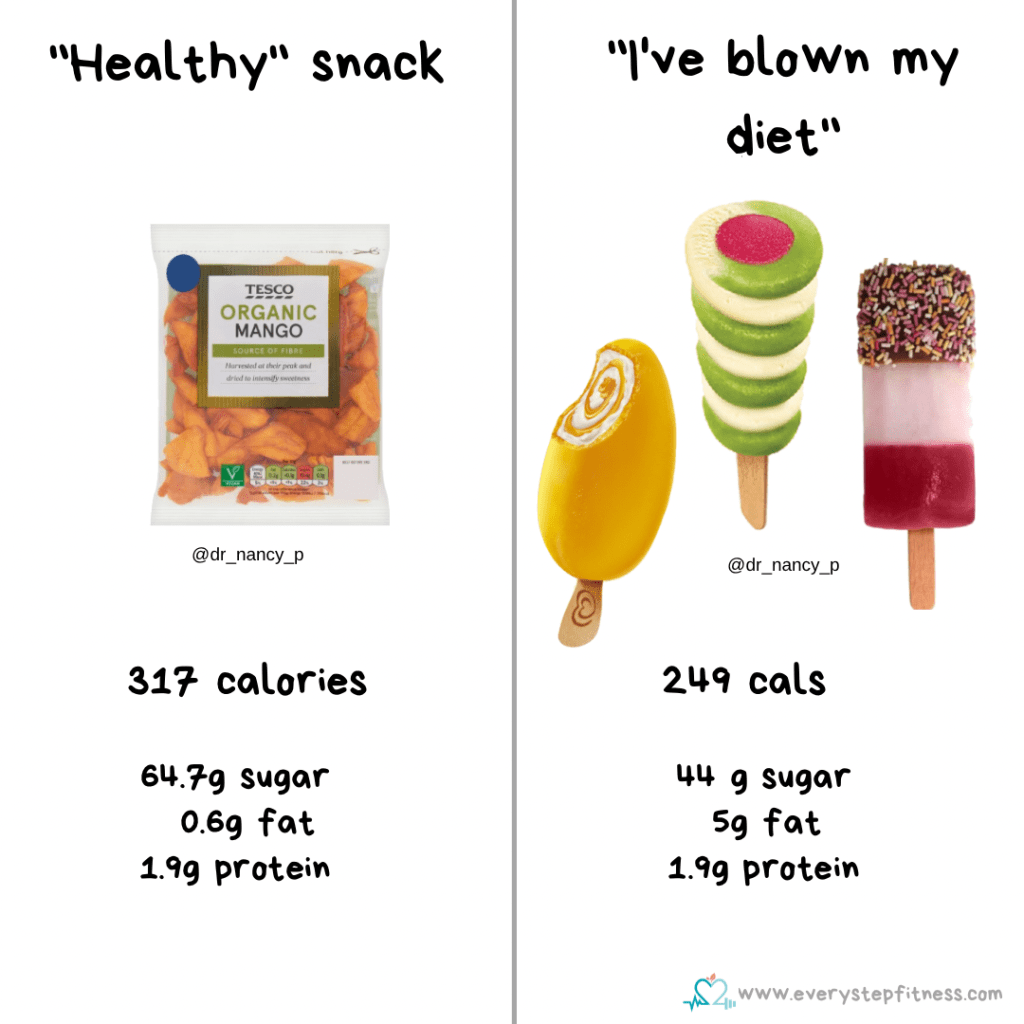
When you’re trying to lose weight we often conflate ‘healthy’ foods as automatically

helpful for weight loss. With the weather a little warm (at times) at the moment you may be craving an ice lolly or two. You may even have two or three and then find yourself feeling guilty for having succumbed to the craving and berate yourself for being really ‘bad’ and blowing your diet. Or you may think you’re being very virtuous and avoid the ice cream and have what is perceived to be a ‘healthy’ snack of dried fruit (mango).

In reality in terms of calories the ‘healthy’ snack in this example is actually worse ! Yes the mango does have more micronutrients, but that doesn’t mean the ice cream lollies are a bad option. Of course the ice cream lollies are high in sugar but sugar isn’t inherently bad either (and the mango is even higher) and they have the same

amount of protein. In reality you’re unlikely to eat 3 ice lollies in one go anyway so you’d in fact be consuming even fewer calories!

Overall calories are what count if you’re trying to lose weight. You need to be in a calorie deficit to lose weight so in that scenario the ice lollies are the better option. Especially if you’re eating a balanced diet and getting the other micronutrients in your other meals.

Emotional well being is also important and depriving yourself of foods you enjoy and instead choosing the dried fruit under the misguided impression that it’s a healthier option or because it’s marketed as ‘a healthy snack’ isn’t good for long term sustainability or a healthy approach to food.

Personally I’d choose both on different days – and I’d include them in my calories. The dried fruit is brilliant and does make a great snack option (as long as you’re aware of the calories) but on warm days an ice cream lolly or two is definitely required! 🍦 🤗

Xx

Tuesday Tip

Tuesday Tip: Average Calories

Tuesday Tip: Average Calories 📊

You need to be in a calorie deficit to lose weight but that doesn’t mean you need to be in a calorie deficit every single day. This is where people often get confused and struggle. It’s averages over weeks and months that count.

If you’ve determined that you need to eat 1700 cals per day to give you a deficit to lose weight most people assume that means they have to have 1700 every single day to get results. But of course it doesn’t work like that – in reality you just need to average 1700 cals per day. Some days you could eat more calories, and some days you could eat fewer, but if you’re averaging 1700 cals by the end of the week, you’ll be on track.

E.g.

Monday – 1700 calories

Tuesday – 2200 calories

Wednesday – 1400 calories

Thursday – 1700 calories

Friday – 1500 calories

Saturday – 2000 calories

Sunday – 1500 calories

Weekly Average – 1714 cals (basically on target)

Now, let’s say that you hit 1700 cals every day for a week, but then you have a day where you have a bit of a blow out at the weekend.

Monday – 1700 calories

Tuesday – 1700 calories

Wednesday – 1700 calories

Thursday – 1700 calories

Friday – 1700 calories

Saturday – 2600 calories

Sunday – 1700 calories

Weekly Average – 1828 calories.

So yes in that second example you’ve gone over but your weekly average is still not far off the deficit goal and long term that small amount of extra cals won’t stop progress. So many people will have a bad day and think they destroyed their progress for an entire week, but that’s not the case. You’d have to have that blow out Friday, Saturday and Sunday to have any meaningful impact.

You will have days where you go over your calories – intentionally or unintentionally. When that happens, don’t panic and think f*ck it and then ruin the next few days. Just put it behind you and, most importantly, get back on track the next day. Do that, and you’ll still be moving in the right direction.

Happy Tuesday 🤗xx