Nutrition and Calorie Tips

Half an Avocado….

Half an Avocado…. 🥑

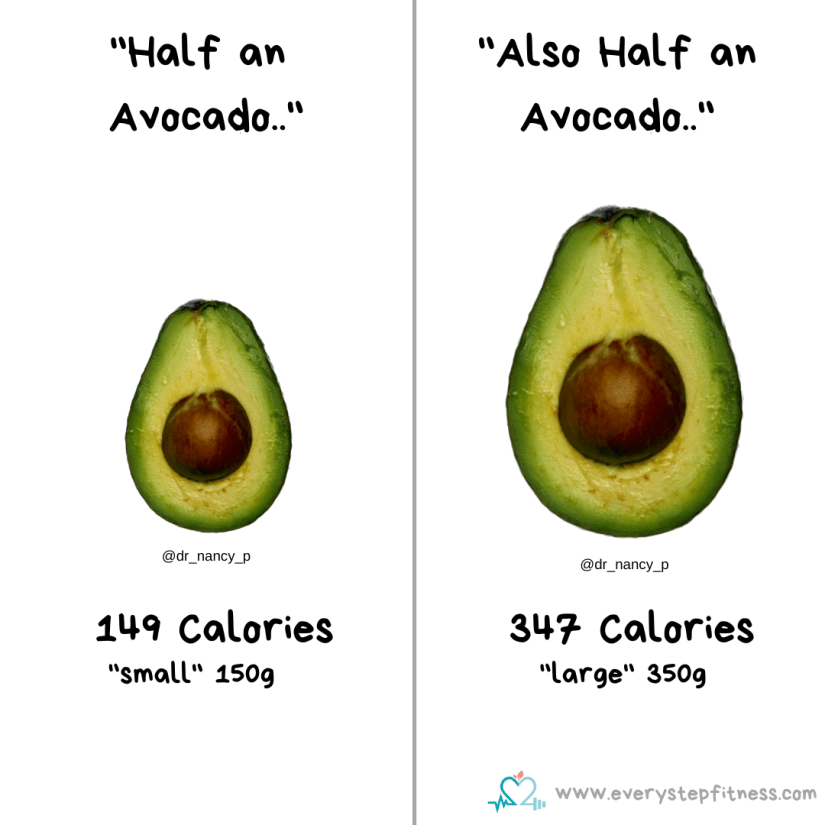
If you’re trying to lose fat and tracking your calories it’s really important to be as accurate as you can and this is why. If you’re using an app like myfitnesspal you might assume that the calorie value for half an avocado is a generic measurement for all avocados. Of course in reality avocados vary quite a lot in size – is that half an avocado a small one? A medium one? Or a large one? Obviously the nutritional value, and calories, will vary significantly with size. In this example one half is a pretty small avocado (150g), which means half will be around 149 cals. However, if you’re lucky enough to get a large avocado (350g) then you’d be looking at 347 cals for half!

So if you were just logging a generic half

an avocado at 149 cals but actually eating a large avocado then you’d be underestimating your calorie intake by 200 cals. If you’re an avocado fan and having some most days that could be an underestimate of 1000 calories or more a week – which is significant enough to prevent or slow fat loss.

If you’re having something low calorie then it won’t matter but with something calorie dense like avocado it really is important to know how much you’re having – assuming your goal is to lose weight/fat.

This is why I encourage my clients to weigh, in grams, rather than using generic, subjective measures like ‘half an avocado’. So if you’re trying to lose fat and tracking your calories have a go at weighing your avocado next time. You may be surprised! 😬

🤗

Xx
Tuesday Tip

Tuesday tip: Get back on track

Tuesday tip: Get back on track 🙌🏼

With lockdown changing routines and habits it may be that you’ve gained a little weight recently. We all have! With Summer approaching and the regulations lifting it may really get you down and weight loss may seem overwhelming. Here are a few tips to get back on track.

# Do something

Stop saying “I’ll start tomorrow”, you never will! So start small and start today. If it’s exercise that’s slipped then just commit to 5 mins of something, whatever it is, once you do 5 mins, it’s easier to do 10, 15 or even 20 mins. Same with food, start small e.g. cut out post dinner chocolate, only have 1 glass of wine, reduce portion size etc. Small steps quickly equal big leaps.

# Ditch the guilt

It’s natural to feel guilty, embarrassed, even ashamed if you’ve regained weight. Everyone gains sometimes, beating yourself up over that chocolate bar won’t help, instead focus on how you’ll make sure your next meal is healthier. Strive for progress, not perfection.

# Plan to succeed

Meal planning is helpful to prevent you reaching for easy, high calorie options. It doesn’t need to be a detailed plan, just decide on main meals for the next few days/week and have a list of snack options. Write it out and put it somewhere visible (e.g. the fridge)

# Friends

Tell your friends what you’re doing and ask for their support. You could even do a challenge together. Sometimes it just helps to have someone to vent to as well! Also get your family on side and ask them to help and support you.

# Ask for help

Whether it’s from the dr, a nutritionist or a PT it helps to have someone to hold you accountable. A professional can help unpack why you may have gained the weight and what you can do to make a change that sticks. If you’re coming back from illness or injury then speak to a physio/GP to learn what exercises you may have to modify. I often work closely with clients’ physios/ Dr’s to design safe and effective programs for them.

Weight gain happens and weight loss is hard work, so if you’re struggling don’t give up or feel defeated, we all feel like this and you’re not alone.

Happy Tuesday 🤗 xx

Nutrition and Calorie Tips

Rice cake or Crumpet?…..

Rice cake or Crumpet?….. 🥯

As I often say, the key to managing your dietary intake and weight or fat loss is about understanding that there is no such thing as a ‘good’ or ‘bad’ food. There are just different foods that serve different needs.

The nutritional breakdown and mirconutrients in food are important of course. So in that context you may feel that a rice cake, with peanut butter and banana is a ‘good’ snack. It’s full of good fats, protein and some carbs too. It will certainly keep you satisfied, but it is also perhaps higher calorie than you’d expect for a ‘good’ snack – averaging around 244 cals per rice cake (and let’s be honest I’d certainly have two!). Given the perception that this is a ‘good’ snack it would be easy to assume it was lower calorie or ‘better’ than the ‘bad’ snack – a crumpet with butter.

In fact the crumpet and butter is only

135 cals. Nutritionally it’s still good – with carbs and fats, but does contain less protein. That doesn’t make it ‘bad’. If your goal is weight or fat loss then it may be a better snack for you, that day, depending on your calorie target.

Most importantly you may actually just fancy a crumpet – and if so you should have it! Remember food also provides enjoyment too! And having things you enjoy will increase the likelihood of long term adherence and sustainability.

Personally I like both these snacks – and I’d happily have either! But being aware of the calories helps me make an educated choice.

🤗

Xx

Tuesday Tip

Tuesday Tip: Fat Burners – Fact or Fallacy?

Tuesday Tip: Fat Burners – Fact or Fallacy? 💊

Fat burners – you’ve seen them on social media, you know people taking them, you may even have taken them yourself. But do they work and are they worth the money? I’ve talked about this before but with gyms still closed and people looking online for quick fixes I’ve seen an increase in these things for sale.

Fat burners are combinations of food based natural or chemical products which claim to burn fat/increase metabolism. Common ingredients include caffeine, green tea extract, green coffee extract, ginseng, pepper, capsicum etc. More dangerous ingredients include bitter orange, yohimbine, garcinia etc (linked to risk of stroke, heart attack). They claim to increase fat oxidation, induce thermogenesis, affect fat burning hormones/enzymes, etc. In reality they do none of that.

They increase metabolism slightly, in the short term (increasing heart rate) but in terms of increasing BMR i.e. calorie burn at rest, which is what is needed to burn more calories (and hence fat), the effect is negligible. A 2017 study found an increase of 65 cals in BMR. This is a tiny increase over the day and won’t lead to increased fat loss. Green tea extract has been shown to increase fat oxidation (i.e. fat burnt by the body) BUT this only leads to fat loss IF you are in a calorie deficit, as fat stores are simply restored the moment you eat. Another study in the Journal of the International Society of Sports Nutrition found no difference over 6 weeks between fat burners and a placebo in fat loss (or muscle mass).

There is limited evidence that SOME fat burners MAY reduce hunger, but they’re linked to gastrointestinal distress so not a great option and again a study in the journal “PLoS one” found that coffee has exactly the same effect on exercise performance and endurance (i.e. an instant coffee an hour before you workout).

Bottom line – if someone is selling you fat burners stop, think and reconsider. Aside from the potential health risks, you’re throwing money down the drain. Make yourself a coffee or green tea and enjoy the same effects with less risk for less money.

Happy Tuesday 🤗

Xx

Tuesday Tip

Tuesday Tip: Diet Drinks

Tuesday Tip: Diet Drinks 🥤

Are diet drinks bad? This is something I hear a lot and there seems to be a lot of concern out there over drinking zero or low calorie soft drinks. So I thought I’d address them today.

Proponents of the “diet drinks are bad” message often claim that the sweetener in them, aspartame, causes cancer. In fact there is no scientific evidence that aspartame causes cancer (or any disease). One study, on rats, found a possible link to blood cancers, but the largest study on humans found no link at all.

Others claim that diet drinks cause obesity. Obesity is caused by consuming excess calories, but diet drinks contain no calories so they can’t possibly cause obesity. They can’t work against the laws of thermodynamics!

Then there’s the people that say it must be bad because you can clean a coin/ silver etc with Diet coke…erm.. well what it does to your body is not the same as what it does to a coin. You can clean a coin with lemon juice/vinegar etc yet people consume those without question. Some argue that it negatively affects gut health but as the gut doesn’t have much involvement (there is nothing to be absorbed) this isn’t the case. Studies have only shown an impact with extreme consumption (we’re talking over 8 litres per day every day).

Finally the most recent claim is that the diet drinks “trick” your brain into thinking you’ve had sugar and therefore causes an insulin response (which then causes you to eat more sugar). This simply isn’t true – insulin isn’t released unless sugar is present, no calories, no sugar – no insulin response.

Some people are sensitive to aspartame (just as some people are sensitive to a range of foods) and obviously if it doesn’t agree with you then clearly don’t have these drinks. But zero calorie drinks can be a really helpful way to replace a calorie dense soft drink with something of similar taste but no calories, so can really help aid fat loss. In addition (as per last week) they contribute to the volume of things being consumed and help to keep you fuller longer.

So consuming diet drinks in moderation (a few cans a day or so) is perfectly ok!

Happy Tuesday 🤗

Xx