Nutrition and Calorie Tips

A snack or loads of snacks…

A snack or loads of snacks… 🧁

There are lots of strategies you can use when trying to stick to your calorie deficit to lose weight/fat. Being aware of the calories in the foods you choose to consume and swapping to lower calorie foods which you also enjoy is an obvious option. As well as the calories though it’s worth considering the quantity and volume of the food you’re choosing.

Snacking is a common problem and an easy way to extra calories to sneak in. If you were to snack on a lemon muffin you’re looking at a substantial 428 calories of food. That’s quite a lot for a snack, and it will be gone in a few bites. However for only 259 calories you could have a curly wurly, a light babybel, some raspberries and a packet of popchips. This combination not only has the advantage of fewer calories overall, but also higher protein overall which will help to keep you fuller for longer, and they contain more fibre (mainly from the raspberries) and other micronutrients which will also help. But an often overlooked aspect is that there is also a greater volume of food in the lower calorie option. It will take you longer to eat the 4 snacks than the muffin, which will also increase feelings of satisfaction. You may also even find you don’t even need to eat all 4 snacks.

Obviously if you fancy the muffin and can fit it into your calories then go for it but this is just another strategy to add to your toolkit to help you stick to those calories.

Enjoy

Enjoy 🤗

Xx

Tuesday Tip

Tuesday Tip: Dealing with Weight Loss Plateaus

Tuesday Tip: Dealing with Weight Loss Plateaus📈

Usually a few months into a new diet (or eating regime) we start to see plateaus – this is despite people claiming they are still eating the same amount (at a calorie deficit) and exercising the same. Why?

As you get ‘smaller’ your resting metabolic rate drops so you need fewer calories, therefore you may need to adjust your calorie target. You may also be more tired as you’re running at a calorie deficit – this impacts your activity levels – both consciously in terms of perhaps skipping workouts, working out less, reduced intensity, fewer steps etc but also subconsciously. A recent study found that for every 1kg lost participants expended 20 – 30 cals less energy per day. This is a subconscious reduction in NEAT (non-exercise activity thermogenesis) such as standing less, walking less, less fidgeting etc and a decrease in bodily functions e.g. blinking less, breathing slower etc

In addition as you progress diet adherence weakens and motivation wanes, so you’re more likely to have a few more ‘off track’ days. You’re also likely to be relying more on eyeballing portions and not being as accurate – without realising it extra calories sneak in and portion sizes subtlety increase.

Subconscious eating also increases – a nibble of the kid’s tea, a handful of cereal as you pass the kitchen, grabbing a biscuit at work etc. You become less aware of these.

A couple of recent studies found that as weight (fat) loss dropped participants subconsciously increased their calorie intake. For every 1kg of fat lost, they were consuming an extra 100 calories per day, without even realising they were doing it.

So after losing 3-4kg you could be unknowingly consuming an extra 400 cals, and burning 120 cals less, that means an extra 520 cals a day which wipes out your deficit, can stall any fat loss and even cause weight regain.

So what can you do?

First accept it’s happening. The hard thing is that it won’t FEEL like you’re eating more and moving less, so it’s easy to blame other causes – hormones, ‘my stubborn body’, the ‘diet’ etc. Go back to basics and measure portions again and be mindful of extra mouthfuls of things you’re not tracking (grabbing the odd handful of cereal, crisp, etc). Focus on more filling foods to help combat the hunger too – foods high in fibre, protein and good fats.

In terms of energy expenditure – try to be as active as possible – add a few more steps to your day for example, be mindful of standing more than sitting etc.

Happy Tuesday 🤗

Xx

Nutrition and Calorie Tips

Raw vs cooked calories….

Raw vs cooked calories…. 🍝

A question I’m often asked is whether you should track your calories as raw or cooked weights? To be honest it doesn’t matter as long as you’re consistent and know which you’re tracking so you can record the correct calories, but it can be a little confusing!

Unless otherwise stated nutrition labels are usually raw weights. However, you’ll find sometimes some grains, pasta and pulses might be listed as cooked or ‘as prepared’ weights – which is when you need to be careful, as you will underestimate cals if you weigh them raw.

Different foods absorb different amounts of water as they’re cooked. This makes them swell and weigh more. So for things like rice, pasta, cereals etc it’s probably best to track them as raw weights. As you can see there are small differences between white and brown varieties but only after cooking really, which is down to the differing amounts of water they absorb. You’ll also find different shapes and types of pasta will vary too for the same reason. Oats are the same and in fact over 80 percent of the weight in cooked oats is actually water.

Protein sources, like chicken, tend to lose weight when cooked. This is because the water and liquids in the meat evaporate during cooking. They loose 20-25 percent of their weight during cooking. Again it’s best to track raw weights. It’s also worth noting that the cooking method has an impact on meat too. The calories for 100g cooked chicken are based on a grilled skinless chicken breast, the same amount of roast chicken (skinless) is 220 cals – due to the fats in the meat thanks to the roasting. So that’s also worth remembering if you’re a roast fan or are oven baking chicken with the skin on.

Whichever you chose to track is up to you but be sure to choose the right option in your tracking app.

Enjoy 🤗

Xx

Tuesday Tip

Tuesday Tip: Weekend Woes

Tuesday Tip: Weekend woes 😬

This is an extremely common pattern I see in my clients, and myself. Weekdays are often “ok” calorie wise or even good, and then weekends it goes a bit off track. A common pattern is as follows:

⁃ Super restrictive eating during the week (1200 cals or below)

⁃ Cutting out everything you ‘enjoy’ to meet those low calories

⁃ Resulting in low energy, fatigue, hunger, cravings and resentment.

⁃ Ineffective workouts as energy levels are low

Then the weekend hits:

⁃ Willpower is low and because you’ve been ‘good’ all week you indulge without restraint

⁃ Brunches, take aways, meals out, drinks, food-centred social events etc tend to occur and you don’t bother calorie counting.

⁃ You also snack on everything you’ve been craving all week.

⁃ End result – massively over your calories over those 1-3 days

⁃ This pushes your weekly calorie average up and halts progress

⁃ You wake up on Monday feeling rubbish, like a failure and end up being more restrictive the following week.

⁃ And it continues….

How do you resolve this?

For starters view your week as a whole and consider the average calories over the whole week. Avoid being too restrictive on weekdays but recognise you’ll want more calories in your budget to spend at the weekend. So save some calories on weekdays (100-150 per day). You’ll head into the weekend feeling less miserable and better able to exercise some control. Plan the weekends – reduce some of the indulgences but factor in some of the things you enjoy. Plan ahead for restaurant meals, drinks etc using those extra calories you’ve saved.

So it’s two pronged – eat a little more during the week, eat a little less at the weekends. Track your weekends rather than viewing them as a free pass. Consistency is key!

Happy Tuesday 🤗

Xx

Nutrition and Calorie Tips

Coffee time!

Coffee time…! ☕️

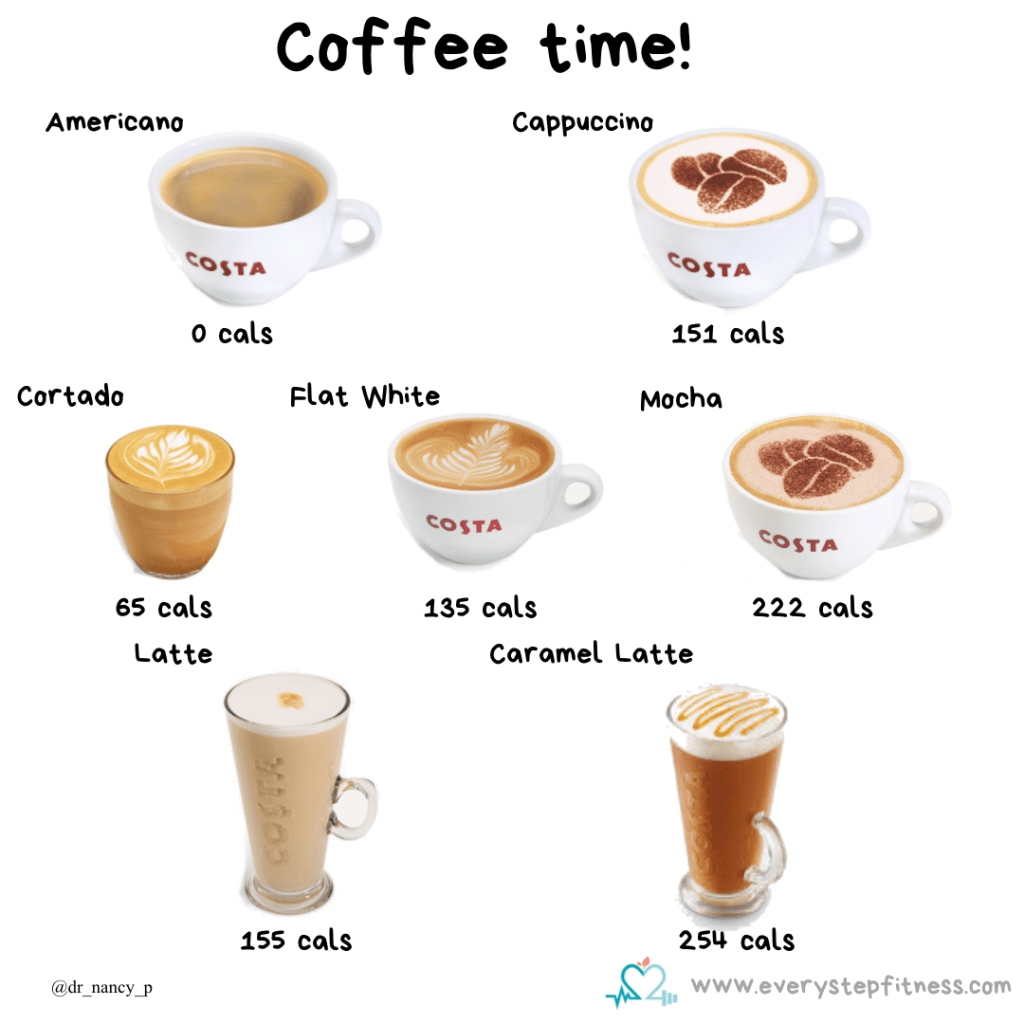
If you’re a coffee drinker then it might be worth just taking note of the calories in your brew of choice (if you’re trying to lose weight/fat).

A swap to a different style of coffee can help save some cals – especially if you’re a multiple brew a day kinda person.

Remember coffee itself is essentially calorie free so it’s the milk and any additional syrups etc that add the calories. This is just an overview of a few of the most commonly ordered coffees. They happen to be Costa coffees but the calories are similar across brands. These calories are based on a medium sized drink , made with semi-skimmed milk. I’ve discussed the calories in other milks before and you can also save calories by going for skimmed milk or unsweetened almond milk which is the lowest calorie option.

Here’s a run down of the most commonly ordered brews:

Americano – if you have it black it’s basically 0 cals.

Cappuccino – 155 cals

Cortado – 65 cals

Flat white (nb this is for the largest size which is a small) – 135 cals

Mocha – 222 cals

Latte – 155 cals

Caramel latte – 254 cals

Enjoy 🤗

Xx