Tuesday Tip

Tuesday Tip: Lockdown Mental Health

Tuesday Tip: Lockdown Mental Health 💜

With news of the second lockdown it’s natural to be feeling anxious, upset, frustrated etc. This situation is out of our control so it’s important to focus on things we can control to help protect our mental health. Here are a few tips:

#1 Acknowledgement

Acknowledge that this is a sh*t situation and it’s ok to be sad, mad, angry etc about it. It’s ok to feel anxious about it.

#2 Moderate news consumption

It’s great to stay informed but be mindful of obsessing over the news and updates. Avoid scaremongering news and find positive stories or reliable data instead.

#3 Stay active

Exercise keeps you fit and healthy (stimulating the immune system), and needs concentration, so is a distraction. It combats physiological symptoms of anxiety e.g. nausea, muscle tension etc and endorphins make you feel good, as will fresh air and sunshine if you can get out.

#4 Eat well

It’s easy to resort to self destructive behaviours e.g. booze, overeating etc. Remember alcohol is a depressant so won’t help your mood, and overeating can lead to a cycle of guilt. Aim for balanced meals and include all the foods you enjoy, in moderation.

#5 Routine

Set yourself a routine; including leisure time like walks, baths, calls to friends or family etc. If you’re working from home again set boundaries and a consistent daily work routine and stick to it! Take breaks, accept that you won’t be as productive at home. Stick to a good sleep routine; get up at similar times.

#6 Unfollow

If people or accounts are causing you stress mute or unfollow them. You’ll probably be on social media more over the next few weeks so make sure your feed includes people/content you actually want to see or that makes you feel better.

#7 Connections

Connect with friends/family rather debating with strangers on social media. If you have someone you’re close to make a pact to keep an eye on each other, or a code phrase for when you’re not doing ok. It’s also ok to want, and to take some alone time from those you live or work with too.

Above all, be kind – to yourself and each other. 💜 Take care, and if anyone needs anything I’m always here – anytime.

Happy Tuesday 🤗

Xx
Nutrition and Calorie Tips

Weekdays vs Weekends

Weekdays vs Weekends 😇

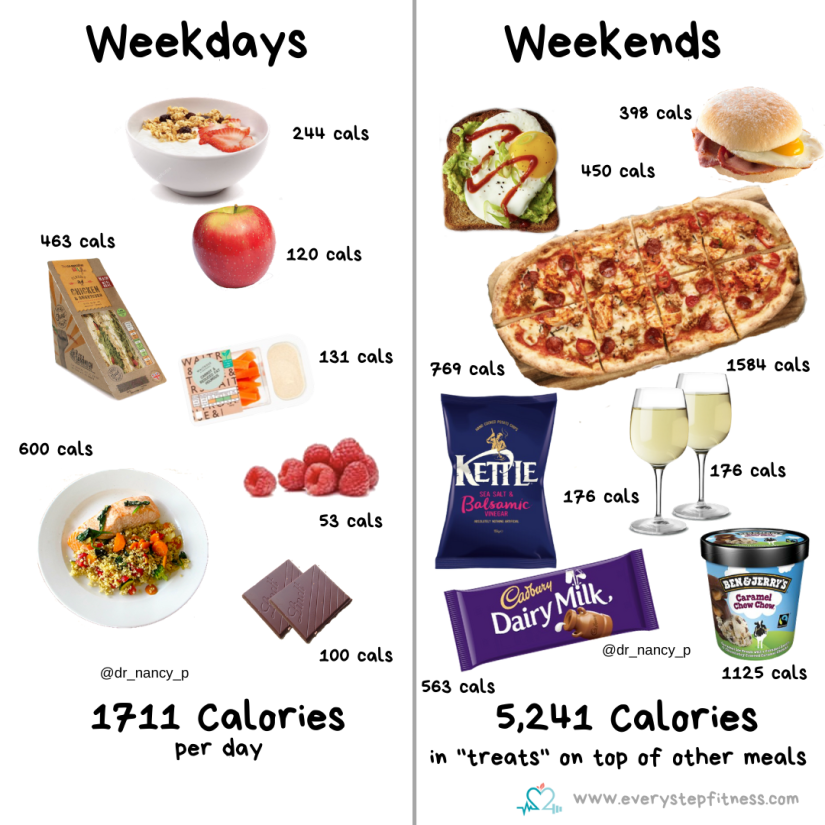
This is an extremely common pattern I see in my clients, and myself. Weekdays are often “ok” calorie wise or even good, and then weekends it goes a bit off track.

You may think that if you stick to your fat-loss calorie target for most of the time (5 days a week) that it’s ok to just relax at the weekend. Now sometimes this can work, but it rather depends how much you relax lol! In this example I’ve assumed a daily calorie goal of 1,800 cals for fat loss, or 12,600 calories per week. So Monday to Friday you hit those calories, or perhaps are even a little under (8,555 cals during the week in this example). Then on Saturday and Sunday you “relax” and have a few “treats”, because it’s the weekend right? You’ve been good all week so it’s fine… In this example I’ve included two weekend breakfasts, a pizza one night, a couple of glasses of wine, some crisps in front of a movie, sunday evening ice cream and chocolate etc. That’s 5,241 calories and doesn’t even include a full weekend of eating and drinking (especially if you start on Friday evening.. or even Thursday). Just those treats on top of the weekday calories take you to 13,796 calories for the week. So you’re already over by nearly 1,200 cals.

That extra 1,200 cals (or more) is why you won’t be losing fat. It’s very easy for that to happen. The things I’ve described for weekend treats aren’t crazy or particularly over indulgent. I’m sure we’ve all had weekends like that right? Now I’m definitely not suggesting you don’t enjoy some of these foods from time to time, but if you really want to lose fat then its worth getting away from the idea of weekends being focused on food and drink “treats”. Have the things you enjoy but in moderation and within your overall weekly calorie target.

Ways to do this include, reducing your weekday calories a little to give you a buffer for the weekend (be cautious with this though as if you take them too low you will find you tend to binge at the weekend which is counter productive so only aim to save 100-150 cals per day max). Also try going for smaller options of the weekend treats, a small bar of chocolate, a single portion bag of crisps, low cal ice cream etc. Pick one meal you want to let your hair down with rather than the entire weekend and keep tracking over the weekend so you can see where the extra cals are creeping in.

OR decide that life’s too short and you don’t want to restrict your calories over the weekend but then accept that you won’t be able to lose fat (which is absolutely fine too! You don’t need to lose fat – no one does).

🤗

Xx

Tuesday Tip

Tuesday Tip: Post-workout Bloat

Tuesday Tip: Post-workout Bloat 💨

Working out usually leaves you feeling good and full of endorphins, but it’s not uncommon to feel bloated after working out. So what’s going on?

One main cause of bloat is air in the colon, which makes you feel uncomfy and makes the abdomen distend. When you’re working out hard you’re breathing heavily and gulping down air, some of which goes down into the digestive system.

Working out also puts your body into a “stressful” situation; your flight or fight response is engaged which means blood is diverted away from your digestive system. The Gastro-intestinal tract slows down, so the air doesn’t get moved out quickly, hence the build up and bloat. Also any recently eaten food won’t get digested either.

In addition that fight or flight response results in production of the stress hormone cortisol. That promotes the production of glucose by the liver, the breakdown of muscle protein into amino acids that are then converted to glucose for energy, and the secretion of glucose into the bloodstream for ready-to-use energy. All good things during a workout but elevated cortisol can lead to elevated blood pressure, which results in fluid retention. This also leads to a further bloating.

How to prevent it.

⁃ Try inhaling through your nose and out your mouth. Focus on taking longer, slower breaths.

⁃ Avoid eating too close to your workout.

⁃ Avoid fatty foods, sugary drinks or very high fibre foods for a pre workout snack – they take longer to digest and can cause bloating

⁃ Stick to simple carbs like fruit or easy to digest starches e.g. toast

⁃ Avoid commercial “pre workout” gels etc – these often cause digestive discomfort until you’re used to using them (and even then they still cause issues).

⁃ Stay hydrated to avoid water retention

Finally, if you’re new to exercise or just ramping it up then expect it to take a while for your body to get used to it. The stomach is a muscle and needs to be trained to handle the up and down motion of running/HIIT workouts.

Happy Tuesday 🤗

Xx

Nutrition and Calorie Tips

Unhealthy or Healthy Mashed potato?

Unhealthy or Healthy Mashed potato? … 🥔 🍠

I often have clients telling me they’re having mashed potato, but it’s sweet potato, so that’s ok. The common perception is that white potatoes are “unhealthy” and a bad choice, whilst sweet potatoes are inherently healthier and therefore a good choice to go for.

Sweet potatoes are good – they have a lower glycaemix index than white potatoes (though it’s not actually ‘low’) which means it has a lesser impact on blood sugar levels. It’s also a great source of vitamin A, C, B6 and Potassium and also fibre.

In contrast white potatoes have a higher glycaemic index, slightly less fibre and less vitamin A but are also good sources of Vitamin C and B6. But they aren’t unhealthy.

Despite the higher glycaemic index it’s not the individual foods that matter in that context but rather the glycaemic index of the whole meal so it will depend what you’re eating with the potatoes. Combined with other low GI foods, protein and fats the overall GI of the meal will be lowered.

In addition, as you can see, when made with exactly the same recipe the mashed sweet potatoes actually contain more calories, carbs and fat than white potatoes. So from a fat/weight loss perspective – when it comes down to calories you’d be marginally better off having white potatoes.

So if you’ve been tucking in to sweet potatoes thinking they’re better for weight loss then perhaps think again. In reality the difference is pretty small, and the calorie impact is fairly similar.If you prefer the taste then definitely go for the sweet potatoes – just have the potatoes you actually enjoy!

🤗

Xx

Tuesday Tip

Tuesday Tip: Anxiety and Diet

Tuesday Tip: Anxiety and Diet 🤯

Anxiety can be a particularly tricky thing to deal with at any time, but at the moment levels of general anxiety are even higher and people who perhaps wouldn’t normally class themselves as being “anxious” are finding things increasingly difficult.

Mental health is so important, and if anxiety or anxious thoughts are affecting you then do please speak to someone (be it a professional, or even a friend/work colleague etc) but it is also possible to help with what you’re eating.

A 2010 study found that diets higher in vegetables, fruit, fish and whole grains led to lower incidence of anxiety disorders. A further study in 2017 directly compared a mediterranean-style diet with “social support (friends etc) for the treatment of anxiety and depression. The diet actually provided better relief than the social support. It’s believed this is due to the impact of short-chain fatty acids (created from digestion of fibres in the food). It’s though that consuming 30g fibre a day can help thus.

Omega-3 is also linked to mental health with higher levels reducing the incidence of low moods, depression and anxiety.

One study found a 20% reduction in anxiety with omega-3 supplements compared to a placebo but evidence is mixed. However it certainly won’t do any harm as it has many other health benefits so definitely worth a try.

In contrast studies have shown that diets high in caffeine, sugar and saturated fat are linked to increased anxiety. Alcohol is also an issue – it initially relaxes you by increasing the activity of the brain chemical gamma-aminobutyric acid (GABA). But this is short term and as the alcohol wears off the levels of GABA reduce which exacerbates anxiety.

So a few things to consider (as well as seeking professional help if it’s impacting your life)

Happy Tuesday 🤗

Xx