Nutrition and Calorie Tips

A summer treat…

A summer treat…🍦

What’s better for a summer dessert than some ice cream (despite the rather unsummery weather!). I don’t know about you but once I start on a tub it’s gone before I even realise it!

Whilst there’s no problem with including any ice cream you like in your diet, if you are trying to lose weight/fat you may find that fitting a whole tub into your calories quite tricky. So you have two options – either limit the amount you have, or swap from a calorie dense type of ice cream to something that’s similar tasting, but lower calorie. There are the obvious swaps to the low calorie brands like oppo or halo top etc but another option is to switch to something else entirely.

In this example switching from the Häagen-Dazs mango and raspberry ice cream to twisters makes a massive calorie saving. You could have 4 twisters for almost a third of the calories of the Häagen-Dazs. As an added bonus the chances of you eating 4 twisters in a row is considerably less than working your way through a tub anyway. Psychologically it’s much easier to work your way through an open tub than help yourself to 4 lollies in a row.

So if you do want to enjoy some
Ice cream but save some cals try going for the lower cal, higher volume option if you

🤗xx

Tuesday Tip

Tuesday Tip: Post-workout Munchies

Tuesday Tip: Post-workout Munchies 🥤🥪

Feeling very hungry after your workout? Regular workouts boost your metabolism and often increase your hunger. Those dreaded post-workout munchies can make you reach for extra snacks and eat more than you want to which could derail your fitness goals.

#1 Reconsider your burn

Did you really burn as much as you’re about to eat? Studies have shown that we usually underestimate the calories consumed through food and overestimate the number of calories burned by exercise. As I’ve said in previous posts those fitness machines almost always over estimate and even fitness trackers aren’t as accurate as we’re led to believe. So be realistic when it comes to choosing post-workout foods. Go for something with protein, carbs and fat – and if it’s not a main meal then aim for only about 150-200 cals. A glass of milk (dairy or soya) or chocolate milk is an excellent post workout refuel.

#2 Are you really hungry?

Ask yourself are you really hungry? Unless it’s a definite yes don’t reach for that protein shake or snack (and remember as I said last week – protein shakes aren’t really necessary for most of us anyway!)
Drink a big glass of water first and then decide. Try not to just get in to the habit of eating after workouts for the sake of it.

#3 Eat regular meals

If you’re starving after your workouts then maybe you haven’t eaten enough earlier in the day. Studies have shown regular meals with a good balance of proteins, carbs and fats results in less desire to eat extra snacks post workout and curb that hunger.

#4 Schedule your workouts

If you always feel hungry after working out, then simply make sure to schedule exercise before one of your main meals.
That way you won’t need to eat any extra snacks, and thus additional calories, between meals.

#5 Don’t try to earn calories to eat later

Try not to workout simply for the reward of eating later. Again something I’ve talked about before – try not to reward yourself with food. Exercise itself should be the reward so find something you enjoy – cycling, running, classes, dancing etc and then enjoy the endorphins!

Happy Tuesday 🤗
Xx

Nutrition and Calorie Tips

Reasons to go low carb… or not……

Reasons to go low carb… or not…… 🍞

Carbs are often demonised in the media. Like any nutrient they can indeed cause weight gain, if over consumed. But as I mentioned in my article last week, they don’t inherently cause weight gain – unless you’re eating over your daily calorie allowance. In fact a recent review of studies show no significant differences in fat loss in a low carb vs normal carb diet (with protein and calories controlled for).

The foods most people associate with “carbs” are high sugar, often also high fat, foods. These are often very easy to over eat so often diets high in these foods result in less weight/fat loss or even weight gain. However it’s the surplus calories, not the carbs themselves causing the gain.

People will often avoid carbs because they’ve been led to believe that insulin will lead to increased fat storage. As carbs are the main driver of insulin elevation they are often blamed for weight gain/ lack of weight loss. However the studies simply don’t support this. In the studies mentioned above high carb diets do not cause more weight gain than any other diet (when protein and calories are consistent), despite having higher insulin levels. So diets low in sugar /carbs or a keto diet (low carb) don’t automatically result in weight loss UNLESS overall calories are lower and you are in a deficit.

Having said that for some people reducing carbs helps them achieve the calorie deficit. I would never recommend going very low carb, as usually it is unsustainable. But if you find that focusing on higher protein/fat options and reducing some carbs helps to hit your calories then that’s fine – IF that’s your preference. If most of your calories come from high carb junk food then removing some of the will definitely help! If you find your snacks are generally high carb/sugar based and that they don’t fill you up, leading to more chance of over eating later, then it’s worth considering swapping these out. Obviously if you don’t like carbs or have been medically advised to reduce them then go for it!

🤗xx

Nutrition and Calorie Tips

‘I’m being good and having a weight watchers cake bar….’

‘I’m being good and having a weight watchers cake bar….’ 🍰

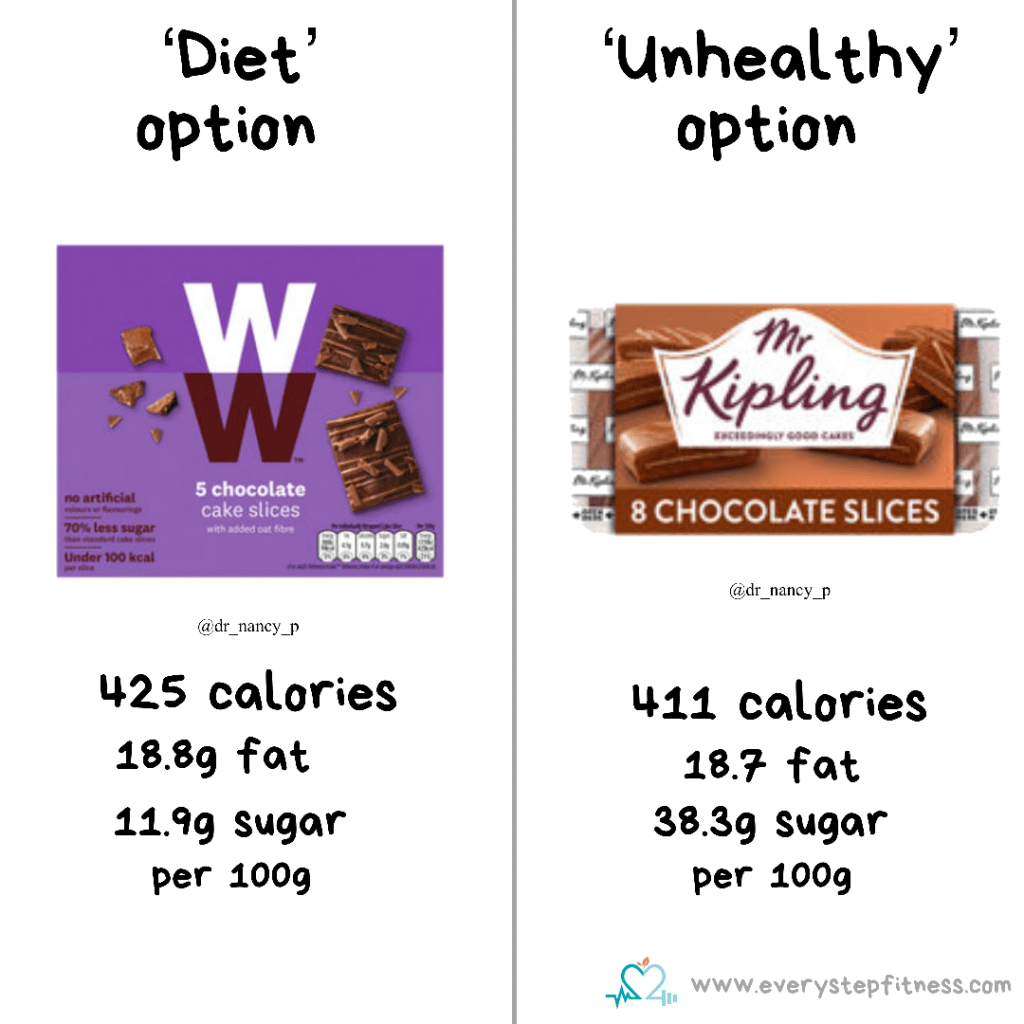
Most people would assume that the weight watchers cake bars (or other weight loss brand foods) are automatically a more virtuous choice of snack. Whilst the Mr Kipling chocolate cake slice would be considered the less healthy choice.

In reality they’re almost the same in terms of overall calories and fat. And in fact the My Kipling slices are actually lower in calories per 100g. So in reality you could have either and it would make little difference to your overall calories. The weight watchers slices are also over double the price per gram too!

So don’t automatically assume these weight loss branded foods are always the better option. Sometimes they’re the same or worse than other brands. And usually pricier! If you enjoy them then definitely have them, but if you’re only having them because you think they’re ‘good’ then think again.

Read the labels and look at the calories and then make sure choice. If you’re trying to lose weight then go for the lowest calorie option, that you actually want to eat!

🤗xx

Tuesday Tip

Tuesday Tip: Fresh vs Frozen

Tuesday Tip: Fresh vs Frozen 🥦🫐

I am a big fan of frozen veg and fruit – both as a way to help save time for myself and my clients, for convenience, cost and also freshness! But there still seems to be a bit of a stigma around frozen fruit and veg.

The concerns around frozen produce tend to centre on issues of freshness and perceived nutrient loss and a view that it’s ‘lazy’. For most brands, prior to freezing the produce is blanched (boiled / steamed briefly). This stops enzyme activity and ensure the colour and flavour remain intact. There can be a small amount of nutrient loss in this process – although recent improvements mean these are minimised. Fresh produce on the other hand is not quite as fresh as we might think. Unless it’s been grown yourself or locally, it’s spent days/weeks/months being stored and transported to the shop. Studies show that the transportation and storage of fresh fruit and vegetables can often lead to more severe nutrient losses than the blanching and freezing. For most shop bought produce it will be at least 14 days after harvest (and that’s a low estimate) vs frozen produce which is frozen within hours of harvest.

Most importantly frozen produce can be more convenient, and avoid waste. This means you may be more likely to actually eat more fruit and veg. It can also meal prep easier and faster. A recent study of more than 16,000 people found that those who purchase frozen fruit and vegetables consume more servings of them, compared to those who do not.

That’s not to say fresh produce isn’t good – in an ideal world fresh produce would be affordable and delivered the day it was harvested. And the more of this that you can source locally, the better! But frozen fruit and veg are great too!

Enjoy!

Happy Tuesday 🤗

Xx