Tuesday Tip

Tuesday Tip: Can you boost your metabolism?

Tuesday Tip: Can you boost your metabolism? 🤔

You may have read about various ways to boost your metabolism and burn more calories. But is this really possible?

‘Metabolism’ consists of 3 components:

⁃ 60-70 % basal/resting metabolic rate (bmr) – energy burnt at rest

⁃ 10 % Thermic effect of food (TEF) – energy burnt digesting/storing food.

⁃ 20-30% Activity Energy Expenditure (AEE) – 10-15 % is energy burnt through physical activity (intentional exercise) and the remainder is Non-Exercise Activity Thermogenesis (NEAT) -all activity that isn’t intentional exercise. NEAT is the most variable component of your metabolism and can account for 15% of total energy expenditure in sedentary individuals and up to 50% in active individuals.

Can you boost these? Short answer not by much sadly!

Your BMR is determined by age, sex, height, muscle mass, genetics which you can’t change much (I’ll come back to the muscle mass).

Eating more protein can increase your metabolic rate as it has the highest Themis effect (takes more cals to digest) BUT TEF only accounts for 10% of total energy expenditure. So this isn’t going to have a significant effect.

Increasing physical activity will increase your metabolic rate BUT, unless you train for several hours per day, the magnitude of this

increase isn’t as much as you think. What about increasing muscle mass? Well yes more muscle increases your BMR so you burn more at rest BUT again the overall impact isn’t as great as you’re led to believe. 1kg muscle burns around 13 cals per day so if you added 5kg muscle (which is a lot!) you’d be burning an extra 65 cals a day.

What about metabolism boosters/fat burners etc? The main ingredient in these “metabolism boosters” is caffeine. And while it’s true that caffeine has a “thermogenic effect” 100mg of caffeine only increases energy expenditure by 3-4% and it diminishes as you build a tolerance.

The one component that can significantly impact metabolic rate is NEAT (e.g. walking, standing, fidgeting, house work, gardening etc ). In studies most of the variability in energy expenditure between individuals is due to differing levels of NEAT which can vary by over 1000 calories per day.

So really the most significant impact on metabolism is to avoid being sedentary and to move more throughout the day like interspersing sitting with standing, taking

breaks to walk and move, using the stairs, etc. So avoid those expensive supplements and fad diets/exercise trends and stick to the basics!

Happy Tuesday 🤗

Xx
Nutrition and Calorie Tips

I’ve blown my diet.… 🫣

I’ve blown my diet.… 🫣

When you’re trying to lose weight we often conflate ‘healthy’ foods and automatically

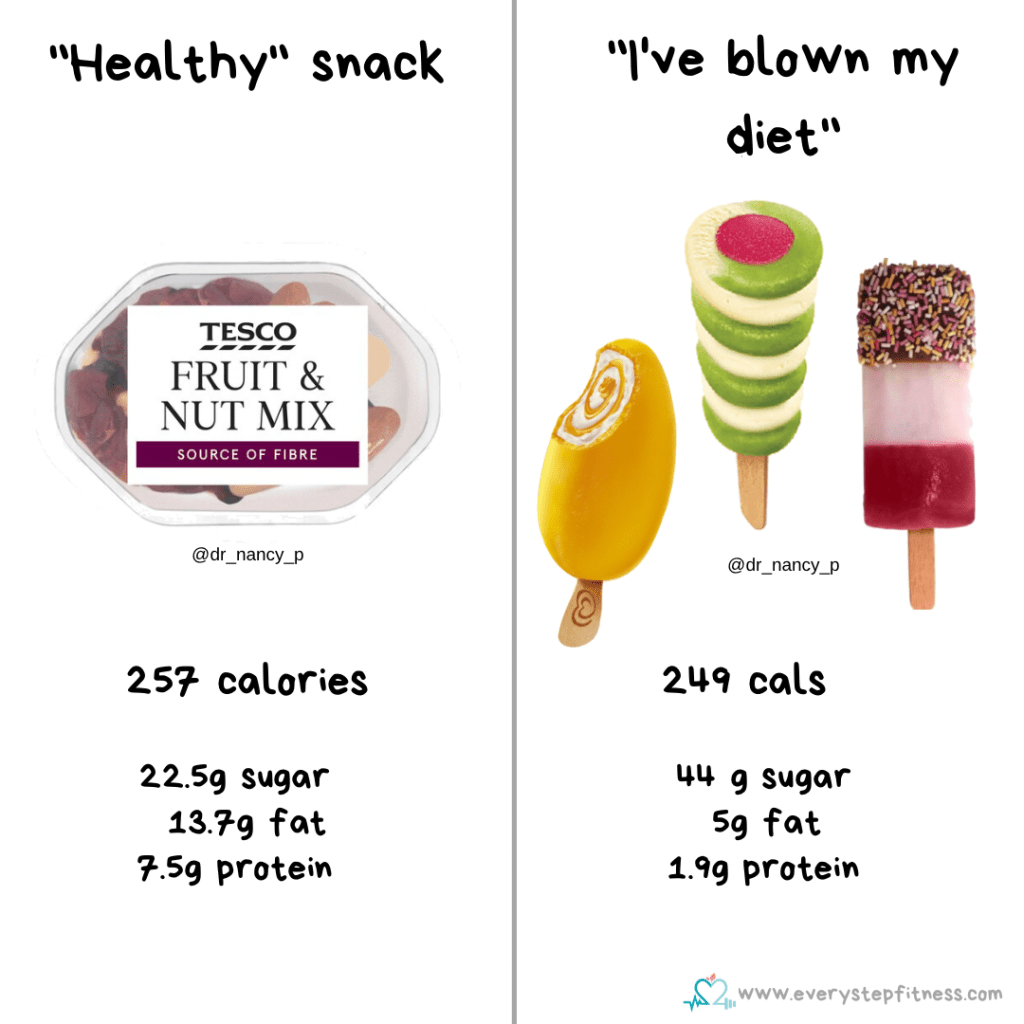
helpful for weight loss. With the weather so warm at the moment you may be craving an ice lolly or two. You may even have two or three and then find yourself feeling guilty for having succumbed to the craving and berate yourself for being really ‘bad’ and blowing your diet. Or you may think you’re being very virtuous and avoid the ice cream and have what is perceived to be a ‘healthy’ snack of nuts and dried fruits.

In reality in terms of calories the ‘healthy’ snack is actually worse ! Yes the snack pot has a more protein (which can help you feel fuller for longer), and more micronutrients, so it is a more balanced snack, but that doesn’t mean the ice cream lollies are a bad option. Of course the ice cream lollies are high in sugar but sugar isn’t inherently bad either! In reality you’re unlikely to eat 3 ice lollies in one go anyway so you’d in fact be consuming even fewer calories!

Overall calories are what count if you’re trying to lose weight. You need to be in a calorie deficit to lose weight so in that scenario the ice lollies are the better option. Especially if you’re eating a balanced diet and getting protein and the other nutrients in your other meals.

Emotional well being is also important and depriving yourself of foods you enjoy and instead choosing the fruit and nuts under the misguided impression that it’s a healthier option or because it’s marketed as ‘a healthy snack’ isn’t good for long term sustainability or a healthy approach to food.

Personally I’d choose both on different days – and I’d include them in my calories. The fruit and nuts are brilliant and do make a great snack option (as long as you’re aware of the calories) but on days like we’ve had lately an ice cream lolly or two is definitely required! 🍦 🤗

Xx

Tuesday Tip

Tuesday Tip: Are you Dehydrated?

Tuesday Tip: Are you Dehydrated? 💧

Obviously the hot topic this week is the heat wave so it seemed wise to discuss hydration this week. Our body contains 5 litres of water and we can lose 2 in a single workout. Dehydration is a risk, and once you’re thirsty you’ve probably already been dehydrated for a while. So what should you watch for?

#1 Dry skin

Skin is 80% water so if you’re not drinking enough your skin will show it; dull, peeling, dry skin can mean you’re dehydrated.

#2 Fewer loo trips

Kidneys use water to remove waste from blood. When dehydrated they don’t function as well and you’ll need fewer loo trips. So if you’re pee-ing less than normal, drink more!

#3 Dark pee

Generally the darker your urine the more dehydrated you are (some foods also colour your pee). You want straw coloured pee!

#4 Cramps

Muscles are 75% water. If you’re dehydrated the body will divert water and blood from muscles to essential organs so you’ll get cramps.

#5 Blood pressure changes

As you dehydrate your blood becomes thicker as the water-containing plasma becomes more concentrated. With less blood volume to pump blood pressure can drop making you dizzy or light headed.

#6 Headache

The brain is sensitive to the chemical changes lack of water causes, resulting in a headache, often in the back of the head and may get worse when you bend over. A sports drink or rehydration sachet will help.

#7 Constipation

Dehydration causes the intestinal cells to extract more water from food waste in the intestines, causing the waste to become hard, leading to constipation.

#8 Joint pain

Dehydration causes cartilage in joints to rub; weakening and wearing over time. Lack of water delays repair to these damaged joints, causing pain.

#9 Bad breath

If you don’t have enough water then you won’t have enough saliva, so you’ll get a dry mouth and bad breath.

#10 Fatigue

The brain is 85% water. Water deficiency can result in a reduction of the brain’s energy supply, which leads to fatigue, lethargy, and even depression.

Never drink the 2-3 litre daily water quota in one sitting, instead drink regularly, and eat hydrating foods e.g. melon, cucumber, grapes, celery etc.

Get Sipping!

Happy Tuesday!🤗

xx

Nutrition and Calorie Tips

‘Just a dip to go with my Pizza…’ 🤔

‘Just a dip to go with my Pizza…’ 🤔

If you’re hoping to lose fat in a sustainable way you need to be aiming for a deficit of around 200-300 cals a day. Most people are pretty good at tracking the big stuff – the sandwich, the packet of crisps, the porridge for breakfast etc but how often do we overlook the little stuff. You’d probably be pretty aware of the pizza or garlic bread you order but might not think twice about the dip on the side.

A great example of this is the Domino’s garlic and herb dip – which is now available in a larger size (though still feels like a small side). You’d probably assume it would be a couple of hundred calories … maybe overlook recording it… in reality it has more calories in it than an entire meal, including a small glass of wine! Now that’s not to say you shouldn’t have the dip – if you want it and like it then have it! Just be aware of the calories in it before you do.

So if you’re tracking cals and hoping to lose fat make sure you include these, and if you’re just trying to cut some cals maybe they’re a good place to start being more mindful too?

Remember – calories count! 🤗xx

Nutrition and Calorie Tips

Tuesday Tip: Hunger Management

Tuesday Tip: Hunger Management 😝

Hunger management plays a crucial role in successful weight loss. People often over restrict and starve themselves which, whilst obviously may work temporarily , usually leads to cravings, binge eating, and hunger. All of which derail progress and of course make it unsustainable.

With a sustainable calorie deficit there will still be some mild hunger. This isn’t a cause for concern and it’s to be expected but it’s helpful to have some strategies to help manage this so you can stay on track. Essentially it comes down to making food choices which maximise feelings of fullness whilst minimising calories. Remember total calories still count when it comes to weight loss so these are all within that context.

Here are a few things that can help:

#1 Higher protein intake may lead to improved feelings of satiety and less cravings. But, if you already eat a high-protein diet (1.6g/kg+) then it won’t make much difference. Also be aware that prioritising protein too much may lead to to eating fewer carbs which you also need and can mean you end up low on energy and more hungry. So don’t remove carbs either!

#2 High fibre foods help by bulking food volume, slowing digestive time and increasing gut fermentation – all

Of which lead to feelings of fullness. Low energy dense high fibre foods like fruit and veg are a great option.

#3 Fats can help with feelings of fullness (especially when combined with protein) but

they may not be the best option for

hunger management, especially if you

have a tight calorie budget. Fat provides more then double the energy of carbs / protein so it easy to eat more cals with a smaller serving of a high-fat food, compared to a high-carb food

# 4 Go for high volume foods or combinations of foods. If you’re having a lower calorie snack bulk it out with things like fruit or veggies, or a zero cal drink (water or soft drink) to help.

#5 include whole , unrefined carbs as they aid in satiety, muscle recovery and training performance /energy levels (and they’re tasty!)

#6 Our beliefs and perceptions impact feelings of fullness. Perceptions of what a ‘normal’ portion size is impacts whether we feel full after eating it. Equally our beliefs about certain foods have the same effect e.g. if you believe a protein in bar is more filling it will feel that way. Increasing knowledge around calorie content can help with this.

Happy Tuesday 🤗

Xx