Tuesday Tip

Tuesday Tip: isn’t tracking food a bit obsessive?

Tuesday Tip: isn’t tracking food a bit obsessive? 🤯

People often tell me they’ve tried everything but can’t reach their goal. When I ask if they track their food they respond with ‘isn’t that a bit obsessive?’ or ‘no I don’t want to do that’. Not wanting to is fine, that’s your choice, but if you’ve been struggling to reach your goals and you haven’t been tracking then why not try it?

Do you track your finances? Most people do so they have an idea of how much they’re earning, spending and saving. That’s not obsessive, so why would tracking your calories be?

Can tracking food become obsessive? Yes, like anything, of course it can. Does it have to? No! Do you have to do it forever? No! Does it have value? Yes! It’s a tool – and its value is determined by how it’s used and what you learn from it.

We don’t have an innate working knowledge of portion sizes and calorie content. In fact, studies show that people are awful at estimating how much they eat. We underestimate ALL the time, even nutrition experts do! We are surrounded by highly palatable, calorie dense foods and we have evolved to seek them out. So it’s unsurprising, when these sorts of foods are so readily available, that we need to do some tracking to keep an eye on what’s actually going in our mouths.

The main reasons we don’t track are fear, time and being unsure of how many cals to aim for. The fear is of what we’re going to find out and that we really are eating more than we thought. Time is really about priorities. Yes it can take a few days to get the hang of it, but then it takes seconds to log before you eat. Most people have time to check Instagram/Facebook/watch tv. Even the busiest person has 2 mins to log their food, if they want to. In terms of how many cals to aim for; if you’re not sure, ask! I’m happy to help!

You don’t need to track food forever. You’ll learn about portion sizes, calories in the things you eat and drink, and develop that skill. Then you can cease tracking if you want and see how it goes. You can easily go back and check if you feel that skill needs more honing.

You don’t have to count calories forever, but calories will always count!

Happy Tuesday

😁

Xx
Nutrition and Calorie Tips

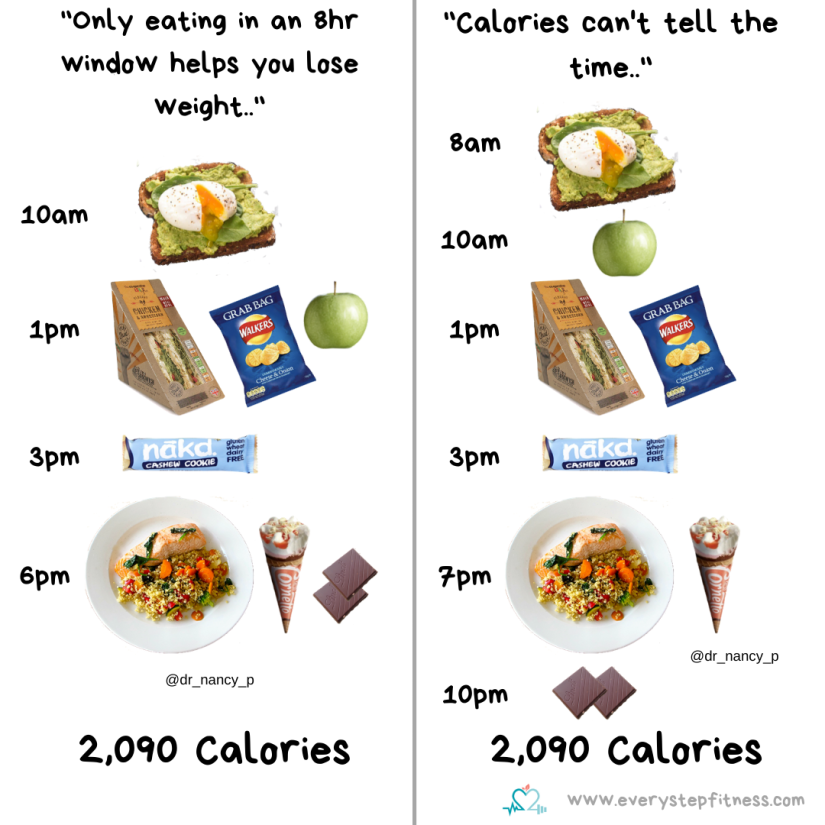
“Calories can’t tell the time…. “

“Calories can’t tell the time…. “ ⏰

It’s really easy to fall into the trap that eating your meals/snacks etc at certain times of day (or not eating at certain times of day) will help you lose weight (fat) more quickly.

One common idea is that you should fast for a certain number of hours during the day and only eat within a certain window of time. This varies but is usually an 8hr window or so. Proponents of this method suggest that by only eating during certain hours you can forget “complicated” diets etc and lose weight without doing anything more. You’ll hear lots of people saying they’ve achieved great fat loss using this method and they undoubtedly have. So surely it works then? Well yes it works – but only because those people have ended up eating fewer calories and therefore been in a calorie deficit, and lost fat/weight.

The problem with this method is that it doesn’t account for individual’s daily caloric requirements. So if someone started this method, but was eating more than their daily calorie requirement within that 8hr window, then they wouldn’t make any progress. Studies have shown that this method ONLY results in fat /weight loss when participants eat fewer calories than they are expending, and are therefore in a calorie deficit. Meal timing is irrelevant in terms of fat loss, it’s energy in vs out that matters.

Having said that, for some people, it’s easier to eat fewer calories if they restrict the hours in which they are “allowed” to eat. So if skipping breakfast, or not allowing yourself to eat after 8pm works for you then go for it! BUT you still need to be eating in a calorie deficit. For some people though, fasting for long periods of time, or skipping meals, isn’t a sustainable strategy long term. It can result in reduced energy levels, and excessive hunger, leading to periods of “binge” eating and therefore eating more than their daily calorie target. It can also lead to less activity (and therefore fewer calories burned) due to low energy levels.

So basically – do what works for you, but remember it’s the total calories that count – not when you eat them

🤗

Xx

Tuesday Tip

Tuesday Tip: Small changes, big results

Tuesday Tip: Small changes, big results 🤗

Fad diets and massive changes to eating and exercise habits work well for some people, in the short term but research shows that for most people these drastic changes don’t last and only increase the likelihood of gaining back the weight when we go back to our old ways. It’s also overwhelming and much more likely to lead to failure. So stop trying to change everything at once!

Instead, identifying lots of smaller changes and trying to do them daily works much better. This ‘habit stacking’ has been shown to be more successful than making one massive change. Big goals are overwhelming and scary, and you’re far more likely to stick to small, easy changes and you’ll also get a confidence boost from sticking to them.

So for example rather than going cold turkey on sugar try reducing your 2 spoons of sugar in your tea to one, then none, try reducing your soft drinks to one a day instead of three, try adding one portion of veg to your meals, then two etc. A recent study showed that it takes approximately 8 weeks for a new habit to form so stick with them and you’ll find these new habits will stay with you!

Happy Tuesday

😁

Xx

Nutrition and Calorie Tips

Half an Avocado….

Half an Avocado…. 🥑

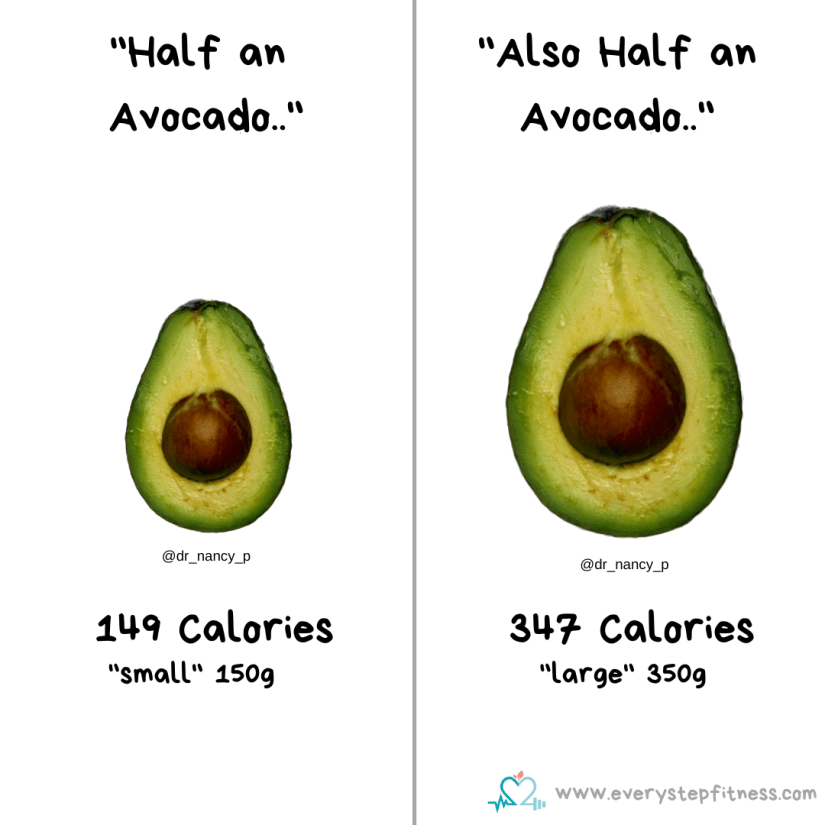
If you’re trying to lose fat and tracking your calories it’s really important to be as accurate as you can and this is why. If you’re using an app like myfitnesspal you might assume that the calorie value for half an avocado is a generic measurement for all avocados. Of course in reality avocados vary quite a lot in size – is that half an avocado a small one? A medium one? Or a large one? Obviously the nutritional value, and calories, will vary significantly with size. In this example one half is a pretty small avocado (150g), which means half will be around 149 cals. However, if you’re lucky enough to get a large avocado (350g) then you’d be looking at 347 cals for half!

So if you were just logging a generic half

an avocado at 149 cals but actually eating a large avocado then you’d be underestimating your calorie intake by 200 cals. If you’re an avocado fan and having some most days that could be an underestimate of 1000 calories or more a week – which is significant enough to prevent or slow fat loss.

If you’re having something low calorie then it won’t matter but with something calorie dense like avocado it really is important to know how much you’re having – assuming your goal is to lose weight/fat.

This is why I encourage my clients to weigh, in grams, rather than using generic, subjective measures like ‘half an avocado’. So if you’re trying to lose fat and tracking your calories have a go at weighing your avocado next time. You may be surprised! 😬

🤗

Xx

Nutrition and Calorie Tips

Rice cake or Crumpet?…..

Rice cake or Crumpet?….. 🥯

As I often say, the key to managing your dietary intake and weight or fat loss is about understanding that there is no such thing as a ‘good’ or ‘bad’ food. There are just different foods that serve different needs.

The nutritional breakdown and mirconutrients in food are important of course. So in that context you may feel that a rice cake, with peanut butter and banana is a ‘good’ snack. It’s full of good fats, protein and some carbs too. It will certainly keep you satisfied, but it is also perhaps higher calorie than you’d expect for a ‘good’ snack – averaging around 244 cals per rice cake (and let’s be honest I’d certainly have two!). Given the perception that this is a ‘good’ snack it would be easy to assume it was lower calorie or ‘better’ than the ‘bad’ snack – a crumpet with butter.

In fact the crumpet and butter is only

135 cals. Nutritionally it’s still good – with carbs and fats, but does contain less protein. That doesn’t make it ‘bad’. If your goal is weight or fat loss then it may be a better snack for you, that day, depending on your calorie target.

Most importantly you may actually just fancy a crumpet – and if so you should have it! Remember food also provides enjoyment too! And having things you enjoy will increase the likelihood of long term adherence and sustainability.

Personally I like both these snacks – and I’d happily have either! But being aware of the calories helps me make an educated choice.

🤗

Xx