Nutrition and Calorie Tips

Stop exercising to burn calories…

Stop exercising to burn calories… 🏃🏼‍♂️

Whenever someone wants to lose weight inevitably they place a huge focus on exercising to burn more calories. Exercise appears to be the holy grail of weight loss behaviours. Exercising to burn calories becomes the main goal. And yes, of course it’s important to exercise and yes of course it does increase your energy output but, as I’ve discussed before, you will never ever be able to out-exercise food.

So whilst I wholeheartedly support people exercising more (I’m an instructor so obviously I do!) it’s not with the sole purpose of burning calories. That’s last on my list of reasons for anyone to partake in exercise and it should be last on yours too!

Instead, move your body to improve your mental and physical well being. There are so many reasons to exercise that go beyond burning calories.

• Exercise improves muscle mass and joint health and keeps you functioning independently into old age.

• Whilst excess exercise can down-regulate immune function, regular exercise serves to improve the resiliency and expression/activity of immune cells and mediators so it improves immune function and helps protect against disease.

• It makes you feel stronger and more empowered

• It improves mood, can reduce anxiety and some symptoms of depression and relieves stress.

• It improves cardiovascular health and reduce disease risk

• It increases self confidence

Above all – exercise to celebrate that you can! Not to burn calories!

🤗xx

Nutrition and Calorie Tips

Anyone for ice cream?.

Anyone for ice cream?.. 🍦

It’s warmed up a bit now so definitely time to crack open the ice cream! I don’t know about you but once I start on a tub it’s gone before I even realise it!

Whilst there’s no problem with including any ice cream you like in your diet, if you are trying to lose weight/fat you may find that fitting a whole tub into your calories quite tricky. So you have two options – either limit the amount you have, or swap from a calorie dense type of ice cream to something that’s similar tasting, but lower calorie. There are the obvious swaps to the low calorie brands like oppo or halo top etc but another option is to switch to something else entirely.

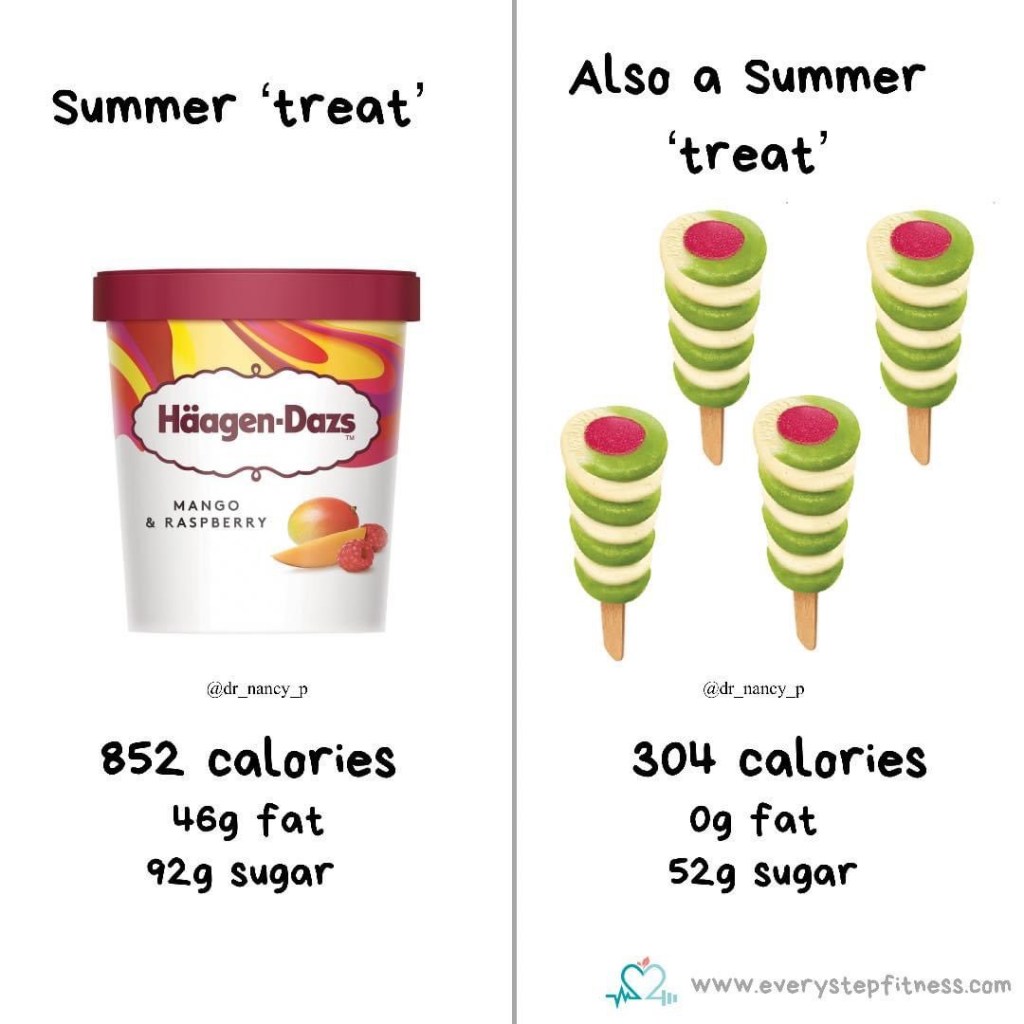
In this example switching from the Häagen-Dazs mango and raspberry ice cream to twisters makes a massive calorie saving. You could have 4 twisters for almost a third of the calories of the Häagen-Dazs. As an added bonus the chances of you eating 4 twisters in a row is considerably less than working your way through a tub anyway. Psychologically it’s much easier to work your way through an open tub than help yourself to 4 lollies in a row.

So if you do want to enjoy some

Ice cream but save some cals try going for the lower cal, higher volume option if you can.

🤗xx

Nutrition and Calorie Tips

What you tend to focus on… and what you should focus on…?

What you tend to focus on… and what you should focus on…? 📉

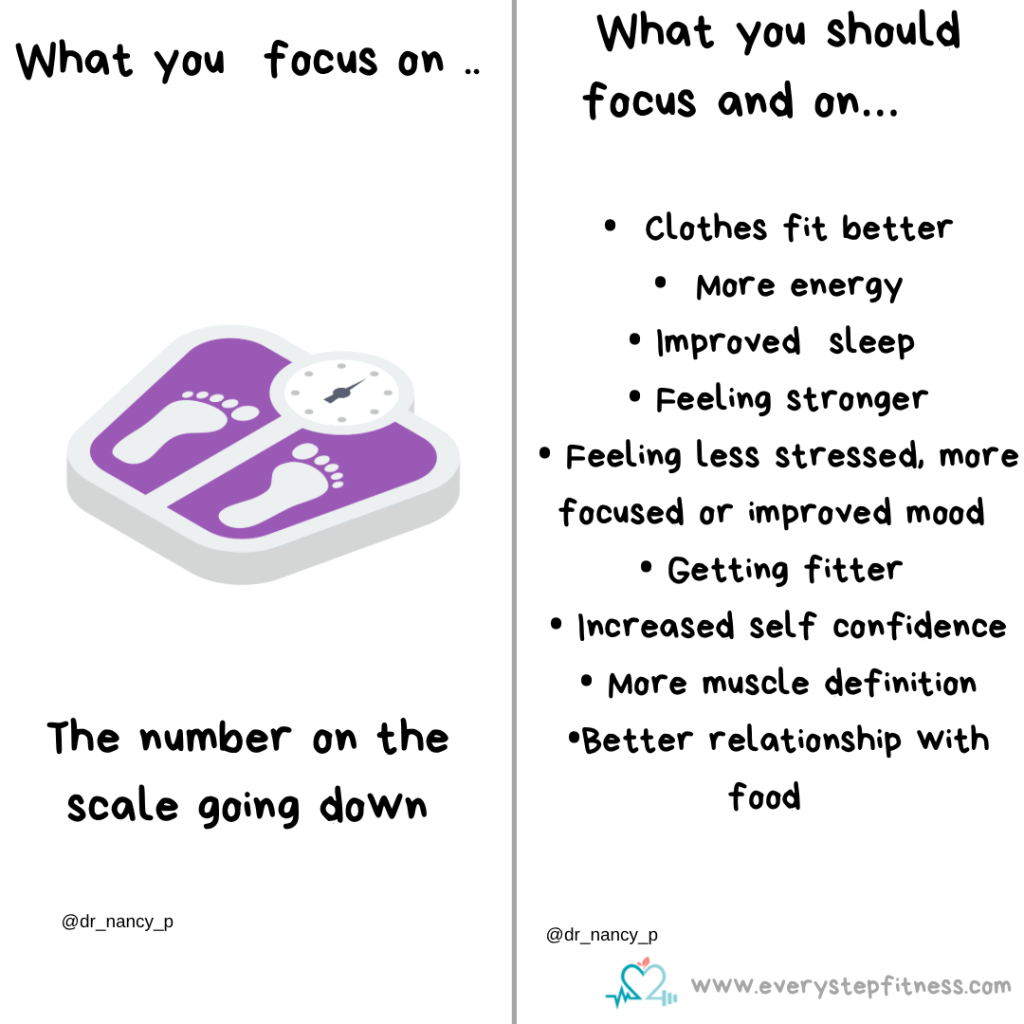
If you’re trying to lose weight (by which we really mean body fat as that is what actually results in body shape change) then it’s important to find ways to measure progress. We tend to focus on a single goal and most often it’s weight related and it’s the ‘final’ goal. This can be one of the reasons you may self sabotage and struggle to stick to your weight loss journey. The goal is so far away that you don’t feel like you’re making progress and in addition because it’s focused on the scales if that number stays static or goes up that can cause you to give up.

We are all conditioned to use body weight scales. They can be a great tool to assess whether you’re making progress. However, the number the scale shows is JUST a number. It’s merely your relationship to gravity at that particular moment in time. It’s not actually the best way to measure progress. Just because the number on the scale hasn’t gone down in a while, doesn’t mean you’re not improving your overall health.

If you decide to use the scale, you need to overlook the day to day changes you will inevitably experience. Scale weight is affected by lots of factors – amount of food in your system, hydration levels, glycogen levels, hormones, salt content of your diet, recent exercise, type of food you ate yesterday (diff foods can result in more or less temporary water retention) etc. None of which are a reflection of how much fat you’ve lost/gained or how your shape has changed. Think about it – if you had the body you wanted and felt confident to wear anything you liked, would it matter what that scale number was? No!

It’s vital to trust the process and think long term. The reality is your body shape can change without the scale going down – in fact a recent client actually put on weight (muscle and fluid probably) yet has lost body fat and cm’s.

So instead of focusing on the end goal weight try to use other measures and do use on the daily/weekly changes outside weight and the number on the scales. e.g. items of clothing and how they fit, sleeping better, feeling stronger, getting fitter, improving your relationship with food etc. Try to focus on some of these other, arguably more important, measures of progress. If you must step on the scales then look at averages over time rather than daily variations and focus on long term trends.

🤗

Xx

Nutrition and Calorie Tips

Eating certain foods doesn’t make you a ‘bad’ or a ‘good’ person…

Eating certain foods doesn’t make you a ‘bad’ or a ‘good’ person… 🍷

I lose count of the number of times I hear clients tell me they’re ‘bad’ because they’ve eaten something they feel they shouldn’t have. How often do you eat something and label it as ‘good’ or ‘bad’ and by extension consider that you’ve been ‘good’ or ‘bad’?

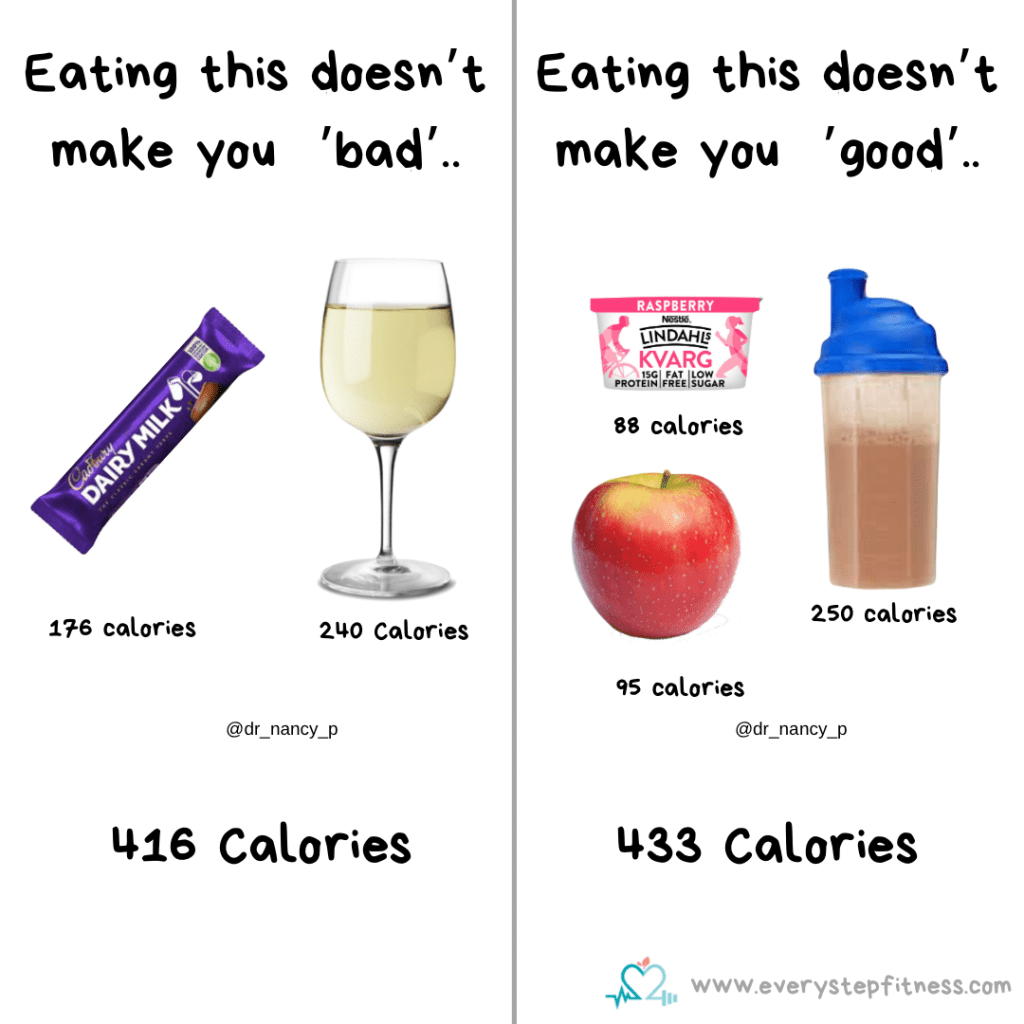
If you succumb to a bar of chocolate and a glass of wine after a long day you tell yourself you’ve been ‘bad’ and that you’re a ‘bad’ person. Yet if you have a yoghurt, apple and a protein shake (in this example a standard protein powder mixed with 300ml semi skimmed milk as per the instructions) you’d be feeling very virtuous and like you’re a ‘good’ person.

It’s really time we stop labelling foods and good or bad. There are no good or bad foods. There are simply foods which contain a greater or fewer number of nutrients. The foods themselves aren’t bad – the quantities may be though. You are also not a bad person for eating those foods. It’s time we stop attributing some form of morality to snacks etc. What you eat or don’t eat has absolutely no bearing on your worth as a person. You’re not a bad person for snacking on a doughnut. You’re also not a good person for choosing an apple and almonds.

Yes the apple, yoghurt and protein shake will have more fibre, more micronutrients (vitamins and minerals) and more protein. The wine and chocolate undoubtedly have fewer vitamins and minerals, but it will provide you with energy and joy! If you were trying to hit a certain number of calories then the wine and chocolate may even be a better choice as they’re fewer calories (and if you swapped to a small glass of wine it would be even fewer!) but neither is inherently good or bad. They both have a place in a balanced diet. The only reason to describe either as good or bad is in terms of how you think they actually taste!

Enjoy!

🤗

Xx

Nutrition and Calorie Tips

Banning vs allowing foods

Banning vs allowing foods 🚫

You might struggle with overeating particular foods when they’re in your environment. Naturally this may make you

frustrated because it’s getting in the way of your health/weight loss goals. An extremely common approach is to instantly ban certain foods which you may struggle not to over consume. But is banning ‘problem’ foods really a good solution? Eliminating these foods may work, but is it really a long-term solution? Is it feasible for you to never encounter these foods ever again? Does that sound like the relationship with food you want to have?

The issue with banning foods e.g. chocolate/biscuits/ cheese etc is that unless you never want to eat that food ever again you will undoubtedly encounter it in future. When you do you’ll be back in the same cycle of eating it to excess and feeling bad about it. Demonising foods and restricting them has been shown to lead to increased stress and poor mental health. It creates a negative relationship with food and can lead to a cycle of restriction and binge eating.

Instead legalise those foods and allow them in your diet. It will allow a more balanced and healthier relationship with food that’s associated and studies have shown that it’s associated with reduced disordered eating, more self-control, less depression, reduced anxiety, better body image and increased self esteem and fewer food obsessions.

Studies have also shown that over time it leads to weaker desires for potentially tempting food. You become habituated to the food and that means you’re less likely to over eat it to excess. This means you need less self-control and less cognitive (brain) power to deal with it. As a result you can focus your attention on things like hunger signals etc and learn to manage your appetite more naturally.

How do you actually do this?

Use tools like calorie tracking/logging food together with things like rating your hunger and fullness. Eat mindfully – avoid distractions and focus on what you’re actually eating. Use repeated exposure – so have that food regularly in your diet.

So don’t ban foods – learn to enjoy them as part of your overall diet. This will promote long term success, satisfaction and enjoyment, rather than guilt.

🤗xx