Nutrition and Calorie Tips

Why you think you’re struggling with weight loss ….

Why you think you’re struggling with weight loss …. 🤔

If you’re struggling to lose weight you may look to things like your age, metabolism, stress levels, hormones, lack of sleep, amount of water you’re drinking etc as the reasons why you can’t achieve your goals.

It’s true that all these areas can and do have an effect and some will certainly impact on things like your appetite and ability to ‘stick’ to a calorie deficit. However it’s actually rare that these are the main reasons behind stalled progress. They do however get a lot of attention – why? Because they are much easier to accept than ‘You’re eating too much’. It’s a lot easier to focus on the idea that your metabolism, hormones or stress levels are preventing your weight loss rather than a heavy social life being the issue.

Of course things like snacking, increased portion sizes and booze can be a response to lack of sleep or stress, or hormones, but it’s far better to focus on these habits instead. Why? because they’re the direct cause, they’re tangible and easily identifiable and they’re the thing that need to change. Rather than trying for some vague notion of ‘increasing sleep’ or ‘reducing stress’.

Obviously nutrition and weight loss can be complicated but if you try focusing on things like reduced portion sizes, fewer or lower calorie snacks, less booze you will see progress. Managing meals out or reducing them (it’s extremely hard to eat out multiple times a week and maintain a calorie deficit without some proper planning), and increasing general activity (note this isn’t just exercise sessions but general activity – walking, fidgeting, moving more!) are also things which are tangible ways to help make progress. You will probably find that despite any issues with sleep, stress, hormones etc you will be able to make progress. Certainly my clients can and have done! So if they can, so can you!

🤗
Xx

Nutrition and Calorie Tips

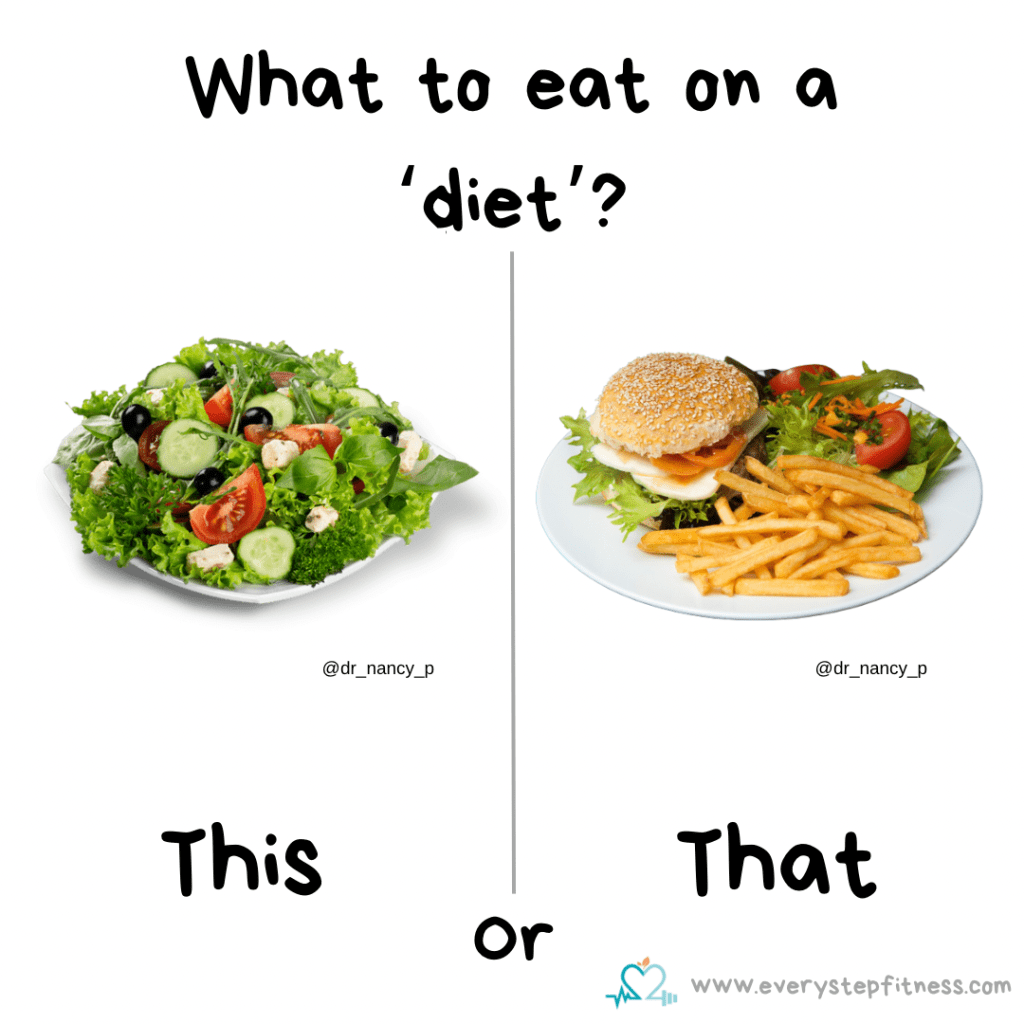
What ‘should’ you eat on a ‘diet’?

What ‘should’ you eat on a ‘diet’? 🥗

People often say to me ‘I know what I ‘should’ eat, but I just don’t’ . There’s a whole load of guilt and shame in that statement. And it’s often this guilt and shame that leads to feelings of resentment and deprivation and ultimately leads to unsuccessful weight loss attempts.

I do talk about this a lot but it’s so important. What if there are no good or bad foods? Just foods that serve a purpose in that moment. When you remove the stigma around certain foods you enjoy, you can also remove the fixation on them which may naturally lead to a more balanced approach to our diets.The more you (or social media) tells you that a food is bad and you can’t have it or that you’re ‘bad’ for indulging in it – the more you are likely to focus on it. Those thoughts circulate in your head until you can’t hold out any longer, binge on those foods and then feel embarrassed or ashamed or angry with yourself. This can lead to you just saying ‘f*ck it’ and throwing in the towel , then just indulging continuously until you decide to ‘be good’ again. The classic yo-yo dieting approach we are all so familiar with.

Instead just allow all foods to be a regular part of your life. Instead of demonising and banning foods just give yourself some guidelines – staying within a calorie target, ensuring you’re getting your 5 a day in, making sure you’re including some protein in your main meals etc Then fill the rest of your diet with the foods you’d traditionally attempt restrict and avoid.

It doesn’t need to be this salad or that burger… it should be this AND that.

🤗xx

Nutrition and Calorie Tips

What actually happens when you lose weight fast…

What actually happens when you lose weight fast… 📉

We seem to be conditioned into expecting extremely rapid weight loss when we start a new diet or exercise regime. Social media is also full of promises of diets that will help you ‘lose 5kg in a week’. I can see why it’s tempting and I can also see why it’s nice to lose large amounts of scale weight when you start a new diet, and why it’s easy to feel disheartened if you don’t.

First things first, remember weight loss is not the same as fat loss. You’ll see lots of diets promising x kg loss in a week etc. What these diets – be they juice cleanses, ‘detoxes’, 7 day challenges, fasting, keep etc , don’t explain is that if you did indeed see that amount of loss in a week then it wouldn’t be fat loss. The harsh reality is that most of that weight loss is actually water weight, stomach contents, and a fraction of that is also muscle , and only a little bit of actual fat. Plus if it’s a particularly restrictive diet or is using pseudoscience to back it up it can also mess up your relationship with food and mental health.

Weight loss and fat loss are not the same thing. It’s quite easy to manipulate water weight by consuming fewer carbs (as 1g carbs binds approx 3g water), reducing salt intake or using diuretics (which increase the amount of water and salt excreted in the form of urine). This is how some athletes cut a few kg in the week before a competition.

So what should you do?

Do not crash diet – please! Instead try to make sustainable longer term changes to your calorie intake. A moderate calorie deficit will allow you to lose sustainably and steadily (an average of <1% body weight/ week). Shift your expectations away from big scale losses as a measure of success each week and instead look at long term trends and changes in things like clothes size, or measurements or progress photos rather than the scales.

🤗xx

Nutrition and Calorie Tips

Reverse lent!

Reverse lent! 😇

We may be a week into Lent already but regardless of your beliefs or faith Lent has traditionally become a time when people give up various things they consider ‘bad’. Now whilst there’s absolutely nothing wrong with that at all sometimes it can become more of a negative rather than positive experience.

So how about instead of giving up things, you turned it around and tried taking something up or giving something to others?
You could do some voluntary work, or you could give things to charity. For example, try setting up a box and popping one item of clothing or something you don’t want anymore in it every day for each day of lent, then donate to charity at the end!
You could give your time to someone – it could be something simple like helping a friend or neighbour, or calling someone for a chat. Or you could take up a new hobby or challenge during Lent – try something new like gardening, knitting, drawing, or perhaps a fitness based challenge – trying new classes, walking every day, working out 3 times a week etc.

What do you say? 🤗
How about a reverse lent?
Xx

Nutrition and Calorie Tips

Best methods for recovery?

Best methods for recovery? 🧊

Like everything in the fitness and diet industry the subject of recovery and methods to aid recovery are full of fads and social media trends. Common post workout recovery options include, foam rolling (with expensive, fancy rollers), massage guns and cold water immersion, with the latter gaining popularity as ice baths have become a must in “self-improvement/discipline” circles recently. Social media is full of celebrities and fitness personalities sharing their cold water immersion practices, with dedicated tubs/barrels etc.

Studies have shown that cold water immersion, massage guns and fancy foam rollers don’t actually result in significantly better recovery than just resting and good nutrition. In fact some are less effective. Several studies have also found that ice baths can negatively impact muscle and strength adaptations. A recent overview of studies found that taking an ice bath immediately after a workout leads to less muscle growth than resistance training alone.

Whilst often promoted as “game changers” these methods aren’t really that at all – at best they may help reduce soreness and perceptions of fatigue but don’t come even close to the effect that sleep and nutrition have on your recovery and muscle growth.

For competitive athletes, it may be important to incorporate some of these things into their recovery leading up to a competition, in conjunction with adequate rest and food, particularly at time where fatigue needs to be quite low. If you’re someone looking to increase muscle mass, cold water immersion should be used sparingly (e.g. only after very hard training sessions) as it can interfere with hypertrophy (muscle growth).

For most of us simply spending more time and energy focusing on good sleep and good nutrition will not only help you recover better and faster, and benefit your progress in the gym, but it will also likely positively contribute to your overall health and wellbeing.

🤗xx