Nutrition and Calorie Tips

Choose your hard…

Choose your hard… 💪🏼

It can seem really hard when you’re trying to lose weight/get fit and healthy. It’s hard to change your habits – it’s hard to reduce your calories, to reduce your alcohol intake, to increase the amount of fruit and veg you eat. It’s hard to go to the gym, go to workout classes or walk more or increase your activity – especially when you’re busy and stressed and tired. It’s even harder to prioritise sleep when you have so much going on and a thousand demands on your time.

But it’s also hard always being tired, being unwell because your immune system is wrecked or being at risk of cardiovascular disease and diabetes. It’s hard not fitting into the clothes you want to, it’s hard being out of breath going up and down stairs, or playing with your children. It’s going to be even harder when you’re older and unable to get up and down from the toilet unaided, or pick yourself up when you fall. It’s hard not feeling confident in your own body, strength and fitness.

I know it’s never quite a straight forward as this but on some level you have to choose your hard. Neither option is easy – they’re both hard. Even when you reach the level of fitness you want or the dress size you want – it won’t magically become easy to maintain it. It’s still going to be hard some days.

Choose your hard!

Xx

Nutrition and Calorie Tips

Moderation is key!

Moderation is key! ☕️

When it comes to weight loss the keys

to success are consistency and moderation.

If you want to succeed then you have to find ways to maintain a calorie deficit over the long term. That means you have to engage in moderation. Depriving yourself of all the foods you love and enjoy won’t result in success. But equally saying ‘f*ck it’ every day and not being willing to make some sacrifices won’t result in success either.

In this example – the coffee on the left is a large caramel oat latte – and costs 305 cals. On the right is an oat milk flat white with skinny caramel syrup and is a mere 66 cals. Sometimes you can definitely have the latte but most people won’t be able to accommodate 305 cals of coffee into their day every day. So find that alternative and enjoy that most days, then have the more expensive one as a ‘treat’. Your calorie budget is yours to spend however you like but this is just one way to help make it go further.

🤗

Xx

Nutrition and Calorie Tips

Are you focusing on the small stuff instead of the big stuff?

Are you focusing on the small stuff instead of the big stuff? 🫣

One of the biggest weight loss mistakes I see people make is a focus on the small details. We often spend a lot of time and energy on things that don’t really matter that much. Meanwhile we overlook things that actually matter the most. People often get hung up on things like specific foods they should or shouldn’t eat, obsessing over what time they should eat, tracking ratios of protein to carbs etc, wanting to take supplements, worrying about which specific workout they should do or thinking it’s the end of the world when they can’t do the workout they planned etc.

When it comes to weight/fat loss none of that actually matters – at all! Focusing on all these small details just serves to complicate things, and potentially cause you to not make progress, Instead pay attention to the big things. The most important thing to focus on is a calorie deficit (how you achieve this is up to you but it can be achieved via ANY diet or eating regime) and secondly this needs to be maintained consistently- over weeks and months (not days). Cultivate healthy habits – drink water, get some sleep, eat fruit and veg etc and learn to manage social events/booze and weekends and don’t fret about what exercise you do – just be generally active and do whatever exercise you can fit in that you enjoy.

Keep it simple and you’ll succeed!

🤗

Xx

Nutrition and Calorie Tips

Estimating amounts is hard….

Estimating amounts is hard…. 🍝

I’m always telling my clients to try to be as accurate as possible when they’re tracking their food and calories. This means actually weighing things – particularly anything that is calorie dense.

Very often people tell me that they’re “pretty good” at estimating the amounts they’re having, that they have the same thing each day so they know what it looks like now, that they can estimate pretty well etc. I’m sure some can, but I know I can’t. I can at first but then often amounts creep up without you even realising it.

In this example on the left is 100g of pasta (uncooked weight), on the right is 175g pasta (a much more likely portion size too).

As you can see they look pretty similar to the naked eye, yet the calorie difference is significant. It would be very easy to assume you were using around 100g pasta but actually be using closer to 175g or more! It may not matter now and then but these calories do add up. And if that’s just the plain pasta, what about other things? With less calorie dense foods it won’t matter as much but with calorie dense foods (e.g. nut butters, spreads, cheese, avocado etc) when you get it wrong you’re adding a large number of calories. This is also why measure like a ‘handful’ or ‘cup’ of pasta, a ‘medium’ banana or “a scape of butter’ are no good – what’s a handful? scrape? What’s medium? My scrape may not be your scrape etc

So if you are trying to lose fat/watching your calories maybe it’s time to go back and get those scales out and double check those estimates and see if you really are as good as you think you are.

🤗

Xx

Nutrition and Calorie Tips

Is alcohol holding you back…

Is alcohol holding you back… 🍺

Ok I know this is probably not going to go down well but let’s talk about alcohol, weight loss and fitness.

I never tell clients to cut food groups from their diet but alcohol is one thing I often recommend people consider reducing. It’s the ONLY actual toxin we regularly consume and it’s classed as a ‘class A’ carconigen (together with asbestos, radiation and tobacco) meaning there is no ‘recommended’ safe amount that can be consumed without increasing your risk of cancer (and other diseases). ‘It doesn’t matter how much you drink – the risk to the drinker’s health starts from the first drop of any alcoholic beverage’

Alcohol calories are also processed differently. The cals are used immediately to generate adenosine triphosphate (ATP) to detoxify it. This detoxification is a labour intensive process so the liver ‘shuts down’ and stops processing fat, carbohydrates and protein because it needs to deal with alcohol. Hence why you get the munchies, because the detoxification of alcohol inhibits gluconeogensis (breaking down of our internal food stores). So not only does alcohol inhibit fat burning it also encourages over eating.

So if you’re training hard and wanting results, is alcohol one aspect that’s holding back your progress?

Aside from the impacts on fat loss studies have shown that consumption of any amount of alcohol decreases athletic performance – it’s associated with decreases in strength, power, speed and endurance. It also decreases the ability to regulate body temperature, reaction time, coordination, balance and judgement. It increases risk of dehydration, water excretion and risk of injury.

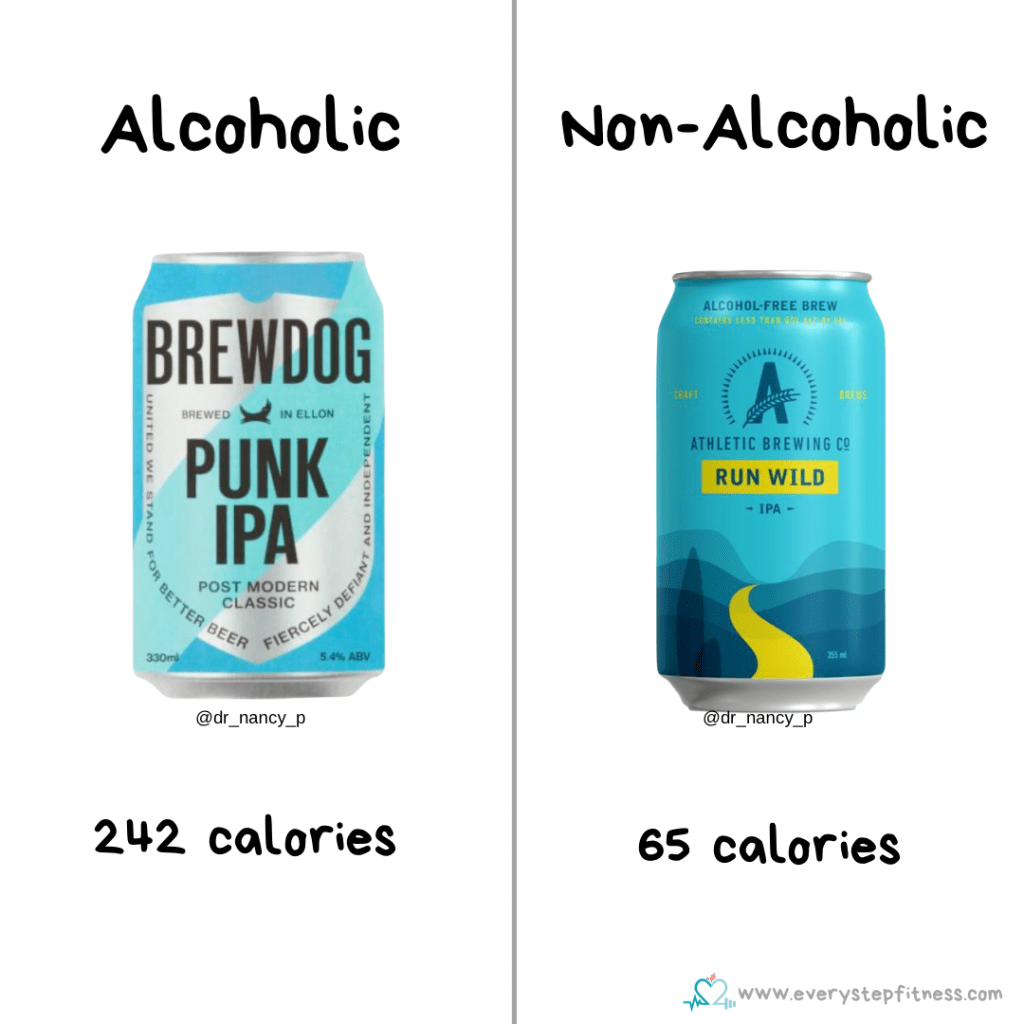
A reason people often give me to drink is that they genuinely like the taste. So if you really do enjoy the taste of beer etc but don’t want the negative effects on your performance and weight loss then it’s a no brainer really. Go for a non-alcoholic option – there are so many excellent ones on the market now!

🤗