Blog

Nutrition and Calorie Tips

Seasonal snacks….

Seasonal snacks…. 🐣

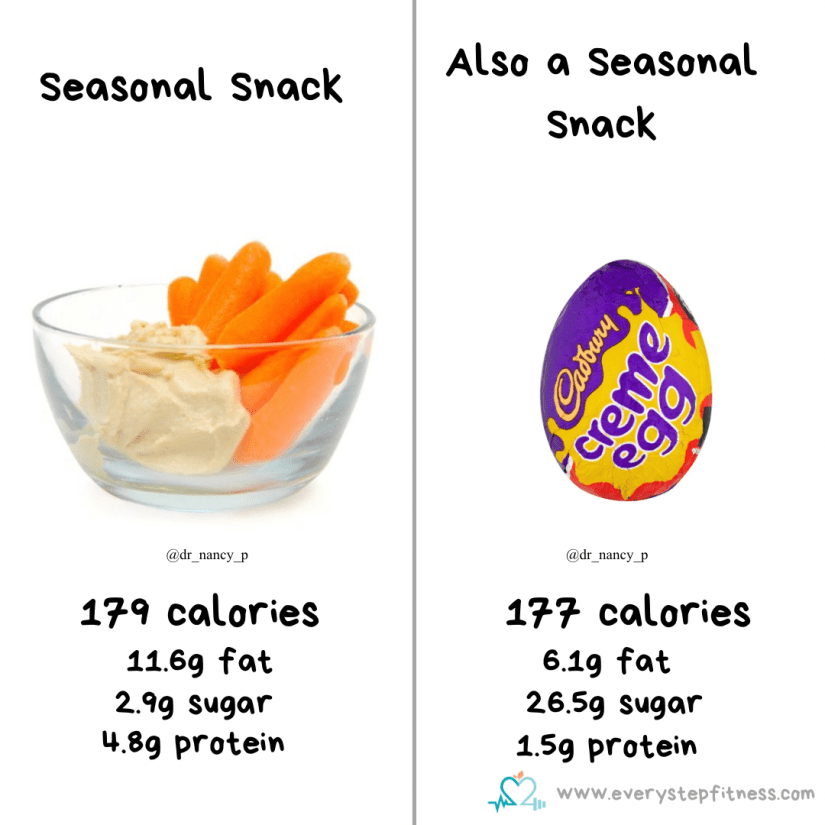
It’s nearly Easter – probably my favourite celebration – because I do love a chocolate egg! It’s also a symbol of new beginnings and spring. There’s loads of lovely seasonal foods around now, many of which make great snacks. A delicious seasonal snack could be some lovely fresh baby carrots (or other spring veg) with 70g humous. It’s full of nutrients – vitamin A and fibre from the carrots, good fats and protein from the humous etc and a reasonable number of cals for a snack. But you could also have an equally seasonal snack – of a creme egg (or your egg of choice!). Obviously this has a different nutritional profile – with more sugar, but fewer calories and less fat.

Both are perfectly good snacks. It doesn’t always have to be about the nutritional value of the food you’re eating. Food serves a purpose beyond pure fuel – it’s also an emotional activity. We enjoy eating and we enjoy food, and we enjoy the associations we make with food. So you could choose to snack on veg and humous. It will undoubtedly taste delicious and keep you satisfied until your next meal. Or, you may decide you’d rather enjoy a creme egg to snack on instead! Both are fine, within the context of a balanced diet overall. And as you can see from the comparison – if calories are what’s important to you – the creme egg is marginally lower anyway! lol!

So if you fancy the odd chocolate egg over the Easter period then go for it!

Happy Easter! 🐣

Xx
Tuesday Tip

Tuesday Tip: Booze 101

Tuesday Tip: Booze 101 🍸

I never tell clients to give up booze, life would be miserable without that if it’s one of your go to ‘treats’ – I do however suggest it could be one way to ‘easily’ cut calories by reducing the amount they consume. Mainly because it’s a discreet, easily identifiable thing to reduce, but also because alcohol can affect weight loss in other ways.

Alcohol contains 7 calories per gram (vs 4 cals for carbs and protein,and 9 for fat). More alcohol means more calories. So alcohol by volume, or ABV, is a good guide for how calorific your drink is relative to others. Drinks that are sweeter will also generally pack more calories (and remember mixers too!).

Unlike food, alcohol contains little to no nutritional value. Alcohol calories don’t fill you up like food calories do, or provide many micronutrients. This isn’t an issue in a balanced diet but just worth remembering when prioritising what you choose to consume.

Alcohol calories are processed differently too. Alcohol is a toxin so the cals are used immediately to generate adenosine triphosphate (ATP) to detoxify it. This detoxification is a labour intensive process so the liver ‘shuts down’ and stops processing fat, carbohydrates and protein because it needs to deal with alcohol. Hence why you get the munchies, because the detoxification of alcohol inhibits gluconeogensis (breaking down of our internal food stores). So not only does alcohol inhibit fat burning it also encourages over eating. The lack of inhibitions associated with alcohol also make it more likely you’ll ‘stuff the diet’ and eat more than you intended; so it’s a triple whammy!

In addition many alcoholic drinks aren’t labelled with calories and they can vary widely so it’s almost always an estimate e.g a can of beer ranges from 100 – 320 cals. If you’re consuming a lot it could impact on whether you manage to maintain a calorie deficit.

Tips to help:

  • Alternate drinks with water.
  • Use small glasses to make it easier to keep track.
    Swap to spirits with low or zero cal mixers or a dry white wine/ rose etc
  • Eat first to keep hunger at bay and make you less likely to overeat later.

Happy Tuesday 🤗xx

Nutrition and Calorie Tips

Reasons you think you can’t lose weight…

Reasons you think you can’t lose weight.. 🤔

We are all used to reading or hearing about reasons why we can’t lose weight/ fat. Commonly people will blame the fact that they’re eating too many carbs, or that they need to cut out sugar. Sometimes the blame is laid at fat in the diet and that’s what supposedly needs to be cut out. Perhaps it’s those ‘toxins’ in your diet?

As well as food groups we like to blame things like our hormones (particularly towards and after the menopause), or perhaps it’s the fault of a slow metabolism or lack of exercise? You’ll also hear people blaming the fact that they eat too late at night.. or even that they don’t eat enough (and are therefore storing fat).

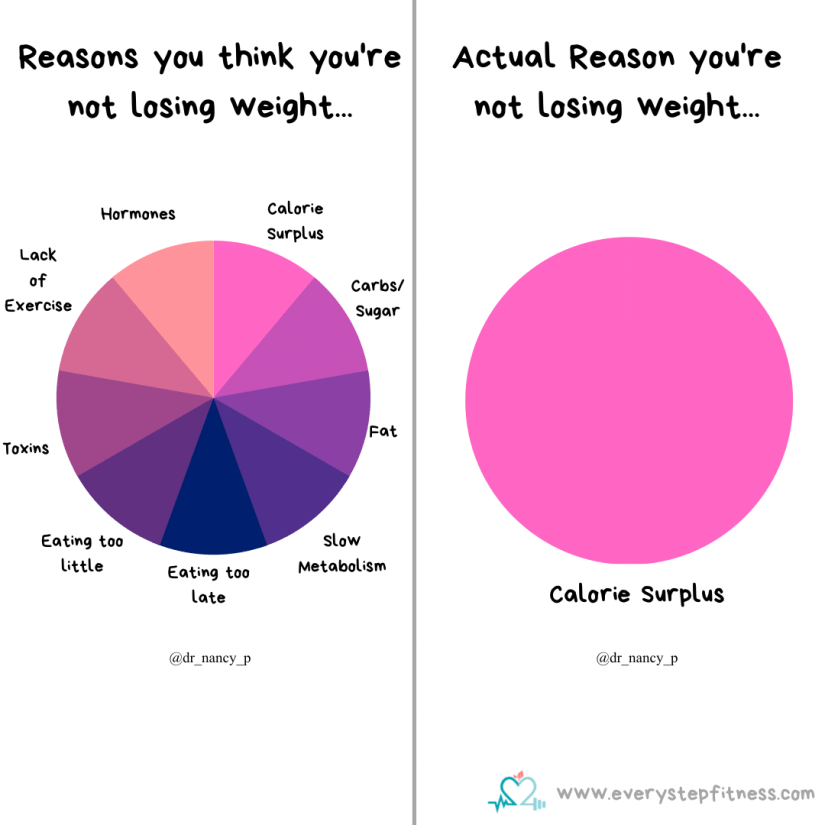
The reality is the only reason you aren’t losing weight is because you’re eating a calorie surplus. It is physiologically impossible to gain weight without a calorie surplus so if you’re putting fat on then I’m afraid you are eating more than you need.

Now that’s not to say these things don’t have an impact. Whilst individual food groups don’t inherently cause you to gain or not lose weight, some foods will affect your ability to stick to you calories. It is far easier to overeat if you’re having lots of fat and carb heavy foods – by which I mean things like cakes, biscuits, pizza etc etc. Despite what people tell you we don’t need to detox to lose weight – our kidneys and livers do that just fine! The only thing we consume regularly which is a genuine toxin is alcohol but even that is fine if you’re accounting for the calories.

Hormones and your natural resting metabolic rate (and how it changes as you age) will have an impact too. They affect the amount of calories you need to maintain your weight – so all that means is you have to adjust your goal down a bit to lose. The time of day you eat has zero impact except in terms of your own behaviour and likelihood to over or under eat. And no, you definitely aren’t eating too little – if you were you’d be losing weight!

No matter what the underlying cause, a calorie surplus is always the reason for lack of weight loss.

🤗

Xx

Tuesday Tip

Tuesday Tip: Attentive Eating

Tuesday Tip: Attentive Eating 😋

Although calories are the overall determinant of weight loss/gain there are many factors which influence how likely you are to stick to your calories. One such issue is distracted eating. Distracted eating is becoming increasingly common due to today’s increasing reliance on electronic devices etc. Attentive eating is essentially removing distractions whilst eating, and monitoring the true amount of food being consumed. This allows you to more accurately remember how much you’ve already eaten which can help reduce over eating for the rest of the day. It helps you to focus on what you actually need food-wise , rather than relying on external cues like plate size, packet size etc.

A recent review of 10 studies showed a significant increase in the amount of food consumed when distracted e.g. by TV, mobile phones etc. I’m sure we’re all aware of times when we’ve been focused on our phones or the TV and not even noticed the plate of food we’ve just inhaled! The studies also showed that there was also an impact on meals later in the day. So those who were distracted would then go on to eat more in subsequent meals. This is related to the working memory of what you’ve eaten. If you’re distracted then the memory of what you’ve eaten is distorted (you remember eating less than you did which results in eating more later). A simple study tested this by asking participants to recall what they’d eaten in their last meal before eating an afternoon snack. Recalling previous meals led to participants eating less, compared to those that recalled non-food related memories.

So what does this mean for us? Distraction definitely increases the amount of food consumed both at that time, and later on in the day, and impacts on your memory of what you’ve already eaten that day. So removing visual distractions and eating attentively will help reduce the chance of over eating. Actively considering what you’ve already eaten that day before you eat the next snack/meal also helps. In terms of the practicalities of doing this this is yet another reason why tracking your food can really help you to stick to your calorie goal.

Happy Tuesday 🤗xx

Recipes

Veggie ‘feta’ roasted veg pasta

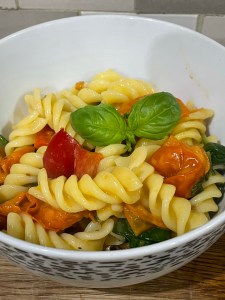
I’m sure many of you have seen the posts on social media of the feta and tomato pasta hack. This is my version of it – using a dairy free (vegan) feta! I wanted to see if it would work and it does! Obviously you can use a normal feta if you prefer. I also pimped it up a bit with mixed peppers, mushrooms, spinach and basil.

This serves 5-6 and comes in at around 380 cals per portion.

You will need:

500g pasta

1 200g block ‘feta’ (I used Violife Greek white cheese)

600g cherry tomatoes (1 punnet)

2 small peppers

5 mushrooms

100g baby spinach

Fresh basil

Salt, pepper, mixed herbs

1 cal oil spray (I used the olive oil version)

Preheat the oven to 200 C.

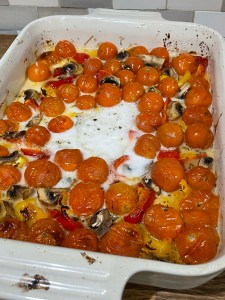
Chop the peppers and mushrooms into chunks. Spray a roasting dish with oil spray and pop the block of cheese in the centre, and throw the cherry tomatoes and peppers around it. Season and spray with oil.

Pop in the oven for 10-15 mins to start with.

While it’s in the oven cook the pasta to your taste. Drain and pop to one side.

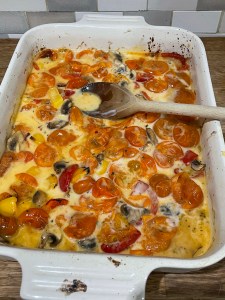
Check the oven after 10-15 minsand if the tomatoes are just starting to split a little then add the mushrooms and pop back in the oven for 10 mins or so. Timing will depend a little on how ripe your tomatoes are so check and see if they are soft and that the juices have run into the dish. The feta will have melted too.

Using a wooden spoon stir the veg and feta together and gentle squish the tomatoes.

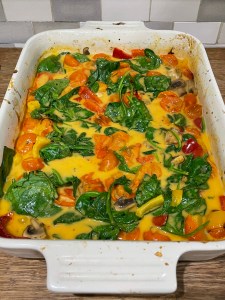
Add the spinach a little at a time, stirring in each time. Pop back in the oven for 3-5 mins.

Remove from oven Once the spinach has wilted and stir in a handful of fresh basil leaves.

Stir in the pasta

Then serve with a little sprig of basil!

Enjoy! 🙂

Xx