Nutrition and Calorie Tips

Practical New Year’s Resolutions…

Practical New Year’s Resolutions… ⭐️

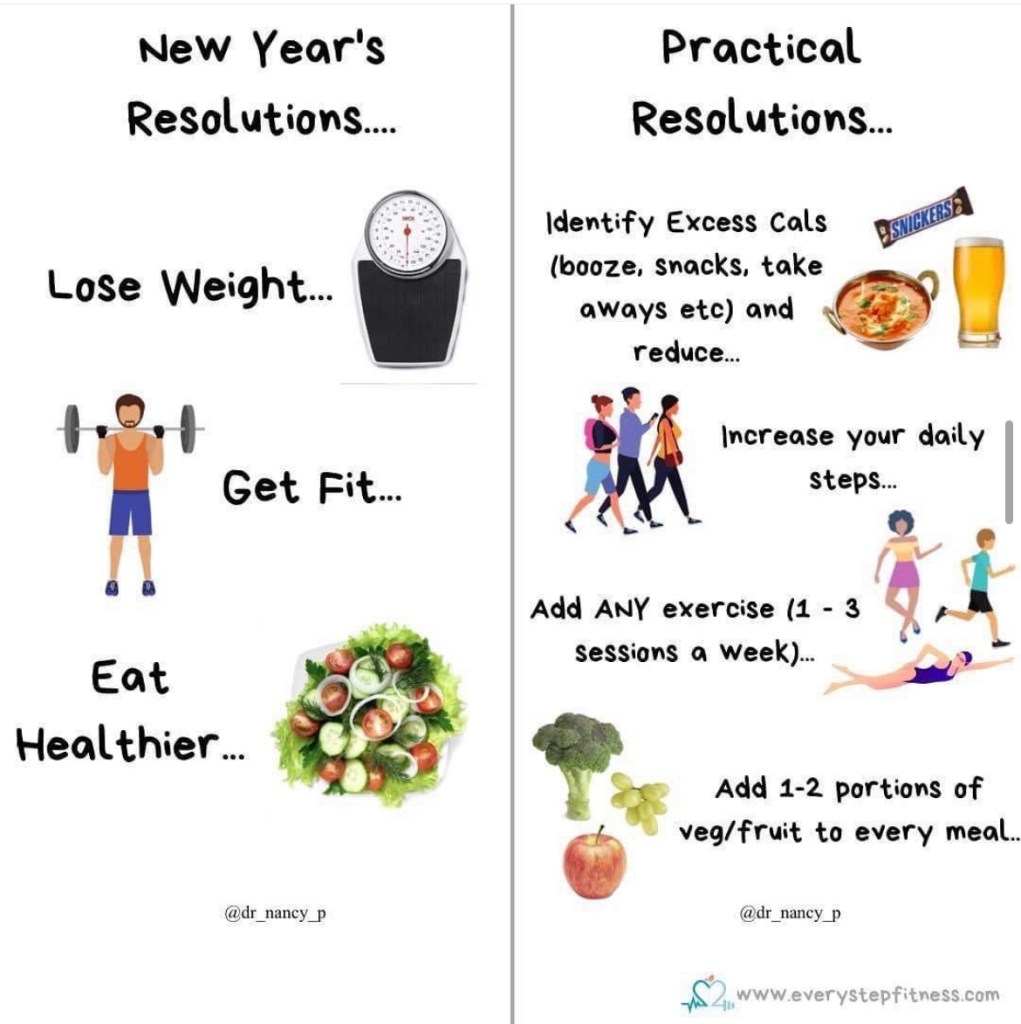
Although I suggested alternative resolutions yesterday I’m aware that for many their resolutions involve making a fresh start at health and fitness. Often these will include to “lose weight” or to “get fit” or perhaps “eat healthier’. Now whilst these are all great goals they’re quite hard to achieve without some practical steps. They’re outcomes of changes you need to make rather than actual resolutions per se.

If you are making New Year’s resolutions about your health and fitness, then instead of making generalised statements try to focus instead on small actions you can take every day that will lead to those end goals.

So instead of resolving to lose weight, perhaps instead resolve to identify where the excess calories are in your diet. Are they coming from alcohol? Extra snacks? Take aways? Portion sizes? And then you can take steps to reduce them and therefore reduce your calorie intake (leading to fat and weight loss).

Instead of resolving to “get fit”, instead focus on upping your daily steps. Rather than choosing an arbitrary goal of 10,000 steps, instead commit to increasing your steps. If you’re already hitting 12,000 steps a day then aim for 14,000, if you’re getting 4,000 aim for 6,000 etc. Also consider adding some exercise 1-3 times a week. It doesn’t matter what that exercise is really just pick something you actually enjoy; dancing, running, weight lifting, swimming cycling etc.

Rather than resolving to “Eat healthier” commit to adding a portion of fruit or veg to every meal. Aside from the fact that it will increase your overall nutrition, it will increase fibre levels, and will probably help reduce overall calories as by filling some of your plate with fruit and veg you’re going to eat less of other, more calorie dense foods.

This approach is far better than making massive changes, subscribing to fad diets/detoxes/challenges etc which may well cause you to lose weight quickly but will also see you putting that weight back on once you’re back to eating normally again. Take small sustainable steps and you’ll find you’ll hit your goals and be able to maintain it within your lifestyle too! 🙂

Xx
Tuesday Tip

Tuesday Tip: Say No to ‘Detoxes’

Tuesday Tip: Say No to ‘Detoxes’ 🥗

It’s January and predictably across social media people are peddling “detoxes” and “cleanses”. We’re told our bodies are full of toxins from overeating at Xmas, and if you follow plan X / buy the pill/tea/shake you’ll get rid of them and lose weight/ feel/look amazing. You don’t need it, your liver and kidneys do a great job of “detoxing” you, and these products can make your health worse. But we still fall for it.. why?

Post holiday detox

Over holidays we eat and drink more, so we crave simple, nutrient dense food like salads. Physically it feels good, and psychologically it feels good too; drawing a line under all the junk. This sort of “detox” isn’t silly, it’s just a word we use to say “lets get back to eating well”

Bloat

Over-indulging, or eating certain foods makes you bloated e.g. rich foods, alcohol, beans, or foods high in salt, certain starches and sugars. If it’s a chronic issue see a Dr. If you’ve been eating lots of salt you will retain water, making you look and feel bloated, reduce the salt for a few days and you’ll be fine. Overdo the food and drink? You don’t need to do anything just eat normally for a few days.

Constipation

If you’ve been eating badly you may be constipated. Most detoxes /cleanses are laxatives, which can permanently damage your intestines. So first of all, increase water, then increase fibre intake with fruits, veg, and whole grains, but do it gradually; a sudden fibre increase can make you feel worse. If that doesn’t help, see a Dr, not a Facebook ‘expert’.

Fat loss

No, just no. A juice/pill/shake won’t do that! Sometimes just buying something is a powerful psychological message that you’re making a change and acts as a kickstart; which is why we fall for it. Sadly it won’t last, and you’re left out of pocket and likely to rebound. The more radical approach to losing weight, the more likely it is to fail. Slow and steady wins the race; make small, sustainable habit changes and you’ll reap the rewards.

It’s normal to want to reset, feel better and make changes, but you don’t need a “detox”. Just try to get some sleep, drink more water, eat veg and get moving. You’ll look and feel far better for it!

Happy Tuesday 🤗xx

Nutrition and Calorie Tips

Happy New Year!

Happy New Year! 🥂🥳

A short and sweet one today for the New Year. I’m sure a few glasses of Champagne were raised last night and maybe again today. Enjoy! And at only 95 calories a glass it’s a bargain!

Nutrition and Calorie Tips

Fear Mongering vs reality…

Fear Mongering vs reality… 😱

It’s January so there are lots of fitness and ‘wellness’ experts on social media shaming people with misinformation about many things. Once such claim I’ve seen this week surrounds sugar. You may hear claims that sugar is ‘toxic’ – it isn’t and I want everyone to remember that.

These sorts of claims usually have a basis in some sort of science but it’s be simplified and twisted out of context into a headline grabber. There is a huge difference between the fear-mongering claim that “sugar is toxic” and the nuanced reality that anything we need in a balanced diet for optimal health (which does include sugar) can be potentially harmful in excess. The reality is that the human bloodstream contains sugar (glucose) at all times, and the moment it doesn’t – we die. However that sort of information doesn’t get people clicking their links, buying their diets/products etc and isn’t as sexy as ‘sugar is toxic’. This sort of simple clickbait pseudoscience creates fear and us humans aren’t great at overriding fear with logic. Plus, pseudoscience is a lot sexier than legitimate science because it provides simple, definitive claims about what can impact our health. The reality, which is far more complicated, and contains plenty of nuance and context, has less of a wow factor because it includes important details about dosage and the fact that health is impacted by many factors.

So no, sugar isn’t toxic, we need it. It can be harmful in excessive quantities but so can anything (even water) – it’s the dose that makes the poison. So, when you come across social media influencers/ fitness professionals, people selling diets/diet products etc making sweeping statements, take a pause and remember that it’s a whole lot more complex than “SUGAR IS TOXIC!” and then scroll on by and don’t give them your pennies or time.

🤗

Xx

Tuesday Tip

Tuesday Tip: Setting goals a different way

Tuesday Tip: Setting goals a different way🥅

With the new year comes the inevitable barrage of health and fitness programs and ‘resets’. Most of these will involve some goal setting and encourage you to visualise those goals. While this can get you excited and focused on what you want to achieve, there’s one massive issue with this approach. You can get so focused on the end goal, you forget about all the things that could go wrong. A more effective approach is anti-visualisation. Instead of visualising achieving your goal, do the opposite: visualise not achieving your goal.

I know that sounds very negative but trust me on this. Imagine failing and then write down all the all the potential reasons this could have happened. Essentially you now have a list of all the obstacles and setbacks you might face as you work toward your goal. Starting with the possibility of failure in mind makes you aware of the things that could potentially go wrong. Thinking about these things ahead of time allows you to come up with solutions to better handle them, instead of them cropping up unexpectedly and throwing you off. l’ve found anti-visualisation to have another benefit. It can spur action. If you don’t feel like doing something, reminding yourself of what could happen if you keep putting off the task then the thought of failing is enough to get me taking action!

The other thing to consider is making your goals flexible. The problem with a rigid goal is that you either hit the goal or you don’t. And if you didn’t, you ‘failed’. If you hit 7,000 steps instead of 10,000 or went to the gym 3 times a week instead of 4 is that a failure? No! So you want to set goals in a way that emphasizes action, not perfection. Instead of setting rigid goals, use flexible goal setting. Instead of a goal to go to the gym 4 times a week make it a goal 2-4 times. You’re less likely to ‘fail’ and it’s a good reminder that doing something is better than doing nothing; that consistency is more important than perfection.

Happy Tuesday 🤗xx