Nutrition and Calorie Tips

“I’m being good and choosing the healthy brekkie…”

“I’m being good and choosing the healthy brekkie…” 🥗

Restaurant dining can be a bit of a minefield if you’re trying to watch your calories or lose weight. As I’ve said before, we often have a number of preconceived ideas about which the ‘healthier’ option is and equate that with lower calorie. In reality sometimes things aren’t quite as you’d expect.

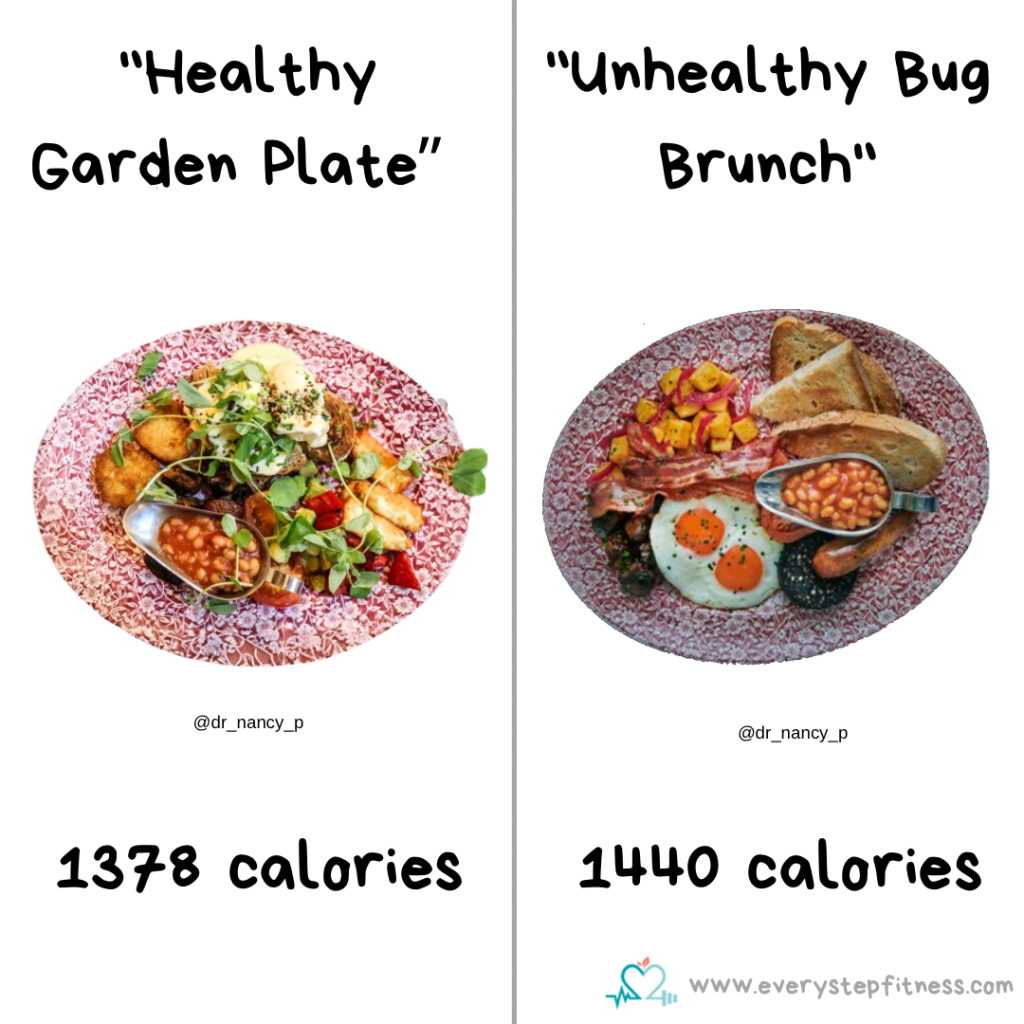
Another great example of this are brekkie/brunch options – this particular example is from

Bills. If you were out for brekkie / brunch you might assume that something like the ‘Garden plate’ is the better choice. It sounds healthy doesn’t it? It’s got poached eggs, halloumi, roasted plum tomatoes, red peppers, smashed avocado, hollandaise, mushrooms, hash browns, baked beans etc. Compare that to the Big Brunch which is fried free-range eggs, bacon, sausages, tomatoes, mushrooms, hash browns, baked beans, black pudding etc and the choice is obvious isn’t it?

However that’s not the case. Garden Plate comes in at approx 1378 calories, while the Big Brunch is approx 1440 cals. That’s only 60 cals different – essentially the same.

This is a great example of how food marketing and naming can shape our assumptions. Dishes that sound fresh, wholesome or plant-based are often automatically labelled as ‘healthy’ and therefore assumed to be lower calorie. Ingredients like avocado, halloumi, oils, sauces and grains all have great nutritional value but they’re also energy dense, and when combined the calories add up quickly.

Now if you want the Garden Plate because you like it then definitely go for it, but if you’re choosing it when you’d prefer the Big Brunch maybe stick to what you like! If you do want to reduce the calories then choose something totally different!

Enjoy 🤗

xxx
Tuesday Tip

Tuesday Tip: Re-train your brain

Tuesday Tip: Re-train your brain 🧠

One trap many of us fall in to is treating food as a reward, and exercise as punishment; “i’ve had a really good week, I deserve a dessert” or “I’ve had such a bad weekend I need to really work hard at the gym tomorrow”. This cycle is self-defeating and creates a negative relationship with food and exercise. The key is trying to view both food and exercise as ways to fuel and care for your body, so you can sustain a healthy lifestyle long term. Here are some tips to help:

1 Non-food rewards:

Instead of food, reward yourself with other things that are calming/relaxing or fun e.g. massage, manicure, new smellies, a bath, a walk, time reading your book, watching your favourite show etc. Or try things that encourage the healthy habits -new workout clothes, a new experience (e.g. rock climbing) or recipe books. Having nice things to go along with a behaviour makes that behaviour more fun, so your reward motivates you to do better

2 Try not to justify food:

When you think, “I can have this because I’ve been good all week” etc then pause and remind yourself that your behaviour doesn’t determine what you can eat e.g. don’t reward yourself with cake because you went to the gym. Think about what food you want and decide why you want it e.g. you want cake because it tastes good – that’s fine. Re-train your mind to disassociate food from your behaviour. Have cake because you like it, not because you “deserve” it.

3 Find fun workouts:

If the workout you’re doing isn’t enjoyable then change it. Try something new – if you usually run on the treadmill try doing a class, if you do classes have a swim etc – find something you actually like doing.

4 Remember the good times:

Recent research in the journal “memory” has shown that recalling times when you had fun working out can help you look forward to future workouts. So reminisce about a workout you really enjoyed – it could be a fun class, or a race you took part in, or a game of football with your friends, or a walk or cycle outside – anything!
Happy Tuesday 🤗
xx

Nutrition and Calorie Tips

‘It’s not worth recording…..’

‘It’s not worth recording…..’ ☕️

If you’re trying to lose fat and are working on reducing calories then you’re probably going to be recording your cals somehow. But are you really recording everything? It’s very easy to overlook some things because they seem so insignificant.

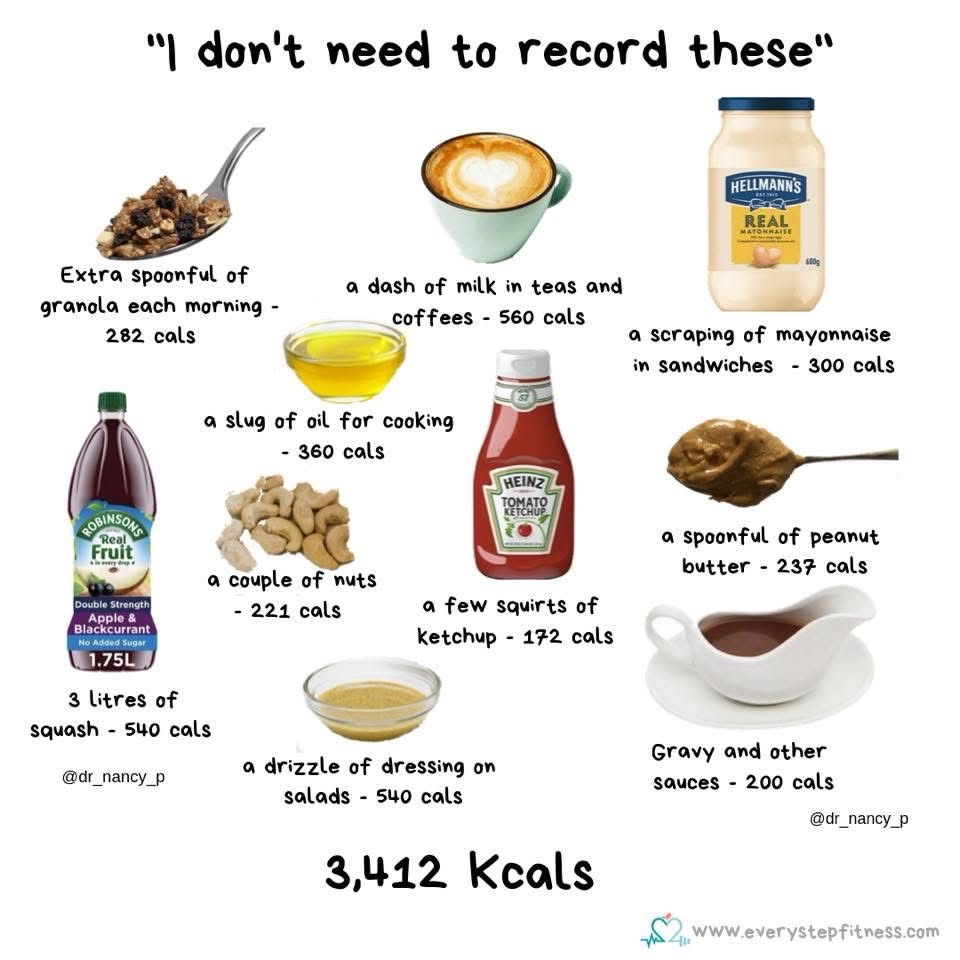
This is just an example of an average week for many people and where extra calories can sneak in. An extra spoonful of granola with brekkie every day (282 cals), a dash of milk in your tea or coffee (assuming 2 cups a day – 560 cals), a scraping of mayonnaise on your lunchtime sandwich (3 times a week – 300 cals), a slug of oil for cooking (3 meals – 360 cals), a sneaky spoonful of peanut butter because you’re hungry (237 cals), low sugar squash (a mere 18 cals for 100ml, but 3 litres of squash over the week – 540 cals), a few cashew nuts in the afternoon (a few every day – 221 cals), a squirt of ketchup with meals (5 meals – 172 cals), a drizzle of dressing on salads (3 salads – 540 cals), and finally gravy or similar sauces on your Sunday Roast (200 cals)…. That little lot totals 3, 412 cals over the course of a week. And let’s be honest for many of us we probably have even more of some of these….

But hey, they’re not worth recording right? Wrong! A sensible calorie deficit for fat loss is around 200 – 300 cals per day. With this little lot you’ve wiped out your weekly deficit without even noticing. All these little extras sneak in without really affecting how full we feel and without us noticing but they can really add up.

So if you are trying to lose fat, or your fat (weight) loss has stalled perhaps go back to basics and double check where some little extras could be coming in? And be a bit more mindful of these, or simply record them and have them within your daily calories. 🤗
Xx

Tuesday Tip

Tuesday Tip: How Much Cardio Is Actually Enough?

Tuesday Tip: How Much Cardio Is Actually Enough? ❤️‍🔥

Cardio gets a bad rap, either it’s too much, or it’s too little, or it prevents muscle gain, or wrecks your hormones, or even wastes your time and it seems it’s trendy now to avoid cardio. But is it really bad? Nope!

1. Cardio Is Necessary (Not Optional)

Cardio isn’t punishment and it isn’t the enemy of strength. Your heart, lungs, muscles, mitochondria, and brain all need it. Regular cardio lowers the risk of cardiovascular disease, metabolic dysfunction, and early death and improves performance both in and out of the gym.

2. The Guidelines are the minimum

For general health, the evidence-based minimum is 150 minutes/week of moderate-intensity cardio, or

75 minutes/week of vigorous cardio, or A mix of both (1 min vigorous ≈ 2 min moderate).

These are minimums but being below them doesn’t make it pointless – every bit counts. Hitting them is great but going beyond them if you have the time and capacity can bring extra benefits.

3. More Can Help

Up to approx 300 minutes/week is associated with greater improvements in aerobic fitness, VO₂ max (a strong predictor of longevity), and mental health. Beyond that, benefits tend to plateau so you don’t need to go mental.

4. What Actually Counts as Cardio

Cardio is any activity that raises your heart rate and keeps it there. Moderate is roughly 50–70% of max HR, whilst vigorous is 70–85%.

Options include brisk walking, cycling, swimming, hiking, running, intervals, rowing, dancing—if your heart rate is up, it counts. Short bouts matter too and even 2–10 minute bits add up, especially across the day.

5. It’s About Fitness

Intensity matters – the goal isn’t just to ‘do cardio’ but to Iomprove aerobic capacity, build mitochondrial density and increase VO₂ max. Ultimately you want to be able to do more in life with less effort


Cardio isn’t punishment and just because it’s not trendy on social media doesn’t make it pointless . Aim for consistency first, and do something, progress when you can, and train in ways you actually enjoy. Your future heart will thank you!

Happy Tuesday 🤗xx

Nutrition and Calorie Tips

Body Composition Changes: Is it Ageing or Menopause?

Body Composition Changes: Is it Ageing or Menopause? 🤔

The top trendy topic at the moment on social media is menopause. There’s a strong tendency to blame changes in body composition — losing muscle, gaining fat, feeling ‘different’ in your body on menopause. And it’s completely understandable. It’s a big life transition, symptoms can be tough, and your body may not respond the way it once did. But how much of this is due to menopause and how much is just ageing which affects men and women? Why does it matter? Because people are preying on menopausal women and selling magic supplements and training programs as a way to make money.

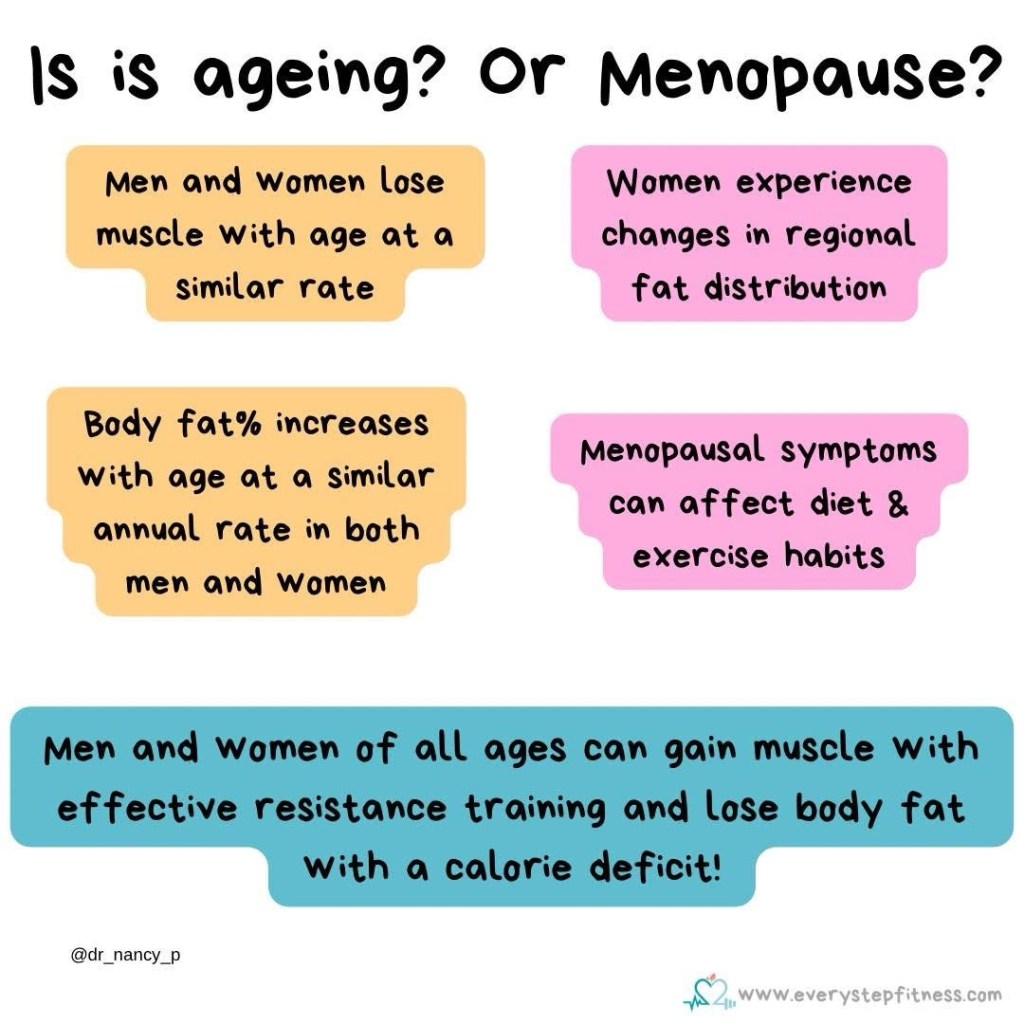
On average, men and women actually lose muscle with age at a very similar rate. Body fat percentage also tends to increase gradually over time in both sexes at similar rates . In other words, many of the changes we notice are driven by aging itself rather than menopause alone.

That doesn’t mean menopause is irrelevant, far from it. Hormonal changes can affect where fat is stored, often leading to more central or abdominal fat gain, which can feel especially frustrating. Menopausal symptoms like poor sleep, low mood, hot flushes, joint pain, or fatigue can also make it harder to train consistently or stick to usual eating habits. That disruption can absolutely influence results because it impacts your behaviour and diet.

But it’s good news because it means women aren’t doomed, broken, or ‘past it’. Men and women of all ages can gain muscle with effective resistance training. Body fat can be reduced with a sensible calorie deficit. Progress may look slower, and strategies may need adjusting, but the fundamentals still work.
So rather than blaming menopause or feeling defeated, focus on what is within your control- sensible training, adequate protein, enough calories to fuel life, and realistic expectations. The power of exercise and nutrition is unequivocal for everyone, at any age.

🤗xx