Tuesday Tip

Tuesday Tip: Caffeine and sleep

Improving sleep improves pretty much everything when it comes to nutrition, health and performance. It’s easier to eat well and train hard when vou sleep well. Many of us use caffeine not only to give us general energy through the day but also as a pre-workout boost. In fact specific caffeine based ‘pre-workout’ powders/drinks are sold to improve performance etc. How might this intake, be it from ‘normal’ beverages like tea/coffee or specific pre-workout drinks impact sleep?

We know caffeine can prevent or disrupt sleep. A recent study found that for caffeine to have minimal impact on sleep it requires a cut off time of approx 13 hours prior to sleep for pre workout, 9 hours prior to

sleep for coffee and no cut off time for a cup of black tea. If we based this on an example bedtime of 10pm a coffee would need to be consumed before 1 pm or pre-workout would need to be consumed prior to 9am. Higher doses of caffeine require longer time frames. This is why the review didn’t find much issue with black tea, but the duration for pre-workout was so long.

As a general guide the caffeine levels in common drinks are as follows:

Tea – 40mg (10-50mg),

375ml coke – 40-50mg,

Brewed Coffee – 80mg (40-110mg)

500ml Energy Drink – 160mg

1x serve pre-workout – 150-300mg

On average this study found that caffeine consumption reduced total sleep time by 45 min and sleep efficiency by 7%. These numbers listed here are averages and the half-life of caffeine does differ between people but for most people stopping caffeine a bit earlier in the day than you otherwise would can improve sleep quality and quantity

It’s also worth noting that these numbers are based on coffee or pre-workout in isolation. It is very common to have more than one source of caffeine in a day, which will add to the total amount of caffeine.

So if you’re struggling with sleep then consider this and perhaps make a small change which could have a huge positive impact.

Happy Tuesday 🤗xx
Nutrition and Calorie Tips

How to get a flat belly…

How to get a flat belly… 💪🏼

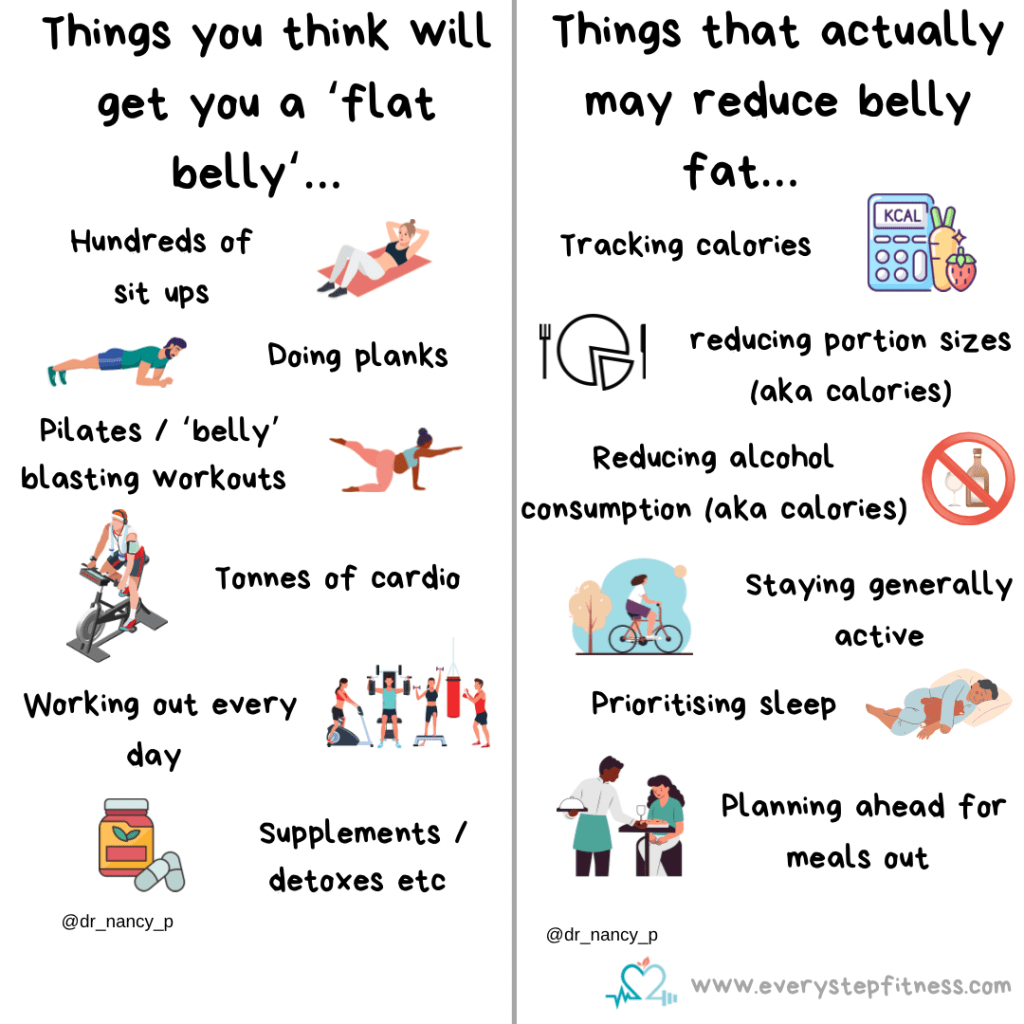
Many people want a flat stomach/visible abs and one of the most common things I’m asked is which exercises are best to achieve this. The common myth is that in order to ‘tone’ your stomach and get a flatter belly you need to do lots of abdominal exercises like sit ups or planks, do specific belly blasting workouts (you see so many of these advertised on social media) or do Pilates (or similar workouts), do a tonne of exercise., or even perhaps take some sort of belly fat blasting supplement/ tea or detox product.

The reality is that sadly there’s no quick fix – if you want a flat stomach it’s going to take more than some magic tea or a load of ab exercises. First off, everyone has abs – the muscles may be tiny or weak but that 6 pack is there. They’re just hidden under a layer of fat for most people. Fat does NOT turn into muscle; they are two different things. You could have strong abs, but if they are buried under fat no amount of exercise will give you a flat stomach or a 6 pack, because it doesn’t address the fat on top of your muscles.

A flat stomach only appears when you have a low enough bodyfat percentage. But ab exercises and magic teas are a lot more exciting to market than ‘eat less, move more’ … so it’s not surprising there are so many products out there making these claims.

So if you’re punishing yourself with endless sit ups every day – stop – it’s not going to give you a flat stomach. You can’t target or spot reduce fat from anywhere. That doesn’t mean we shouldn’t work those muscles, it’s important to work the ab muscles to protect your back etc but it won’t reduce belly fat.

So how can you lose belly fat? Everyone loses fat from certain parts of their body in different orders depending on age, weight, sex, genetics etc. You can’t control where it goes from first. Women will tend to hold more fat in their belly, hips and thighs, whilst men tend to store more in the belly and butt. You may not lose it from those areas first; it may go from your arms or legs etc.

All you can do is aim to lose bodyfat generally and once you lose enough of it you will see it go from everywhere eventually! The only way to do this is to consume fewer calories than you currently are. So track your calories, find out how many you’re currently eating and then reduce it! And stick with it for weeks or months (not just 5 days!). Reduce or plan in the obvious high calorie things like alcohol/meals out etc,stay generally active (walking or exercise you enjoy) and prioritise sleep (it’s very hard to control your appetite when you’re tired). These will all help you maintain that calorie deficit.

If you’re at a calorie deficit you will lose fat and at some point that fat will come off your belly too!

🤗Xx

Tuesday Tip

Tuesday Tip: Start when you’re busy

Tuesday Tip: Start when you’re busy ⏰

One common thing I hear from people is that they want to start losing weight/ getting fit etc but they’re just going to wait until they’re less busy/have fewer social commitments going on etc. Now whilst I understand this completely, in actual fact it’s not the best approach. If you’re waiting until you’re less busy/less social to start a new habit/program then it sort of assumes that when you are busy again you’ll stop or revert back to your old ways. If you have to be less busy to do it then surely you can’t do it when you are busy right? In reality the best time to do it if you want a long lasting change is when you’re busy! Learn how to make it work in the worst conditions so you can easily stick to it long term.

It doesn’t need to be all or nothing, it doesn’t need to be perfect… it just needs to be something … consistently. If you are unhappy and wanting to make a change then you need to stop making excuses or using being busy/having lots of social events on etc to justify not starting to make a change. The reality is you will always have busy or sociable periods and waiting for the ‘perfect’ time to start is not a realistic way to make long term sustainable changes, because the moment you get busy etc again then you’ll struggle to stick to it.

So if you want to make a change but you’re telling yourself you’ll just wait until this week/month/holiday/event is over then stop. Today is the perfect time to choose change regardless of the what else is going on in your life. Take a small step today – consistency over perfection right?

Happy Tuesday 🤗xx

Tuesday Tip

How to get bikini ready..

How to get bikini ready.. 👙

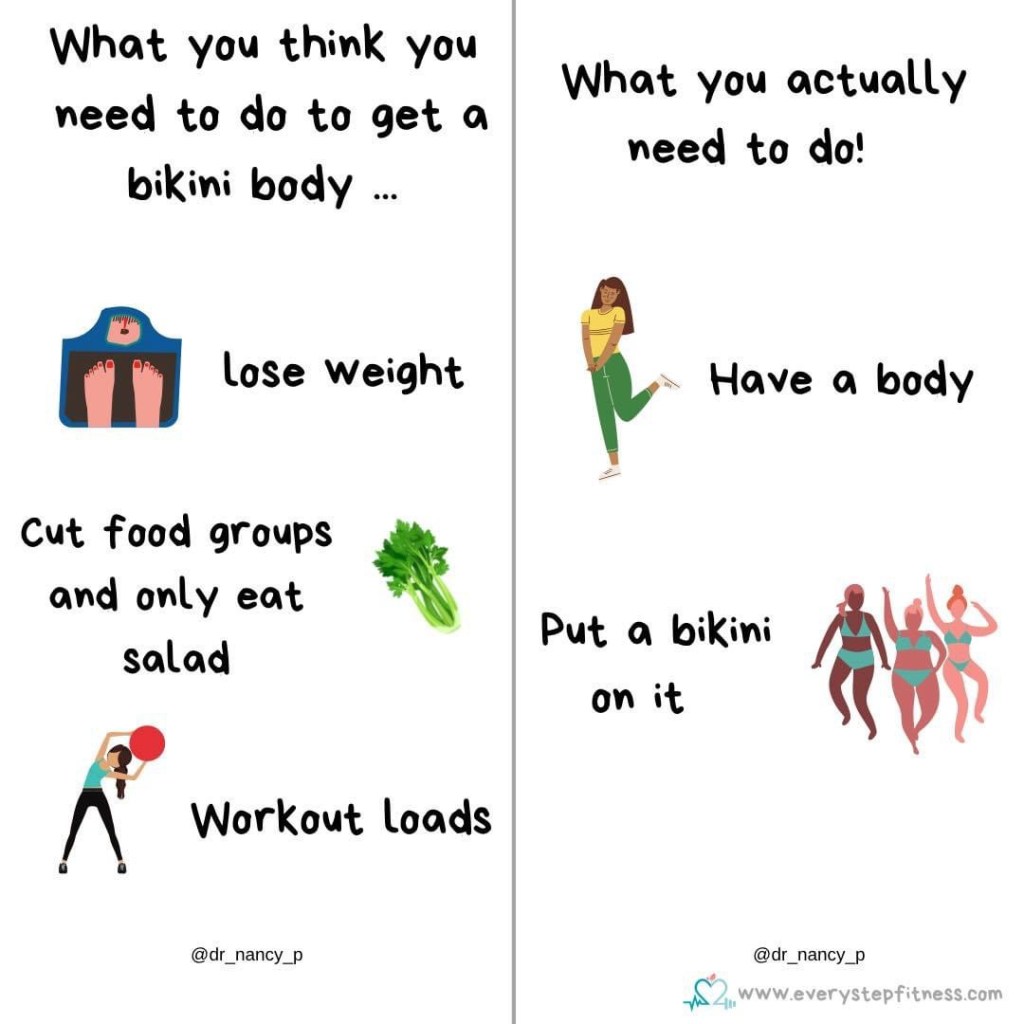
Summer holidays are on the horizon and already people are talking about wanting to get bikini body ready… so here’s my top tips for getting a bikini body! You probably assume you need to lose weight, cut out food groups and foods you enjoy, live on salads, do loads of workouts etc…

Nope – it’s a very simple 2 step process to getting your bikini body.

Step 1 – have a body ✅

Step 2 – put a bikini on it !

Ta da!

Now I realise it’s actually not that simple – and that wanting to look a certain way in your swimwear is totally valid. If you want to lose weight to feel more comfortable when you’re on the beach then that’s great – go for it! However whether you prefer a bikini, a swimsuit, a swim dress , a tankini, a sarong, T-shirt and shorts… whatever.. you’re entitled to wear whatever you like however you like. You deserve to enjoy the sunshine regardless of your shape or size. You don’t have to lose weight to do that! Find a style you like and rock it!

Happy summer!

Xx

Tuesday Tip

Tuesday Tip: How to age well!

Tuesday Tip: How to age well! 👵🏻

Ageing is something we all experience but perhaps we feel like it’s out of our control. In reality up to 80 percent of how we age is directly influenced by your lifestyle choices.

Movement, exercise, good nutrition, and sleep can make significant differences to how you age.

Regular physical activity can significantly slow the aging process in joints. Studies have shown that inactive individuals experience a rapid deterioration of joint health, leading to increased pain, stiffness and reduced mobility.

Regular exercise not only helps maintain muscle mass, but it also plays a crucial role in preventing age-related muscle loss. In contrast, a lack of physical activity is associated with muscle wasting, weakness, and frailty. It also helps with proprioception and balance. Proprioception is the body’s ability to sense movement, action, and location. It’s present in every muscle movement you have. Without proprioception, you wouldn’t be able to move without thinking about your next step. Proprioception allows you to walk without consciously thinking about where to place your foot next. As you age this becomes even more important and helps you to stop yourself falling. Preserving muscle mass also means you can get back up if you do fall. All this enables longer independence

People who regularly do some form of aerobic exercise, experience significant improvements in cognitive function and a decreased risk of age-related cognitive decline. Meanwhile, sedentary individuals have been shown to be prone to memory loss, reduced mental sharpness and at greater risk of neurodegenerative diseases

A diet abundant in fruits, vegetables, whole grains, and lean proteins provides essential vitamins, antioxidants, and minerals that combat oxidative stress, protects against age-related diseases, and promotes cellular health.

Lack of sleep disrupts vital processes, which can lead to some signs of aging, such as fine lines, dull skin, and impaired cognitive function. During deep sleep, the body engages in critical repair and rejuvenation activities, promoting cellular regeneration and optimising brain function.

So take some control back and prioritise some of these habits and prioritise your nutrition, exercise and sleep to ensure you age as well as possible!

Happy Tuesday 🤗xx