Nutrition and Calorie Tips

Stop exercising to lose weight…

Stop exercising to lose weight… 🏃🏼‍♂️

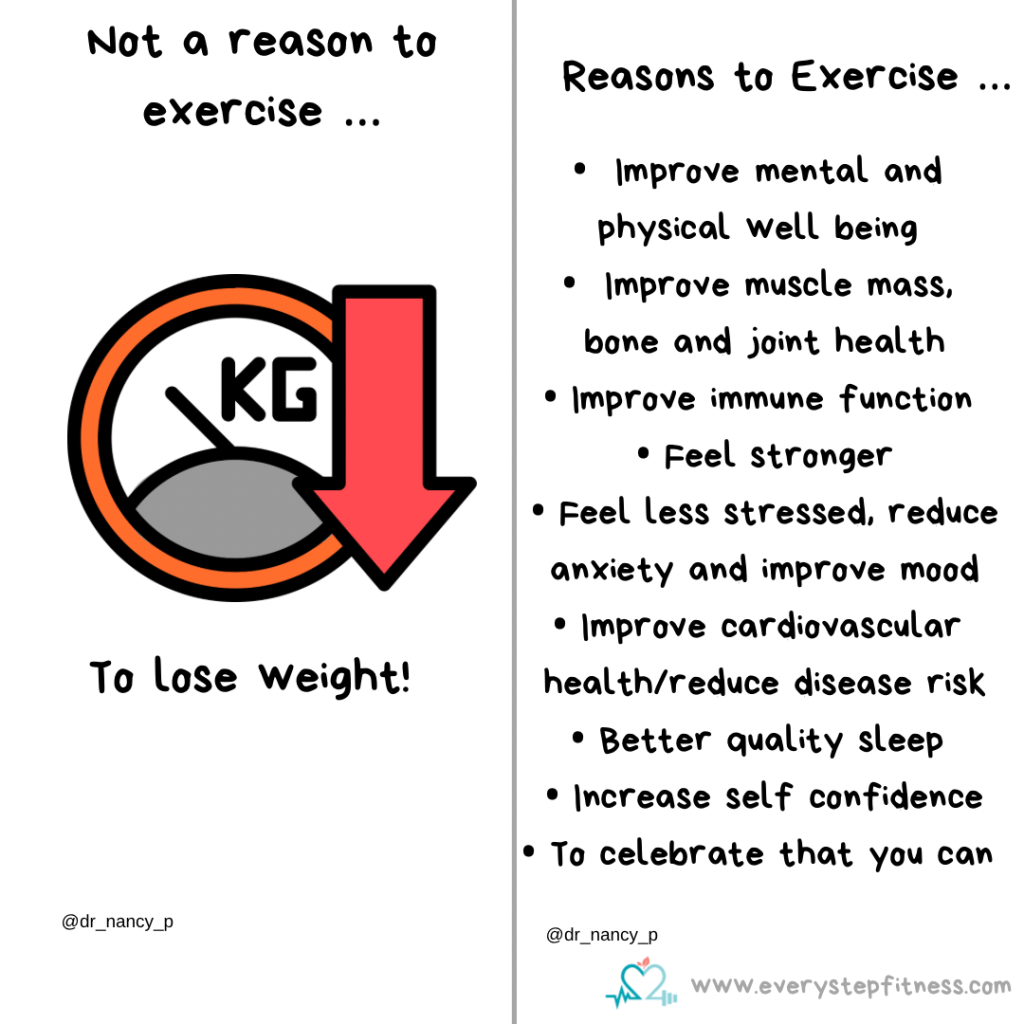
Whenever someone wants to lose weight inevitably they place a huge focus on exercising to burn more calories. Exercise appears to be the holy grail of weight loss behaviours. Exercising to burn calories and lose weight becomes the main goal. And yes, of course it’s important to exercise and yes of course it does increase your energy output but, as I’ve discussed before, you will never ever be able to out-exercise food.

So whilst I wholeheartedly support people exercising more (I’m an instructor so obviously I do!) it’s not with the sole purpose of losing weight. That’s last on my list of reasons for anyone to partake in exercise and it should be last on yours too!

Instead, move your body to improve your mental and physical well being. There are so many reasons to exercise that go beyond burning calories.

* Exercise improves muscle mass, bone and joint health and keeps you functioning independently into old age.

* Whilst excess exercise can down-regulate immune function, regular exercise serves to improve the resiliency and expression/activity of immune cells and mediators so it improves immune function and helps protect against disease.

* It makes you feel stronger and more empowered

* It improves mood, can reduce anxiety and some symptoms of depression and relieves stress.

* It improves cardiovascular health and reduces disease risk

* It increases self confidence

Above all – exercise to celebrate that you can! Not to lose weight!

🤗xx
Tuesday Tip

Tuesday Tip: Fasting for fat loss

Tuesday Tip: Fasting for fat loss 🚫

I’ve had quite a few people ask me about this recently so thought it was worth revisiting. Various forms of fasting have become extremely popular in the past few years, due to purported health and weight loss benefits. There are various methods – from ‘eating windows’ of 6-8 hours a day (intermittent fasting), to 24-48 hr fasting etc. The claim is that fasting will

accelerate weight and fat loss and sometimes that it will ‘reset’ your metabolism/system etc. However, the data doesn’t actually support these claims.

A recent 2021 study investigated fasting and the impact on fat loss. It tested 3 protocols – fasting with a calorie deficit, fasting without a calorie deficit and a calorie deficit with no fasting. The group that fasted without a calorie deficit overall did not lose fat or weight. Both groups with the calorie deficit lost body weight. However the group that fasted lost less fat and more

muscle. Whereas the group that just had the calorie deficit lost mostly fat. There was no impact of fasting on their metabolism either.

So in short, fasting had no overall benefit in terms of fat loss and in fact could result in increased muscle loss rather than fat. It is actually the calorie deficit that causes the weight or fat loss.

There are claims that will boost your metabolism but research suggests that fasting has the same or negative effects on metabolism compared to a calorie deficit from other ‘diets’. When you severely limit calories, your body slows down basic functions to conserve energy. Instead of boosting your metabolism, you may experience a reeducation of up to 20% your BMR.

So there is nothing ‘magic’ in fasting, the only way it aids weight loss is if it helps someone create a calorie deficit (with the proviso it may result in some muscle loss too). So it really is just another tool to help you create a calorie deficit – it may work for some people, and if so that’s great but it’s not for everyone and it doesn’t offer any significant benefits to any other method of reducing calories.

It’s also worth noting that fasting can have impacts on gastrointestinal health and increases the risk of acid reflux etc so should be undertaken with caution.

Happy Tuesday 🤗

xx

Nutrition and Calorie Tips

Fear Mongering vs reality…

Fear Mongering vs reality… 😱

It’s January so there are lots of fitness and ‘wellness’ experts on social media shaming people with misinformation about many things. Once such claim I’ve seen this week surrounds sugar. You may hear claims that sugar is ‘toxic’ – it isn’t and I want everyone to remember that.

These sorts of claims usually have a basis in some sort of science but it’s be simplified and twisted out of context into a headline grabber. There is a huge difference between the fear-mongering claim that “sugar is toxic” and the nuanced reality that anything we need in a balanced diet for optimal health (which does include sugar) can be potentially harmful in excess. The reality is that the human bloodstream contains sugar (glucose) at all times, and the moment it doesn’t – we die. However that sort of information doesn’t get people clicking their links, buying their diets/products etc and isn’t as sexy as ‘sugar is toxic’. This sort of simple clickbait pseudoscience creates fear and us humans aren’t great at overriding fear with logic. Plus, pseudoscience is a lot sexier than legitimate science because it provides simple, definitive claims about what can impact our health. The reality, which is far more complicated, and contains plenty of nuance and context, has less of a wow factor because it includes important details about dosage and the fact that health is impacted by many factors.

So no, sugar isn’t toxic, we need it. It can be harmful in excessive quantities but so can anything (even water) – it’s the dose that makes the poison. So, when you come across social media influencers/ fitness professionals, people selling diets/diet products etc making sweeping statements, take a pause and remember that it’s a whole lot more complex than “SUGAR IS TOXIC!” and then scroll on by and don’t give them your pennies or time.

🤗

Xx

Tuesday Tip

Tuesday Tip: Setting goals a different way

Tuesday Tip: Setting goals a different way🥅

With the new year comes the inevitable barrage of health and fitness programs and ‘resets’. Most of these will involve some goal setting and encourage you to visualise those goals. While this can get you excited and focused on what you want to achieve, there’s one massive issue with this approach. You can get so focused on the end goal, you forget about all the things that could go wrong. A more effective approach is anti-visualisation. Instead of visualising achieving your goal, do the opposite: visualise not achieving your goal.

I know that sounds very negative but trust me on this. Imagine failing and then write down all the all the potential reasons this could have happened. Essentially you now have a list of all the obstacles and setbacks you might face as you work toward your goal. Starting with the possibility of failure in mind makes you aware of the things that could potentially go wrong. Thinking about these things ahead of time allows you to come up with solutions to better handle them, instead of them cropping up unexpectedly and throwing you off. l’ve found anti-visualisation to have another benefit. It can spur action. If you don’t feel like doing something, reminding yourself of what could happen if you keep putting off the task then the thought of failing is enough to get me taking action!

The other thing to consider is making your goals flexible. The problem with a rigid goal is that you either hit the goal or you don’t. And if you didn’t, you ‘failed’. If you hit 7,000 steps instead of 10,000 or went to the gym 3 times a week instead of 4 is that a failure? No! So you want to set goals in a way that emphasizes action, not perfection. Instead of setting rigid goals, use flexible goal setting. Instead of a goal to go to the gym 4 times a week make it a goal 2-4 times. You’re less likely to ‘fail’ and it’s a good reminder that doing something is better than doing nothing; that consistency is more important than perfection.

Happy Tuesday 🤗xx

Nutrition and Calorie Tips

What you need to do after the Xmas excess?

What you need to do after the Xmas excess? 🤔

At this time of year, after the Christmas and New Year inevitable excesses it’s natural to want to ‘get back on it’ and you may well think the way to do this is to go into overdrive – exercise excessively, slash your calories down to under 1000 a day, maybe do a ‘detox’/ ‘cleanse’ or throw money at a diet fad, cut carbs or other food groups… You may be beating yourself up and calling yourself a failure for eating so much over the holidays … Or you may just think ‘f*ck it’ and give up completely and continue over eating…

None of this will actually make you feel better or get you where you want to be.

Exercising excessively will only make you tired, prone to injury and probably likely to eat more in the long run. Slashing calories down to unsustainably low levels may work initially but it won’t last and you’ll end up rebounding and probably overeating even more – and you’ll be miserable! ‘Detoxes’ or ‘cleanses’ are just an expensive way to cut calories/replace meals – they result in rapid initial weight loss from water loss but aren’t sustainable… and they definitely do not ‘remove toxins’ – your liver and kidneys do that for you just fine! Cutting food groups out has a similar effect – yes you’ll reduce your calories but unless you plan on never eating those food groups again it’s not sustainable and it’s frankly pretty sad to cut foods you love totally out of your diet for life.

Saying ‘f*ck it’ will definitely be very liberating but if it results in you continuing to over eat then long term it probably won’t feel that good! Whilst you definitely do not need to lose weight (no one does unless medically advised) if you aren’t happy with your weight then longer term then you’ll certainly want to regain some control right?

Beating yourself up is definitely no good. It’s so hard not to – we are often our harshest critics – but let’s be honest here – you enjoyed a few weeks of good food and drink with family and friends, is that really a bad thing? Does it make you a ‘failure’ or a bad person? No! It makes you a human being – and it’s not something to feel bad or guilty about!

So what should you do?

Go back to your normal exercise /walking routine, eat balanced meals at a sensible number of calories, Avoid all detoxes/cleanses/ diet fads and save your money! Enjoy all the things you enjoy eating, but in moderation – skip the expensive fads and focus on these fundamentals! Oh and remind yourself you’re a brilliant human being!

Happy New Year!

Xx