Tuesday Tip

Tuesday Tip: 3 tips to help weight loss

Tuesday Tip: 3 tips to help weight loss 🙏🏻

#1. Stop labelling foods GOOD or BAD

Foods don’t have a moral compass. No food is inherently bad or wrong but beating yourself up over eating foods you enjoy is bad. Yes, some foods have a higher nutritional value than others but it’s not helpful to demonise the less nutrient dense options. It’s always dependent on the context. Ask yourself – will this food satisfy me? Is eating it right now helpful to my goals or does it fill another need (emotional etc)?

Does it fit into my remaining daily calories?

#2. Stop depriving yourself of everything delicious in life!

It’s not realistic to avoid sugar, fried foods, pizza, alcohol and cake for weeks or months on end. It’s also not necessary. Instead embrace an 80/20 balance. 80% whole foods, 20% more indulgent foods like cookies and pizza (all within your calories)

You’ll feel less deprived and more likely to stick to your diet long enough to actually see results

#3. Learn your hunger triggers

Are you truly hungry? We’ve all eaten when we are not hungry. And that’s OK! But when you’re trying to lose weight, knowing the difference between physical and psychological hunger is helpful. Use the acronym BLASTED ( am I – bored, lonely, angry, stressed, tired, emotional, distracted) to identify emotional eating triggers and try to tackle the root cause rather than eating something which won’t fix the actual issue

These 3 simple mindset shifts can take some of the struggle out of your weight loss journey.

Happy Tuesday 🤗xx
Nutrition and Calorie Tips

Optimal vs reality….

Optimal vs reality…. ⭐️

One of the keys to losing weight and maintaining it is consistency, and one of the key things that help with consistency is learning not to throw in the towel and say f*ck it every time things don’t go to plan.

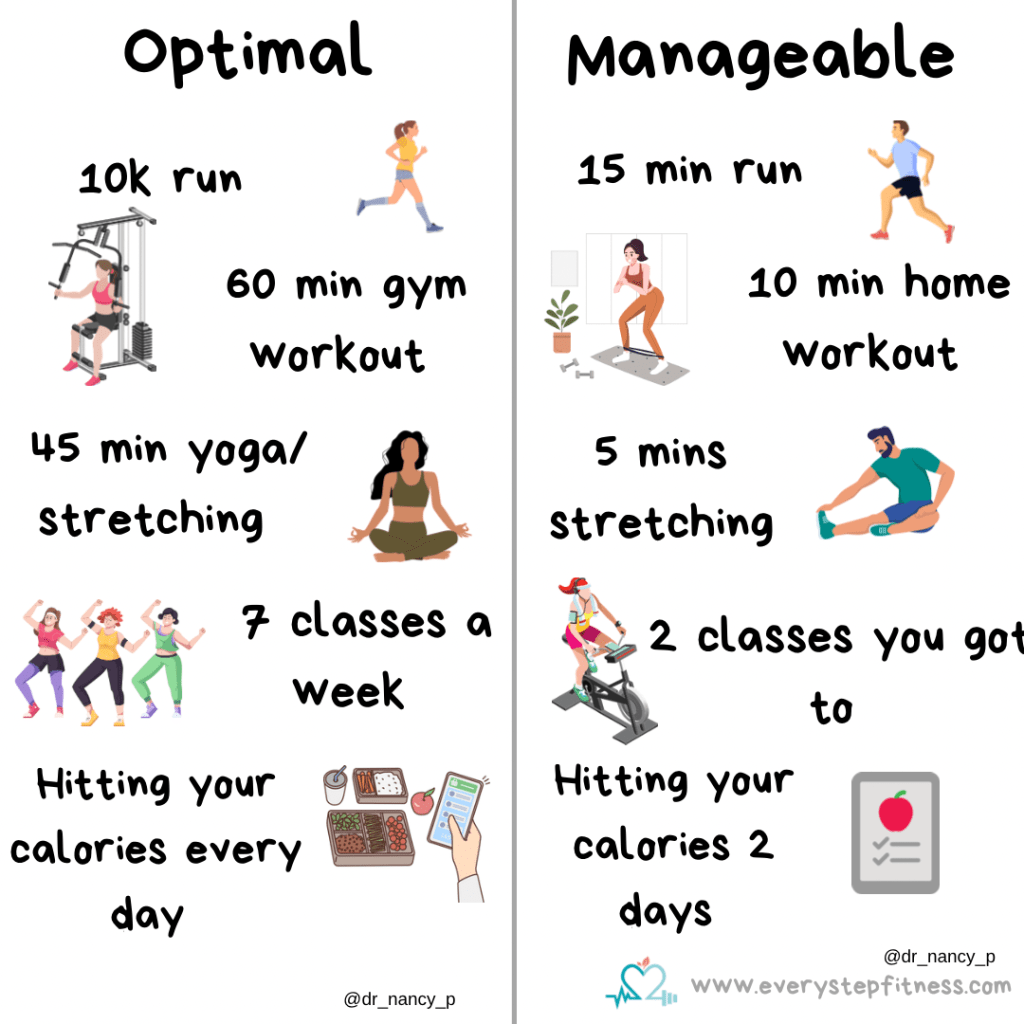
Obviously in an ideal world we’d all have an optimal workout routine – you’d manage 7 classes a week, you’d fit in 45 mins if stretching and your 10k run, and hit your calories every day. But life isn’t optimal and optimal is irrelevant if you don’t or can’t do it. Imperfect action is better than no action! The 5-10 min workout you actually do is better than the 45 min workout you don’t manage to fit in at all.

Life is full of unexpected obstacles. You can either let it defeat you and use it as an excuse to come off the wagon completely , or you can change your mindset and accept that it’s not about being perfect every single day. It’s about doing the best you can in the circumstances – that day/week.

So maybe you can’t fit in your planned 45 min workout, but could you do ten mins instead? Can’t fit in a 10k but can manage a 15 min run instead? Not going to hit that step goal – could you do a 5 mins walk anyway just to get a few more steps in? Not tracking your calories like you planned – ok well can you focus on making some different choices, fill up half your plate with veggies, cut back on a the dessert or booze? Had a rubbish day and eaten half a packet of biscuits? Stop stressing and just make sure the next thing you eat is back on track.

Even doing something, no matter how insignificant it may seem, is better than doing nothing!

🤗xx

Tuesday Tip

Tuesday Tip: Weights won’t make you bulky

Tuesday Tip: Weights won’t make you bulky 💪🏼

Many female clients often tell me they don’t want to lift weights because they’re afraid of getting too big or bulky. What they mean when they say this is that they don’t want to put on too much muscle mass – they have visions of chunky thighs, thick necks, huge biceps, heavy set shoulders etc.

The reality is that over 30 you’re losing lean muscle at a rate of 3-8% a year if you don’t regularly do resistance workouts. As you age oestrogen levels drop which contribute to this loss. So getting ‘bulky’ is actually a pretty big uphill battle.

To get to a bulky or body-builder level of muscularity, you’d not only have to train and diet in an extreme fashion, but you’d have to keep at it for years. I’ve got clients actively trying to ‘bulk’ and it’s a slow process that requires dedication to weight training and to eating … a lot! Body builders and those types of athletes work extremely hard to look the way they do; you won’t end up there by accident, I promise. If you want to gain significant amounts of muscle mass, you’re looking at five to six days of heavy lifting a week, every week for months and months. Doing a few weights workouts a week, or a few pump classes will not make you bulky. Gaining muscle mass comes from a combination of heavy weight training and an excess in calories.

So if you are aiming to lose fat and are at a calorie deficit (or even maintenance/ slight surplus ) then doing weights workouts 3-4 times a week won’t result in large amounts of muscle growth. What it will do though is increase your lean body mass. This has two benefits – it increases your metabolic rate which means you’ll burn more calories at rest. It will also help provide the ‘sculpted’ or ‘toned’ look many people want. By working those muscles you’ll create a solid muscular base so that as you lose fat you’ll start to see the shape you’re looking for. It will also make you feel strong – and that’s a great feeling!

So don’t be afraid of lifting weights – they’re an important component of any fitness program. They’re also vital – especially for women as we age – as a way to help protect against osteoporosis. So try to to get over the fear of getting “too muscly”, and step away from the obsession with thinness and instead focus on getting stronger!

Happy Tuesday 🤗xx

Nutrition and Calorie Tips

Why exercise alone won’t get you results …

Why exercise alone won’t get you results … 🏋🏼‍♂️

I know I say this a lot but If I had a pound for everyone I speak to who tells me that they exercise a lot but can’t understand they aren’t getting results I would be a rich woman!

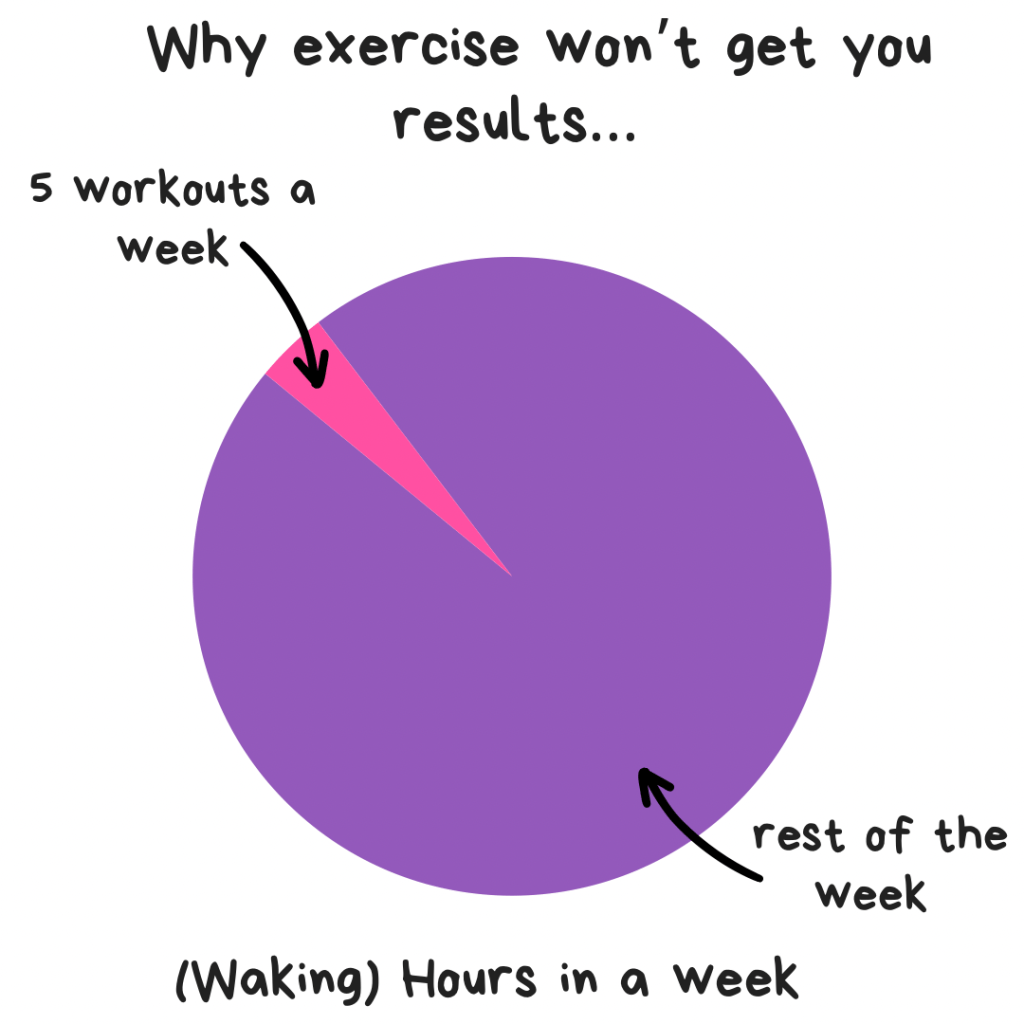
I discussed this last week but I thought this pie chart helps visualise why those workouts have so little impact on your fat/weight loss and how what you do outside your workouts is far more important.

Fat loss is far more about behaviour change than it is about the calories you burn during a workout. It’s very hard to create a meaningful calorie deficit via exercise and activity alone. You have to work extremely hard to burn more than a few hundred calories in a workout and you can’t put exercise your diet (it’s a lot easier to eat several hundred calories than burn it off). Studies also show we usually over estimate cals burnt and how active we are. So instead of fixating on the small amount of your waking hours that you’re doing a workout, instead focus on the rest of the time.

The calories you burn in a 45 min workout will be considerably fewer than what you burn being generally active for the rest of the day. So think about how you spend the rest of your day. Do you find yourself sitting more than perhaps you need to? Do you amble instead of walking with purpose? Do you take the lift instead of the stairs. Think beyond the gym and focus instead on making yourself more active – get up, stand instead of sit, walk faster, walk more!

Also don’t be tempted to eat exercise calories back – just treat them as bonus cals rather than something to eat back.

Exercise for health and well-being and focus on the food side of things if you want to lose weight!

🤗xx

Tuesday Tip

Tuesday tip: Calorie balance and Bank balance

Tuesday tip: Calorie balance and Bank balance 💵

View your calorie balance like your bank balance and budget accordingly. I often use this analogy with my clients and some people don’t like the comparison because it over simplifies a complicated thing like why we eat/make food choices/ emotional eating etc. But that’s exactly why this analogy works – because how we spend money is just as complex and illogical (sometimes) as why we eat.

We spend money to impress people, to fulfil social norms we don’t actually care about, because it was on sale (even if we didn’t want it) etc. We refuse to look at our credit card statements because we don’t want to acknowledge debt; a bit like refusing to weigh yourself to see how much weight you’ve gained. We think about money differently depending on where it came from. You might go and blow the £100 you won on the lottery but you are far less likely to do that if you worked overtime for it. Yet it is the same £100 (this is known as mental accounting).

We experience loss aversion: we prefer to avoid losing money than to gain the same amount. Much like how when you lose 1kg ‘its nothing’ but when you gain 1kg

‘it’s loads!’

We over spend and over eat to make ourselves feel better or when we are bored/lonely/emotional/ stressed. We assume we will be happy when we earn X much like we assume that we will be happy when we weigh X.

My point is that many factors influence how we eat just like many factors influence how we spend money. We certainly aren’t logical in either but we would likely do better if we were. This is why it is so interesting to question your decisions.Understanding your own cognitive biases helps you make better and more logical decisions. So try viewing that calorie budget the same way you view your financial budget and see how you get on.

Happy Tuesday 🤗

xx