Nutrition and Calorie Tips

Are you focusing on the small stuff instead of the big stuff?

Are you focusing on the small stuff instead of the big stuff? 🫣

One of the biggest weight loss mistakes I see people make is a focus on the small details. We often spend a lot of time and energy on things that don’t really matter that much. Meanwhile we overlook things that actually matter the most. People often get hung up on things like specific foods they should or shouldn’t eat, obsessing over what time they should eat, tracking ratios of protein to carbs etc, wanting to take supplements, worrying about which specific workout they should do or thinking it’s the end of the world when they can’t do the workout they planned etc.

When it comes to weight/fat loss none of that actually matters – at all! Focusing on all these small details just serves to complicate things, and potentially cause you to not make progress, Instead pay attention to the big things. The most important thing to focus on is a calorie deficit (how you achieve this is up to you but it can be achieved via ANY diet or eating regime) and secondly this needs to be maintained consistently- over weeks and months (not days). Cultivate healthy habits – drink water, get some sleep, eat fruit and veg etc and learn to manage social events/booze and weekends and don’t fret about what exercise you do – just be generally active and do whatever exercise you can fit in that you enjoy.

Keep it simple and you’ll succeed!

🤗

Xx

Tuesday Tip

Tuesday Tip: Fat burning ≠ Fat loss

Tuesday Tip: Fat burning ≠ Fat loss 🚫

It’s quite common to see things described as fat burning. Sometimes it’s in reference to specific diets, modes of eating or certain types of exercise. Low carb diets are often promoted as fat burning on the premise that because there are fewer carbs to burn for energy, fat burning will increase. The same rationale is used by those promoting working out before eating (rather than after) or fasting for periods of time.

You’ll find certain types of workout described as fat burning or you may find your activity monitor describes your workout in terms of the percentage of time in the ‘fat burning’ zone. The argument is that the body burns a greater percentage of fat with lower-intensity exercises than higher intensities because the body doesn’t require ‘fast energy’ from glycogen. As such, this theory promotes longer and lower-intensity workouts that maintain your heart rate within the ‘fat burning zone’. However, while the body does burn fat during low-intensity workouts, the rate remains low and you have to exercise longer to burn the same amount of calories you would at higher intensities.

The main issue is that burning fat is often confused with losing body fat. Fat burning or oxidation refers to the use of fat as a fuel source by the body. This doesn’t equal body fat loss. Eating low carb (and therefore high fat) does mean you’ll burn more fat as fuel because there is more of that available to use. But if you need 1800 cals a day and are eating 2000 cals then you have an additional 200 cals of fat. This won’t increase your fat burning. In a calorie surplus more fat is available in the bloodstream due to a higher intake, so the rate of fat storage is also greater. Research shows that whilst low-carb diets increase fat oxidation, they don’t actually result in

superior fat loss in comparison to higher-carb diets when calories are matched.

This same concept applies to ‘fat burning workouts’ or fasted cardio vs fed cardio. Yes fasted cardio BURNS more fat in the session (because fewer carbs/glycogen are available) but if total calorie intake for the day is in surplus to your needs then you won’t lose body fat.

“Fat burning’ and “fat loss” are not

interchangeable concepts.The biggest priority for fat loss is a calorie deficit. If eating fewer carbs, or eating after your workout etc help you to maintain a calorie deficit and therefore make weight loss easier then fab! But going low carb / fasted workouts / fat burning workouts will not inherently be better for fat loss when calories are matched. The overall goal is to find a sustainable way for you to consistently achieve a calorie deficit.

Happy Tuesday 🤗

Xx

Nutrition and Calorie Tips

Estimating amounts is hard….

Estimating amounts is hard…. 🍝

I’m always telling my clients to try to be as accurate as possible when they’re tracking their food and calories. This means actually weighing things – particularly anything that is calorie dense.

Very often people tell me that they’re “pretty good” at estimating the amounts they’re having, that they have the same thing each day so they know what it looks like now, that they can estimate pretty well etc. I’m sure some can, but I know I can’t. I can at first but then often amounts creep up without you even realising it.

In this example on the left is 100g of pasta (uncooked weight), on the right is 175g pasta (a much more likely portion size too).

As you can see they look pretty similar to the naked eye, yet the calorie difference is significant. It would be very easy to assume you were using around 100g pasta but actually be using closer to 175g or more! It may not matter now and then but these calories do add up. And if that’s just the plain pasta, what about other things? With less calorie dense foods it won’t matter as much but with calorie dense foods (e.g. nut butters, spreads, cheese, avocado etc) when you get it wrong you’re adding a large number of calories. This is also why measure like a ‘handful’ or ‘cup’ of pasta, a ‘medium’ banana or “a scape of butter’ are no good – what’s a handful? scrape? What’s medium? My scrape may not be your scrape etc

So if you are trying to lose fat/watching your calories maybe it’s time to go back and get those scales out and double check those estimates and see if you really are as good as you think you are.

🤗

Xx

Tuesday Tip

Tuesday Tip: Habit prompts

Tuesday Tip: Habit prompts ✅

Part of losing weight is about creating new habits around food and activity. Building new habits is hard though! So how can you make it easier?

Environmental cues play an important role in building habits and your environment is extremely influential in decision making. So setting up your environment in a way which reminds you of the habits/behaviours you want to start incorporating will help.

The main idea is having something visible which reminds you to do that specific habit or which makes that the easiest choice. Do this by putting a cue in a spot where you can’t miss it and won’t forget. Conversely you make the habits you want to ditch harder by making things associated with them less visible.

For example for habits you want to encourage you could;

– Place hand weights next to the sofa to remind you to do 5-10 mins of exercises each evening in the advert breaks,

– Have a snack box on the kitchen side containing lower calorie snack options and fruit for the day.

– Have a bottle of water on your desk to encourage you to stay hydrated.

– Pop a post it note on the bathroom mirror reminding you to stretch your calves while you brush your teeth.

– Ensure when you open the fridge the first thing you see are easy lower calorie snacks – vegetables sticks, mini light babybel, yoghurts, berries and other fruit etc .

– Move the calorie tracking app on your phone to the home page next to WhatsApp or a frequently used app to remind you to track.

For habits you want to break make it harder to do them;

– Store chocolate in a sealed tub at the back of the cupboard.

– Keep the bottle opener upstairs so it’s more of an effort to ‘just open a bottle’ after a stressful day.

– Leave your phone in another room/place when working so you’re forced to get up to get it regularly to avoid sitting for long periods.

Try setting up your environment for success today!

Happy Tuesday 🤗

Xx

Nutrition and Calorie Tips

Is alcohol holding you back…

Is alcohol holding you back… 🍺

Ok I know this is probably not going to go down well but let’s talk about alcohol, weight loss and fitness.

I never tell clients to cut food groups from their diet but alcohol is one thing I often recommend people consider reducing. It’s the ONLY actual toxin we regularly consume and it’s classed as a ‘class A’ carconigen (together with asbestos, radiation and tobacco) meaning there is no ‘recommended’ safe amount that can be consumed without increasing your risk of cancer (and other diseases). ‘It doesn’t matter how much you drink – the risk to the drinker’s health starts from the first drop of any alcoholic beverage’

Alcohol calories are also processed differently. The cals are used immediately to generate adenosine triphosphate (ATP) to detoxify it. This detoxification is a labour intensive process so the liver ‘shuts down’ and stops processing fat, carbohydrates and protein because it needs to deal with alcohol. Hence why you get the munchies, because the detoxification of alcohol inhibits gluconeogensis (breaking down of our internal food stores). So not only does alcohol inhibit fat burning it also encourages over eating.

So if you’re training hard and wanting results, is alcohol one aspect that’s holding back your progress?

Aside from the impacts on fat loss studies have shown that consumption of any amount of alcohol decreases athletic performance – it’s associated with decreases in strength, power, speed and endurance. It also decreases the ability to regulate body temperature, reaction time, coordination, balance and judgement. It increases risk of dehydration, water excretion and risk of injury.

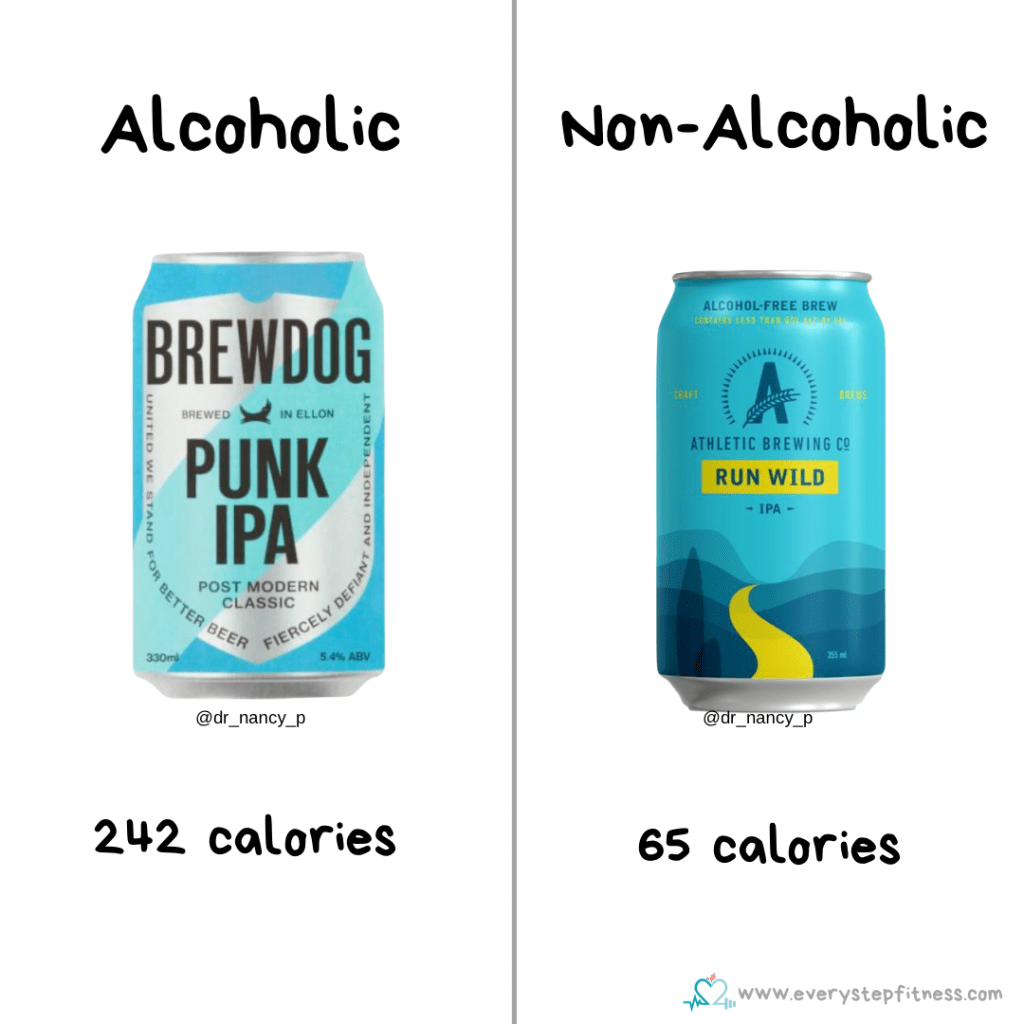
A reason people often give me to drink is that they genuinely like the taste. So if you really do enjoy the taste of beer etc but don’t want the negative effects on your performance and weight loss then it’s a no brainer really. Go for a non-alcoholic option – there are so many excellent ones on the market now!

🤗