Tuesday Tip

Tuesday Tip: Maintain to lose

Tuesday Tip: Maintain to lose 🤔

Believe it or not weight loss isn’t actually about dieting – it’s about maintenance. People wrongly assume that maintenance is something you do once you’ve reached your goal weight, when in reality maintenance begins on day one of your ‘diet’

Quick fixes and fad diets are really appealing and everyone wants to feel better about themselves as quickly as possible – I get that. But what then? You start a new ‘diet’ and do it religiously for weeks or months, then the diet ends and you go right back to ‘normal’ eating again and your old behaviours and you gain the weight back.

Think about it – your ‘normal’ behaviour and eating hasn’t helped so far has it? Otherwise you wouldn’t be wanting to diet to lose weight. So a quick fix fad diet and then returning to it isn’t the answer to life long weight loss. That’s the issue with these diet clubs / shakes/ cleanses / trendy diets – none of them actually address the root cause of why you’re overweight or the behaviours and habits that have got you there.

The reality is the habits and behaviours that help you lose weight are the ones that will help you maintain it as well. You can’t expect to keep the weight off if nothing has changed. I often tell my clients they need to behave like the ‘slimmer’ / ‘fitter’ / ‘stronger’ (whatever THEIR goal is) version of themselves . What would that person do? That person probably can’t get away with 3 takeaways a week, or boozy lunches at the weekend etc. It’s about finding things you enjoy (both food and exercise) that fit into your goal lifestyle. Swapping behaviours and habits for new ones. For example – not restricting foods you enjoy, but learning to include them as part of your eating plan, trying to be as physically active as possible for you generally and doing exercise you enjoy etc

Don’t waste your money on fads and quick fixes. Instead look at how you’re approaching your fitness and diet goals and ask yourself – is this something I can maintain for the long term? Because if it isn’t, you’re going to struggle to make (and later maintain) progress.

Happy Tuesday 🤗

Xx
Nutrition and Calorie Tips

Shift your mindset…

Shift your mindset … 🍩

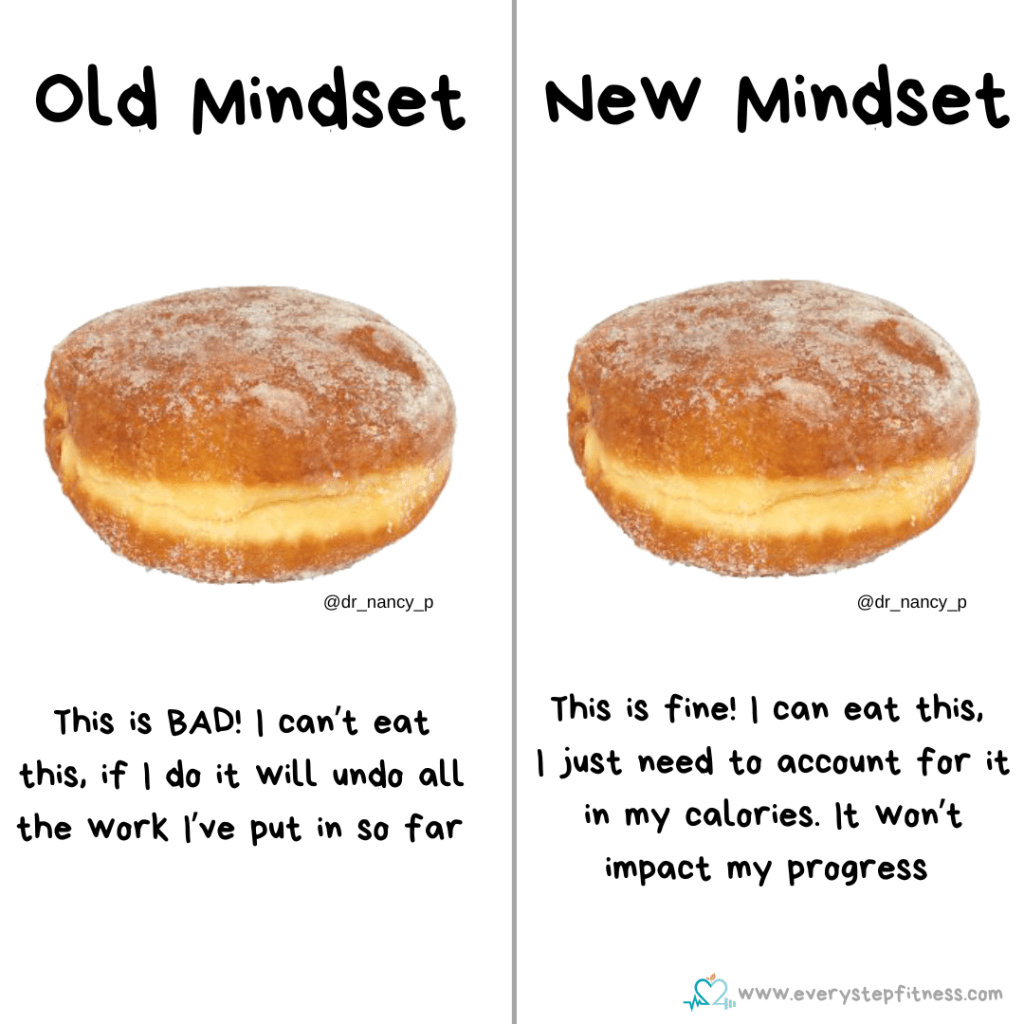
The nutrition and fitness industry has excelled at categorizing foods as either ‘good’ or ‘bad!’ and we buy into it so easily. But what does it even mean? In what context is a food ‘bad’ or ‘good’?

If your goal is eating fewer calories then maybe a higher calorie food might be perceived as bad? But if your goal was gaining weighing then that same food is ‘good’. Yes some foods may contain more nutrients than others but that doesn’t mean they’re inherently good or bad – just different. Food not only provides energy and nutrients, it also has an emotional component and we choose foods for a myriad of reasons – none of which are bad.

It’s time to shift your mindset when it comes to food. You can reach your goals, whilst still enjoying all the foods you love, you just need to account for them. Rather than labelling foods and good or bad, instead just focus on a more flexible approach that encourages a positive relationship with food. This will help to create sustainable long-term results and leave you feeling considerably happier than demonising and avoiding delicious foods you love forever!

Enjoy 🤗

Xx

Tuesday Tip

Tuesday Tip: Simple food for busy days

Tuesday Tip: Simple food for busy days 🥫

When you’re busy and stressed trying to decide what to eat can be a bit much, on top of that if you’re trying to lose weight/fat then trying to find something that’s lower calorie or fits your calories can be even harder. That’s when it’s easy to just grab a take away or a high calorie snack/meal – which then doesn’t align with your weight loss goals.

Many people are under the impression that you MUST plan and prep your meals ahead and they MUST all be home cooked masterpieces if you want to lose weight. The reality is they don’t need to be.

Make your life easier and take the pressure off. There are loads of super simple, convenient options you can keep in your cupboards/freezer for days like that. You don’t need complicated, organic, home made meals for weight loss. What you do need are things you can easily put together into a meal when you’re busy and tired. If having these things means you can stick to your calories and get nutrients in then that’s perfect!

There’s lots of options but some of the basics include:

⁃ frozen veggies

⁃ Pre-Cooked meat

⁃ Eggs

⁃ Jacket potatoes

⁃ Tinned fish (tuna, mackerel etc)

⁃ Bread (beans on toast or eggs on toast – perfect quick meal)

⁃ Canned veg (baked beans, sweetcorn etc etc)

⁃ Microwave rice

⁃ Tinned fruit

⁃ Tinned soup

⁃ Frozen veggie protein products

So stock up on some of these essentials and then next time you’re too tired to cook you’ve got some easy options on hand

Happy Tuesday 🤗xx

Nutrition and Calorie Tips

Raw vs cooked calories….

Raw vs cooked calories…. 🍝

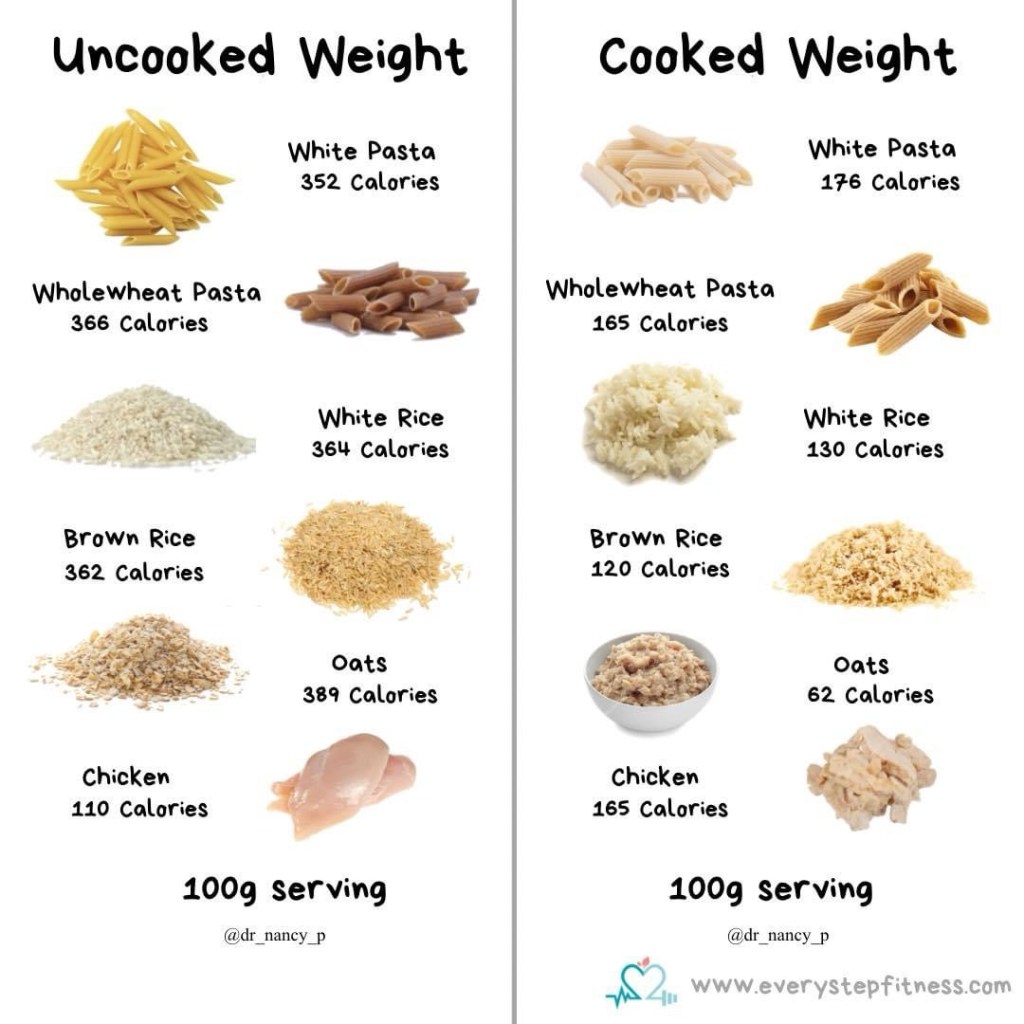
A question I’m often asked is whether you should track your calories as raw or cooked weights? To be honest it doesn’t matter as long as you’re consistent and know which you’re tracking so you can record the correct calories, but it can be a little confusing!

Unless otherwise stated nutrition labels are usually raw weights. However, you’ll find sometimes some grains, pasta and pulses might be listed as cooked or ‘as prepared’ weights – which is when you need to be careful, as you will underestimate cals if you weigh them raw.

Different foods absorb different amounts of water as they’re cooked. This makes them swell and weigh more. So for things like rice, pasta, cereals etc it’s probably best to track them as raw weights. As you can see there are small differences between white and brown varieties but only after cooking really, which is down to the differing amounts of water they absorb. You’ll also find different shapes and types of pasta will vary too for the same reason. Oats are the same and in fact over 80 percent of the weight in cooked oats is actually water.

Protein sources, like chicken, tend to lose weight when cooked. This is because the water and liquids in the meat evaporate during cooking. They loose 20-25 percent of their weight during cooking. Again it’s best to track raw weights. It’s also worth noting that the cooking method has an impact on meat too. The calories for 100g cooked chicken are based on a grilled skinless chicken breast, the same amount of roast chicken (skinless) is 220 cals – due to the fats in the meat thanks to the roasting. So that’s also worth remembering if you’re a roast fan or are oven baking chicken with the skin on.

Whichever you chose to track is up to you but be sure to choose the right option in your tracking app.

Enjoy 🤗
Xx

Nutrition and Calorie Tips, Tuesday Tip

Tuesday Tip: Blood glucose/ Gut microbiome diets

Tuesday Tip: Blood glucose/ Gut microbiome diets 📉

There are a lot of companies at the moment that track your blood glucose, blood fat and gut micro biome – are they really the answer to all our health and weight loss goals?

Healthy individuals without diabetes shouldn’t be worried about their glucose levels since glucose spikes are a totally normal physiological response.
But even if you decide to ignore that statement and use a glucose monitor anyway a recent study found glucose monitors can vary quite wildly in their response to the same meal eaten at different times. So much so that the individual variability in post-meal blood sugar response to eating the same meal had as much variability as eating an entirely different meal. I don’t think people should overhaul their entire diet based on potentially faulty readings.

Even if they were accurate does it translate to more weight loss or better health (which they equate to a ‘better’ glucose response) when following the advice? A 2022 study found no difference in weight loss over 6 months between a control group on a low-fat diet or a personalised diet based on glucose response to foods. A 2023 study found that the personalised diet didn’t lead to greater reductions in blood sugar variability or HbA1c levels compared to a standardised diet.

But what about gut microbiome?
In truth we still know very little about what impact the gut microbiome has on overall health, despite how confidently some people on the internet talk about it. A recent study suggested most diseases are not in fact linked to an altered gut microbiome. Also, the claims that an imbalance in the Firmicutes/Bacteroidetes ratio of the gut microbiota in humans is a hallmark of obesity hasn’t actually been reproduced in human studies. So it’s difficult to associate the gut microbiome with health status and obesity.

In addition a recent study found an increased risk of disordered eating from the use of these glucose monitors in healthy, non diabetic people.

A personal observation – of the clients I know who’ve tried these products – their supposedly personalised diets were all identical which is an interesting coincidence. Remember these companies want your money and are cherry picking studies to support them. If you’re worried about your insulin sensitivity, your first priority should be losing body fat and doing regular physical activity as these will have a far bigger impact on improving your overall health than anything else. As for the gut microbiome, just do what most people already know they should be doing–eat a varied diet of with plenty of whole foods, fruit and veg.

Save your pennies until the research is clearer!

Happy Tuesday 🤗xx