Nutrition and Calorie Tips

“Oh no, you can’t have Frosties for breakfast – thats so bad…”

“Oh no, you can’t have Frosties for breakfast – thats so bad…” 🥣

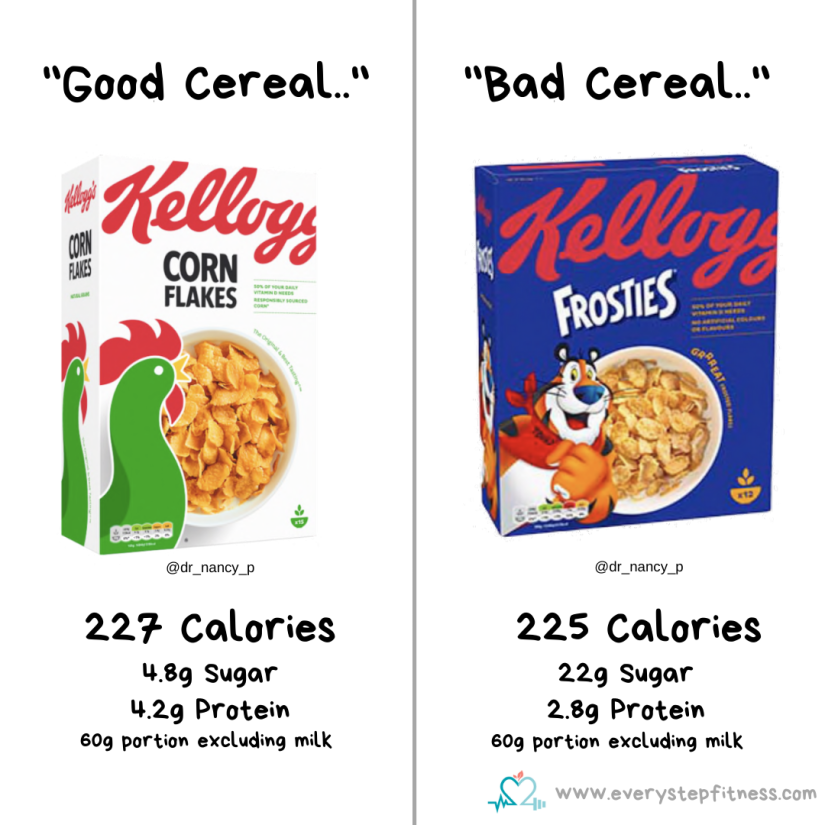
I don’t think many people would think that frosties – sugar coated flakes of corn, are a particularly healthy breakfast. Most people would naturally assume it was higher in calories than other less sugary cereals and I imagine that given the choice, most people would choose the cornflakes as the “healthier” option. But is it really?

A 60g portion of frosties (because who actually has the recommend 30g?!) comes in at 225 calories (excluding the milk). Now as expected it’s high in sugar (22g) – I mean it’s coated in the stuff so that can’t be a surprise.

In contrast 60g of cornflakes are 228 cals, so they’re actually marginally more calorific. Now they obviously contain much less sugar (4.8g) which is one benefit of course but that doesn’t make them automatically better.

When it comes to fat loss it’s the calories that matter – create a calorie deficit and you will lose fat/weight. So in this scenario you’d be no better off with the cornflakes over the frosties. Now there are some additional benefits to the muesli – less sugar and a little extra protein which may help keep you a little fuller, but cornflakes aren’t high protein so it won’t make much difference. Both cereals are fortified with vitamins and minerals anyway so you’re not missing out on as much as you think with the frosties.

Now personally, I am not a fan of frosties at brekkie – but not because I think they’re that much worse than cornflakes – rather I just don’t want super sweet cereal at that time in the morning lol!

However if you love frosties and you enjoy a bowl for brekkie then go for it (they’re also great sprinkled on ice cream …) ! If you love the cornflakes then have it! But if you’re eating cornflakes because you think it’s healthier, or feeling guilty for loving a bowl of frosties to start your day, then stop worrying. As long as you’re having a balanced diet you’ll get plenty of nutrients in throughout the day so if you love frosties enjoy them! 🥣 😋

Whichever you choose – read the labels, check the calories and be mindful of your portion size but most importantly enjoy it!

🤗 xx
Tuesday Tip

Tuesday Tip: Mindset matters

Tuesday Tip: Mindset matters 🤯

Mindset is one of the most overlooked parts of any successful exercise or fat loss plan. Unless you have the right mindset then any plan you intend to follow will likely fail. Here are some tips:

# 1 Don’t let one mistake become many.

You’ve fallen off the wagon and ended up eating that large pizza, don’t use that as an excuse to spend the whole weekend over eating. Draw a line under it and get back on track. Focus on the next meal not than the one you’ve just had.

# 2 Focus on consistency not perfection

4 weeks of being pretty consistent with your cals will give you better results than 3 days of ‘perfection’, a day off the wagon and 2 more days feeling guilty and over eating. The odd day over your cals won’t matter if you’re consistent over the long term.

# 3 It’s not a race

You won’t get long lasting results in 7, 14 or even 21 days – it’s weeks, and months. Recognise that and take the short term pressure off yourself.

# 4 Moderation not restriction

if you’re feeling deprived you will eventually eat or drink it anyway, and probably in far greater portions. Accept that you can still eat the foods and drinks you love. Shift your mindset from unnecessary misery and restriction to appreciation that no foods are bad foods. You just may have to compromise; have less of it, or forego something else to stay on track, or accept that the pleasure of that food outweighs that fat loss and go with it.

# 5 Lifetime changes

Sustainable fat loss is about changing things for life. So unless you never want to eat chocolate ever again it’s a good idea to include some chocolate in moderation when you’re trying to lose fat. Find ways to enjoy foods you love in a way that align with your goals long term. Don’t chase results you won’t be able to sustain.

#6 Joy of missing out

You don’t have to say yes to every event/food/drink if it doesn’t align with your goals. Focus on the benefits and you’ll realise you didn’t miss out on much anyway and it was actually a good decision because you didn’t get that hangover, or eat that dessert you didn’t want etc. Just say no thanks. No need to justify, no need to explain.

Happy Tuesday

🤗

Xx

Nutrition and Calorie Tips

Weight loss is rarely linear….

Weight loss is rarely linear…. 📉

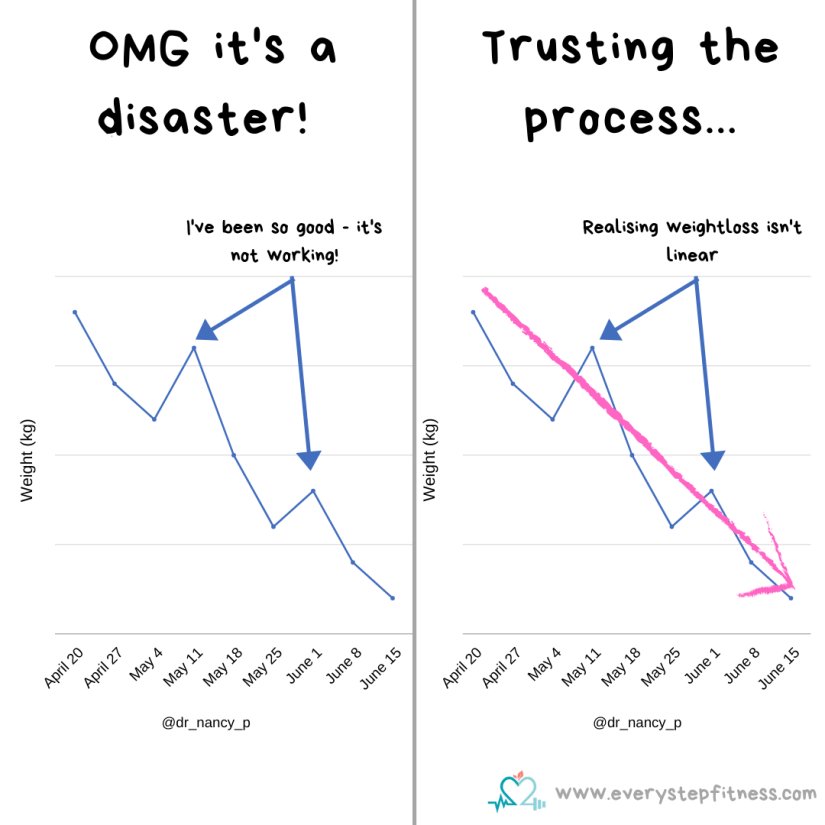
Most people measure their fat loss progress by stepping on scales. This can create an all or nothing mentality and can impact not only your happiness but your behaviour. If the scales don’t go down when you’ve been ‘good’ then what’s the point? You may as well throw in the towel and enjoy that cake!

Weight loss is rarely linear. It’s normal for your weight to fluctuate on a day-to-day basis. There will be days where your scale weight goes up, just like there will be days where your weight will drop, and there will also be days (maybe even weeks) where your weight will stay exactly the same. Your weight can fluctuate up to 6kg during the day depending on what you eat and drink, and how you exercise. If you drink 2-3 litres of water a day that’s up to 3kg. Then how much do you pee, sweat and breathe out over the day? It’s impossible to measure. Our bodies are mainly water so changes in hydration cause significant weight fluctuations.

In addition a bowel full of food, a big meal the night before, fibrous or salty meals, and menstrual cycle hormone changes can all influence weight and cause greater daily fluctuations so real change can be hidden. Exercise can affect the scale both ways; if, after a workout, you’ve refuelled properly your muscles will be full of glycogen and water. On the other hand if you’ve sweated loads your weight will drop due to dehydration. Alcohol does the same; it’s a diuretic so will dehydrate you initially, but can cause cravings for salty foods leading to water retention.

For many of us, seeing that weight go up, despite ‘being good’, can make us give up. It’s vital to trust the process and think long term. The graph above is real client data. Look at how the weight fluctuates and look at the overall trend. By trusting the process and not giving up when the scales went up they’ve continued their weight loss over time.

We’re conditioned to focus on weight but instead try to use other measures e.g. items of clothing and how they fit, or cm measurements etc. If you must step on the scales then look at averages over time rather than daily variations and focus on long term trends.

🤗 xx

Tuesday Tip

Tuesday Tip: isn’t tracking food a bit obsessive?

Tuesday Tip: isn’t tracking food a bit obsessive? 🤯

People often tell me they’ve tried everything but can’t reach their goal. When I ask if they track their food they respond with ‘isn’t that a bit obsessive?’ or ‘no I don’t want to do that’. Not wanting to is fine, that’s your choice, but if you’ve been struggling to reach your goals and you haven’t been tracking then why not try it?

Do you track your finances? Most people do so they have an idea of how much they’re earning, spending and saving. That’s not obsessive, so why would tracking your calories be?

Can tracking food become obsessive? Yes, like anything, of course it can. Does it have to? No! Do you have to do it forever? No! Does it have value? Yes! It’s a tool – and its value is determined by how it’s used and what you learn from it.

We don’t have an innate working knowledge of portion sizes and calorie content. In fact, studies show that people are awful at estimating how much they eat. We underestimate ALL the time, even nutrition experts do! We are surrounded by highly palatable, calorie dense foods and we have evolved to seek them out. So it’s unsurprising, when these sorts of foods are so readily available, that we need to do some tracking to keep an eye on what’s actually going in our mouths.

The main reasons we don’t track are fear, time and being unsure of how many cals to aim for. The fear is of what we’re going to find out and that we really are eating more than we thought. Time is really about priorities. Yes it can take a few days to get the hang of it, but then it takes seconds to log before you eat. Most people have time to check Instagram/Facebook/watch tv. Even the busiest person has 2 mins to log their food, if they want to. In terms of how many cals to aim for; if you’re not sure, ask! I’m happy to help!

You don’t need to track food forever. You’ll learn about portion sizes, calories in the things you eat and drink, and develop that skill. Then you can cease tracking if you want and see how it goes. You can easily go back and check if you feel that skill needs more honing.

You don’t have to count calories forever, but calories will always count!

Happy Tuesday

😁

Xx

Nutrition and Calorie Tips

“Calories can’t tell the time…. “

“Calories can’t tell the time…. “ ⏰

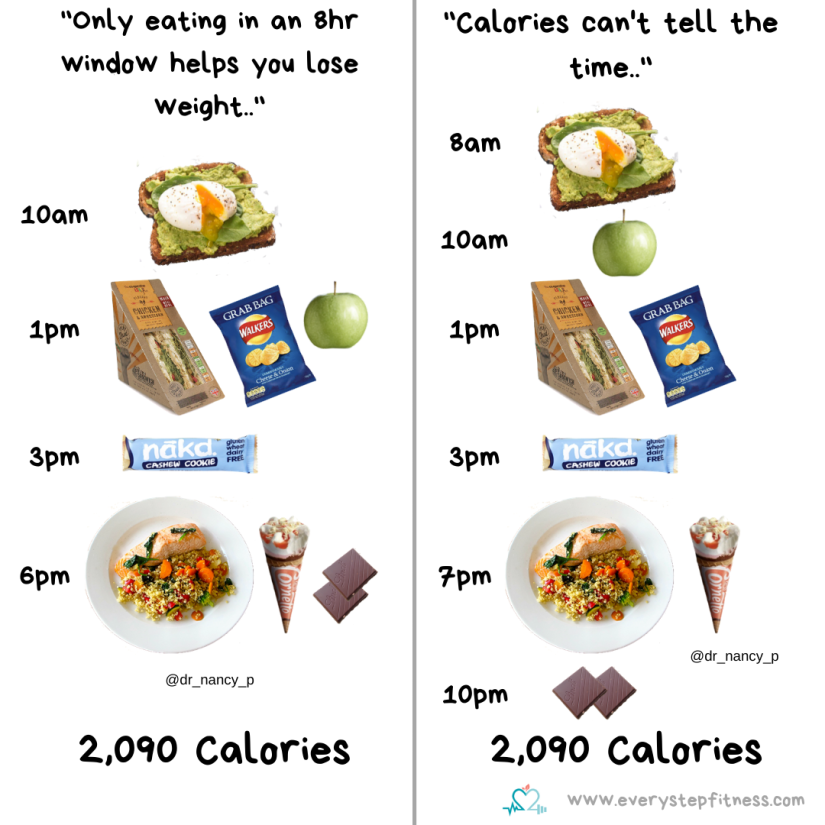
It’s really easy to fall into the trap that eating your meals/snacks etc at certain times of day (or not eating at certain times of day) will help you lose weight (fat) more quickly.

One common idea is that you should fast for a certain number of hours during the day and only eat within a certain window of time. This varies but is usually an 8hr window or so. Proponents of this method suggest that by only eating during certain hours you can forget “complicated” diets etc and lose weight without doing anything more. You’ll hear lots of people saying they’ve achieved great fat loss using this method and they undoubtedly have. So surely it works then? Well yes it works – but only because those people have ended up eating fewer calories and therefore been in a calorie deficit, and lost fat/weight.

The problem with this method is that it doesn’t account for individual’s daily caloric requirements. So if someone started this method, but was eating more than their daily calorie requirement within that 8hr window, then they wouldn’t make any progress. Studies have shown that this method ONLY results in fat /weight loss when participants eat fewer calories than they are expending, and are therefore in a calorie deficit. Meal timing is irrelevant in terms of fat loss, it’s energy in vs out that matters.

Having said that, for some people, it’s easier to eat fewer calories if they restrict the hours in which they are “allowed” to eat. So if skipping breakfast, or not allowing yourself to eat after 8pm works for you then go for it! BUT you still need to be eating in a calorie deficit. For some people though, fasting for long periods of time, or skipping meals, isn’t a sustainable strategy long term. It can result in reduced energy levels, and excessive hunger, leading to periods of “binge” eating and therefore eating more than their daily calorie target. It can also lead to less activity (and therefore fewer calories burned) due to low energy levels.

So basically – do what works for you, but remember it’s the total calories that count – not when you eat them

🤗

Xx