Nutrition and Calorie Tips

‘I’m trying to lose weight so I’m avoiding carbs ….’

‘I’m trying to lose weight so I’m avoiding carbs ….’ 🍞

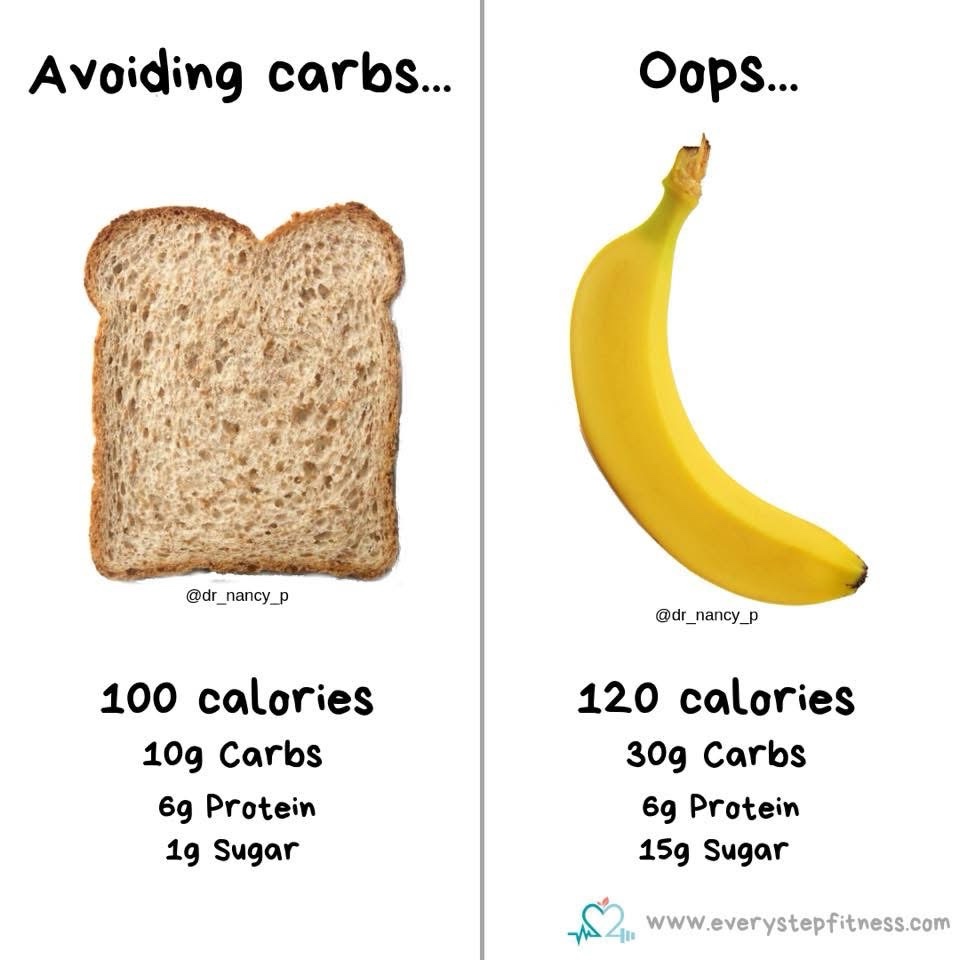
There is a common misconception that carbs are inherently ‘bad’ and that in order to lose weight you need to cut them out or avoid them completely. This usually means people cut out bread, pasta, rice, potatoes etc.

However they continue to eat fruit and veg without thinking twice when many actually contain more carbs. For example compared to a slice of bread a small Banana contains more calories, 3 times as many carbs and 15 times as much sugar! Now that doesn’t make the banana bad either – but why would you avoid the bread if you like it, yet happily eat the banana if you’re trying to avoid carbs?

In reality there is no reason at all to cut carbs from your diet. You can lose weight with or without carbs – it’s all about calories. Now obviously some people have medical reasons to avoid things like bread (coeliacs etc) but for the majority of people these foods are fine. The reason you may see weight loss when cutting these sorts of carbs is simply because you’re reducing your overall calorie intake. However unless you never want to eat carbs again then you’re not really setting yourself up for sustainable, long term weight management.

Obviously different carbs have different pros and cons – complex carbs will keep you fuller longer, whilst simple carbs (fruits mostly) will provide a faster hit of energy, you’ll get different nutrients from the different types too.

It’s important to have a balanced diet – including a range of carbs from bread to fruit. What works for you may not work for someone else and you may prefer to reduce consumption of carbs, but it’s important to be informed about what’s actually in the food you’re eating before you make that choice. Cutting out whole food groups is never a sensible or sustainable approach though.

Personally I enjoy all sorts of carbs – from bread, to fruit, to pasta, to potatoes – to doughnuts! Eat the carbs you like and enjoy and just be mindful of the calories! 🤗
Xx

Tuesday Tip

Tuesday Tip: Are Seed Oils Really Toxic?

Tuesday Tip: Are Seed Oils Really Toxic? 🌻

You may have seen social media wellness influencers decrying the evils of seed oils (canola, corn, cottonseed, grapeseed, rice bran, soybean, sunflower, and safflower oils), calling them inflammatory or toxic. But what does the actual evidence say?

The main argument is that seed oils are high in omega-6 fatty acids, which supposedly cause inflammation and chronic disease. It sounds scary, but it’s not that simple.

#1 What Omega-6s Actually Do
Omega-6 fats, like linoleic acid, are essential, our bodies need them for cell structure and function. Most people get about 6% of their calories from them, and research shows this intake is linked with lower risk of heart disease, not higher. When people replace saturated fats (like butter or coconut oil) with seed oils, LDL (“bad”) cholesterol tends to drop.

#2 The Inflammation Myth
Yes, linoleic acid can be metabolised into arachidonic acid, a compound involved in inflammation, but only a tiny fraction (0.3–0.6%) actually does. Large studies show no link between omega-6 intake and inflammation, heart disease, or cancer. Inflammation is a complex process driven by stress, sleep, illness, smoking, and environment, not by a drizzle of oil.

#3 Processing and ‘Toxins’
Seed oils are refined with a solvent called hexane. That sounds alarming, but residual amounts are negligible and far below safety limits. Refining actually makes oils more stable, less rancid, and more affordable.

#4 The Bigger Picture
Health isn’t just about one ingredient. Social media fearmongering about seed oils distracts from real issues such as limited access to fresh food, chronic stress, inequities in healthcare, and disordered eating habits which cause far more harm.

So, can you have seed oils?
Yes, they’re safe, evidence-based, and heart-healthy when used instead of saturated fats. So instead of cutting them out, focus on adding more omega-3s (salmon, flaxseed, walnuts) for balance.

Don’t let fear-based social media nutrition trends dictate your diet. Eat a variety of foods, that you enjoy, and remember balance always wins.

Happy Tuesday 🤗xx

Nutrition and Calorie Tips

Movie Snacks…

Movie Snacks… 📺

We all love a snack with a movie, and I’m sure if you’re a chocolate lover like me you could easily chomp down through a large bar of chocolate without even thinking about it. A 180g bar of chocolate isn’t even that large really so you might even have more. That bar is 961 calories though!

Why waste 961 calories on a chocolate bar when instead you could have:

  • 150g raspberries
  • A mini bag of buttons
  • A curly wurly
  • A substantial chocolate protein mousse
  • A snack bag of popcorn
    All for the just over half the calories, but with approx 25g of protein.

You could deceive yourself that you’ll only eat a few squares of the large bar or you may end up eating it all without even thinking about it. However instead you could opt for smaller chocolate bars paired with nutrient-dense foods that provide more nutritional benefits and protein, keeping you fuller for longer and making you significantly more likely to maintain your calorie deficit whilst still satisfying your sweet tooth.

There’s nothing wrong with enjoying some snacks with a movie but maybe try a few swaps to reduce the cals without reducing the enjoyment.
Enjoy!
🤗
Xx

Tuesday Tip

Tuesday Tip: Ultra-Processed Foods

Tuesday Tip: Ultra-Processed Foods 🍟

With all the social media attention around Joe Wicks and ultra processed foods it’s worth looking at the actual research. You’ve probably heard that ultra-processed foods (UPFs) are toxic but let’s look at what the evidence actually says. Yes higher UPF intake is linked with greater risk of heart disease and metabolic problems etc but why?

The reasons are not as dramatic as social media makes it sound and it’s all about quantity and context.

#1 Energy balance

UPFs are easy to overeat because they’re tastier, quicker to eat, calorie dense and often lower in fibre and protein. One study showed people given UPF-based diets ate around 500 extra calories per day

compared to those eating minimally processed meals. So they’re very easy to overconsume.

#2 Diet quality

When you eat more UPFs, you naturally eat fewer whole foods. That means less fibre, fewer vitamins and minerals, and less protein from real food sources. Over time, that shift alone can explain a lot of the health differences seen in studies. It’s not that one snack bar causes disease, it’s that a diet built mostly on them means you eat less of the good stuff your body needs.

#3 Direct impact of Additives

This is the part that gets the most online attention and yet it’s probably the least important. While some research suggests certain additives might affect gut bacteria or inflammation, these effects are small, short-lived, and not shown to cause disease in humans.

The main reason UPFs are harmful isn’t because they’re toxic

or unnatural. It’s because they make it easier to eat too much and to eat fewer nutritious foods. Being overweight is biggest predictor of heart and metabolic disease, depression and early death. Over consuming anything can lead to that and UPFs make it easier to do that. The science here isn’t new.

So don’t panic, don’t stress about removing all UPF’s from your diet. Eat mostly whole foods, enjoy treats in moderation, and don’t fall for fear-based nutrition trends.

A balanced, evidence-based approach isn’t very social media worth, but it’s the truth

Happy Tuesday 🤗xx

Nutrition and Calorie Tips

Low calorie snacks for cheese lovers …

Low calorie snacks for cheese lovers … 🧀

If you’re trying reduce your calories then cheese is often something that’s quite hard to incorporate easily due to it being very calorie dense. There are however a few options out there which are lower calorie and can still give you a cheesy hit! These options would be great to grab on the go for a snack, or combine for a picnic lunch or dinner etc. They also have the added advantage of being relatively high in protein so will help to keep you fuller for longer.

This list is by no means exhaustive – but it’s just a range of the options out there.

Cheese triangle – 25 cals

Cathedral City lighter mini – 62 cals

Philadelphia light mini- 52 cals

Boursin mini – 63 cals

Mini babybel light – 42 cals

Marmite cheese – 57 cals

So you can grab a cheesy snack without worrying that it’s going to derail your progress!

Enjoy 🤗

Xx