Tuesday Tip

Tuesday Tip: Why lift weights?

Tuesday Tip: Why lift weights? 🏋🏻

There are a lot of misconceptions and fears around lifting weights – especially for women. Many people believe lifting weights is only something you should do if you want to build ‘big’ muscles and will result in a certain, often termed ‘bulky’, look. Whilst altering body composition to achieve that look is valid reason to lift weights there are loads of other important reasons, not related to aesthetics, which are even more important as we age.

# Strong musculoskeletal system

Lifting weights improves the strength of our entire musculoskeletal system – muscles, ligaments, tendons, joints and bones. This helps us stay mobile, strong and safe and far less prone to injuries and health concerns such as osteoporosis.

# Independence

As we age we lose muscle mass which means we lose strength and bones become more brittle and prone to fractures etc. By lifting weights you maintain bone strength and muscle mass meaning as you age you can maintain your independence – get up without assistance, carry your groceries, lift heavy stuff, and are less likely to break bones if you do fall.

# Improved power

Power depends on the ability to generate force. As you get older you have to continue challenging your nervous system to be stable, powerful and coordinated. We lose power at almost twice the rate we lose strength. Power enables you to stop yourself if you fall, stop your children running out in front of a car, lift bags onto the kitchen side etc. Lifting weights aids in power development and maintenance.

# Proprioception

This is the awareness of your body’s position and movement in space and is a component of balance. Lifting weights improves your awareness of what your body is doing and how it’s moving. This improves coordination and is vital for daily movement.

# Resilience

Any form of fitness training requires you to challenge yourself, learn new skills, be consistent and willing to put yourself out of your comfort zone. This encourages mental and physical resilience and can help you manage stressful situations.

So lifting weights isn’t just about your looks – it’s vital to loads of aspects of your life, health and well-being. So if you’re not already then consider adding some form

of weight training (be it a class or in the gym) to your workout schedule.

Happy Tuesday 🤗xx
Nutrition and Calorie Tips

Most commonly under-reported food and drink items when tracking…

Most commonly under-reported food and drink items when tracking… 🍷

If you’re trying to lose fat and are working on reducing calories then you’re probably going to be recording your cals somehow. But are you really recording everything accurately? It’s very easy to overlook some things because they seem so insignificant or to under estimate certain things.

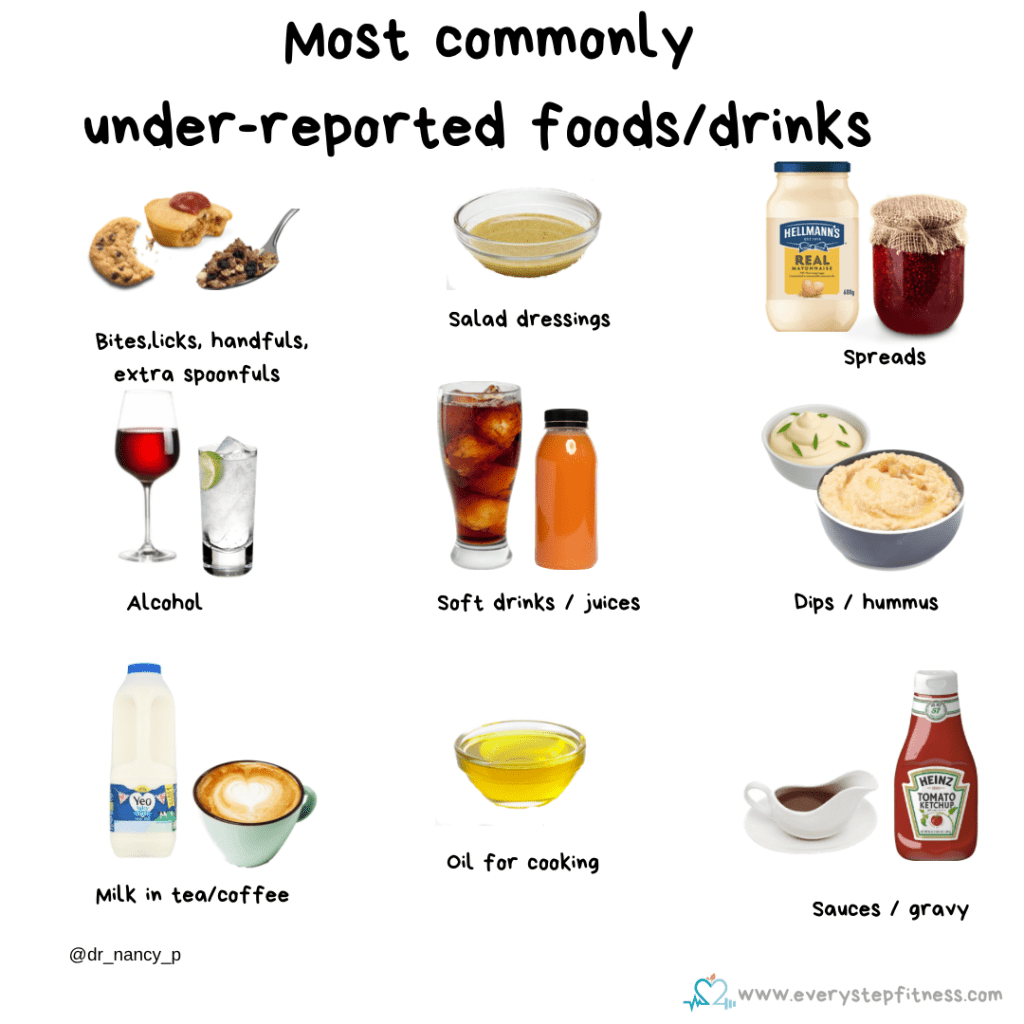
In studies the most commonly under-reported foods and drinks include things like spreads, sauces, dips, gravy, salad dressings etc. All those little extras in meals seem pretty insignificant and so people often either don’t record them at all or they’ll estimate them and usually those estimates are too low. For example a scraping of mayonnaise on your lunchtime sandwich may not seem much but if you have it 3 times a week that’s still at least 300 cals, and the gravy on your Sunday roast is probably another 200 cals, whilst a drizzle of salad dressing 3 times a week is another 540 cals. That’s already an extra 1000 cals that you may not have bothered to record or have under-reported. Oil for cooking is another key area that people underestimate – a slug of oil when you cook is at least 120 cals – but most people use more than that and estimate far less.

Liquid calories are something people often ignore or underestimate e.g. the dashes of milk in teas and coffees, soft drinks, juices and alcohol. These are easily overlooked or under estimated and can really add up across a week. The little nibbles – bites, licks, tastes, extra spoonfuls or foods or snacks are rarely tracked and of course can really add up (an extra spoonful of granola (40-50 cals), a lick of peanut butter (30 cals), a bite of the kid’s muffin (60 cals) etc etc).

A sensible calorie deficit for fat loss is around 200 – 300 cals per day. With this little lot you’ve wiped out your weekly deficit without even noticing. All these little extras sneak in without really affecting how full we feel and without us noticing but they can really add up. So whilst I wouldn’t want people to become overly obsessed with tracking the minutiae, at the same time if you’re not seeing progress then perhaps it’s worth just going back to basics and paying attention to some of these areas to see if you’re underestimating or overlooking them.

🤗

Xx

Tuesday Tip

Tuesday Tip: Why you overeat

Tuesday Tip: Why you overeat 🍕

Overeating can be an issue for everyone and whilst there are many reasons for it which don’t relate to the food itself (e.g. emotional eating, binge eating etc), there are some more general scenarios which make it much ‘easier’ to overeat.

Before I start I want to make it very clear that none of these foods are ‘bad’ and there is no reason at all why you shouldn’t include them in your diet, in fact I’d never recommend totally cutting any food out because it’s just not sustainable long term. However, there are certain foods that are more likely to lead to over eating. Foods that are high in sugar, salt and fat, such as pizza, ice cream, cakes etc cause a dopamine response in the brain. This means that eating them makes you feel good – as a result you will want to eat more to get that reward again. Having these foods isn’t bad and you shouldn’t cut them out completely but it’s important to be aware of the effect they have and to be mindful when you do have them. This also doesn’t mean you’re ‘addicted’ to sugar etc – you’re not – you’re just eating high-reward foods which makes you want to eat more.

So if you’re susceptible to overeating certain foods then it might be sensible not to have them around all the time e.g. If you know you can’t stop at one biscuit it might be better not to have a cupboard full of biscuits, but just buy them now and then instead.

Happy Tuesday 🤗xx

Nutrition and Calorie Tips

Healthy vs unhealthy starter?

Healthy vs unhealthy starter? 🥟

If you’re trying to watch your calories or lose weight then restaurant meals can be tricky (although considerably easier now larger restaurants have calories on their menus). We often have a number of preconceived ideas about which the ‘healthier’ option is and equate that with lower calorie. In reality sometimes things aren’t quite as you’d expect.

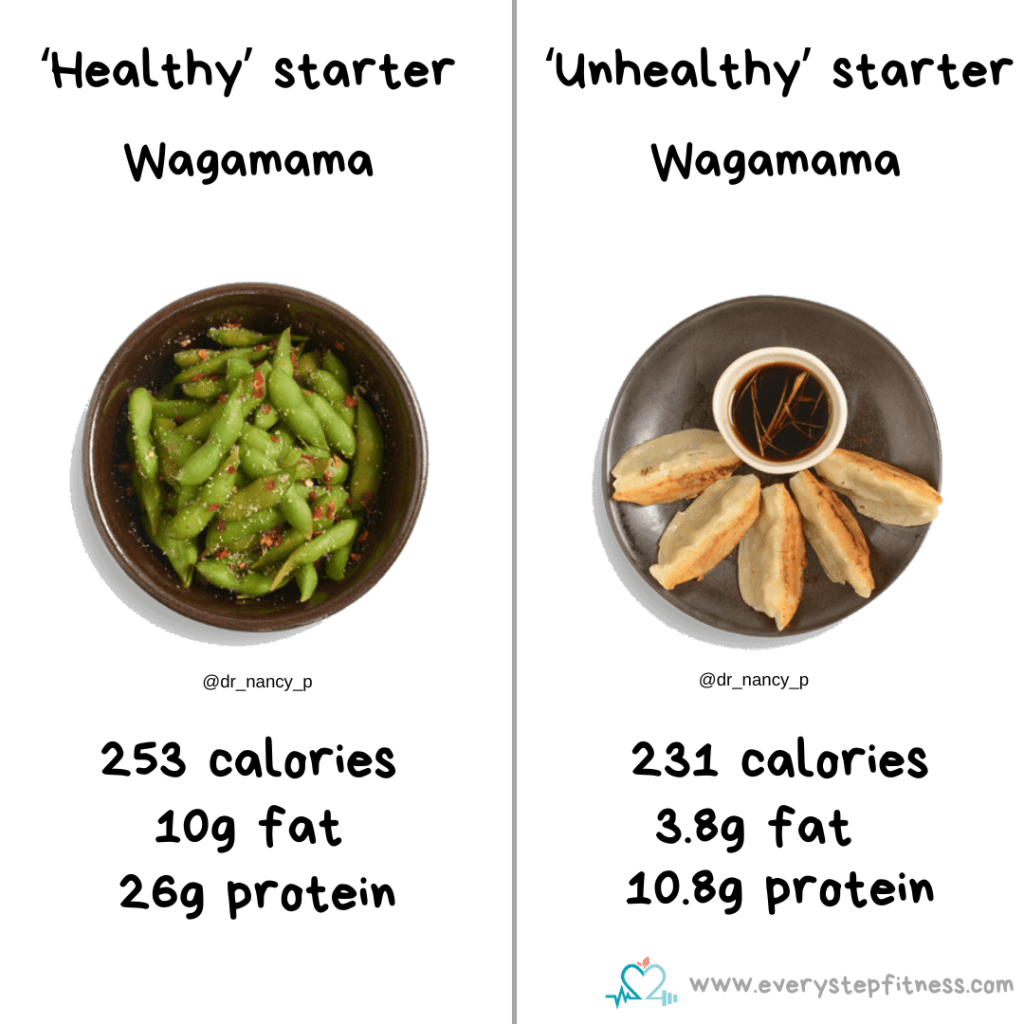
A great example of this is the classic Wagamama starter or side of edamame beans with chilli garlic salt. These yummy little beans are a popular dish and definitely a healthy choice as they’re full of nutrients. I think most people would order them thinking they were the best option calorie wise, and probably not even really think about tracking the cals (because they’re just veg right?). You’d probably munch on these without even thinking about it before you had your main starter and meal. Or you may even avoid another starter or side you actually prefer to choose these instead in the belief they’d be lower calorie.

However that’s not actually the case. It would be natural to assume that the pulled pork gyoza starter was a ‘worse’ choice in terms of calories. In reality that dish is actually lower calorie and fat than the edamame beans. The difference isn’t huge but it is there nonetheless. It also shows that those beans are a significant addition to the overall calories of the meal. So they are definitely worth counting and not something to have as an extra unless you actually want them!

Enjoy 🤗

xxx

Tuesday Tip

Tuesday Tip: Diet and Sleep Quality

Tuesday Tip: Diet and Sleep Quality 😴

I recently wrote about the link between sleep and fat loss and how increased sleep can aid fat loss. I discussed ways to help aid sleep but one other factor that impacts sleep quality is diet.

Sleep quality can be characterized by the amount of slow wave sleep (SWS) & rapid eye movement (REM) sleep one gets at night. As sleep progresses these 2 stages occur with greater duration. SWS has a restorative function and is known as deep sleep. Both SWS and REM are involved in memory consolidation.

Studies have found that certain nutrients can influence sleep quality. Increased saturated fat and decreased fibre intake reduces SWS , increased night time wake ups, and decreased overall sleep quality.

Alcohol consumption decreases REM sleep, whilst caffeine is linked to delayed sleep

onset (difficulty falling asleep) and decreased sleep quality. I’m addition larger portions or eating large meals just before bed also disrupts sleep due to the thermogenic effect of digestion.

In contrast increased carbohydrate consumption is linked to faster sleep onset (falling asleep faster), and increased protein and dairy can promote longer sleep duration. This is particularly true for tryptophan rich protein sources such as milk, yogurt, turkey,chicken, fish, eggs, pumpkin seeds, beans, peanuts and leafy green veggies. The idea of a nighttime glass of milk aiding sleep comes from the fact it’s rich in tryptophan and natural melatonin

Antioxidant (Vit C, E & A) and magnesium consumption not only aids recovery from exercise but may also affects sleep since their regulation is influenced by pro-inflammatory cytokines which promote sleep.

So what’s the takeaway here? No takeaway that’s for sure!

Avoid large meals, alcohol and caffeine close to bedtime. Instead have a balanced light meal including carbs, protein and dairy (if you eat it) and green veggies to aid sleep. And if you need a snack later on consider something like a bowl of cereal with milk for example.

Happy Tuesday 🤗xx